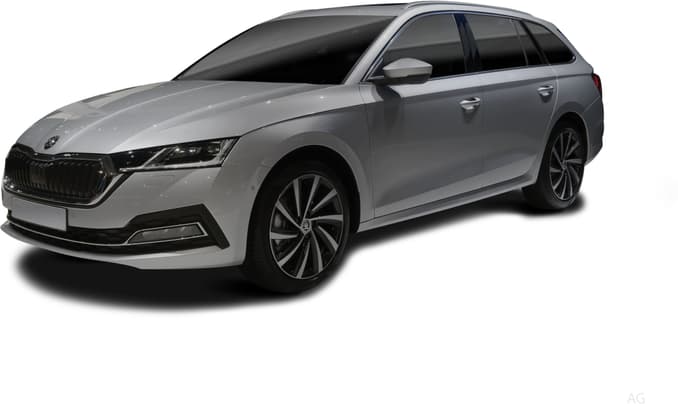
The 2024 Skoda Octavia range of configurations is currently priced from $35,990.
Our most recent review of the 2024 Skoda Octavia resulted in a score of 8.1 out of 10 for that particular example.
Carsguide Deputy Editor James Cleary had this to say at the time: Is the Octavia SportLine your kind of automotive quiet achiever? It’s well-equipped and keenly priced with sleek yet understated looks, top-notch safety and a compelling ownership package.
You can read the full review here.
This is what James Cleary liked most about this particular version of the Skoda Octavia: Value (including ownership), Safety, Dynamics
The 2024 Skoda Octavia carries a braked towing capacity of up to 1600 Kg, but check to ensure this applies to the configuration you're considering.
The Skoda Octavia 2024 prices range from $33,220 for the basic trim level Wagon Sportline 110Tsi to $62,260 for the top of the range Wagon Rs 195Tsi.
The Octavia Liftback offers 600 litres of boot space with rear seats upright and 1555L with the second row folded, while the Wagon has a capacity of 640 and 1700 litres, respectively.
In most cases, engine life has far more to do with long-term service and maintenance than anything else. A new vehicle with the correct preventative maintenance and servicing can easily cover 200,000, 300,000 or even 400,000km before major work is needed. But the same car with patchy maintenance might last only a fraction of that distance before it needs major engine work. So the service record is where to look first when considering a particular vehicle.
The type of driving the vehicle has done is also important. A car that has spent all its life in stop-start, gridlocked traffic will rarely cover the same distance as a car that has been used for highway driving where it’s in a high gear and just idling along. So try to find out about the car’s ownership history, too.
The price of the car you’re looking at seems to be at the high end of things for this year and mileage, but not by a whole lot. Certainly, most sellers post a price higher than they will take to allow for some haggling room during negotiations.
Show more
The DSG gearbox in your car has given Skoda and other members of the Volkswagen family all sorts of grief over the years. The problem you’ve described suggests a build-up of metallic particles (from wear and tear inside the transmission) which are being attracted to the magnetic sensors inside the gearbox and leading to bogus commends being sent to the car’s on-board computer. I’ve also heard of these symptoms being the result of faulty mechatronics and even a software glitch. The mechatronic unit, by the way, is the module that acts as middle-man between the computer and the gear selectors and clutch packs contained within the gearbox itself.
So there are three (among many) possibilities. And the VW (and Skoda) DSG transmission is no stranger to any of them. Either way, a loss of drive at any stage – whether it’s Drive or Reverse – is a potentially dangerous situation and needs to be fixed. Unfortunately, Skoda Australia only extended its factory warranty to five years on vehicles sold after January 1, 2017; after your car was sold. That said, I’d certainly be talking to the brand’s customer relations department with a view to at least finding out what’s wrong and then negotiating on whatever repairs are required.
Show more
On the surface, it sounds like the electrical system is somehow letting you down, Todor. The no-charge light comes on because the engine has stalled and is not driving the alternator, so that’s probably not the root cause here. But only when the glow-plug light appears (which it should every time you turn the ignition on ready to crank the engine) will the engine fire. That’s the clue that whatever glitch is at work here has settled down and is allowing the electrical system to work properly. Of course, a diesel engine doesn’t have a spark (electric) ignition system, so we could be barking completely up the wrong tree here. That said, the modern diesel engine does use a series of electric fuel pumps, and a faulty pump could easily cause the problem you’ve described.
With that in mind, the absolute best advice is to take the car to a workshop with the necessary diagnostic gear and have the car scanned to see what fault codes it coughs up. Until you do that, and can isolate the problem, you can run around in circles for months changing perfectly good components in a costly process of elimination.
Show more
‘Candy White’ is the single no-cost Octavia paint colour, with ‘Black Magic Pearlescent’, ‘Graphite Grey Metallic’, ‘Moon White Metallic’, ‘Race Blue Metallic’ and ‘Velvet Red Metallic’ are extra-cost optional shades.
The Octavia’s interior is dominated by a handsome multi-layer dash design with a 10-inch multimedia touchscreen in the centre and a 10.25-inch ‘Virtual Cockpit’ instrument display facing the driver.
Even for taller people there’s plenty of breathing room in the front, the low-level dash helping to deliver a spacious feel. And in the back there’s plenty of room for feet, legs and head as well as enough shoulder room for three full-size adults on cozy, medium length journeys.
At a minimum all versions of the Skoda Octavia feature a reversing camera, a power tailgate, a leather-trimmed steering wheel, the ‘Virtual Cockpit’ instrument display, a 10-inch multimedia touchscreen, dual-zone climate control, interior ambient lighting, LED headlights and 18-inch alloy wheels.
The Octavia Style and SportLine are powered by a 1.4-litre all-alloy, direct-injected, turbo-petrol four-cylinder engine sending 110kW/250Nm to the front wheels via an eight-speed automatic transmission. The sporty RS has a 2.0-litre turbo-petrol four delivering 180kW/370Nm, again to the front wheels via a seven-speed dual-clutch auto.
Skoda claims the 1.4-litre Octavia Style and SportLine will accelerate from 0-100km/h in 9.0 seconds for the Liftback and 9.1 seconds for the wagon with top speeds of 223 and 216km/h, respectively. The 2.0-litre Octavia RS is appreciably quicker at 6.7sec 0-100km/h and 250km/h maximum speed.
Offered in Liftback or Wagon form the Skoda Octavia is a five-seater.
Skoda’s official combined cycle fuel economy number for the 1.4-litre Octavia is 5.7L/100km for the Liftback and 5.9L per hundred for the Wagon which translates to a theoretical range of around 790km. For the 2.0-litre RS the figure for both body styles is 6.8L/100km which deliver a range of roughly 730km.