What's the difference?
The hotly anticipated Renault Megane E-Tech has arrived on our shores but we're only getting the mid-spec variant for now.
Renault's newest EV is related to the well-known Megane in name only because it has been built from the ground up as an EV. It’s not a hatchback, like its namesake, either, rather a crossover, which means it’s a bit lower than some of its small SUV rivals.
It faces firm competition in the likes of the Hyundai Kona Electric, Volvo C40 and newcomer bZ4X from Toyota. In this review we'll see how Renault's cutest EV handles life with my family of three.
BMW added a new iX3 base model in September last year as a crafty way to navigate the government's increased luxury car tax (LCT) threshold for fuel-efficient vehicles.
The Bavarian carmaker now has six electric cars under the $91,387 threshold with major benefits for those looking to purchase a car on a novated lease program – not to mention less strain on the hip pocket for others.
This particular iX3 M Sport being made in China helps the pricing equation, but it remains a complete specification with plenty of gadgets, features and luxury touches.
A new X3 is due in 2025 but an electric replacement for the iX3 isn't expected until 2026 when it will sit on the Neue Klasse platform and be a very different beast.
That means if you're after an electric mid-sizer from a German brand, this iX3 is what BMW has to offer. With that in mind, it's time to take a look at BMW's most affordable mid-size electric SUV to see if it's a good deal.
The design for the Renault Megane E-Tech is top-notch and the eco-conscious footprint is even better. It’s an easy and comfortable car to be in but the price is a smidge too high in my opinion when you consider there’s currently only one choice for us Aussies and it’s a mid-spec variant at that. It also misses out on some items its rivals have but is a solid EV to consider for urban dwellers.
The BMW iX3 is a rarity in the market, a premium-feeling electric model that's not a whole lot dearer than petrol alternatives.
For those happy to trade some of the Tesla Model 3 and Kia EV6 GT's all-paw performance for a luxurious cabin, slick drive and badge cachet, the iX3 M Sport is a very attractive package. Until Audi's Q4 and Q6 e-tron arrive, the iX3 remains basically peerless in this part of the market.
No wonder, then, that BMW is Australia's third most popular electric car brand after Tesla and BYD. The vehicles capture everything the brand promises at a price that looks good on paper and better in the real world.
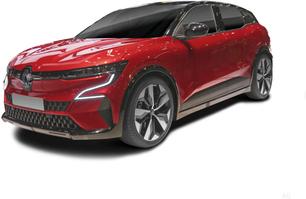
The E-Tech’s plump body panelling gives me some cute marshmallow vibes from certain angles but there are enough features to keep it looking slick, like the fun LED headlights, massive 20-inch alloys and optional two-tone paintwork.
I’m also a fan of the door handles on the E-Tech as they add some nice focal points, because the front has auto-flush handles that pop out on approach and the back door handles are positioned on the C-pillar.
If you're eco-conscious the E-Tech ticks the box because Renault has designed it to be 90 per cent recyclable.
The body is made of aluminium and can be reformed and shaped into new products at the end of its life. The interior materials are made from recycled fabrics and trims; even the lithium-ion battery is free from any rare earth minerals.
Head inside the cabin and the grey knit trims and upholstery on the seats, doors and dashboard creates a cabin space that feels warm and inviting. It's a similar feel to the Polestar 2 - simple but refined.
Although, with my kid around I have higher anxiety about dirtying them!
Now that we've seen the new X3, the current model is already dated. Not that it was a cutting-edge design at launch but there is precious little offensive about this mid-size SUV.
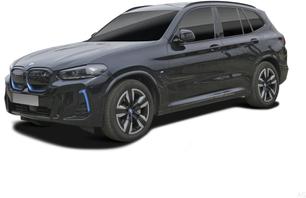
Fussy wheel designs, strange closed in grilles and clashing blue accents aside the iX3 M Sport remains a plenty handsome option as you approach.
Inside the cabin's shapes feel positively conservative next to BMW's latest efforts like the X2 and 7 Series but, in a way, this is no bad thing.
It's also nice that you can tailor this car's appearance to your liking without spending extra, the combination here rocks a nice blue paint with tasteful brown upholstery for a classy look.
You can have Oyster white leather or simple black and the paint colour palette is refined without being restrictive.
The E-Tech’s cabin is fairly roomy up front with plenty of head- and legroom. The front seats are super comfortable with powered lumbar support and I wouldn’t mind them not being powered if the price point was a bit lower.
The rear seat is comfortable enough once you get seated but the top of the door apertures are low, and I have to duck my head to get in and out.
Your head also brushes against the roof lining in the back which isn't terribly comfortable, especially considering there is no fold-down armrest to lean on.
The front row benefits the most with individual storage and you get a lot of options to choose from but the centre console is one of the most practical I’ve seen for the class. Lots of pockets and nooks that feature adjustable 'walls'.
You get a single permanent cupholder but with the removable walls, accommodation for a second cup or bottle, can be catered for.
Underneath the multimedia screen you get a dedicated phone shelf, which I love using.
In the rear, you get two map pockets and shallow bin storage in each door.
The charging options are good with two USB-C ports in each row as well as a 12-volt outlet and a wireless charging pad up front but you miss out on V2L (Vehicle to Load) functionality in this model.
The 9.0-inch touchscreen multimedia system looks great headlining the dash and is easy to access and use. The system rebooted once on me while driving but other than that everything is responsive.
You get wireless Apple CarPlay and Android Auto and the CarPlay is easy to get started.
The steering wheel has numerous stalks, controls, regen paddle shifters and even the gearshifter on the column, too. It takes a beat to get used to it but I like how driver orientated it is.
The boot offers great storage at 440L but it’s a deep well, which might be annoying if you’re unloading heavier gear. There is underfloor storage for the cables, too, and like I said, you miss out on a powered tailgate.
The BMW X3 was developed with family buyers in mind and that has paid dividends because it has an extremely practical cabin with lots of thoughtful storage.
Each of the four doors has a bottle holder and generously-sized pocked for extra storage. There are two cup-holders in the centre with a wireless charging pad, secure spot for the key fob and USB port in easy reach. You can slide a roller cover down to hide valuables.
Key driving controls are smartly grouped together around the iX3's unconventional gear selector. Here, you'll find the start/stop button along with hard switches for drive mode selection, stability control and exterior cameras.
Right next door is where the rotary 'iDrive' controller lives with yet more physical shortcut buttons. Including the extra option to easily interact with the multimedia system on the move is a refreshing delight that you don't see in so many touchscreen-heavy EVs. There's also a physical stack for HVAC and seat heating controls.
The 12.3-inch touchscreen is responsive and bright with BMW's slightly older system having a more conventional appearance than the latest software in the iX2. Apple CarPlay and Android Auto are wireless and still work flawlessly.
If there are some negatives, they would be some build-quality niggles. On the whole the materials are high quality and the car is well screwed together but the indicator stalks feel decidedly flimsy compared to BMWs of old and I noticed a rattle from the parcel shelf on the road.
The eight-way power adjust seats with tilt and under-leg extension are classic BMW, being sporty enough to hold you in but with enough padding to stay comfy. Though we will knock this car down for lacking power lumbar adjust.
Those in the back will be plenty comfortable even if they're taller than 180cm with ample head, leg and toe-room. There doesn't appear to be a major compromise to the floor height despite BMW stacking 10 lithium-ion modules beneath.
Vision out is excellent with an expansive glasshouse and full-length sunroof.
Amenities include two USB-C charge points, a third climate zone, fold-out armrest with pop-up cup holders and generous storage in the doors.
Fitting child seats should be pretty simple with doors that open wide, two sets of ISOFIX ports (that you can't lose the covers of) and three prominent top tether anchors in the recline-adjustable backrest.
The boot is large with 510L of space at a minimum that expands to 1560L if you fold the 40/20/40 split backrest flat. There's a sense of solidity in that process, too, with sturdy levers and components.
So sturdy that the retractable luggage cover is quite difficult to remove, especially for shorter owners. Other niceties include a single shopping bag hook, LED lighting and 12-volt socket in the back.
No BMW X3 comes with a spare tyre so that should come as no surprise. The iX3 instead has a tyre repair kit. There is underfloor storage in the iX3, though, which is the perfect place to store both charging cables — Mode 2 and 3 — that are included.
For the moment, the Megane E-Tech is being offered in only one grade for the Australian market and that’s the Techno EV60, which is the mid-level version of Renault’s brand new EV.
The EV60 is priced from $64,990, before on-road costs, and that positions it right in the middle of its rivals. The nearest competitor is the Hyundai Kona Extended Range at $60,500 MSRP, newcomer Toyota bZ4X 2WD slides in at $66,000 MSRP and the Volvo C40 Plus sits at $78,990 MSRP.
The E-Tech comes with a decent array of features for a mid-spec variant and premium items include heated front seats, a heated steering wheel, a digital rear view mirror and wireless functionality for Apple CarPlay and Android Auto but you do miss out on items like a powered tailgate and electric front seats which most of its rivals sport.
Technology looks good with a 9.0-inch touchscreen multimedia system, 12.3-inch digital instrument cluster, dual-zone climate control, faster USB-C ports (four total) and a wireless charging pad.
Sound is covered by the Arkamys Auditorium sound system with six speakers and the mood can be set with the 48-way configurable ambient lighting system.
Despite missing out on a powered tailgate, the EV60 has some features that still offer convenience like keyless entry, heated and auto-folding side mirrors and auto-folding flush door handles that pop out on approach (front only).
The iX3 M Sport may be expensive compared to a rear-drive Tesla Model Y but next to premium-badged rivals, it cuts rather attractive shapes at BMW's $89,100 before on-road costs asking price.
Outside, there are 19-inch alloy wheels, adaptive LED headlights, no-cost choice of six metallic paints (Phytonic blue is what you see here), illuminated door sills and a power tailgate.
The impressive list continues inside with 'Vernasca' leather-appointed seats available in three colours and 'Sensatec' artificial leather on the dash and high-traffic touchpoints.
The front seats are heated and power adjustable and the ambient lighting is customisable. The iX3 also has tri-zone climate control, tyre pressure monitoring, free-of-charge open poor wood trim, adaptive dampers, a heat pump and even a full-length opening sunroof.
Paying the best part of $12,000 extra for the M Sport Pro doesn't change the single 210kW motor, 74kWh (usable) lithium-ion NCM battery and 461km of WLTP driving range.
Instead, you get bigger 20-inch alloy wheels, black grille surrounds, acoustic glass with tinted rear windows, lumbar adjust, gesture control, head-up display and a Harman Kardon sound system.
There are also BMW's 'Iconic Sounds' in the Pro and the more expensive model includes five years from Chargefox public charging.
Mercedes-Benz no longer sells the EQC so the iX3's natural three-pointed star rival becomes the EQE300 SUV, which retails at $134,900. Audi's Q6 e-tron is not yet here so cross-shoppers will need to look at the smaller Q4 from $88,300.
The iX3's only direct premium rival is the Genesis GV70 Electrified, starting from $125,858 in the sole Performance AWD guise.
Even higher trims of mainstream rivals such as the Kia EV6 GT-Line RWD ($79,590) and Mustang Mach-E Premium RWD ($79,990, all prices before on-road costs) sit in close proximity to the BMW.
The Techno EV60 has a single electric motor. It produces a power output of 160kW and 300Nm of torque, and Renault says it will sprint from 0-100km/h in 7.4-seconds.
That's perfectly adequate for keeping up with traffic or getting around town. You only notice a sluggishness with power when you have a full load of gear. Flipping it to 'Sport' mode make it feel peppier, if you ever need it.
In this case there isn't much under the bonnet except for electric gubbins. The single electric motor – that uses no rare earth materials – resides at the back and generates 210kW/400Nm.
Those outputs are fairly close to a petrol X3 30i, though of course this model is rear-drive only.
Thanks to the rapid response of electric motors, the iX3 M Sport can sprint from 0-100km/h in 6.8 seconds (claimed).
BMW has chosen to give the iX3 a long-travel progressive throttle pedal that makes grunt easy to meter out. However, the regenerative braking could do with a little more refinement.
There are two settings, 'D' — just like letting off the throttle in a combustion car — and 'B' which is quite strong. The blending between regenerative and physical caliper-on-rotor braking is vague, though, which can make low-speed moves a bit jerky.
The official energy consumption figure is 15.6kWh/100km and I averaged 13.9kWh after a fair mix between urban and open-road driving.
That’s outstanding consumption but the official driving range for this E-Tech’s 60kWh lithium-ion battery is up to 454km, which is similar to the Hyundai Kona Electric but I still had an eye on the range during longer trips.
The E-Tech has a Type 2 CCS charging port which means you can benefit from faster DC charging speeds, however, it can only accept a top speed of 7.4kW on AC power.
On a 7.4kW AC charger, you can go from 0-100 per cent in a little over nine hours but on a standard 2.3kW house plug, that jumps up to over 30-hours.
On a 130kW DC charger expect to go from 15-80 per cent in as little as 30 minutes, which is pretty convenient if you have access to one.
Sadly, the E-Tech doesn’t have vehicle-to-load capability, so you can’t power or charge bigger items.
The iX3 M Sport's WLTP rating is a respectable but not groundbreaking 461km on the combined cycle. The reality is a little bleaker, our test car displaying 316km on its digital instruments at 100 per cent charge.
Going against what you might expect for an electric car, the iX3 was not very efficient in town, we initially saw 24kWh/100km on the read-out which is quite high.
It is better suited to a longer, steady-state run. Our regular 200km country and suburban test loop dropped the consumption to 18kWh/100km for a real-world driving range of 411km.
When it's time to bring the charge levels back up the iX3 will take on AC electricity at 11kW, for flat to full in seven and a half hours.
Public fast-charging caps out at 150kW (DC) though averages to 104kW over a 10-80 per cent session. This should take 21 minutes, says BMW.
We only observed a maximum of 101kW on a DC charger though the pylon did not appear to be performing at full energy with other vehicles having similar issues.
I have mostly loved driving the E-Tech. It's easy to cruise around in and the power is adequate for open-road driving but it prefers an urban environment.
The power can feel a bit lacklustre when you are carrying lots of people or gear but you mostly feel that when you're on a steep incline and trying to keep up your speed.
The steering is crisp and that makes the E-Tech very responsive to drive. The power is delivered smoothly and it feels well-balanced when you put your foot down.
There is more roll in corners than I was expecting but the car still feels firmly planted.
The ride comfort is great. The suspension is more firm than soft which means you feel the road but it's not a major bother. There is a bit of wind noise at higher speeds, as if the door isn’t properly sealed by a millimetre but it doesn't annoy me.
The regenerative braking is controlled by paddles on the steering wheel and you have three levels plus a one-pedal function to choose from.
The single pedal set-up is pretty smooth, even in stop/start traffic, but it’s great to be able to quickly change modes on the go.
The smaller size of the E-Tech makes it an easy car to manoeuvre in a small car park. You get front, rear and side parking sensors which is great because the reversing camera isn’t as clear as it should be for this price level.
Despite no saucy straight-six, V8 or twin-cam four-cylinder there is an inherent 'BMW-ness' in the iX3 M Sport. The way it steers, accelerates and rides all match the brand's DNA.
It is not a plush SUV, with some firmness to the suspension even in Comfort mode on the adaptive dampers — this may have something to do with BMW's 40PSI front and 45PSI rear tyre pressure recommendations — but without ever being crashy.
Build up a little more speed, beyond 60km/h for example, and the body settles nicely with a solid, assured stance.
There's no evidence of suspension noise and road noise is very well insulated as well, even without the up-spec M Sport Pro's acoustically insulated glass.
The steering is light in Comfort mode which makes it ideal for urban driving. It also has three turns lock-to-lock which is a lot for a sporty-ish BMW, however that is largely down to the improved steering angle. Without an engine or AWD system, the iX3 has a great turning circle of just 12.1 metres.
Moving things up a notch into Sport adds extra weight to the steering which helps judge the grip on good roads, which is pretty decent from the 245/45R19 Yokohama Advan Sport V107 tyres.
When you approach the limit, the iX3 is very secure but significant mid-corner bumps can unsettle the car, bringing its 2180kg tare weight (a 325kg penalty over the xDrive20i) sharply into focus. Pull it back a touch, though, and the iX3 M Sport is plenty rewarding on a country road.
Mostly, the iX3 is a refreshingly natural electric car out on the road. You could put anyone in the driver's seat and they'd be smooth just like in a combustion car.
The E-Tech has a maximum five-star ANCAP safety rating from testing in 2022 and has seven airbags, including a front centre airbag.
The EV60 comes with lots of passive safety features including dusk sensing auto LED headlights, LED DRLs, a rear fog light, child safety locks, tyre pressure monitoring, traffic sign recognition tech, an intelligent seatbelt warning, a reversing camera plus front, rear and side parking sensors.
Active safety equipment includes items like blind-spot monitoring, driver attention alert, rear collision warning, forward collision warning, rear cross-traffic alert, lane departure alert, lane keeping aid, and adaptive cruise control (with stop and go).
You also get a digital rear view mirror which is essential as the back window is narrow and the camera feed provides a clearer view than you’d have without it.
The rear row also features ISOFIX child seat mounts on the outboard seats and three top tethers but two seats will fit best. The front passenger seat also has ISOFIX child seat mounts and a top tether.
AEB with car, pedestrian, cyclist and junction turning assist function is operational from 8.0-80km/h (160km/h for cars) but it is common to see that starting figure sit closer to 5.0km/h.
The BMW X3 was awarded a five-star ANCAP rating in November 2017 which expired last December as part of ANCAP's push to stay more relevant.
Electric, petrol and diesel models carried the five-star score but, strangely, the 30e plug-in hybrid model did not.
The iX3 has seven airbags (dual frontal, side chest, side head-protecting curtain and driver knee airbags are standard), autonomous emergency braking with pedestrian detection, lane-departure warning, blind-spot monitoring and lane-keep assist.
BMW has one of the better programmed adaptive cruise and lane-trace assist systems. The lane-trace assist worked well on test without being too intrusive.
The E-Tech comes with a five-year/100,000km warranty, but it’s usual to see an unlimited km term for the class. The battery is covered by an eight-year or up to 160,000km warranty term.
Service intervals are reasonable at every 12 months or 30,000km and you also get five-years roadside assistance included.
Pricing over the first five years ranges from a low of $230.04 to a high of $519.62, averaging out at pretty competitive $317.72 per service. No capped-price deal is available.
The iX3 M Sport is now covered by a five-year/unlimited kilometre warranty in Australia.
Servicing is due on a conditional basis with the multimedia system prompting the owner when to visit a dealer.
BMW offers serviced packages for electric vehicles that last six years/unlimited kilometres, with the iX3's pack costing a reasonable $2325 over that time.