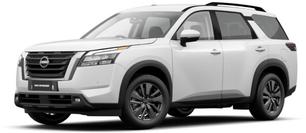
What's the difference?
The Nissan Pathfinder has evolved over the years from what was quite a rough-and-tumble Ford Everest style vehicle to a remarkably plush three-row family SUV.
Although it took a while to reach Australia, when the fifth-generation version landed in late 2022 it was a huge leap over its predecessor. And yet it has been a relatively slow seller in Australia.
In the first half of 2024 only 405 were registered, less than a tenth of the segment benchmark Toyota Kluger (5861 sales).
This can be largely attributed to a lack of choice in the Pathfinder range, following Nissan culling entry-grade variants early on leaving only the relatively expensive Ti and Ti-L grades, both fitted with a V6 petrol engine.
To increase customer choice, Nissan has reintroduced the ST-L mid-spec trim with the option of front-wheel drive for under $60,000, before on-road costs. But is it a good buy?
Over the past 12 months, some of the most significant names in camper-trailers have fallen victim to their own success. Ultimate Campers, one of the most interesting and (previously) desirable camping products was placed in voluntary administration and bailed out, while Kimberley Kampers, always the pinnacle of off-road camper design, still has a very uncertain future, if one at all.
But amongst all that, here is Patriot Campers, an Aussie company essentially building $40,000 to $60,000 soft-floor camper-trailers and flourishing where others are failing.
So what’s so good about them, and are they really worth all that money?
There’s a lot to like about the Nissan Pathfinder. The current model not only looks a lot better than its predecessor but in ST-L trim — and with an even cheaper front-wheel drive model — it offers the kind of value Australian families are chasing.
For all its practicalities, towing capacity and refined driving experience, the Pathfinder’s fatal flaw is its limited engine choice. A thirsty petrol V6 with no engine start-stop tech stunts its appeal for those who live in suburban areas where a Kluger hybrid just works better.
The ST-L is a worthy consideration for your next purchase if you’re less bothered about fuel use, and it's the pick of the line-up, offering just about every creature comfort and safety feature you'd want in a good-value package.
The Patriot X1 GT is an expensive camper-trailer but there’s very little on the market with such attention to detail, such well-thought design and such practical features.
There’s almost nothing like it, which means, to some extent, as long as people keep buying them, the price, beginning at $52,990, is right on the money. I’d buy one, if I could afford it.
Of course, there is the standard X1, at around $46,000, which pares back the features a little to bring the price down.
The Pathfinder is a thoughtfully packaged and practical vehicle, trading on more than just size with plenty of clever storage solutions.
In the front there are generous door bins, twin cupholders and a deep central cubby. But there’s more, with a thin rubberised storage shelf above the glove box perfect for phones or sunglasses and a pass-through space below the centre console for larger items.
A storage space for a smartphone is found in close proximity to USB-A, a USC-C and 12-volt sockets. All of thus is beneath a physical switch panel for the dual-zone climate control.
The 9.0-inch multimedia touchscreen is the only letdown, feeling quite small in the Pathfinder's vast cabin. It is still responsive and features wireless Apple CarPlay and Android Auto, though. The Pathfinder’s sound system is passable after tweaking the bass and treble balance.
The analogue speedometer and tachometer sits either side of a 7.0-inch media screen that gives driving information along with settings for safety systems. There are switches on the steering wheel to control major functions, including cruise control, media and the screen operation.
Among its competitive set, the US-built Pathfinder’s build quality is excellent. There are cleverly positioned soft-touch plastics and we didn’t notice any rattles over our week of testing, unlike Palisades and Klugers. The steering wheel, especially, is appointed in a high quality, smooth-grained leather.
While the ST-L may only get cloth upholstery, which is admittedly harder to clean than leather, the high-quality material is more temperature stable than the imitation cow hide often seen at this price. It’s also combined with heated front seats.
Adding to the comfort factor is power adjustment for the driver’s seat including in/out and up/down lumbar control. The passenger seat is manually adjustable but with a lever for height and the driving position is pleasingly low-set.
The low front seats open up a world of excellence for the second row’s stadium seating which gives passengers a fantastic view out. Not only is this just nice, it also helps kill travel sickness for kids (and grown-ups).
The second row is on front/back sliding rails with fine backrest adjustment to dial in a comfortable position. There’s ample room even for adults over 185cm with plenty of head, leg and toe-room.
Amenities include a third climate zone, USB-A and USB-C charge points, a total of six beverage holders and a fold-out armrest.
The Nissan Pathfinder has ISOFIX tabs in the two outboard rear seat positions. The anchors are not hidden behind a cover so there is nothing to lose and the three top tether points are big and meaty for easy access.
Nissan deserves praise for its wide opening doors, the Pathfinder’s go almost perpendicular to the body with a large square aperture making loading dogs, children or shopping extremely easy.
But there’s one crucial flaw — the back windows don’t go all the way down leaving around a third of the glass sticking up.
The Pathfinder’s three-wide third row is vast in the third row, with enough space for adults in a pinch — at least two across the three-wide bench — and up to four beverages.
The power-actuated second row gets out of the way quickly (perhaps a little too fast!) and slides back into place easily. The rear bench is split 60/40 with the long portion on the Australian kerbside.
There are no ISOFIX or top tether points in the third row of the Pathfinder ST-L which does hurt its practicality. The Ti-L features ISOFIX and top tether for one third row seat.
Aside from that, the Pathfinder is about as good as an SUV gets for practicality, though a Kia Carnival people mover has the edge for outright human carrying ability.
Behind the shapely power tailgate, the Pathfinder offers either 205L, 554L or 782L of cargo space depending on how many seats are in use. And while the smallest figure sounds compact, the space is tall and square making it quite practical. Four school bags would fit easily or five at a pinch.
With the third row stored elegantly in the floor, the space is generous although interrupted by the roof-mounted middle third-row seat belt which is a faff to unbuckle.
Amenities include two shopping bag hooks, a 12-volt socket, four tie-down points and a spacious wet storage area below the boot floor.
The spare tyre is hung beneath the Pathfinder however it is a temporary space saver, rather than a full-size item.
Despite no diesel powerplant, the Pathfinder’s towing capacity is best in class, beating both Palisade and Kluger with its 2700kg braked limit (750kg unbraked).
Though still shy of the ladder frame Ford Everest and Isuzu MU-X (3500kg), the monocoque Pathfinder’s high limit is impressive.
Once the tent’s set up, the living space is quite clever. So that the bed and tent base doesn’t hang over the sides of the trailer when packed up, and so it can fit a king-sized bed anyway, the bed folds in the middle. Patriot has also developed (and patented) a staircase up to the bed, rather than a ladder, which makes the climb up and down far less daunting.
A zippered cut-out in the tent wall provides access to the two-large storage area in the driver’s side of the camper, which is where you’d keep clothes, charge phones and maybe store a second fridge or Porta-Potti.
If you’re travelling with kids, the zip-on kids’ room (pictured) is easy to set up, can be left attached to the tent while packed up and has enough room for two to three stretchers across the floor (depending on which stretchers you use). Another bed can be laid out under the master bed’s overhang.
The Nissan Pathfinder is a remarkably pleasant drive. It is smooth and quiet on the motorway, comfortable around town and talented on testing Australian country roads.
Nissan has managed to nail the fundamentals including a well-weighted electronic power steering system, good ride comfort at high and low speeds and impressive body control for a high-set 2052kg vehicle that rides on passive dampers.
The 18-inch alloys are wrapped in 255/60 Kumho Crugen HP71 tyres which are notably cushier than the Ti-L’s bigger 20-inch alloy wheels shod with 255/50 rubber.
Being a car-based SUV, the Nissan Pathfinder is more comfortable and a sportier drive than more off-road focused vehicles such as the Ford Everest and Mitsubishi Pajero Sport. It is not as dynamic as smaller seven seaters such as the Kia Sorento but is still secure and stable.
There are seven drive modes in total, with three ('Sand', 'Mud' and 'Snow') dedicated to off-roading, a further trio ('Auto', 'Eco', 'Sport') for the tarmac and a dedicated 'Tow' mode.
Along with adjusting steering weight and shift logic, the all-wheel drive Pathfinder adjusts the torque split settings. It can be a little slow to shift torque to the front wheels leading to chirping on fast getaways but it is mostly solid and a worthy $4500 investment over the new front-wheel drive only model.
Visibility is not great with a high belt line and low-set driving position. With the third row's large headrests up it's hard to see out the rear window, too, so it can be difficult to judge kerbs and walls while parking. A standard 360-degree camera system helps in low-speed manoeuvring.
As compact as the camper is, it’s not a drama to tow. Underneath the camper is the Cruisemaster suspension that Patriot helped develop and which is exclusively available on Patriot campers and products. That’s quite significant, as others have tried that with Cruisemaster, but have usually ended up developing their own. It’s a dual shock, air-bag set-up that’s completely adjustable, whether that’s for extra clearance or to level out the camper at camp.