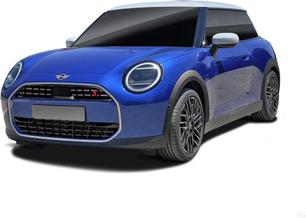
What's the difference?
Can it be possible that, between 1959 and 2023, there have only been four distinct generations of Mini?
Besides the 1959 British Motor Corporation (BMC) original, it’s just been a trio of hatchback versions under BMW stewardship – the R50 of 2001, 2006’s R56 and the 2014 F56.
Now, in 2024, that number has suddenly jumped to six.
The F56 has morphed into the lightly restyled and solely petrol-powered F66 Cooper range in F66 three-door (3DR) and coming F65 five-door (5DR) hatchback guises like before.
Meanwhile, the completely new and electric-only J01 Cooper 3DR joins the fold, along with its J05 Aceman 5DR crossover spin-off.
Despite their shared name and similar styling inside and out, the British-built Cooper and electric Cooper from China are two different cars. You can read all about the latter in another review, as this is about the petrol-powered Cooper range.
More of a thorough makeover and less of a total redesign, has it changed enough? Let’s find out.
If EVs are to make a meaningful difference to our collective environmental impact, there's one thing standing in the way: price.
Complexity, competency and capability have all improved since EVs started entering new car showrooms a decade ago, but in that time the price tags haven't improved all that much.
Buying an EV is still a rich person's game and scarcity on the used-car market means there are few true bargains for those willing to go with something second-hand. Even the Chinese aren't selling electric cars below the $40K barrier yet.
And that's where the Mitsubishi eK X EV comes in - or at least it would, if Mitsubishi Motors Australia chose to bring it to our shores.
Though it's unconfirmed for our market for now, we took the opportunity to spend a bit of time behind the wheel in its home (and so far, only) market of Japan.
Appetite for eco cars has been strong in Japan for a long time now, and the eK X EV (along with its platform twin the Nissan Sakura) arrives at a time where Japanese motorists are crying out for more affordable all-electric options.
Though its diminutive size and limited single-charge range would exclude it from consideration for a large number of Aussie motorists, would the compact eK X EV nevertheless make sense in Australian cities as a low-cost runabout for urbanites? It's certainly a question worth asking.
The new petrol Cooper range very gently evolves the upmarket Cool Britannia cliché BMW invented with the R50 back in 2001 and fostered with every iteration since.
More of the same, only slightly updated and just improved enough to justify trading the old one in. If this appeals to you, then go for it. This is the best petrol version yet. Probably.
But the Cooper’s real spark literally and metaphorically lies within the EV version.
Two very different Minis indeed.
Note: CarsGuide attended this event as a guest of the manufacturer, with meals provided.
And that’s the core takeaway from our time driving the Mitsubishi eK X EV – it’s a near-perfect tool for dealing with inner-urban congestion and tightly-packed city streets. After all, while cars have become progressively more bloated, our roads haven’t expanded in sympathy with that. The tiny measurements of the eK X EV and its slick and seamless electric powertrain allow drivers to flip that paradigm.
But even if Mitsubishi's Australian office chose to bring it here, it wouldn't be the first time the company has experimented with an ultra-compact EV in this country. Remember the i-MiEV from a decade ago? That too was a kei car EV with similar performance stats, however it languished in obscurity thanks to a high $48K price tag and a generally ho-hum offering.
By comparison, the eK X EV feels much more complete and better-equipped, though its price will need to be considerably sharper than the i-MiEV's if it's to convince would-be EV adopters to look away from the entry-level options from Chinese automakers like MG and BYD.
Will Mitsubishi take the plunge? It'll be chasing a niche within a niche if it does, but provided that audience uses the car within its urban-only design parameters, and provided Mitsubishi can offer it for a compelling price, the Japanese company could carve out a meaningful toehold in the EV space at the entry-level end of the spectrum.