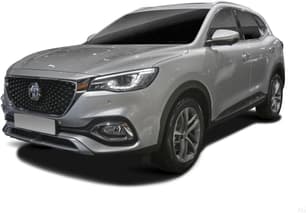
What's the difference?
The MG HS +EV Essence is a smart-looking hybrid medium SUV that comes well-stacked with features and has a price point that will make you swoon.
Add the plug-in hybrid engine/motor combination and it’s pitched as a firm competitor against heavyweights like the Ford Escape, Toyota RAV4 and the newer-kid on the block – the Haval H6.
For the top model, it has the goods on paper but how does it perform in real life? I’ve been driving it with my family of three to find out for you.
In the realm of family friendly mid-size SUVs, few names have the same reputation as Mitsubishi’s Outlander.
While this new one looks almost identical to the previous version, it’s hiding some serious, Australian-flavoured changes under the skin.
But in a segment now full of not only upgraded mainstream rivals, but also new cut-price alternatives from China, does such a modest upgrade to the Outlander do enough to deserve your consideration in such a crowded market?
We went to its Australian launch to find out.
The MG HS +EV Essence is a nicely specified medium SUV that should suit a lot of people. It looks really nice and I love that it's fairly practical with its features and size but would like some of the tech to improve. It’s not always seamless to use and in this market, tech is very important. The price tag and the on-going costs are hard to beat and if you’re looking for a greener option that will happily cruise in the city or on the open-road, this isn’t a bad option.
Mitsubishi has leaned into its strengths with this Outlander update, spending its money in subtle areas to upgrade what was already a widely appealing mid-size SUV.
The local tuning has made a notable difference to the refinement and comfort of this version, while subtle updates to the software and interior trim help to refine things even further.
If you’ve had an Outlander before, you’ll love this one, although it doesn’t help the brand to challenge new players on the value front. This leaves you with the decision of whether to pick a brand with the reputation and network of Mitsubishi, or roll the dice on a far more affordable new player.
For what it’s worth, it’s genuinely tough to pick a sweet spot here. I think the best picks are at either end of the spectrum, with the ES being outstanding value, and the Exceed being particularly plush.
Note: CarsGuide attended this event as a guest of the manufacturer, with travel, accommodation and meals provided.
It has an inoffensive exterior design that you won’t be embarrassed to be seen in. Curvy in all of the right places, it still manages to look sharp with its tapered LEDs and chrome accents.
It sits firmly within the medium SUV specs at 4574mm long, 1876mm wide and 1685mm high, so navigating your local shopping centre car park will be manageable.
The interior looks polished with the Bader leather sports seats and their suede-like inserts. The air vents are cute and add some personality to the robust dashboard.
There’s a plethora of soft touchpoints throughout that enhance the overall comfort and refinement, too.
Blink and you’ll miss the changes. Actually, squint and you still might miss them. Aside from the eye-catching new 20-inch wheels on the Exceed and Exceed tourer grades and the new ‘Moonstone Grey’ paint colour, it’s hard to tell the new Outlander apart from its predecessor.
Look closer and there’s new lower garnish designs front and rear, a tweaked grille and a smoked appearance for the rear tail-light clusters.
It’s very subtle stuff, but Mitsubishi has chosen to spend its time and money on upgrades on unseen areas.
For example, the bonnet is now steel rather than aluminium, which helps with noise insulation (and also has the side-effect of removing the high-speed ‘fluttering’ effect the aluminium bonnet had on the previous version), there’s additional sound insulation throughout the car, and cladding in the transmission tunnel to make the cabin a quieter place.
Back on the topic of appearance, though, the dash and console has also been tweaked a little. For example, the new screen looks a bit more contemporary, with a much smaller bezel and more attractive software. The console has been rearranged to move the bottle holders to one side of the electronic gear shifter, which makes for a larger centre console.
High-grade leather seat trims also now have alternate patterns, but the range follows the same trims, from cloth on the ES and LS, while the Aspire gets a microsuede and synthetic leather blend, while the Exceed and Exceed Tourer get the ‘high-grade semi-aniline’ leather trim.
The cabin space is very practical with its size. Each row has a decent amount of head and legroom. The big sunroof also makes the cabin feel airy and light-filled, which adds to that roomy feeling.
The leather-accented sports seats are quite comfortable and both are electric but the passenger side misses out on additional lumbar support.
I did have a few comments this week about the front seats, though, mainly that it feels like you’re perched forward in them. It would have been nice to be able to dip the bottom of the seats back.
The individual storage options are solid for this sized SUV with a glove box, two cupholders, drink bottle holders in the doors for front occupants and an air-cooled middle console box.
I missed having a utility tray next to the two USB-A ports and 12-volt outlet, as the Essence features wired Apple CarPlay and Android Auto, but there is a dedicated phone holder next to the cupholders.
Back seat passengers enjoy two cupholders in the fold-down armrest, map pockets and drink bottle holders in the doors.
The seats in the back are well padded but you feel like your knees are propped up a bit because of the shallow footwell. Taller passengers may feel like they’re folding in on themselves.
The technology looks good but isn’t always easy to use. The 10.1-inch touchscreen multimedia system is simple to understand but regularly feels laggy.
It has built-in satellite navigation but a lot of the controls are found via accessing the touchscreen – like the climate control and heating function for the front seats.
The 12.3-inch digital instrument panel is very easy to read but not really customisable.
Charging options are okay and I like the two USB-A ports in both rows but there’s no wireless charging pad or USB-C port which would provide faster charging speed.
The boot is a decent size for the class at 451L and you can bump that up to 1275L if you fold the back seats down. The rear seats have a 60/40 split for added practicality.
There’s a cargo blind and some underfloor storage for the charger and a tyre puncture repair kit. I liked using the powered tailgate but found it a bit glitchy, it sometimes stopping mid-action.
The previous Outlander was already known for having a spacious and versatile cabin, and this continues for the new car with a few small tweaks.
The width and satisfying seat positioning continue, and seats in all grades are generous and comfortable, but particularly the leather seats on the Exceed and Exceed Tourer grade we tested.
Adjustability is good in all positions, and the digital instrument cluster has an attractive dual-dial layout and functional display options. While not the best in class, it’s far better than many rivals.
The touchscreen’s new software is meant to be faster, but I found it a bit laggy still, although the integration of Google’s API into the navigation suite is an excellent tweak, making it relevant and useful for much longer.
The tweaks to the centre console make the area more space efficient and useful, but the new cupholders seem strangely shallow, potentially causing large bottles to tip. The tweaked centre console box is nice and large, and the wireless charger is nice and accessible, although its surface is not quite rubbery enough to stop your phone from leaving the charging area in the corners.
The back seat is noticeably stadium – you sit a fair bit higher than in the first row, which eats into headroom in cars equipped with a sunroof for adults. However, width is good, as is the seat comfort.
The rear doors open nice and wide, which should make fitting a child seat easy enough, and the floor is surprisingly flat, too, which makes the middle position more useful.
The third row, which I sampled in an Aspire grade, is both hard to get into and tight once you’re in there. The second row can slide forward on a rail, offering just enough room for me, at 182cm tall, to fit back there, with my knees hard up against the seat in front, and my head nearly touching the roof.
It is for this reason Mitsubishi calls seven-seat versions ‘5+2’. Good for kids, maybe, but not adults for any extended period of time.
The boot is enormous with two rows in use (485 litres in five-seat versions, or 478 litres in seven-seaters), and for this update, the space now has a wider aperture that should make loading objects easier. Space with seven seats up is 163L. Five-seaters get a full-size spare under the floor, while seven-seaters get a space saver.
Braked towing capacity is a middling 1600kg for petrol-powered variants. The brand says not many Outlander buyers are focused on towing as a key capability for the mid-sizer.
There are only two models in the HS +EV line-up and the Essence is the top dog.
It will cost you $51,990 drive-away and that positions it as one of the most affordable options relative to its rivals. Only the Haval H6 is more affordable at $41,990 (drive-away) but admittedly, it’s by a fair chunk of change - almost $10K!
The Essence is well-specified with Bader leather-accented trims, heated front seats, electric front seats with four-way adjustment for the passenger seats and six-way for the driver, a powered tailgate, as well as a massive panoramic sunroof. The middle console is even cooled with air-control for added convenience.
The exterior hosts full LEDs with its daytime running lights, headlights and tail-lights, as well as, a heated rear window with timed cut off.
It also sports dual-zone climate control up front and directional air vents in both rows, plus multiple charging options add to interior practicality.
Its technology feels up to category standard with the sizing but the usability isn’t as great as its rivals. More on that later.
And an added bonus. All the paintwork colours are included in the price.
Let’s get the bad news out of the way first: prices are up across the whole Outlander range.
The increases are modest, contained to between two to three thousand dollars across this mid-size SUV’s sprawling eight-variant range.
It sounds like an overwhelming number of versions but the Outlander is split across five grades in front- or all-wheel drive, with either five or seven seats.
Check out our pricing table below for the detailed prices before on-road costs:
Traditional rivals in the 5+2 mid-size SUV category include this model's platform-mate Nissan X-Trail (from $38,025 - $59,265) and the Honda CR-V ($41,900 - $59,900), with the Hyundai Santa Fe ($53,000 - $72,500) and Kia Sorento ($50,880 - $84,660) being a price-bracket above.
The biggest issue is the Outlander is facing increased competition from models like Chery’s Tiggo 7 (as a five-seater), which can be had for as low as $29,990 drive-away! Even the most expensive version of the Tiggo 8 (seven-seater) in plug-in hybrid form costs the same as a mid-grade Outlander, at $49,990 (d/a).
Options like this put the choice back in your hands. You can choose a brand with the heritage and support network of Mitsubishi, or you can go with the value of a new player yet to put those runs on the board.
Although it has an almost identical visage to the previous car, there are some major upgrades hidden below the metal. Sure, there’s a tweaked equipment list, but importantly, there’s a completely revised ride and handling tune, which was developed by Mitsubishi right here in Australia using local expertise.
It’s a similar program to the successful ones undertaken by Kia and Hyundai in recent years to improve the handling of their cars, and Mitsubishi in Japan was impressed enough with the depth of the changes that most of them have been adopted to the global tune for the car.
On the topic of standard equipment, LED interior lights and the 12.3-inch digital dash have been made standard across the range, there is now seat ventilation to join the seat heating for the front two positions in the top Exceed and Exceed Tourer grades, while the upper mid-spec Aspire grade scores front seat heating and a heated steering wheel.
The 12.3-inch multimedia screen has also been upgraded, featuring a smaller bezel and more processing power for a faster response rate, as well as a tweaked software suite with a new layout. This screen also hosts wireless Apple CarPlay and Android Auto across the range.
In addition, there’s also the introduction of the Mitsubishi Connect phone app, which features a range of safety and security features, as well as the ability to remotely control things like the ignition, climate system, navigation and locking system.
Across the range the audio system has also been upgraded to an eight-speaker Yamaha-developed system, with the top-spec Exceed Tourer grade scoring a 12-speaker Yamaha system with up to 1650W of power.
The interior now uses higher-quality materials, according to the brand, with extended upholstery across the range. The top-spec Exceed Tourer also scores a new brown interior colour.
A 360-degree parking camera is now standard across the range, and the safety suite also includes the driver monitoring system and traffic sign recognition system as also used in the Triton.
The plug-in hybrid version, which is what the Outlander is arguably most famous for, is not yet available, but Mitsubishi tells us it will arrive in a few months time, at very least before the end of 2025, and it, too, will carry an Australian-developed ride and handling tune.
Both HS +EV models share a 1.5-litre, four-cylinder petrol engine and electric motor hybrid combination. Maximum outputs are 189kW of power and 370Nm of torque.
It’s very responsive with its power output and you definitely will be surprised by how much grunt this thing has.
Drive goes to the front wheels via a 10-speed auto transmission but it’s clunky and a bit too slow to shift out of the lower gears. This can make it feel like the engine is pulling back even when you’re accelerating, which I didn’t like.
On the electric motor side of things – the lithium-ion battery has a 16.6kW capacity and 63km (NEDC) driving range.
It has a Type 2 AC charging port but it can’t be hooked onto a fast charger as it lacks the CCS enhanced port. On a 7.0kW system you should see a full charge be completed in around five hours.
The petrol-powered Outlander soldiers on with a drab non-turbo, non-hybrid 2.5-litre four-cylinder engine, mated to a continuously variable automatic transmission.
The brand calls this combination “proven” and it’s hard to argue given it hasn’t cropped up with any major reliability issues in the pre-facelift car.
Still, it produces a middling 135kW/244Nm, not as punchy as many turbo options, and nowhere near as efficient as hybrid alternatives.
Those seeking a more powerful fuel-sipping option may want to wait for the PHEV version arriving later this year.
With the electric motor being used, the official combined cycle fuel figure is 1.7L/100km and the urban figure comes out at 5.8L/100km.
My real-world usage came to 6.6L. That’s not bad at all, but I have done a lot of open-road driving this week.
Based on the urban figure and the 55L fuel tank, you should see an approximate driving range of 948km.
MG recommends a minimum 95RON petrol be used.
As a result of its relatively old-school sounding powertrain, fuel consumption isn’t at the forefront of the petrol-powered Outlander, with official consumption ranging between 7.5L/100km for the lightest five-seat ES 2WD version, to 8.1L/100km in the heaviest, top-spec Exceed Tourer AWD.
C02 emissions are also on the high side, which the brand will no doubt be off-setting with the new PHEV version which will offer even more emissions-free driving range than before.
One benefit of this long-serving engine, though, is it can be fed entry-level 91RON unleaded, better for the back pocket. The petrol-powered Outlander has a 55-litre fuel tank.
I’ve been pleasantly surprised by the overall driving experience. Besides the slower gear shifting, it’s generally smooth to handle. The power is there and makes it easy to keep up with traffic or overtake if you need to.
The suspension handles bumps very well and the steering is responsive. You can tackle corners or a winding road with confidence and without too much roll!
The cabin is quiet, even at higher speeds but you will note the whining of the engine at lower speeds as those gears shift.
On a windy day at higher speeds, the car moves about in the lane more than I like but otherwise, is firmly placed.
The regen braking isn’t customisable but it’s firm enough that you’ll feel it when you pull off the accelerator.
Going down a mountain let me gain five per cent charge on the battery and despite driving over 500km this week I only popped it on charge once (with 15 per cent left) - just to give you an indication of its performance.
I kept the EV mode on default but you can switch it over to a full EV if you want to wring out the most from the electric range.
This is not a difficult car to park and you’ll love its size in a small car park. However, the 360-degree camera view, while pretty clear, is jumpy.
At first, I thought it was laggy but the image just shudders, like a bad connection. I's prefer to see front parking sensors, too, as this MG only has them at the rear.
The Australian team had a significant amount of input on the driving dynamics of this new Outlander, but does it make a big difference behind the wheel?
We were granted the chance to drive the old one alongside the new version to find out, and the changes are significant.
Overall, the character of the car hasn’t been fundamentally altered. This is still a somewhat plush and soft-around-the-edges family SUV, but redeveloped new suspension parts and even very minor, nerdy modifications like the thickness of sway bars have added up to a much more pleasant vehicle to spend an extended amount of time in.
The first thing you’ll notice is the retuned steering. Mitsubishi’s engineers tell us the tweaked feedback was all down to the software in the rack, and it’s a big difference, upping the firmness of the steering at low speeds, keeping the vehicle on track with more confidence while heading straight, and also removing a slight twitchiness with sudden adjustments.
Next is the cabin ambiance. The new Outlander is a relatively quiet place to be thanks to the extra insulation throughout. It combines with the new steering to give the car much more of a sense of heft than before. The engine is reduced to a distant thrum, and the road is damped away for the most part. Mitsubishi says the 20-inch wheels are a particular hit with buyers, which to me is a shame because I’m willing to bet it’s particularly comfy on the lower-grade tyres.
Elsewhere, the Outlander has a softer initial response to bumps thanks to retuned shocks, and the reduced width of the front sway bar makes for less ‘head toss’ for front seat occupants.
Does it make a significant difference? Yes. The new Outlander is all-round better balanced and better suited to our road conditions. It might not have the sophistication of more expensive options, and it still might be a tad off what the also balanced-and-comfortable RAV4 offers, although it will be interesting to get one back to see how it compares to rivals in a like-for-like test.
Just expect a much more comfort-oriented option than some rivals. These changes don’t make the Outlander as fun to drive as a Mazda CX-5 or a Skoda Kodiaq. For example, while the 2.5-litre engine and CVT combo provides a surprisingly urgent initial response, it's a dull, rubbery power application from there on.
The safety features are good on the HS and I like the 360-degree camera view but don't like the way the image shudders while in use.
It has a blind-spot monitoring system but the interior ‘alert’ light is in a blink-and-you’ll-miss-it position.
Other features that come standard, are LED daytime running lights, forward collision warning, rear cross-traffic alert, lane keeping aids, lane departure warning, intelligent seat belt reminders, rear parking sensors, traffic sign recognition, a driver fatigue monitor and adaptive cruise control.
It has autonomous emergency braking with car, pedestrian and cyclist detection which is operational from 0-80km/h.
The HS +EV hasn’t been assessed by ANCAP but its fuel-based sibling achieved a maximum five-star rating in 2019.
It only has six airbags, which is pretty low for an SUV, but the curtain airbags cover the back row.
There are ISOFIX child-seat mounts on the outboard seats and three top-tether anchor points but two seats will fit best.
Front passenger space may be compromised a little when a 0-4 rear-facing child seat is installed but overall, it was very easy to install my booster seat this week.
The Outlander has a robust array of active safety kit, with all the key gear like autonomous emergency braking, lane support, blind-spot monitoring and rear cross-traffic alert available across the range. Traffic sign recognition and driver attention monitoring is now available from the new Triton, however it is also worth noting some relatively minor items are only available on higher grades.
The ES and LS grades miss out on adaptive high beams, traffic jam assist and steering assist (although they maintain lane departure warning and lane-keep assist).
Mitsubishi is hoping the updated Outlander will qualify for a continued five-star ANCAP safety rating held by the pre-facelift model.
During our drive we also found the lane-keep and driver attention software (which was much-derided at the launch of the Triton) was reasonably well behaved, with the brand saying it had had significant software tweaks over time to make it less invasive. We’ll need to save our final verdict on this system for when we spend an extended time behind the wheel.
The ongoing costs are great on this! It comes with a seven-year/unlimited km warranty, which includes the hybrid battery.
It also has a seven-year capped-price servicing plan, which is above average for the class, and services average $426 which is competitive.
Servicing intervals are every 12 months or 10,000km, whichever occurs first, which is fine if you don’t clock a lot of kays every year.
Mitsubishi continues to offer its near-industry-leading 10-year/200,000km warranty, conditional on the car being serviced at a Mitsubishi dealer. Otherwise, it reverts to a five-year/100,000km promise.
The 10 years of warranty is joined by 10 years of capped-price servicing required at 12 month or 15,000km intervals.
Prices are tame, varying between $320 and $680 per visit, for a total yearly average of $434. It’s not the cheapest yearly average out there, but most brands also don’t have capped price servicing extended this far, so it seems like a good deal regardless.