What's the difference?
The V6 X-Class is big, bold and bloody expensive – and it has segment-topping safety tech– but its price-tag swiftly climbs above more than $80,000 when you start adding one of the many optional extras and is it really worth that much beyond the cache of the badge? Really?
Sure, the bigger engine is what most potential X-Class buyers were pushing for after the launch of the four-cylinder-powered utes as part of the first-gen X-Class wave, but is there room – or even actual demand – for such a high-priced supposedly luxury ute?
Read on.
This is the most affordable plug-in hybrid available in Australia – as this review is published – but it’s got a lot more going for it than just that.
The 2026 BYD Sealion 5 is a mid-size SUV wearing a BYD badge that has been thrust into the public’s awareness by the popular BYD Shark 6 – as well as by widespread criticism of brand's less popular aftersales shortcomings through much of 2025.
It’s also a plug-in hybrid that is showing up as the nation faces a fuel crisis, despite many remaining sceptical of going ‘full EV’.
The Sealion 5 has a long list of features, of course, plus a claimed four-figure driving range. Is this BYD too good to be true?
We grabbed the entry-level Essential to find out.
The V6 X-Class is nice enough to drive on-road and it’s effective enough off-road, but it’s let down by its less-than-impressive interior and those elements combined certainly do not justify such a high price-tag.
Sure, its safety gear is top-notch but the X-Class, even in this V6 guise, feels like a lacklustre attempt at ute greatness, rather than a real effort.
Right now, if you’re in the market for a super-comfortable and capable V6 ute with real class and German precision, check out a top-spec V6 Amarok – and save about $25,000 while you’re at it.
While the BYD Sealion 5 lacks the polish of some more established plug-in hybrids, it has a seriously compelling price advantage over some competitors. It makes a base-model Mitsubishi Eclipse Cross PHEV feel positively outdated and it’s $13,800 cheaper.
BYD's lack of ANCAP rating for the Sealion 5 and the uncertainty around it still being a new brand are downsides, even if BYD is quickly moving past the latter. But being the most affordable PHEV available while having this much showroom appeal is bound to work in the Sealion 5’s favour, just don’t expect a dynamic masterpiece once you’re out on the road.
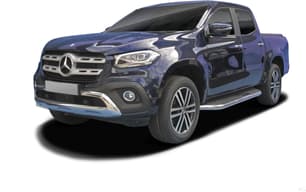
From the outside, the X-Class looks pretty impressive – it’s chunky and blocky and has a real tough-truck presence.
As mentioned, a fair few of the cool exterior touches are actually paid-for options, and our tester was loaded with these extras and, as a result, looked like a work-or-play ready luxury workhorse.
So, it looks pretty good but, as always, looks can be deceiving and the interior is a very different story.
The BYD Sealion 5, from the outside, is inoffensive but also uninspiring. That’s likely not such a bad thing for a mid-size SUV – it’s rare you’re hearing someone talk about how beautiful the Mazda CX-5 or Toyota RAV4 is.
Its quartet of colour palette options comes in on the safe side, too. Aurora White is standard, Atlantis Grey, Harbour Grey and Cosmos Black are cost-options.
Our test car is Atlantis Grey, which is interestingly quite blue.
The relatively upright shape is a slight departure from the more ‘aquatic’ silhouettes of BYD’s line-up, but the front grille and light layout are decidedly in step with the brand’s oceanic design language. There’s a bit going on, you could say.
The slimline tail-lights are the rear, especially from a three-quarter angle to the side, look attractive and help break up the rear without looking messy.
The Sealion 5’s design is overall net-good, but it’s inside where the mid-sizer feels like you’re getting plenty for your dollar.
The seats, despite the leather fakery, feel like decent material, and the layout uses buttons and physical controls cleverly without feeling outdated.
I’m not a snob about interiors but if I spent almost $90 grand on a ute I’d expect it to have a very high level of fit and finish inside, plenty of storage options and an overall premium feeling inside.
That’s sorely lacking in here.
From the many hard-plastic surfaces, fake leather, brushed-aluminium sections and sort of half-hearted attempts at three-pointed star styling – such as the vents – no part of the interior looks or feels anything like the premium quality you’d expect to find in a Mercedes-Benz.
As for equipment inside, you get the 7.0-inch floating touchscreen and a few other bits and pieces but there are some glaring omissions: you don’t get a reach-adjustable steering wheel, heated seats, or real leather (our tester has the optional black leather seats fitted at a cost of $1750), you don’t get much in the way of storage anywhere, and you don’t get Apple CarPlay or Android Auto – you don’t even get a driver-side grab handle. All of those sort of mod cons, you get in a ute that costs much less than this X-Class.
Room and comfort inside is adequate but a long way from unreal for something so pricey.
Driving position is nice, with plenty of vision all-round, but everyone's seats could do with a bit more cushioning and length in the base.
In the grand tradition of all utes, the rear seat is really the realm of young children and, at a stretch, smaller adults, especially for longer trips in the saddle.
Storage is minimal in the back seat – you don’t even get a drop-down arm-rest with cup-holder.
To actually interact with the interior is, at times, another story. BYD’s tech interface is generally easy to manage, but could be simpler when it comes to navigating menus for the sake of driver distraction.
While larger text and buttons would be welcome, the multimedia system is easy to use when parked, and the functionality is impressive for the price point.
Winning more points for the Sealion 5, though, are the physical controls – buttons and the traditional gear selector – which make the cockpit much more intuitive while on the move.
Ergonomically, though, the adjustment between the steering wheel and driver’s seat could do with some work, as I found it difficult to find a truly comfortable driving position. This is coming from someone 178cm tall, a very normal height in Australia.
Better adjustability on the steering column would be helpful, as it’s something I’m not sure I’d ever get totally used to.
Visibility and physical space inside the Sealion 5 is impressive, though. The car is 4738mm long, 1869mm wide and 1710mm tall, and the roof and window lines don’t swoop too aggressively towards the rear.
There are low window shoulders even into the rear, so light isn’t at a premium, though under-leg support could be better on the pew.
It’s otherwise un-cramped. The 2712mm wheelbase means decent legroom for second-row folk, plus behind the 60/40 split-fold seats there’s 463 litres of space for luggage. That becomes 1410L with the seats folded.
There’s unfortunately no spare tyre, just a tyre repair kit.
The 350d Power ($79,415 plus on-road costs*) is the top-spec variant in a two-variant V6 X-Class range; the other variant is the Progressive, which starts from $73,270 plus on-road costs.
Our tester has a 3.0-litre six-cylinder diesel engine a seven-speed automatic transmission and permanent all-wheel drive system – all from Benz. All of those certainly make a refreshing change from the Navara-based four-cylinder model that preceded this X-Class. (Price as tested is $88,618, including GST plus on-roads.)
Standard gear includes steering-wheel paddle shifters, 19-inch alloy wheels (our tester had the optional 18-inch rim design, part of the $1990 Style Pack), body-coloured exterior parts with chrome accents, fog-lamps, dusk-sensing LED High Performance headlamps, ARTICO/DINAMICA seat upholstery, ARTICO dash and door sill covering with contrast stitching, Electric front seats with lumbar support, front foot-well, vanity and door illumination lamps, dashboard trim in aluminium and black roof liner and more.
Safety gear includes seven airbags, AEB, tyre-pressure-monitoring system, Active Lane Keeping Assist, Hill Start Assist, 360 degree surround-view camera, i-Size child seat anchorages and more.
The roof rails and side steps add to the X-Class’s commanding appearance, but those are part of the optional $1990 Style Pack, they are not standard.
The silver styling bar ($1551) and the tray liner ($899) also look cool– but they’re optional extras.
The BYD Sealion 5 Essential kicks off from $33,990 before on-road costs, four big ones less than the Premium ($37,990). We’re focusing on the Essential today, but don’t think that means a shallow list of features.
As you’d expect from BYD if you’ve been paying attention to the Chinese brand in its emergent years, the Sealion 5 comes with more than $34K would normally get you – a 10.1-inch central multimedia touchscreen, an 8.8-inch driver display, synthetic leather upholstery, dual-zone climate, a six-speaker sound system, wireless Android Auto and Apple CarPlay, USB-A and -C ports front and rear, digital radio and keyless entry.
On the outside, LED headlights and tail-lights are the same for both variants.
Both also have 18-inch wheels, not unwelcome for the benefits of on-road comfort.
Consider that the most popular SUV in the country, the Toyota RAV4, costs at least $45,990 without the benefit of a plug-in drivetrain (yet) and comes with, on paper, a more sparse list of features.
The closest PHEV competitors are still more pricey, including the Geely Starray ($37,490) and Chery Tiggo 7 ($39,990), and arguably lack the brand power BYD has come to enjoy.
The V6 350d Power V6 has a Benz-built 3.0-litre diesel engine (190kW at 3400rpm and 550Nm at 1400rpm-3200rpm), matched to a Benz-built seven-speed auto. It’s a mostly smooth combination and any perceived throttle or turbo lag can be swiftly overcome through switching to one of the more sporty of the five driving modes – one of which is actually called Sport – and making judicious use of the steering-wheel-mounted paddle shifters. The other driving modes are Comfort, Eco, Manual and Off Road and all are designed to adjust throttle input, gear changes and shift times to suit the terrain.
This X-Class has Benz’s 4Matic full-time 4WD system with 4MAT (40:60 torque split for daily driving), 4H (the X-Class’s high range, with 30:70 torque split for looser surfaces) and 4L (aka low range with a 50:50 torque split to suit low-speed 4WDing). The driver uses a simple dial – unfortunately tucked away low down, almost hidden, on the centre console – to switch between these modes.
The Sealion 5’s front wheels are driven by a combined maximum of 156kW thanks to a 1.5-litre four-cylinder petrol engine (145kW/300Nm) and a permanent magnet synchronous motor (72kW/122Nm).
BYD claims a 0-100km/h sprint of 7.7 seconds for the Sealion 5 Essential, four tenths faster than the Premium despite only a 61kg difference in kerb weight.
Fuel consumption is listed as 8.8L/100km (combined).
We recorded 10.9L/100km on test and that included plenty of low-speed 4WDing.
The V6 X-Class has a 80-litre fuel tank.
With a charged 12.9kWh lithium iron phosphate (LFP) battery and a full 52-litre (95 RON minimum) fuel tank, BYD reckons the Sealion 5 Essential can cover 1001km under NEDC testing, which is optimistic. It claims 71km can be done on EV power alone.
Not only due to the lenient nature of NEDC testing (WLTP is more common and usually results in lower ranges), but the reality is that once the battery is flat, the engine is doing a lot more work.
Charging is slow, limited to 3.3kW (AC only), which should take between 4 and 5 hours to charge from the lower end of the gauge for the battery size. Given most PHEV owners will do this overnight at home, that’s certainly not the end of the world.
Claimed consumption figures are 1.2L/100km with more than 25 per cent battery charge, or 4.5L/100km when it dips below that.
Realistically you could do sub-50km trips and use no fuel, or never plug your Sealion 5 in and see fuel consumption soar. In any case, anything close to 1001km in a single run is extremely unlikely.
Well, this is where the news gets a little bit better.
The V6 is a much better fit for the X-Class than the four-cylinder and it works well with the seven-speed auto, punching the more-than-2190kg ute along – although there is, at times, a substantial delay between foot down and go-time but, as mentioned earlier, that can be overcome by switching to Sport and using the paddle shifters.
It does sit nicely on the road, and ride and handling are generally okay with the X-Class only infrequently revealing some of the skips and jitters you’d expect of an unladen ute.
The coil-spring suspension tends to yield a spongy, comfortable ride rather than the too-firm ride of a ute, especially those of the leaf-spring variety, with nothing onboard.
Steering is pretty sharp and, despite its bulk, the X-Class is reasonably easy to manoeuvre for its size on- and off-road. It has a 12.8m turning circle.
You might expect a car at this price, regardless of its drivetrain, to be underwhelming from behind the wheel.
That, then, makes it even more pleasantly surprising that the BYD Sealion 5 is actually rather competent. Not massively exciting or dynamic, but certainly not a disappointment.
The Sealion 5 is, save for a couple of arguably minor annoyances, quite easy to get used to and drive.
Firstly, when making proper use of its electric power, the drivetrain provides enough shove for its intended use. It’s not overly powerful, but you won’t have trouble overtaking. It’s the same with most of the inputs, the steering is light but not completely numb – again about right for how the Sealion 5 will be driven.
Perhaps its biggest departure from expectations based on other cars from China is its suspension is on the stiffer side of things, but again it’s not unruly or too rugged. In fact, it does provide a better sense of control than many of its compatriots.
Again, the biggest issue with the Sealion 5 day-to-day is its driving position, the steering column adjustment isn’t up to scratch and there’s not really a perfectly comfortable seating position (I’m a very standard 178cm).
On long trips, you might also find the engine gets quite noisy once the battery power is gone as it works hard to pull the mid-size SUV along under acceleration.
Its driver-assist systems are, you might be pleased to hear, on the calmer side of things – BYD is getting better at calibrating its safety features and I didn’t find myself rushing to switch it all off as quickly as usual.
It can still be a bit too persistent in its lane-keeping, but it’s a big improvement on the way things were.
A big plus in the X-Class’s favour is its class-leading suite of active safety tech including AEB, lane keeping assist, as well as that 360-degree view camera and more.
It has seven airbags, and a five-star ANCAP rating.
There’s no ANCAP rating for the Sealion 5, but the list of safety kit isn’t lacking on paper.
BYD lists seven airbags ,including full-length side-curtain bags and an important centre airbag, plus there’s a whole suite of tech that’s, as noted, better behaved than past driver-assist systems from BYD.
The Essential only misses out on a surround-view parking camera and front parking sensors, both arguably important safety features for parents, but the rest of the list is the same as the Premium including adaptive cruise control, lane-keep and lane departure assist, traffic sign recognition, blind-spot monitoring, rear cross-traffic alert with rear AEB (as well as front AEB, of course) and tyre pressure monitoring.
A three-year/200,00km warranty applies to this ute. Service intervals are up to one year/20,000km.
BYD has a six-year/150,000km warranty, which is probably more than you’d need in terms of distance but is behind many competitor brands’ timelines – seven to 10 years is becoming the norm, even if it’s conditional.
An eight-year/160,000km warranty covers the battery, which is about par for the industry.
Servicing for the first five proper services ranges from between $285 and $930, plus there's a free check-up six months into ownership and a total cost over the span of $2355 – an average of $471 per service.
BYD has just over 100 dealerships in Australia, so finding one for servicing shouldn’t be too challenging.