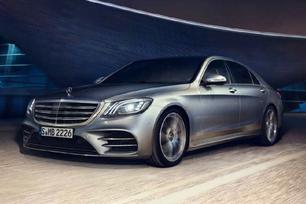
What's the difference?
It's only in the running for the title of world's best luxury car. No biggie here, then.
Like Rolex and Concorde, S-Class has become a byword for ultimate, and deserved or not, the Mercedes-Benz defines its segment despite the best efforts of the BMW 7 Series, Audi A8, Lexus LS and (sadly now-defunct) Jaguar XJ, as well as pointing the way forward with new technologies that eventually trickle down to more proletarian models.
Replacing the half-million selling W222 unveiled in 2013, the W223 is the latest in a long line since the first W187 Ponton debuted in 1951, and includes the famous ‘Finnies' and Stroke-8 models that followed immediately afterwards, but it is the 1972 W116 that really set the template.
Now, seven generations in, the 2021 S-Class is all-new again, with progressive safety and interior features that should help keep it Australia's bestselling full-sized upper-luxury sedan.
The first-generation Volvo XC90 remained on sale for 12 years in Australia before being replaced by the handsome second-gen version that recently clocked up a decade of sales.
There’s a reason for the longevity. People love the Volvo XC90. It is a reliable seven-seat family-friendly SUV with a premium bent. You’ll spot loads of these at fancy private school drop off.
Volvo has extended the life of the second-gen XC90 with a significant late-life update. It adopts some features from its stablemate, the similarly sized and positioned EX90 electric SUV.
It doesn’t get a fully-electric powertrain but you have the choice of a mild-hybrid grade that acts as the range opener and the well-equipped T8 Plug-In Hybrid I’m testing.
Interestingly, a number of this car’s rivals have had their lives extended, too. As many carmakers pour billions into EVs, they’ve taken to delivering major updates to older internal combustion platforms rather than developing all-new underpinnings. The Audi Q7 and BMW X5 are other examples of this.
For the update, Volvo has ushered in a front-end design refresh, a fresh take on the interior, new multimedia and safety tech, a light tweak to suspension and new colours and wheels.
But is this enough to keep premium SUV buyers interested? Let’s find out…
Mercedes-Benz set out to restore the S-Class' place amongst the greatest sedans in the world.
In the heavily-optioned, near-$250K-plus S450 as well as the extended S450L at $300K as tested (the sweet spot of the range for now), we reckon the Germans have succeeded, pushing safety, comfort and technology boundaries, in a package that is true to the heritage of the series.
Tax-fuelled sky-high prices will certainly keep the S-Class niche in Australia, but the car is more than good enough to dominate its tiny corner of the upper-large luxury car sphere.
The best new car in the world? We reckon it's highly likely. Mission accomplished, Mercedes.
It’s a credit to Volvo that the XC90 feels like a new car, even with its older underpinnings. This latest update has successfully addressed areas that needed the most attention, namely the multimedia system, interior and exterior design. The electric driving range now feels somewhat old school compared to the numbers some manufacturers can achieve these days. A lot of PHEVs now exceed 100km EV range and buyers are starting to expect that. And setting up the third row takes way too much effort to want to do it regularly. The new Volvo XC90 is a comfortable, engaging and properly premium family SUV and the updates have only improved what was already a solid offering.