What's the difference?
The ‘Upper Large SUV over $120K’ segment of the Aussie new-car market is what you might call the top end of town, not only in terms of the extravagant models available but also their purchase prices, which stretch well into six figures and require monthly lease payments that rival home mortgages.
It’s where you’ll find some of the most prestigious marques in the automotive world including Rolls-Royce, Aston Martin, Bentley, Ferrari, Lamborghini, Range Rover, Lexus and BMW. And, of course, Mercedes-Benz with its big GLS which represents the flagship of the German manufacturer’s SUV fleet.
It was given a refresh in 2023 with cosmetic and multimedia upgrades along with powertrain enhancements, but there have only been minor changes since then. We were recently entrusted with the keys to the latest GLS to see if the ‘S-Class of SUVs’ leaves any room for improvement.
The Audi SQ8 has had a mid-life refresh but this upper large SUV still offers luxury with its powerful V8 engine that fans know and love, as well as the features you would expect in a top model.
It competes against the Mercedes-AMG GLE and Porsche Cayenne but we’re family testing the SQ8 to see how it handles domestic life.
Keep reading to see what we’ve discovered.
The GLS450d impresses as an entry-level grade, as it’s a more family-friendly allrounder than the specialised AMG and Maybach variants. Its combination of a torque-rich diesel 48V hybrid drivetrain, air-cushioned suspension and plush interior are as well suited to luxury urban travel as they are to grand touring, where its heavy towing and generous load-carrying capabilities can shine. Whether it’s worth around $200K drive-away, only those who shop at the top end of town can decide.
The Audi SQ8 isn’t your typical performance SUV. It’s more refined and less flashy. The tech can be more complicated than it needs to be and if you’re wanting that V8 soundscape, you won’t find it here.
However, the handling and on road experience are superb plus you can comfortably haul the family around and look good doing it.
This is an imposing vehicle in extravagant S-Class tradition, riding on an expansive 3135mm wheelbase and stretching more than 5.2 metres (5215mm) long and more than 2.0 metres (2030mm) wide with a turning circle that's nudging 13 metres.
However, it’s just under 1.8 metres (1798mm) tall, so there’s no clearance issues when accessing multi-storey carparks. And with its side-steps (or ‘running boards’ in nostalgic Benz speak) most adults can step rather than climb aboard, although passengers of shorter stature during our test noted that assist handles on the A and B pillars would be handy.
Central to its sophisticated chassis design is adaptive air suspension, which uses a pneumatic or ‘airbag’ form of springing with adaptive damping to continuously optimise ride comfort and handling response according to road conditions and driving dynamics (see Driving).
The GLS’s styling is clean and uncluttered with tasteful restraint evident in its chrome and satin-chrome highlights, yet it projects a majestic quality with its prominent four-louvre grille and elegantly spoked alloy wheels.
The spacious and sumptuous seven-seat interior is visually pleasing and practical, with a subtle blend of surface treatments, contrasting tones, lots of soft-touch surfaces and exposed stitching. This is combined (thankfully) with physical dials, switches and ‘piano key’ buttons to control numerous interior functions, in preference to distracting touchscreen prompts.
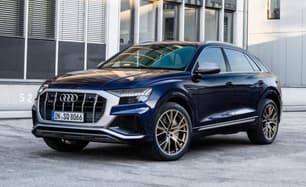
The SQ8 is a gorgeous coupe-style SUV that looks purposeful and poised with its balanced proportions and wide stance. It’s stands apart from its siblings thanks to the S-styled nose treatment and our test model's black accent package makes the honeycomb grille look even sportier.
The update sees new air intake vents at the front, matrix LED headlights and new chrome exhaust tailpipes.
The upgraded 23-inch alloys with red calipers behind them hint at what’s under the bonnet, as does the Sakhir (sack-heer) Gold paintwork which is aptly named after the one-off Grand Prix race circuit.
The interior looks luxuriously appointed with the black Valcona leather upholstery and the dash is headlined by three high-end technology screens. The SQ8 also gets sport seats featuring a quilted design and 'S' badging but there’s not much else separating it from its siblings.
Audi fans will love the the SQ8's more understated interior but newcomers might be surprised it's not as flashy as some of its rivals.
Although it has a hefty 2655kg kerb weight, our test vehicle’s 3420kg GVM rating provides a useful 765kg of load capacity, which should comfortably absorb the combined weight of up to seven occupants and light luggage. Or with the third row of seating folded, five occupants and heavier luggage.
It’s also rated to tow up to 3500kg of braked trailer and with its sizeable 6920kg GCM (or how much weight it can legally carry and tow at the same time) it can carry its maximum load while towing its maximum trailer weight.
So, that’s commendable practicality, given it would be well suited to owners that need to tow large caravans, boat trailers, horse floats etc in style without having to compromise much (if at all) on either passenger numbers or luggage capacity.
Driver and front passenger space and comfort is exceptional, as you’d expect. Storage includes a large glovebox plus a bottle holder and bin in each door. The front of the centre console has two USB-C ports, wireless phone charging and heated cupholders, while the rear of the console has a large storage box with a third USB-C port and padded lid that doubles as a comfy elbow rest.
Even tall passengers in the second row of seating enjoy spacious comfort, given I’m 186cm and with the driver’s seat set in my position I have ample knee clearance, foot room and head space.
However, the central passenger must contend with a transmission tunnel in the floor and shoulder room would be squeezy for three large adults, which is okay for short trips but a maximum of two would be ideal for longer journeys.
The rear of the centre console also treats second-row passengers to a pair of USB-C ports, adjustable air-vents and a control panel that allows independent climate adjustment.
There’s also a large bin/bottle holder in each door plus storage nets on each front seat backrest. The centre seat backrest folds flat to allow long items (skis etc) to slot between the outer backrests. And it also serves as a fold-down armrest, containing two cupholders and a lidded slimline compartment that’s ideal for hidden phone storage.
The third row is uncommonly spacious, even for tall people, with padded armrests on each side containing cup holders and twin USB-C ports.
The carpeted rear luggage area has four load-anchorage points, a first aid kit and 12v socket. With the third-row seats upright it offers 355 litres of load volume, which increases to 1350 litres with the third row folded and 2400 litres (or 2.4 cubic metres) with both the second and third rows folded.
The upper large SUV tag certainly makes sense when it comes to cabin space because there's a lot of it. Both rows enjoy ample head- and legroom and access is great thanks to wide door apertures and high ground clearance.
Comfort is high with well-padded seats and thanks to the Sensory Package all but the middle back seater get some luxury extras.
The centre rear position has compromised legroom courtesy of the transmission tunnel, so it's best for a kid. However, the front seats take the cake with their massage, heat and cooling functions and adjustable supports.
Amenities are great throughout the car and the extendable sun visors, rear electric sunshades, soft-close doors and four-zone climate control clinch the practicality deal.
Individual storage is a bit sparse up front with two cupholders, a drink bottle holder in each door and a shallow middle console that realistically only fits a phone.
The glove box is a great size. I can fit my handbag in it, but there are not a lot of areas to pop your smaller items in.
Individual storage is a bit better in the rear as you get two big map pockets, a drink bottle holder in each door, plus two cupholders in the fold-down armrest - so it feels like you have more places for your bits and pieces.
Technology looks amazing but overwhelming to use until you wrap your head around it all. The haptic feedback also gets tired fast. The built-in satellite navigation is super simple while the head-up display and digital instrument cluster feature pull through directions, which is handy.
Charging options are good with each row getting two USB-C ports and a 12-volt socket but the front also enjoys a wireless charging pad. The pad is slow to charge, though, and left my iPhone feeling super hot whenever it was used.
The boot is a good size at 605L and easy to access, too. The sloping roof means larger items have to sit flush with the seats but you shouldn’t have to worry for road trips.
The back seat has a 40/20/40 split which opens up storage options and this model has a powered tailgate.
Our Polar White test vehicle, which is the base grade in the three-tiered GLS range, comes standard with a 3.0-litre inline six-cylinder turbocharged diesel engine with 48V mild hybrid technology, nine-speed automatic transmission, permanent all-wheel drive and active air suspension for a list price of $189,100.
This pricing is higher than comparative entry-level grades offered by the two marques which dominate sales leadership in this segment, comprising the BMW X7 xDrive40d M Sport ($179,500) and Lexus LX500d AWD ($158,700).
The GLS450d’s standard features include 22-inch AMG alloy wheels with Continental 325/40 R22 tyres and a collapsible spare, ‘AMG Line’ body styling enhancements, aluminium-look illuminated side-steps with non-slip rubber studs, multi-beam LED headlights and more.
Step inside the keyless interior and you’ll find ‘Hey Mercedes’ voice activation, fingerprint scanner (which memorises individual comfort settings for up to seven users), panoramic sunroof, heat-insulating dark-tinted rear privacy glass and the ‘Premium Plus Package’ that includes heating/cooling for the front seats, heated rear seats, head-up display, separate front/rear climate control zones, heated cupholders and more.
There’s also a concert hall-like Burmester surround sound system controlled by a central touchscreen with digital radio and Apple CarPlay and Android Auto connectivity, plus wireless phone charging, multifunction Nappa leather sports steering wheel and USB ports front and rear.
Driver assistance includes the ‘Parking Package’ (360-degree camera, active parking assist and transparent bonnet), ‘Mirror Package’ (auto-dipping rear-view mirror and electric folding door mirrors with puddle lamp projection of the brand logo) and ‘Driver Assistance Package’ (blind-spot assist, exit warning, speed sign recognition, lane keeping etc) all included as standard equipment.
Of course, Mercedes-Benz offers numerous extra-cost options including a 3500kg towing package plus interior, exterior, suspension and wheel enhancements (including Nappa leather trim) for those who want their GLS with the lot, which can easily push the list price beyond $200K.
There are three fuel-based variants for the Q8 and the model on test is the top-spec SQ8 TFSI quattro. Its mid-life refresh has seen a price hike of $10,015, bringing it's before on-road costs price to $178,815.
Our test vehicle has also been fitted with a few extras, like a 'Sensory Package' ($14,400) which includes a black headliner, upgraded 23-speaker Bang & Olufsen 3D surround sound system, massage function for the front seats, heat function for the rear outboard seats, electric sunshades for the rear row and an air-quality perfume function.
Also fitted are various black and matt carbon accents across/inside the body for a total of $5400, optioned 23-inch alloy wheels ($3000) and specialised 'Sakhir Gold Metallic' paintwork for $1600. Which brings the total MSRP price tag to $203,215.
Even with all of these extras, the SQ8 is still the most affordable performance SUV compared to its nearest rivals as the Porsche Cayenne GTS starts from $212,600 MSRP and the Mercedes-AMG GLE 63 outstrips them both at $272,300 MSRP.
As you'd expect the standard features list is robust for the SQ8 and includes premium features like a panoramic sunroof, electric front seats with heating/cooling and memory functions, full-leather upholstery, soft-close doors and a heated steering wheel.
There is a bunch of high-end technology throughout which includes a colour head-up display, 10.1-inch touchscreen multimedia system, 8.6-inch climate control panel, 12.3-inch digital instrument cluster, satellite navigation, wired/wireless Apple CarPlay and Android Auto, digital radio, four USB-C ports, three 12-volt sockets and a wireless charging pad.
Practical features include keyless entry and start, rain-sensing windscreen wipers, dusk-sensing LED headlights, a powered tailgate, adaptive air-suspension and four-zone climate control.
Overall, not a bad list of features for this part of the market and you won't be left wanting.
The GLS450d comes standard with a 3.0-litre turbocharged inline six-cylinder diesel producing 270kW of power at 4000rpm and 750Nm of torque between 1350-2800rpm.
This is paired with a 48V mild-hybrid system comprising a 48-volt battery (charged by regenerative braking) and an integrated starter-generator which provides both seamless engine stop-start and up to 15kW/200Nm of extra power and torque during acceleration.
A nine-speed torque converter automatic provides the choice of manual shifting using the steering wheel-mounted paddles, along with several selectable drive modes.
The active all-wheel-drive system continuously adjusts the engine’s torque delivery between front and rear axles (and individual wheels as needed) to maintain optimum traction and handling.
Our test vehicle has a 4.0-litre, twin-turbo petrol V8 engine that produces 373kW and 770Nm. That means it sits in the middle of its rivals in terms of outputs with the Mercedes being top-dog with its 450kW/850Nm combo.
Still... the SQ8 is no dainty flower when it comes to power delivery and has an impressive 0-100km/h sprint time of just 4.1 seconds.
The SQ8 is a full-time all-wheel drive with an eight-speed auto transmission and the whole engine combo delivers a powerful but elegant on-road experience.
Mercedes-Benz claims official combined consumption of 7.8L/100km and the dash display was showing 9.0 when we stopped to refuel at the completion of our 368km test, which included the usual mix of suburban, city and highway driving with up to five passengers at times and light luggage.
Our own figure, calculated from fuel bowser and tripmeter readings, was close at 9.5 which is outstanding sub-10L/100km economy for such a substantial vehicle in mostly metropolitan use. Therefore, based on our own consumption figure, you could expect a real-world driving range of around 950km from its 90-litre diesel tank.
The official combined (urban/extra-urban) fuel cycle figure is 11.9L/100km, which is lower than its rivals.
My real world usage sits at 12.3L/100km after a mix of open-road and urban driving.
This result is decent for a performance SUV but expect it to be thirsty in an urban environment as the on-board gauge hit the mid-20s in the city.
Based on the large 85L fuel tank theoretical driving range is 714km and around 690 using our real-world result. Respectable for a performance SUV but not as good as some family SUVs.
It’s an enjoyable vehicle to drive, with multiple power adjustments for the seat and steering wheel combined with a large left footrest which provide supreme driver comfort and support.
The powerful and responsive turbocharged six-cylinder diesel and nine-speed auto are well suited to this application. The engine’s ample torque provides spirited acceleration from standing starts, taking only six seconds to reach triple-digit speeds.
This drivetrain would be well suited to heavy towing duties, given the 48V mild-hybrid system can contribute an extra 200Nm (in addition to the engine’s 750Nm), which raises the total theoretical torque output to almost 1000Nm.
The active air suspension provides a wonderfully cushioned ride that floats over bumpy roads, while maintaining excellent handling response and surprising agility. These commendable chassis dynamics, combined with the powerful and responsive drivetrain, makes the vehicle feel smaller and lighter than its dimensions and kerb weight would suggest.
Overall, it’s difficult to fault from a driver’s perspective, with the only exception being the voice activation function. This is often triggered by words or phrases other than ‘Hey Mercedes’ resulting in regular interruption of conversations. This needs some fine tuning.
The SQ8 delivers on power because it’s effortless to get up to speed and the pick up is super responsive when the start/stop function is turned off (otherwise there can be some lag).
The engine doesn’t sound like a big and grumbly V8, though. There are some growls but it’s mainly when you turn the engine on and not to be obnoxious about it but if you're in a V8, you want to hear it as it’s part of the fun of having a big bruiser engine like this!
What doesn’t help the V8 soundscape is the fact the cabin sounds like a noise-cancelling headphone inside. There is a small hum from road noise but it’s pretty darn quiet. Almost EV quiet at times but that means the driving experience leans more towards refined and elegant rather than sporty and fun.
The SQ8's handling is great - super direct steering, stable in corners and well-rounded passenger comfort when it comes to suspension.
You still get road feedback, which I like as a driver, but it’s not too stiff thanks to the adaptive suspension.
The SQ8 is a large car but you wouldn’t know it when it comes to parking. The 360-degree view camera is clear and the dynamic guidelines help you to position this big unit even the smallest of car parks.
The GLS does not have an ANCAP rating as it’s yet to be tested, but comes standard with a suite of passive and active safety features including nine airbags, auto emergency braking (AEB) with pedestrian detection and junction assist, blind-spot monitoring, traffic sign recognition, head-up display, rear cross-traffic alert, lane-keeping, adaptive cruise control with ‘distance assist’ (autonomously brakes/accelerates in heavy traffic), front/rear parking sensors, 360-degree camera and more.
There’s also two ISOFIX and three top-tether child seat anchorages in the second row, plus two more of each in the third.
The SQ8 has a maximum five-star ANCAP safety rating from testing done in 2019 and features eight airbags, including side chest airbags for both rows. It's common to only find the latter in the front – so that’s great for a family car.
The SQ8 scored well across its ANCAP individual protection segments, scoring 93 per cent for adult occupant, 88 per cent for child occupant, 71 per cent for vulnerable road user and 75 per cent for its safety assist.
The SQ8 has a long list of safety features including blind-spot monitoring, safe exit warning, driver attention monitor, fatigue reminder, matrix LED lights, SOS call, forward collision warning, rear collision warning, rear cross-traffic alert, lane keeping/departure aids, tyre pressure monitoring, adaptive cruise control (with stop & go and lane keeping), park assist and a 360-degree reversing camera plus front and rear parking sensors.
The rear row features two ISOFIX child seat mounts and three top tether anchors.
The SQ8 has AEB with car, pedestrian, and cyclist detection and is operational from 10 – 250km/h but it is usual to see this system operate from as low as 4.0km/h.
The GLS comes with a five-years/unlimited km warranty (better than BMW and Lexus) and five years of roadside assistance. Scheduled servicing is every 12 months/25,000km whichever occurs first.
Mercedes-Benz offers capped-price pre-paid servicing packages with three, four or five-year terms. For example, the total upfront cost of the minimum three-year term is $4090, or an average of $1363 per service.
The SQ8 comes with a five-year/unlimited km warranty, which is a normal term for the class.
It also comes with capped servicing for five years or up to 75,000km and averages $920 per service, which is very good for the segment.
Servicing intervals are reasonable at every 12-months or 15,000km, whichever occurs first.