What's the difference?
You have to feel a bit sorry for the Mercedes-AMG GLA 45 S. After all, it shares the same platform and engine as the A 45 S and CLA 45 S, but gets none of the limelight.
Maybe it’s because it’s a small SUV, and by virtue of pure physics, it will never be as fast or fun as its two cousins.
But what it does offer is practicality, thanks to a larger boot and comfort, due to its increased suspension travel.
Wouldn’t this make it a better buy then?
We spend some time behind the wheel of the second-generation Mercedes-AMG GLA 45 S to see if can truly have its cake, and eat it too.
As a child, my parents - who aren't car people - would see a Jaguar and point. It didn't matter if it was an XJ, Daimler Double Six or a Mark II, there was a great deal of mystique around these bastions of Britishness. It also didn't matter that these weren't necessarily good cars. The Seventies and Eighties saw the brand slide into a funk while being passed between owners like hot potatoes.
Somehow, the brand survived its brush with Ford's useless Premier Automotive Group strategy which only came good towards the end as Jaguar's management woke up and put in place a change in direction that produced the Ian Callum-designed XF. Riding high on that design, Jaguar then promptly introduced the very pretty Jaguar XJ.
It has been on sale for ages, but with the addition of a few bits and bobs to stay competitive, it's as compelling as ever. Most importantly, the performance-focused R has kept its unique supercharged V8.
A performance SUV should be an oxymoron and is no doubt a niche product. Is it a high-riding hot hatch? Or a mega-potent small SUV?
Turns out the Mercedes-AMG GLA 45 S is a bit of both and delivers the thrills of a performance car without any of the packaging or comfort-related issues.
While it is getting a little expensive at over $100,000, its blend of space and pace is hard to beat.
It might be old and facing German competition bursting with advanced technology, but the XJR is still a car you can buy with heart and head. But mostly your heart. It goes like stink, has a much better interior than the Quattroporte and is more interesting than just about anything this big or this grand.
It's also a better car than the Maserati Quattroporte if you want to get on with the driving yourself and is far prettier than the Porsche Panamera. It's a wonderful thing and even more wonderful that Jaguar continues to build it. Long live that supercharged V8 and the XJ is a great home for it.
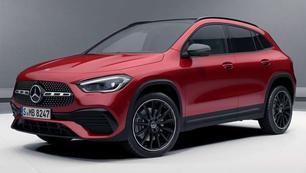
The most obvious tell that the GLA 45 S is something a little special is the Panamericana front grille, an ode to the 1952 Mercedes 300 SL, which is found on all of the German brand's hot models.
But if that wasn’t enough to give it away, the reworked bumper with larger intakes, red-painted brake calipers, lower ride height, black exterior trim and 20-inch wheels should help.
Coming round to the rear, if the AMG and GLA 45 S badges aren’t enough to give away this car’s sporting intent, the quad-exhaust tips and diffuser are sure to give any tailgaters pause.
Our car also came with the optional 'Aerodynamics Package', which adds front fender flicks and a massive roof-mounted rear wing for an even racier look.
If you think the GLA 45 S looks a bit like a jacked up hot hatch, you aren’t far off. Overall, we reckon Mercedes has done a great job at translating the aggressiveness of its A 45 hatch to the larger, higher-riding GLA.
Without the aero package optioned, you might even call it a bit of a sleeper, and it’s certainly more subdued in styling compared to its Audi RS Q3 rival.
In fact, the GLA 45 S might be too subtle for such a hot SUV, at least for our tastes.
Whereas the A 45 S and CLA 45 S get bulky fenders and a hunkered-down, aggressive stance, the GLA 45 S could just blend into the sea of SUVs seen out on the streets, especially without the aerodynamics package added.
Your mileage will vary though, and for some, the subtler looks will be a positive.
Anyone who has sat in a recent small Mercedes should feel right at home in the GLA 45 S, and that’s because it shares much of its interior design with the A-Class, CLA and GLB.
As mentioned before, the 10.25-inch centre screen takes care of multimedia duties, but there are also clicky and tactile buttons underneath for climate controls.
Key to the interior design though is an all-digital instrument display, which is laid out on the high-definition 10.25-inch screen.
With two screens facing you, you might think it’s a bit of information overload, but you can tweak each display to show the information you want.
The digital instrumentation might not be as intuitive as Audi’s 'Virtual Cockpit', but the layout and design of the interior is easy to use and offers owners plenty of customisation to get it right.
The XJ has a marvellously exaggerated length, with a rear overhang redolent of Jag's sporting coupe and roadster pair of the time of its launch, the XK. There's nothing else in the segment like it, with the three Germans - Mercedes' S-Class, Audi's A8 and BMW's 7 Series - having gone all Hugo Boss and and in the latter two's case, almost shrinking violet. The only credible Japanese alternative, the Lexus LS, looks like a Lexused 7 Series. The XJR is a more emotional car, like Maserati's Quattroporte.
The R adds an aggro grille, 20-inch wheels with low-ish profile tyres, a bootlid spoiler, red brake calipers and vents in the bonnet. Bits and pieces get the black gloss treatment and there are V8 and R badges, as well as a rather large leaper on the bootlid. Capping it all off are four exhausts poking out from the bumper and distinctive vertical taillights.
Inside remains largely unchanged. The cabin is big and luxurious, leather-lined and very, very comfortable. The front air vents have to be modelled on the de Havilland Comet's integrated jet engine intakes and, again, the dash design stays away from the horizontal lines of its obvious competition.
There is probably a bit much chrome for my liking, particularly on the centre console and around the rotary dial shifter, which reflects sunlight into your face during the day.
The lovely 'Riva Hoop' - a band that sweeps from door to door across the top of the dash - is a great touch and remains a defining feature in the cabin. The last update brought an Audi-like digital dashboard, including maps, but it's not nearly as slick as the German. The graphics for the dials are good (and quick) but the maps are a bit so-so.
The new-generation GLA 45 S has grown in all dimensions compared with its predecessor, making it much roomier and more practical than before.
For reference, it measures 4438mm long, 1849mm wide, 1581mm tall and features a 2729mm wheelbase, but still sports a roomy cabin for four adults, especially in the front seats.
Storage options include decent door pockets that will accommodate large bottles, a deep centre storage bin, smartphone cradle that doubles as a wireless charger, and two cupholders.
Being a small SUV, the rear seats also afford plenty of room for occupants, with more than enough space for head, shoulders and legs – even with the front seat adjusted to my 183 cm (6'0") frame.
There are decent door pockets, air vents, and USB-C ports that should keep passengers happy on long trips, but the GLA 45 S doesn’t have a fold-down armrest or cupholders for the rear seats.
The boot, however, is where the GLA 45 S really starts to make a case for itself compared to the A 45 S.
The boot boasts 435 litres of volume, and can expand to a massive 1430L with the rear seats folded – making it about 15 per cent bigger than the A 45 S – while the higher load height should make loading and unloading groceries a bit easier.
A downside of the GLA’s tech-focused interior, though, is that all the USB ports are now USB Type-C, meaning you’ll likely have to carry around an adapter to use your old cables.
Mercedes is generous enough to include one with the car, but given most device chargers are still USB Type-A, it is something to be aware of.
It might be over five metres long, but the Jag's cabin isn't as gigantic as that might suggest - luckily, if you want space, the XJ L has it. The SWB version is roomy enough, though, just not palatial. You can fit five people, but the big transmission tunnel will limit the size of that fifth.
Front and rear passengers have a pair of cupholders each, with rubber bubbles to help hold smaller cups in tight. The front and rear doors have pockets but aren't really for bottles.
Boot space is a reasonable 520 litres, with a space saver spare under the floor.
Priced at $107,035, before on-road costs, the GLA 45 S not only sits atop the Mercedes-Benz GLA range, but is also the priciest small SUV available in Australia.
For context, the second-most expensive GLA – the GLA 35 – costs $82,935, while the previous-generation GLA 45 was priced at $91,735 – meaning a $15,300 leap for the new-gen version.
The Mercedes-AMG GLA 45 S also easily blows away its Audi RS Q3 in the pricing department, but also for performance (more on that below).
For the price you are paying, you’d expect a long equipment list, and Mercedes doesn’t disappoint in this regard.
Highlights include an automatic tailgate, keyless entry, push-button start, wireless smartphone charger, illuminated door sills, electronically adjustable front seats with heating, LED headlights, and a panoramic glass sunroof. But at this price you are also paying for a kickass engine and prodigious performance.
As with many of Mercedes’ new models, the GLA 45 S makes use of the 'Mercedes-Benz User Experience' multimedia system, which is outputted across a 10.25-inch touchscreen.
Functions on this system include satellite navigation, digital radio, as well as Apple CarPlay and Android Auto support.
Users have many input options, too, from a central touchpad with haptic feedback, the touchscreen, capacitive touch buttons on the steering wheel, or with voice commands.
Being an AMG, the GLA 45 S also picks up a unique steering wheel with yellow contrast stitching, leather interior, snazzy sports seats, as well as unique instrumentation readouts such as engine oil temperature.
Our test car also came fitted with the optional 'Innovation Package', bundling a head-up display and an excellent augmented reality overlay that shows streets in real time on the multimedia screen.
As is expected at this level, Jaguar was not mucking about with price or specification - the XJR starts at a mildly terrifying $299,995, which is very close to the rather more tranquil Autobiography long-wheelbase relax-o-mobile.
Standard are 20-inch alloys, a 20-speaker stereo, power everything with three memory positions, four-zone climate control, keyless entry and start, front and rear parking sensors, heated and cooled front and rear seats, sat nav, LED headlights and DRLs, leather everywhere, auto wipers and (LED) headlights, electric boot lid, heated steering wheel and a space saver spare.
The Meridian-branded stereo is an absolute cracker, powered by the improved but still laggy 'InControl Pro' system. Oddly, it's all crammed into an 8.0-inch touchscreen when there is seemingly room for the larger (and better-performing) 10.0-inch screen. The software is far superior than the version that preceded the last update, but the screen is hard to use, as targets are placed right in the corners and are hard to hit.
Apple CarPlay and Android Auto are also absent, and the sat nav is still fairly dopey.
A long list of options are available, some of which should probably be included in the big sticker price - DAB+ ($620), premium paint is a splutter-worthy $2060 (although, to be fair, the vast majority of the 19 colours are free), adaptive cruise with queue assist ($2200), adaptive headlights a further $2620 and 'Parking Assist', which adds side sensors and a front camera, a further $2780. Reverse cross traffic alert, blind spot monitoring and forward collision warning cost yet another $1460. Ouch.
Powering the Mercedes-AMG GLA 45 S is a 2.0-litre turbocharged petrol engine, outputting a staggering 310kW/500Nm.
This means the new car jumps up 30kW/25Nm compared to its predecessor, explaining (at least in part) the price jump.
The GLA 45 S is also the top-spec version globally. The 285kW/480Nm GLA 45 which is available overseas would be more directly comparable to the old car.
The engine is also the most potent production 2.0-litre on earth, and is shared with the A 45 S and CLA 45 S.
Paired to the engine is an eight-speed automatic transmission, which sends drive to all four wheels via Mercedes’ '4Matic' system.
As a result, the GLA 45 S will accelerate from 0-100km/h in a frighteningly quick 4.3 seconds, and carry on to an electronically limited top speed of 265km/h.
This is 0.4s slower than its A 45 S sibling, in part due to its heftier 1807kg weight.
Jaguar's lovely 5.0-litre V8 with supercharger continues under the XJ's long and shapely bonnet, delivering a walloping 404kW and a tyre-shredding 680Nm. The sprint to 100km/h for all 1875kg of XJR is completed in an impressive 4.6 seconds, which was very competitive at the car's launch in 2009.
Power reaches the rear wheels via ZF's eight-speed automatic and you can control it with the tacky plastic paddles on the steering wheel. Oh, and it has stop-start.
Official fuel consumption figures for the GLA 45 S are pegged at 9.6 litres per 100km thanks in part to an engine start/stop system.
We managed 11.2L/100km after a few days of testing around Melbourne’s inner city and winding country back roads, but those with lighter feet will no doubt come closer to the official figures.
A performance SUV that can ferry kids and groceries, out accelerate nearly everything else on the road, and sip around 10L/100km? That’s a win in our book.
The combined cycle figure for the V8 is listed at 11.1L/100km but fully expect to see the 16.1L/100km we got, especially as you try and fail to tyre of the monstrous power delivery and lovely (if muted) V8 roar.
Luckily, even if you're belting it, the 82 litre tank is a generous size and you'll cover a fair amount of ground.
If the bespoke styling wasn’t enough of a giveaway, all it takes to realise you are behind the wheel of something special is to turn on the GLA 45 S.
The prodigious engine is fantastic in the A 45 S and CLA 45 S and is no different here.
With peak power coming in at a heady 6750rpm and maximum torque available from 5000-5250rpm, the GLA 45 S likes to rev and makes it feel a little like a naturally aspirated engine in character.
Don’t get us wrong, once the boost becomes available, you will feel that shove into the back, but it’s great that Mercedes has made the engine perform a little more predictably.
Paired to the engine is a smooth shifting eight-speed dual-clutch automatic transmission, which is one of the better versions I've experienced.
Many DCT bugbears, such as jerkiness at low speeds and clunkiness when putting into reverse, aren’t apparent here, and the transmission is up to the task when puttering around town or when driving spiritedly.
Speaking of which, the GLA 45 S’ different drive modes will easily change its character from tame to wild, with available options including ‘Comfort’, ‘Sport’, ‘Sport+’, ‘Individual’ and ‘Slippery.’
Each mode will tweak the engine response, transmission speed, suspension setting, traction control and exhaust, while each can also be mixed and matched in the ‘Individual’ drive mode.
However, a missing feature for the GLA 45 S that is found in its A 45 S and CLA 45 S siblings is a drift mode.
Sure, how many small SUV owners are going to take their car to a track to make use of it, but it still would have been nice to have the option.
With three levels of suspension setting, though, the GLA 45 S offers enough variability to be comfortable around town and soak up the bumps thanks to its long suspension travel, while also switchable for a more involved, driver-focused feel.
The GLA 45 S might never corner as hard or fast as its A45 S sibling, but being an SUV brings its own unique set of plus points.
Indecently quick, surprisingly agile and heaps of fun. While the first descriptor applies purely because of its size, the next two shouldn't when you're in command of 5.13 metres of motor vehicle. As with the Audi and now the 7, the Jag has a lot of aluminium to help keep the kilos off and good gracious, it has worked.
The R is based around the short wheelbase version of the XJ for perhaps obvious reasons. Even so, it appears to be the shorter-again XF's because this thing turns in like a demon. No, it won't stay with the dearly-departed XF-R but it does a mighty fine impression of one, just with a better ride quality.
Rear seat passengers should be prepared to feel a lot of wheelslip, especially when in Dynamic mode, as even the fat Pirelli P-Zero's struggle for purchase when the right foot hits the carpet. The V8 rumbles rather than bellows, but the rears cheerfully spin up until the computers and active differential rein things in. Traction control off and you've got a proper tyre-smoker if you're not playing by the rules. Jag's engineers are clearly hooligans at heart.
As always, ZF's eight-speed transmission does an incredible job of marshalling the horses in a rearward direction and when you're not after a bit of sound and light, have achieved a tremendous amount with the damping. When in normal mode, the car glides along, so much so that the lady of the house wasn't so sure it was a sporting sedan.
Once she was apprised of dynamic mode (you have to cycle the button through winter mode first, for some reason), her only complaint was that it was too long and the steering wheel too big for this type of car. I was persuaded of the latter, especially after stepping out of an Audi S3 which has a tiny wheel. Long story short, the XJR is now 'her' car (to be more accurate, the XFR is, but that hasn't arrived yet, so...), as it felt smaller than it was when not parking and she's a sucker for a torquey V8.
At the time of writing, the new-generation GLA – including this GLA 45 S – has yet to be crash tested by ANCAP or Euro NCAP.
However, standard safety equipment extends to autonomous emergency braking (AEB), lane-keep assist, blind-spot monitoring, traffic sign recognition, adaptive cruise control and a surround-view monitor.
The GLA also has nine airbags spread throughout the cabin, as well as an active bonnet and driver attention alert.
The whole XJ range has six airbags, ABS, stability and traction controls, emergency brake assist, reversing camera, three top tethers and two ISOFIX points. The XJ doesn't have an ANCAP safety rating.
Like all new Mercedes-Benz models, the GLA 45 S comes with a five-year/unlimited kilometre warranty with five years of roadside assist – the benchmark in the premium car space.
Service intervals are every 12 months or 20,000km, whichever occurs first, and the first five services are available to purchase for $4300.
This actually makes the new GLA 45 S cheaper to maintain over its first five years than the outgoing car, which costs $4950 over the same time period.
Jaguar offers a three year/unlimited kilometre warranty and roadside assist for the same period.
Like the F-Type, XJ owners benefit from three years/100,000km free servicing.