What's the difference?
If you’re picturing the premium mid-size segment in Australia, you’re almost certainly picturing Mercedes-Benz. Honestly, the premium carmaker has the kind of powerful and unquestioning stranglehold on the segment that would have despots and dictators turning green with envy.
The C-Class often outsells its nearest competitor by a factor of two to one. Even more impressive, that nearest competitor is another Mercedes, the CLA. Audi and BMW are left off in the middle distance, duking it out for third and fourth place.
So yes, the C-Class is a very important car for Mercedes. And this new one, updated for 2019, is even more so. It’s the first major update in the current car’s four-year lifespan, with a handful of exterior tweaks, some new key cabin technology and, most importantly, a new and clever engine option for its top-selling version.
So is that enough to keep the C-Class at the top of the mid-size pile?
A hybrid BMW 3 Series makes sense now that everything is going electric. And the BMW 330e M Sport is the plug-in hybrid version of the 330i petrol variant. What's not to like, then?
Well, that's what we're here for because this review of the BMW 330e M Sport will reveal everything we've discovered about the car and will help you decide if it really does make sense to make it your next car.
We've covered everything from practicality to on-road performance, features and prices. And yes, we've run a fuel test to see just how efficient this plug-in hybrid is to live with in the real world.
Baby steps these might be, but they're important ones for Benz. The new in-cabin tech and clever engine in the cheapest models only strengthen the C-Class proposition, without taking anything away from the drive experience, cabin ambiance and utterly sublime ride.
In short, Mercedes' reign at the top of the premium mid-size segment is unlikely to be toppled anytime soon.
The 330e M Sport is an excellent car, but it could be a much better hybrid.
In Australia, where driving distances can be vast, a car that's as comfortable and easy to live with as this one is welcome. But for the electric range to dissipate so quickly, and not recoup again at a fast enough rate without plugging into a charger, is disappointing.
There are other plug-in hybrids, even among the more affordable mainstream brands, which can return charge to the battery incredibly quickly and effectively on the go.
If you are looking to make the step into a hybrid, then perhaps consider a fully electric car. There isn't a battery electric 3 Series on the market in Australia (yet), but BMW does sell the iX1 small SUV for less money than a 330e or the iX3 for a tad more.
Both are pure electric SUVs and have a range of between 400-500km. You'll never need petrol again, which makes a hybrid seem outdated.
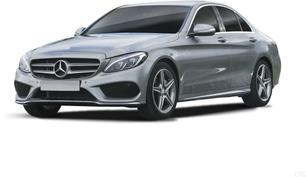
Perhaps not quite blink and you’ll miss them, but we're not talking radical changes either, folks. Benz tells us as much as 50 per cent of the C-Class components are new or changed, but it has clearly subscribed to the 'if it ain’t broke' philosophy in the design department.
Yes, there are new bumpers front and rear, new LED light configurations and new colours and wheel designs, but we’re not talking huge changes outside. Still, the C-Class cuts a fine figure on the road, what with its intricate alloys, bonnet-defining grille and simple, understated body contours. Australia will take every available body style, too, including sedan, coupe, cabriolet and - our personal favourite - the 'estate' station wagon.
The C 43 AMG now gets the twin-blade grille design used on the V8-powered models, as well as a two pairs of rounded exhaust tips at the rear.
Inside, though, the changes are more substantial. For one, the new-generation Mercedes Touch Control steering wheel arrives as standard, as does a new and very effective 12.3-inch screen that replaces the traditional dials in the instrument cluster (standard on every model).
The cabin remains a peaceful and premium-feeling space, with a fine use of materials (including quilted leather on the door panels, polished silver or faux-wood for the centre console and leather for the steering wheel), and Benz deserves credit for ensuring that sense of luxury extends to backseat riders.
Once upon a time sedans were all we drove, well mainly. Then SUVs became the style of car most people wanted. In fact, three out of four new cars sold in Australia today are SUVs.
So, I commend you on your choice of not just doing what everybody else does, and you'll be rewarded with better driving dynamics, and ownership of an iconic BMW - the four door, 3 Series.
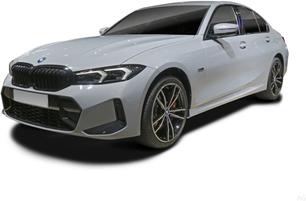
And even though this is a plug-in hybrid version of the 3 Series it's identical in styling to the petrol variants. Only the light blue border around the BMW roundel is the indication that it's an electric vehicle. That and the charging flap near the left front wheel.
The M Sport pack adds some very sexy features such as the M Sport aerodynamic body kit, the door sills and M Sport seats, but the M Sport Pro Pack our car came with adds a black gloss grille, boot lid spoiler and the snazzy seat belts.
The cabin's double screens are impressive but I miss analogue gauges and found the digital instrument cluster overly busy and led more by cool design than functionality.
It all depends, really. All C-Class variants sit on the same 2840mm wheelbase, and stretch 1810mm in width. The sedan, coupe and cabriolet versions measure 4686mm in length, while the Estate’s bigger cargo area increases its size to 4702mm.
Predictably, then, the estate offers the most useable (VDA) boot space, with 490 litres with the rear seats in place, swelling to 1510 litres with the rear seats folded flat. The sedan version is next on the cargo-carrying list, with 455 litres, followed by the 380 litres of the coupe and 285 litres of the cabriolet.
We spent our entire time in the four-door sedan models, and we can report a spacious and comfortable space for driver and passenger (you could play ping pong on the wide centre console) with two cupholders and room in each of the front doors for bottles. There’s all the USB and power connections you might need (most housed in a deep storage bin that separates the front seats) and the more expensive models offer wireless charging for compatible phones, too.
Climb into the sedan’s back seat, and you’ll find impressive legroom (behind my own 176cm driving position), but headroom - especially in sunroof-equipped cars - feels a little tighter. The rear seat is actually wide enough to fit three adults at a pinch, but the tall and bulky tunnel absolutely obliterates leg room for the middle-seat rider.
There are two cupholders in the pulldown divider that separates the backseat, as well two ISOFIX attachment points. Rear occupants also get there own air vents, as well as a 12-volt power source.
People will tell you SUVs are more practical than sedans... and they're right, but not in as many ways as they probably think.
The cabins of sedans and SUVs of the same size are close in terms of space, but the 330e comes with excellent storage - better than many SUVs I've tested, featuring enormous door pockets, and a deep centre console storage bin.
There are four cupholders, too. Two in the fold down armrest in the back and another two up front.
There's also wireless charging up front, plus USB ports for the back passengers. The second row also has its own climate control and directional air vents.
Legroom is excellent in the back and I can sit behind my driving position with plenty of room to spare. Headroom is also excellent thanks to the tall roofline of the 3 Series.
Where a sedan isn't as practical as an SUV is its ride height, which makes getting in and out of the latter easier (although the 330e's doors open very wide) and its boot opening.
SUVs have hatch-like openings and that offers a wider and taller aperture for carrying cargo.
The 330's boot was still big enough to fit our two largest CarsGuide suitcases (see the video), but the location of the battery means cargo capacity has been reduced from 480 litres in a petrol 330i to 375 litres in this 330e.
Mercedes is so far keeping mum on the details, ahead of the updated car’s arrival in August, but you can expect to see prices climb a little from their current levels ($61,900 - $100,611, and $120,642 for the C 43 cabriolet).
The C200 will retain 18-inch alloy wheels, artificial leather (and electric in the front) seats, nav, ambient interior lighting and keyless entry and push-button start, but critically adds a new 12.3-inch screen in the driver’s binnacle that replaces the traditional dials. It joins a landscape-oriented 10.25-inch centre screen - both now standard across the C-Class range - which propels the cabin into a clean and modern-feeling future.
The C220d and C300 features list will likely change little, but all get Mercedes’ new 'Touch Control' steering wheel, as well as new LED head and tail-lights, while the C 43 AMG 4Matic gets the best of Merc's autonomous driving technology.
Expect more information to arrive around July. The C 63 AMG is also due for updating, with a new model scheduled to arrive around December.
The BMW 330e M Sport lists for $97,400, which is $4000 more than its 330i petrol twin.
The M Sport part of the name is there because the 330e comes standard with the M Sport pack. And that gives you a tough body kit, M Sport suspension, M Sport seats and aluminium trim, as well as M Sport door sills.
The car we tested and the one you can see in the video and images also comes with the 'M Sport Pro Package'. It costs $2800 and adds a boot-lid spoiler, glossy black grille and tail pipes, and M Sport seat belts, among other goodness.
This car also had the optional 'Visibility Package' fitted. It costs $4800 and adds a sunroof and adaptive LED headlights.
There's no direct rival for the 330e in Australia now. Mercedes Benz used to have a C300e, a plug-in version of its C-Class, but retired it locally some time ago.
The standard features of the 330e M Sport are identical to the 330i M Sport.
So, along with that M Sport pack also coming standard on the 330e is a head-up display, a 12.3-inch digital instrument panel, a 14.9-inch media screen with sat nav, Apple CarPlay and Android Auto, three zone-climate control, wireless phone charging, digital radio and power adjustable front seats.
Is it good value? There's a stack of equipment, tech, beautiful M Sport additions and it all feels superbly high quality. But knowing you can have a 330i for less means you're paying more just for the hybrid system. So, let's talk about that...
It’s here where the C-Class is at its most updated, serving up a new turbocharged 1.5-litre hybrid engine in the entry-level C200. Alone, it’s good for 135kW/280Nm, but it’s combined with a clever 48-volt system that adds up to 11kW of bonus power low in the rev range, happily plugging the power void usually left by turbo lag when taking off, or if you plant your foot when overtaking.
The C300 is powered by a more conventional 2.0-litre, four-cylinder good for 190kW/370Nm, while the sole diesel (in the C220d) is a four-cylinder unit that produces 143kW/400Nm. All are paired with a nine-speed automatic transmission.
The C 43 4Matic's engine remains a fabulous thing, only now tweaked for a little bit more power. It's good for 287kW/520Nm, and is paired with a nine-speed transmission that sends the power to all four wheels, albeit with a bias toward the rear tyres.
The 330e M Sport has a 2.0-litre petrol engine and an electric motor. The engine makes 135kW while the motor produces up to 80kW, for a combined dollop of 215kW. Total torque is more than sufficient at 420Nm.
Acceleration to 100km/h from zero feels as quick as the 5.8 seconds BMW claims and that's also about a tenth of a second brisker than the 330i.
The 'XtraBoost' function combines the total output of both the engine and motor briefly providing that great acceleration.
An eight-speed automatic shifts gears smoothly with the drive going to the rear wheels.
I like all this very much - the responsive engine, the fantastic transmission, the extra oomph from the motor and the way it all works together seamlessly. It's just a shame it's not as efficient as some other new plug-in hybrids.
Let’s start with the C200, where the addition of the clever hybrid system has helped drop fuel use to a claimed 6.0-6.3 litres per hundred kilometres. The old car delivered 6.5 per hundred, but was slightly quicker from 0-100km/h (7.2sec- 7.7sec).
The C300 will sip a claimed 6.5-6.9L/100km on the same cycle, while the diesel requires a miserly 4.7 litres. The C 43 is the thirstiest, of course, needing 9.1-9.3L/100km on the same cycle.
The C200 makes do with a 41-litre tank (as does the diesel) while the C300 steps that up to a 66-litre tank. And all those numbers related to the sedan body shape, so expect some slight variations if you’re shopping for a coupe cabriolet or estate.
The 330e M Sport is a plug-in hybrid which must be connected to an external power source regularly to charge its 12kWh battery.
The charging flap is located on the left side of the car near the front passenger door, which worked well for me as I could steer the 330e into my driveway and connect to a powerpoint on the wall using the charging cable provided.
It took me about six hours to charge the battery to 100 per cent from zero and that gives you a maximum 57km of electric driving range.
During my four days with the 330e Sydney's summer temperatures were hitting 34-degeres Celsius and with the climate control keeping the cabin at a hospitable 18C electric range was seriously cut short to about 40km.
I drove the 330e in hybrid mode nearly all the time - this is a hybrid after all. But there is a 'Sport' mode for more grunt and a 'Battery Hold' mode to save the charge for later.
I started with a full charge and a full tank of petrol, and for four days I lived with the 330e as I do with all my test cars.
I didn't aim to get the best fuel economy ever, nor was I wasteful with fuel. My wife and I, plus our two kids, just used it as our family car, doing trips to the beach, endless laps of the supermarket car park looking for a space, a birthday party, the lot.
I drove 154.7km over those four days and charged it on the second day after the battery was drained completely before driving another 70km or so over the next couple of days.
When I filled up after this it needed 7.74 litres to reach full again - it's a small 41 litre tank.
That converts to average fuel consumption of 5.0L/100km, which is bang on double the 2.5L/100km BMW says you should get.
I don't doubt you could get 2.5L/100km, but you'd have to be doing short trips and charging almost every time you weren't driving. And not use the climate control on an icy blast setting.
I've tested other plug-in hybrids that achieved much better mileage and that's because their on-board charging capabilities were excellent.
Some were even able to use the petrol engine to power the motor in reverse and therefore act as a generator to recharge the batteries fully.
The 330e M Sport doesn't do a good job of charging its battery while on the go. Sport mode does recoup charge to the battery, but again, if you're doing a long motorway trip that charge evaporates fast.
I don't think this type of plug-in hybrid is suited well to our country where we don't blink an eye at travelling 100km for Christmas lunch and then drive back again.
Also think about if you ever go on a trip away and don't have access to a power point or public charger. It's happened to me.
Keen to sample the new hybrid tech in the C200, we made a beeline for the cheapest C-Class. And if you’d told me, even a handful of years ago, that a piddly 1.5-litre engine would be enough to drag the 1555kg Benz around, I’d have labelled you crazier than Donald Trump's Twitter account.
The C200’s system is a unique hybrid set-up, in the sense that it only delivers extra power in the tiniest of circumstances, but they’re the areas that it really needs it. From a standstill, the electric motor delivers its extra 11kW of oomph at just the right moment need to help get you moving (the same when overtaking) and it does genuinely make a difference.
It can’t completely overrule the concrete laws of physics, though. Plant your foot on anything that even looks like a hill and you can definitely hear that 1.5-litre engine working hard - interrupting the ambience of the cabin - but keep it in the sweet-spot of the rev range and it’s a quiet, capable-feeling engine that delivers more punch than its size might suggest.
On Germany’s epic autobahns, the needle even sailed past 215km/h without too much encouragement (even if I could have knitted a sweater in time it took to to close the last 10-or-so-kilometres). Is that relevant for Australia? Sadly not, but it does suggest the engine is more capable than we will ever need it to be.
Elsewhere, the not-too-different C-Class rides an absolute dream, smooth-sailing over bumps and road imperfections, and the cabin is serene and comfortable - though there was more wind noise at times than I was expecting.
Downsides? Well, the cheapest C-Class doesn’t feel the most dynamic offering, with the light steering serving up a slight disconnect between the steering wheel and the road below in its most comfortable settings. Switching to Sport improves matters, but if you’re life is mostly city and suburbs, it will matter little.
The nine-speed transmission can behave oddly at times, too; smooth and lightning fast as it climbs the gears, and mostly perfect on the way back down. But I noticed a definite thump occasionally as it shifted down from second to first gear, which stripped a little refinement from the drive experience.
It's more noticeable in the C 43 4Matic AMG, but it's vastly overshadowed by the thick and meaty power delivery from that stonking turbocharged engine. It's a rocket, and while it's not as fast or as loud as its C 63 big brother, I honestly think the tweaked C 43 is all the AMG I'd ever need.
The 330e M Sport is outstanding to drive. The driving position is superb, the steering is effortless and accurate, handling is excellent and the ride is beautifully comfortable.
Brake pedal feel is surprisingly good for a hybrid - some have a wooden sensation.
The transition from electric motor to petrol engine is also remarkably smooth.
Acceleration in Sport mode is sudden, with the engine and motor combining their mumbo to move you. There is a 'fake' or synthesised exhaust note in Sport mode, but it sounds convincing.
Speaking of sounds at lower speeds, in fully electric mode the 330e emits a warning tone to alert pedestrians of your presence. It's quite loud in car parks and does actually make people turn around looking for a UFO.
Detailed specifications for Australia are still being finalised for the C-Class, but we don’t think the standard safety equipment will change much.
So expect a comprehensive suite of airbags (including front, front-side, head for the first and second rows and a driver knee bag), joined by the usual kit of traction and braking aids on the C200. Blind-spot assist, tyre-pressure monitoring and AEB - part of the Collision Prevention Assist Plus package - also arrive as standard.
Higher trim levels will nab active cruise, with stop and go, rear cross-traffic alert, active blind-spot monitoring system and active lane keep assist, while the C 43 scores Mercedes' most advanced auto-driving tech.
The 3 Series was awarded the maximum five-star ANCAP rating when it was tested in 2019. The 330e comes standard with AEB, lane keeping assistance, blind-spot warning and rear cross-traffic alert.
There are excellent cameras front and rear and LED headlights, too.
Adaptive cruise control is also standard on the 330e M Sport.
While specific maintenance pricing is yet to be confirmed, each of these models is covered by three-year warranty, with service intervals pegged at 25,000km or 12 months.
The 330e M sport is covered by BMW's five-year/unlimited kilometre warranty. The hybrid battery is covered by a six-year/100,000km warranty.
BMW offers a five-year/80,000km service package for the 3 Series for $2150.
Service intervals are condition-based, and the car will let you know when it's time for a check-up.