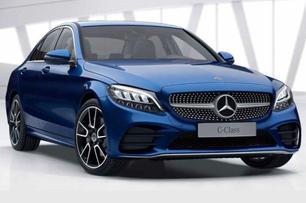
What's the difference?
Australia's relationship status with the Mercedes C-Class has long been… complicated.
Over 40 years and five generations, the German midsized luxury sedan has been a paragon of efficiency and safety on one hand, but on the other, well, the quality and ride comfort haven't lived up to brand expectations.
Now the completely redesigned version has landed in Australia, with shrunken S-Class limousine styling to take on not only the BMW 3 Series, Audi A4 and Genesis G70, but rivals as disparate as the Hyundai Ioniq 5 and Tesla Model 3.
The question is? Is this latest, sixth-generation, new-from-the-ground-up C-Class good enough to take on all those and more? Let's find out.
The first-generation Volvo XC90 remained on sale for 12 years in Australia before being replaced by the handsome second-gen version that recently clocked up a decade of sales.
There’s a reason for the longevity. People love the Volvo XC90. It is a reliable seven-seat family-friendly SUV with a premium bent. You’ll spot loads of these at fancy private school drop off.
Volvo has extended the life of the second-gen XC90 with a significant late-life update. It adopts some features from its stablemate, the similarly sized and positioned EX90 electric SUV.
It doesn’t get a fully-electric powertrain but you have the choice of a mild-hybrid grade that acts as the range opener and the well-equipped T8 Plug-In Hybrid I’m testing.
Interestingly, a number of this car’s rivals have had their lives extended, too. As many carmakers pour billions into EVs, they’ve taken to delivering major updates to older internal combustion platforms rather than developing all-new underpinnings. The Audi Q7 and BMW X5 are other examples of this.
For the update, Volvo has ushered in a front-end design refresh, a fresh take on the interior, new multimedia and safety tech, a light tweak to suspension and new colours and wheels.
But is this enough to keep premium SUV buyers interested? Let’s find out…
Over five decades, the Mercedes-Benz C-Class has pivoted between mastery and mediocrity, and all-too-often relied on that three-pointed star up front to win over buyers.
Thankfully, the W206 is one is one of the better generations. It's easier on the eye, comfier to travel in, more intuitive to use, safer across the board and a huge improvement to drive. On the evidence of the C200 and C300 launch grades, there's newfound depth and consistency to savour.
Sure, prices have gone up, the C200 could use a bit more power, the steering could benefit from a bit more feel, the odd build-quality glitch made itself heard and there's a fair bit of road noise at times, but overall, the C-Class now deserves to be at the top of your luxury medium sedan shopping list.
Particularly if you can afford to stretch to the rorty C300.
It’s a credit to Volvo that the XC90 feels like a new car, even with its older underpinnings. This latest update has successfully addressed areas that needed the most attention, namely the multimedia system, interior and exterior design. The electric driving range now feels somewhat old school compared to the numbers some manufacturers can achieve these days. A lot of PHEVs now exceed 100km EV range and buyers are starting to expect that. And setting up the third row takes way too much effort to want to do it regularly. The new Volvo XC90 is a comfortable, engaging and properly premium family SUV and the updates have only improved what was already a solid offering.