What's the difference?
Mazda has a tendency to have a lot of similar looking horses in the stable; blink and you'll miss the (very) subtle differences between the CX-8 and the CX-9 but if you're not super keen on the bulk of the CX-9 and you've outgrown the space of the CX-5... this one's for you.
Especially, if you've been considering its competition - the Hyundai Santa Fe Elite CRDi AWD and Toyota Kluger GXL AWD. Both of which have become known for their features and space.
So, how does it compare? The CX-8 GT SP diesel all-wheel drive seats seven, has a decent boot space (albeit, when the third row isn't in use) and handles like a dream.
Perfect combination? Maybe. I've been driving it for the last week with my family to find out for you.
It has been a while since we’ve seen a Mitsubishi Express van on sale in Australia, and the one that has just launched here is a very different offering to its predecessor.
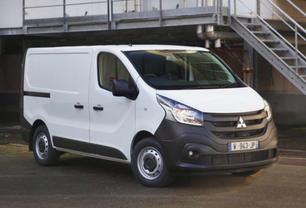
That’s because you could cover the tri-diamond badges on the grille or back door of the new 2020 Mitsubishi Express and be fooled into thinking that you’re looking at a Renault Trafic. Because you are.
The Express is a direct bi-product of the Alliance between Renault and Mitsubishi, and just like the Trafic, it’s made in France, at Renault’s Sandouville plant.
This isn’t a comparison - the headline isn’t Mitsubishi Express vs Renault Trafic - but the question is: why would you choose one over the other?
You’d be correct in assessing this as an exercise in badge engineering - Mitsubishi calls it “branded product” - but it could well be that you’d choose an Express because Mitsubishi has a broader network of dealers (186 at the time of writing, versus Renault’s 56), not to mention the potential for major fleet discounts and an upstream ute alternative in the Triton that helps the brand “offer the complete LCV solution”. Renault, you could counter, has a smaller and larger van for its own “LCV solution”.
There’s more to consider, including ownership, safety and value for money - read on for all the details.
So, what did my family think about the Mazda CX-8 GT SP diesel all-wheel drive? I love how it performs on the road - it's super easy to drive and you don't notice how large it is in a car park.
There are some great family-friendly features scattered throughout and I like how practical this is too with the extra seats and top-tether points. The multimedia system isn’t my favourite and I would have preferred to have seen a few extra airbags and a 360-degree view camera, but overall, it’s a good family car and gets an 8.0/10 from me.
My son loved the sun blinds and the cool colour of the seats. He also gives it an 8.0/10.
The Mitsubishi Express is an impressive return to the market for the brand, albeit one that won’t suit every buyer’s needs or wants. If you need to personalise your van, or if you value the safety technology offered by rivals like the HiAce, then you may need to shop elsewhere.
But if you do choose the Express, you will be getting a value-packed and very comfortable van that is backed by a broad dealer network and decent ownership prospects.
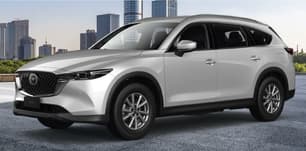
To be honest, I can't really tell the CX-8 and CX-9 apart on the road. They're both large SUVs that sport the classic Mazda bonnet - sharp and long. Up close, the CX-9 has a bulkier shape but otherwise they are remarkably similar.
The CX-8's darkened grille generates some interest with its lattice-work and there are enough shiny chrome accents scattered about the car that it looks pretty.
Yet, the sporty sharpness that Mazda is known for is still hinted at with its shaping and the 19-inch black alloy wheels.
Our model is finished in 'Platinum Quartz Metallic' and it is the highlight for the exterior styling for me. I think because it's such an interesting colour to look at - it varies a lot depending on lighting conditions. Sometimes, it almost has a sheen of pink to it and at others, it looks like pearly sand.
The interior looks polished and refined with its burgundy leather trim and soft-touchpoints. Again, there is a lot of chrome inside to make otherwise dull features, like air vents, pop out.
The badges are different, and so is the front bumper and bonnet. But you might otherwise struggle to tell what’s changed between a Trafic and the Express.
One thing Mitsubishi is offering, though, is a standard three-seat cabin on all models, plus dual side sliding doors and rear barn doors across every variant in the line-up. That’s a win for hard workers.
Here’s a table of dimensions to help you size up which might be best for you:
As you can see, the extra size on offer in the LWB model is strictly nose to tail, with no other compromises to consider apart from, understandably, the larger turning circle. But Mitsubishi claims even the smaller version can cope with two pallets in the back.
As for cargo zone dimensions, here’s how the two body styles compare:
It’s worth noting that there is no high-roof option available, where you can get a taller body in most competitor vans.
And while it is a bonus that there are barn doors (still not available on the HiAce), you can’t option a liftback tailgate. Plus, while the dual side sliding doors is an advantage as many OEMs charge extra for a driver’s side slider, you can’t option glazing for the rear door from Mitsubishi.
The company says that it is simply offering what it can get as part of the Alliance with Renault, but if you need to tailor a van to suit your specific needs, you might end up going with the French van (or the VW Transporter, which is the most configurable on the market).
Check the engine specs section below for more specs on weights and capacities. Next, let’s take a look at the cabin, starting with some interior images.
The CX-8 is a very practical family hauler because there's ample room in all three rows. Yes, even adults will be able to squeeze into that third row without too many complaints!
All rows enjoy well-cushioned seats and up front they are electrically adjustable, but unfortunately, only the driver's side has lumbar support.
The middle row can slide forward manually or by using the electric button found on the side of the seats... but doing it yourself is way faster.
They do slide far enough forward that you won't embarrass yourself too much when you have to clamber into the third row. Where the seats have a 50/50 split-fold and manual adjustments (accessed via the boot).
In the first two rows there are lots of individual storage options but the front enjoys the most. The middle console is deep enough to be useful and I like the dual opening lid. Each row gets a couple of cupholders and drink bottle holders, too.
The charging options are great, with each row getting two USB-C ports and the front getting a wireless charging pad and 12-volt socket.
All of the controls and dials feel within easy reach and the 10.25-inch touchscreen multimedia system graphics are clear.
You can use it as a touchscreen or opt for the rotary dial but switching between the two was awkward for me. Especially, since the touchscreen function is disabled when you are using the wireless Apple CarPlay. This also has wired Android Auto, for those users.
The amenities are practical throughout with a dark headliner, three-zone climate control and heated outboard seats and retractable sun-blinds in the middle row.
Good news for families because there are five top-tether points across the back rows and ISOFIX child seat mounts on the outboard seats in middle row, in case you need them.
You can fit a 0-4 rearward facing child seat and it shouldn’t impact on front passenger comfort.
My six-year old found it super easy to get in and out of this car because of the 205mm ground clearance and wide door apertures. He enjoyed the high seating position, too, but was disappointed he couldn’t see out of the sunroof!
The boot space is a bit cramped with all three rows are in use at 209L but folding the third row opens up a more respectable 775L - perfect for the average family and its stuff!
The loading space is level, with the temporary spare tyre and clever storage compartments housed underneath. There is a retractable cargo blind and net, luggage anchor points and a 12-volt port, too.
And, as always, I love a powered tailgate, which this has!
With a three-seater cabin as standard, the Express is already at an advantage over a HiAce. You can’t get a three-seat HiAce, and if you’ve got apprentices or workmates that always need a lift - but you don’t want the space sacrifice that comes with a crew van - it could be a crucial decision-maker for you.
And there are decent amenities for the occupants, too, with three cup holders and ample storage options across the dashboard, as well as large bottle holders in the doors. In fact, all told, Mitsubishi claims there is 43 litres of loose item storage in the cabin.
The driver’s seat gets manual height adjustment, lumbar adjustment and an armrest, as well as steering wheel rake and reach adjustment, so getting a comfortable driving position should be a cinch. Unlike the Trafic, there’s no driver’s seat heating option, but the clever “Load Through” cavity - for loading items up to 4.14m long - under the passenger seat is fitted on all models (but unlike the Trafic, which has a bulkhead, there’s no porthole, and the vehicles we tested with cargo cages didn’t have an opening to make the best use of this).
It’s set up for hard work, with rubber floor mats and a “hard wearing” poly trim on the steering wheel, though that finish is a bit coarse, and not as pleasant to hold as a leather wheel. The seat trim is fabric, and feels to be made of a durable material.
Ergonomically, it is no different to a Renault Trafic. Most important controls fall easily to hand, though people unfamiliar with Renault switchgear may need to pay attention at the dealership when the positioning of the cruise control and speed limiter buttons are explained. The buttons are between the dashboard and steering wheel.
And if you’re looking for the volume button, it’s on the weird little stalk behind the wheel itself. That has tuning and phone controls too, and it takes some getting used to. Further, if you’re used to the blinkers being on the “right” side of the steering wheel in Japanese cars, the Express is the exception.
When it comes to media and infotainment, there’s a lot left to be desired. There is no touch screen at all, and you can’t option one, either. Some drivers will appreciate that, but others will lament the lack of smartphone mirroring tech (Apple CarPlay and Android Auto), and likewise there is no sat nav available, either. There’s not even a CD player, but as standard the Express gets a smartphone holster with USB port on top of the dash, so there are two USB ports to keep things charged, plus a 12-volt below if you need it.
But the simple media system does offer a USB port to connect your phone or MP3 player, and Bluetooth phone and audio streaming, as well as DAB digital and AM/FM radio. The sound system has just two speakers, but it’s okay.
The cargo zone is, as you’d expect, a big, largely empty space. There’s no steel bulkhead option to separate the two zones, which could be frustrating for some customers - though if you can deal with the noise reverberation but just want to make sure things don’t fly from front to rear, there is a mesh cargo barrier available.
There are 14 tie-down points in the SWB (eight floor mount, six wall mount) and 16 tie eyelets in the LWB (10 floor, six wall). Plus there’s a rear-mount 12-volt outlet near the back doors to keep things charged.
The GT SP diesel AWD is one of the premium models, sitting third from the top and will cost you $65,560, before on road costs.
However, its price tag positions it as the most expensive compared to its rivals. With the closest rival being the Kluger at $65,310 and the most affordable being the Santa Fe at $60,000.
You do get a stylish-looking package with lots of features for your cash, like heated front seats, heated rear outboard seats, a tilt and slide sunroof, and premium leather interior trim.
There's some great tech scattered throughout, too, like the 10.25-inch touchscreen multimedia system, wireless charging pad, USB-A ports in the third row, Bose Premium sound system with 10 speakers, wireless Apple CarPlay and wired Android Auto.
Its starting price is cheaper than a VW Transporter, Hyundai iLoad, Toyota HiAce, Ford Transit Custom and Mercedes-Benz Vito. That could be all you need to know, but here’s the detailed info on the spec of the 2020 Mitsubishi Express range.
There is just one trim level - GLX - but it is available with two body lengths, short-wheelbase (SWB) and long-wheelbase (LWB), and a choice of two powertrains.
The 1.6-litre manual SWB model opens the line-up at $38,490 (RRP), while the 2.0-litre automatic SWB is a hefty $4000 more, at $42,490 (RRP). You can read more about the engines in the relevant section below, but just note those prices are before on-road costs, and therefore not driveaway deals. But keep in mind, Mitsubishi Australia promises “very competitive” fleet pricing.
Need a long-wheelbase model? You’ll have to stretch the budget by $2000. As such, the 1.6L manual LWB is $40,490 (RRP), while the 2.0L auto LWB costs $44,490 (RRP).
As mentioned, GLX is the trim level. But the 2.0-litre auto models get a bit more kit to justify their cost.
As standard on all models: 16-inch steel wheels with a full-size spare wheel, halogen headlights and daytime running lights, grained plastic bumpers, dual side sliding doors, barn doors at the rear, rear parking sensors, three-seat capacity, a stereo with Bluetooth phone and audio streaming plus two USB ports, a digital speedometer, cruise control with speed limiter, and single zone air conditioning.
The 2.0L auto models add a reversing camera which is integrated into an auto-dimming rearview mirror, plus rain-sensing wipers, dusk sensing headlights and front and rear fog lamps.
Interested in knowing what safety spec is standard, and what’s missing? Read the safety section below.
There are four colours to choose from, and they don’t have fancy names, either. You’ve got the no-cost options of White Solid and Red Solid, or the added-cost ($740) Silver Metallic or Black Metallic. If you want a bigger range of colours, be sure to have a look at the Ford Transit Custom, which has more than 100 options to choose from.
There is a range of accessories available as dealer-fit options as well, including: roof racks, roof rails, a roof platform with rear ladder, a cargo net, mesh cargo barrier, rubber floor mat for the load space, wooden panelling for the rear (floor, wall and wheel-arch), bumper protection, barn door protectors, a rear bumper step in galvanized steel, and towbar kits with or without electronic brake controllers. Ask your dealer for pricing.