What's the difference?
Once upon a time Queensland was the home of Aussie camper-trailer manufacturing and companies, such as Lifestyle Camper Trailers, were pumping out camper after camper to happy customers. But then came the imports and the price that people were willing to pay for the product dropped very quickly. Many local companies succumbed and just went out of business, others started importing their own and some innovated, developing new products; Lifestyle did two of the three.
Today Lifestyle only builds light-weight, heavily off-road caravans which it calls Hypercampers and others would call a hybrid caravan, because it takes some elements of a camper-trailer and others of a caravan. It has four models, one of which is built in China in a factory the company part-owns. The other three, including the Reconn R2, which I’m testing, is built in Queensland.
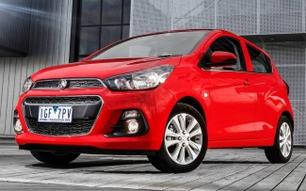
Andrew Chesterton road tests and reviews the updated Holden Spark LT with specs, fuel consumption and verdict.
The micro-car segment in Australia has driven off a cliff. We are shunning our smallest cars in a way we never have before, and nobody seems to be entirely sure why.
The strength of the second-hand market is one suspected culprit, while another is the tempting price point of vehicles that are one size bigger, with city-car shoppers able to upsize for relative peanuts.
Whatever the reason, the segment is stuck in neutral and halfway along Struggle Street. It needs a spark. And Holden's hoping theirs is just the ticket.
Now you might recognise it as a Barina, but Holden dropped that part of the moniker when this new model launched in March. It is now simply known as the Holden Spark, tested here in top-spec LT guise and wearing a sticker price of $18,990. It sits above only the entry-level, bargain-basement LS ($13,990 manual, $15,690 automatic) in the two-model Spark range.
Designed and built in Korea, the Spark seems to have little to do with our unique marketplace, but Holden promises us this new model couldn't be more dinky-di if it ran on vegemite. Australia had crucial input into its design in Korea, while Holden's Aussie engineers put the new model though its paces on the company's proving ground, tweaking the suspension and steering for Australia's road surfaces.
So the question now is, is the Spark bright enough to lure buyers back to the micro-car segment?
This is one of the campers that very finely straddles that line between camper-trailer and caravan. It’s light-weight and simple to use, even if (and mostly because) it lacks the wide-open comforts of a traditional caravan. It’s very capable, well-equipped and very well made.
If you do like to escape the great outdoors occasionally while camping (or someone you dearly love, does), this is well worth a look. It’ll follow you just about anywhere and your camp life will be better for it.
The marvels of local engineering strike again: the Spark LT definitely feels a cut above some of its budget competition from behind the wheel. It is well-equipped, too, and packed with connectivity and technology features. In short, it could be just the spark Australia's city-car segment needs.
The Reconn’s interior is interesting, as unlike most modern caravans, there’s not a lot of free space in here, thanks largely, to the height of the bed. It sits right at the top of the camper, like a second-storey mezzanine. To get in, you have to climb onto the dinette lounge, or use the fold-down step built into the base.
There is also a small dinette and lounge space with a folding table that’s comfortable enough for two to sit at ease and read or eat dinner, but I get the feeling Lifestyle doesn’t expect you to be spending the majority of your time in here – that’s not what this camper is about.
Above the dinette there’s cabinet space, while all the dinette seats lift up to reveal more storage areas. The dinette closest to the door has two drawers in it, to make accessing the storage easy.
If this floorplan isn’t for you, there are three other options. One features a pair of bunks, another an ensuite with shower and toilet. The third packs both the bunks and the ensuite all in, somehow – it’s not an overly large space.
Nope. This is a pocket-sized car, namely because it has the same cargo capacity as your pocket.
Holden has stretched the space between the wheels to maximise passenger space, and as a result there's actually plenty of room in either row. But to add space somewhere, you need to take it from somewhere else, and that somewhere else is the boot, where you'll find a mere 185-litres of luggage space. The situation is improved by dropping the 60:40 split rear seats, but you'll be forever choosing between passengers and luggage.
Front seat passengers share a pair of cupholders, but rear seat passengers get none. They don't get room for bottles in their door pockets. Or door pockets at all, for that matter. The backseat does, however, get two ISOFIX attachment points, one in each window seat.
I towed it behind a RAM 1500 Laramie, which was serious overkill for a trailer of this size and weight, but it did all the right things. Because it has an adjustable air-suspension underneath, its ride is quite compliant and soft and its height can be adjusted to suit the terrain, or even lowered to reduce air resistance.
Off-road, it posed little trouble, although the tracks we did were mild, at worst. It has no shortage of clearance (and can be dialled up further if you are short of it) and is fitted with a Cruisemaster DO35 off-road hitch.
One of its best off-road features, though, is the completely clean underside. There’s actually no plumbing, tanks, wiring or fittings under the floor or exposed to the elements, river crossings, dust or stones. The camper’s two tanks, batteries, pumps, electricals and plumbing are all contained within a compartment under the driver’s-side storage section. There’s even room in there for expansion – it’ll fit another water tank, another batteries and extra electrical gizmos easily.
Holden's Aussie engineering team say they were able to get their hands all over the new Spark pre-launch, launching lap after lap of the company's proving ground as they tweaked the steering and suspension tune to better suit local conditions. And the results are very good.
The 1.4-litre engine doesn't generate a huge amount of power (though it is good for its class), but it's delivered in a way that makes the Spark feel like it's punching well above its weight, rarely feeling underpowered in everyday situations.
There is a certain skittishness to the way it drives at times.
The Aussie magic sprinkled over the suspension and steering transforms the way the Spark LT drives, both in the city and further afield. The ride nudges the firm side of the spectrum (but not enough to bother you over inner-city ruts and bumps) which translates to a low, flat feeling through corners.
All in all, the little Spark more than holds its own on more challenging roads. The steering, too, helps the Spark outshine the regular city commuters, with a naturally engaging set-up that always feels connected to the road below.
There is a certain skittishness to the way it drives at times, though, with the gearbox wanting to continue lurching forward for a split-second after you take your foot off the accelerator, which takes some getting used to.