What's the difference?
If it wasn’t for this review appearing on your screen right now, would you have even remembered the Lexus RC was a thing?
At the time of writing, the RC is actually the fifth most popular model in its sports car segment. Yep, only the two-door versions of the Mercedes-Benz C-Class and E-Class, and BMW 4 Series and Z4 sell better.
So, why is the RC seemingly invisible? But more importantly, does it deserve to be? Let’s test the RC 350 F Sport to find out.
The Audi A4 allroad is the off-roader of the A4 line-up. I’m using the term ‘off-roader’ loosely here because this wagon is obviously best suited to daily duties in a city and suburbs, with perhaps an occasional foray into very light off-roading, i.e. driving on a well-maintained gravel or dirt road with few, if any, corrugations, and in dry weather only.
But that’s not a negative factor because the great thing about adventures is that they can be scaled to suit you, your lifestyle and your vehicle of choice.
However, is this allroad your best option for a comfortable, nice-driving all-rounder? Read on.
If you’re a buyer that thinks with their head, the RC 350 F Sport is the obvious choice when compared to its direct rivals.
After all, it looks great (at least to these eyes), feels luxurious in more ways than one, and is unrivalled when considering value-for-money.
But, if you think with your heart instead, it’s clear it is isn’t on the same level dynamically and therefore doesn’t feel as sporty to drive as its name suggests.
So, don’t let its sports car classification fool you, the RC 350 F Sport is more of a grand tourer, or a comfortable cruiser, to be precise, and an underrated one at that.
The Audi A4 allroad 40 TDI quattro S Tronic is a nice-looking wagon that’s fun to drive.
It’s packed with tech, adequately functional for daily life and it’s also capable enough off-road as long as the driving surface is nothing more challenging than well-maintained gravel or dirt tracks in dry weather, and you’re not planning a rough-and-tumble expedition into remote bushland.
As I mentioned earlier, the great thing about adventures is that you can scale them to suit you and your vehicle and the allroad offers a nice stepping-stone for people who’d like to experience the outdoorsy lifestyle, before perhaps diving deeper into it.
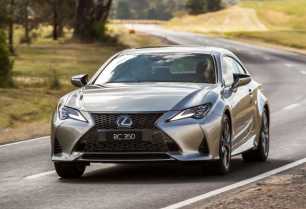
Looking at the RC 350 F Sport, it’s hard to imagine how it became so anonymous on the road, whether you love it or hate it.
Up front, its striking design simply cannot be ignored, with its unique mesh 'Spindle' grille insert demanding attention.
Either side of it are the LED headlights and boomerang-style daytime running lights, which, again, cannot be missed.
Around the side, the RC 350 F Sport has all the hallmarks of a classic coupe, including a swoopy roofline, and looks all the better for it.
The 19-inch alloy wheels wrapped in a mixed set of Bridgestone Potenza tyres are particularly arresting thanks to their sporty 10-spoke design.
That said, the rear end is arguably the RC 350 F Sport’s best angle, at least universally, thanks to its crisp LED tail-lights and chunky bootlid.
The bumper below is also a looker, even with its fake side air intakes, while its diffuser insert is flanked by a pair of chrome exhaust tailpipes.
Inside, the RC 350 F Sport isn’t quite as good, with most of our criticism directed at the 10.3-inch central display, which is powered by an average multimedia system made worse by an incredibly fiddly touchpad controller. The physical shortcut buttons on hand are but small mercies.
Thankfully, Apple CarPlay and Android Auto support is now standard, so a better user interface is literally in your pocket… but you still don’t have a touchscreen to work with.
The RC 350 F Sport’s button-controlled 8.0-inch digital instrument cluster is much better, even if it’s more like a multi-function display due to its limited functionality.
While the centre stack and console designs are undoubtedly showing their age, there’s no doubting this is a premium model thanks to the selection of high-quality materials used throughout the cabin.
In our test vehicle, black leather-accented upholstery with (very cool) 'Tuscan Sun' yellow accents, piping and stitching covers the sports steering wheel, gear selector, sports seats, armrests, door inserts, knee rests and the instrument cluster. So, almost every touch-point.
Pleasingly, soft-touch plastics are used for the upper and middle dashboard as well as the door shoulders, with hard plastics only found on the lower dashboard, door bins and rear seat divider.
As per other Lexus models, the RC 350 F Sport has nice rose-gold accents on its steering wheel, gear selector, front air vents and centre console, while specific Naguri aluminium trim adorns its dashboard and door inserts. And there are also steel pedals.
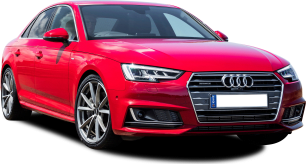
The allroad’s overall look is part of a range-wide refresh and it certainly fits in with the line-up’s updated aesthetic.
Because I’m a bloke who spends the bulk of my time in 4WDs – traditionally bulkier vehicles rather than slim city-friendly wagons – I’m not totally enamoured of the Audi’s style, especially in terms of trip-packing practicality. However, I can certainly appreciate the appeal of its quite low, sleek and streamlined appearance, which its tweaked chunkier grille adds some gravitas to. It’s just not my cup o’ tea.
Hope you’re not expecting the RC350 F Sport to be the first word in practicality, because it’s not.
Measuring 4700mm long (with a 2730mm wheelbase), 1840mm wide and 1395mm tall, the RC350 F Sport is a decently sized coupe, but that doesn’t mean it’s spacious. Hell, it’s hard to get into it the first place, let alone out.
We are of course referencing the token second row, which is cramped at best. In fact, behind my 184cm (6.0ft) driving position, there is no toe-room nor headroom. Yep, if you’re around my height or taller, get used to burying your chin into your chest.
Thankfully, legroom is better but still limited to less than two centimetres, while foot space is compromised by the unusually tall transmission tunnel. And in case you were wondering, even the first row is on the tighter side.
Beyond the central air vents, you’d think rear occupants would be cheered up with cupholders, a fold-down armrest and USB ports at the very least. Well, they don’t get any of that, with a couple of coat hooks the only amenities on offer.
And don’t forget that being a four-seater, there are only two seats in the second row, so this is definitely not a ‘family car.' That said, there are two ISOFIX and two top-tether anchorage points for child seats, so you can theoretically take a couple of younglings with you on a trip.
In-cabin storage options are very limited, with the glove box small in size and mostly taken up by the manual, while the central bin is useable but somewhat occupied by two USB-A ports, a 12V power outlet, and an auxiliary input.
And whatever you do, only bring up to two drinks with you, as beside the pair of cupholders next to the gear selector, there is no other place to officially store extras. Yep, the front door bins are only good for storing very short and narrow items.
The boot is a different story, with a decent 374L of cargo capacity, and it can be expanded by stowing the 60/40 split-fold rear bench, an action that can annoyingly only be performed in-cabin via the manual release latches.
That said, the boot’s tall load lip makes unloading bulkier items a little trickier, while getting them onboard in the first place is complicated by its wide but short aperture. At least there are four tie-down points on hand to secure loose loads?
I’ll answer that question as a politician would – without actually answering the question.
The allroad’s interior looks good and certainly feels open and spacious, although the driver’s seat tends to feel a bit more snug as the dash is angled towards that position.
The new 10.1-inch touchscreen, home for most upfront functions, dominates the dash, in a good way.
The front seats are electrically adjustable with lumbar and driver memory.
There are plenty of places in which to put your everyday bits and pieces (including a decent storage bin/arm-rest), as well as charging points, including two USB ports, for your devices.
Need somewhere to put a cold beverage, mate? There are two cup-holders between driver and front-seat passenger, two in the fold-down centre arm-rest for the back-seat passengers, and bottle holders in all doors.
Back-seat passengers also get air vents, climate control, mesh seat-back pockets and grab handles.
There is a 495-litre cargo space when the rear seats are in use, but that increases to 1495 litres when those seats – 40:20:40 split folding – are stowed away in the floor.
Priced from $78,636 plus on-road costs, the RC 350 F Sport commands $3000 and $8000 premiums over its lower-output RC300 and lower-spec Luxury siblings.
In terms of rivals, the RC 350 F Sport significantly undercuts the best-selling Mercedes-Benz C 300 Coupe ($89,000) but is about on par with the Audi A5 40 TFSI Sport Coupe ($78,900).
Standard equipment not already mentioned in the RC 350 F Sport includes rain-sensing wipers, power-folding side mirrors, satellite navigation with live traffic, digital radio, an 835W Mark Levinson sound system (with 17 speakers), keyless entry and start, dual-zone climate control, power-adjustable front seats with heating and cooling, a power-adjustable steering column and an auto-dimming rearview mirror.
Yep, it’s loaded, which is very good news. What isn’t, though, is its foot-operated park brake. Sure, the RC is six years old, but electric park brakes were well and truly a thing in 2014, so it’s quite an annoying quirk.
The RC 350 F Sport only has two options: a $2500 power-operated sunroof and $1500 premium paintwork, both of which were fitted to our test vehicle, with the latter taking the form of 'Graphite Black.'
The Audi A4 allroad 40 TDI quattro S Tronic has a MSRP of $69,900 (plus on-road costs).
It has a 2.0-litre four-cylinder turbo-diesel engine unit (140kW/400Nm), a seven-speed S tronic automatic transmission, and Audi’s quattro all-wheel drive system.
In standard guise this allroad’s features list includes a new 10.1-inch touchscreen (with Apple CarPlay and Android Auto), DAB+ digital radio, an Audi 10-speaker stereo, wireless charging for Qi-enabled smartphones, Audi’s Virtual Cockpit (a 12.3-inch digital display), smart key with push-button start, leather trim, three-zone climate control, as well as LED headlights, 18-inch alloy wheels, illuminated door sills, and overall tweaked exterior and interior styling.
It also has AEB with pedestrian detect, lane change warning, rear cross-traffic alert, front and rear parking sensors and a reversing camera.
But our test vehicle has a few different features and a fair few extras. Our allroad has a ‘price as tested’ of $75,681 (plus on-road costs), because it has Assistance plus package ($2900), which includes a raft of driver-assist tech, such as adaptive cruise control, active lane assist, collision avoidance assist, high beam assist, head up display, park assist (helps to steer the vehicle into a parallel or perpendicular parking space), as well as a 360-degree-view cameras
It also has 19-inch Audi sport alloy wheels in 10-Y-spoke design ($1350), instead of the standard 18-inch alloy wheels in 5-V-spoke design, and metallic paint (Mahattan grey, $1531).
Note: when we were conducting this test, Audi announced that, among other things, it would release a new-gen A4 allroad quattro 40 TDI in early 2021 that would have an extra 10kW more than our test vehicle, so it’ll be a 150kW/450Nm machine.
For those of you into hot laps, the current-generation achieves 0-100km/h times of 7.9 seconds; the new A4 allroad quattro 40 TDI is claimed to achieve that mark in 7.3 seconds.
Pricing for the upcoming 150kW A4 allroad quattro 40 TDI as standard was set to be $70,700.
The RC 350 is motivated by a lusty 3.5-litre naturally aspirated V6 petrol engine that produces 232kW of power at 6600rpm and 380Nm of torque from 4800-4900rpm.
For reference, the RC 300 uses a 2.0-litre turbo-petrol four-cylinder unit that develops 180kW at 5800rpm and 350Nm from 1650-4400rpm.
Either way, these outputs are exclusively sent to the rear wheels via a well-sorted eight-speed torque converter automatic transmission with paddle-shifters.
This combination helps the RC350 sprint from a standstill to 100km/h in about 6.1 seconds while on the way to its electronically limited top speed of 230km/h.
The Audi A4 all road 40 TDI quattro S Tronic has a 2.0-litre, four-cylinder turbo-diesel engine, producing 140kw at 3800-4200rpm and 400Nm at 1750-3000rpm.
It has a seven-speed S tronic automatic transmission and all wheel drive.
The RC350’s fuel consumption on the combined-cycle test (ADR 81/02) is 9.1 litres per 100 kilometres, while its carbon-dioxide emissions are 212 grams per kilometre, but both claims are a little keen.
In our real-world testing, we averaged 12.2L/100km, which is far cry from the above, given our result came from 180km of driving that was heavily skewed towards highway stints over city traffic.
For reference, the RC 350’s 66L fuel tank takes 95 RON premium petrol at minimum.
It has claimed fuel consumption of 5.2L/100km (combined), but we recorded actual fuel consumption on test of 8.4L/100km – driving in soft sand likely negatively impacted that figure.
It has a 61-litre fuel tank.
The RC350 F Sport is actually pretty good to drive – so long as you understand what it’s about.
Think of it more as a comfortable cruiser than a sports car and you’ll forgive it for some of its shortcomings. Yep, it is that relaxing to drive.
While the F Sport’s suspension (independent double-wishbone front and multi-link rear axles with adaptive dampers) does have a sports tune, it still serves up a comfortable ride on most surfaces.
Naturally you can play with the five drive modes (Eco, Normal, S, S+ and Custom) on hand to increase its stiffness and therefore improve handling, but the difference between soft and ‘hard’ is negligible, so don’t bother.
Either way, the F Sport does have a noticeable habit of picking up sharper road edges, such as nasty potholes, and it's particularly prevalent at the rear. That said, it doesn’t detract from its luxuriousness all that much.
Where the sportiness really comes to the fore, though, is via the F Sport’s electric power steering system, which has a variable ratio.
As well-weighted as this set-up is as standard, you’ll find it hard to forget how sharp it is on turn-in. Among several factors at play, the obvious one is the F Sport’s rear-wheel steering system, which is better executed than most.
This technology turns the front wheels in the opposite direction to the rears at lower speeds but in the same orientation at higher velocities.
The result of the former? A mid-size coupe that feels like it has a short wheelbase, with the improved manoeuvrability especially noticeable in car parks. Conversely, the latter lends itself to greater stability when you need it.
And it’s a good thing it is the way it is, because the RC 350 F Sport has a kerb weight of 1740kg, which is not exactly sports-car light. This heft is a felt when cornering hard, even though body control is pretty strong overall.
Handling performance is also enhanced by the rear Torsen limited-slip differential, which helps improve grip upon corner exit, at which point the RC 350 gets to show off its straight-line abilities.
The V6 engine is buttery-smooth, but you really need to stick the boot in to fully enjoy it, with it only really starting to come alive when engine speeds are above 3000rpm.
That said, it’s easy to appreciate this character trait around town, where the RC 350 is truly unfazed. Take it onto the open road, though, and acceleration is more than pleasing.
The automatic transmission is a great dancing partner here, serving up delightfully smooth gear changes. It’s also surprisingly responsive, perhaps too responsive, as it can be quite fussy in city traffic, shuffling up and down ratios in quick succession.
Biggest gripe, however, is the digitally enhanced sound the RC 350 produces. Sitting inside, the noise being pumped in is satisfying, but you can’t help but acknowledge the aural deception at play.
For a bloke who spends a lot of time in big, tall and bulky 4WDs, I felt like I was driving a go-kart. It’s that low, but it’s also that much fun – and it’s a very different driving experience to what I’m used to.
The allroad is 4762mm long, 1847mm wide and 1430mm high, and has a listed kerb weight of 1720kg. So relative to the 4WDs I usually steer around, this is light and low slung. It’s more car than SUV, that’s for sure.
Acceleration is rather punchy (the engine and auto are a decent match-up), steering is light but precise, and you can cycle through drive modes (efficiency, comfort, auto etc) to set up vehicle characteristics to suit your driving style and conditions.
The quattro all-wheel drive system helps to keep the allroad planted and composed at all times.
Ride is on the sharpish side of firm and you do tend to feel every irregularity in the road surface – it is long and low and on low-profile rubber afterall.
The virtual cockpit plus – a 12.3-inch high-resolution colour display – offers a comprehensive read on all things to do with the allroad.
Throw around your superlative of choice – “sporty” and “dynamic” fit this allroad well – but I’m loathe to gush about its on-road performance much more than that because I reckon if any motoring journos are reading this – many of whom spend the lion’s share of their time swanning about in sports cars – they would have already choke-spat out their dirty chai with surprise by now.
Neither ANCAP nor Euro NCAP have issued a safety rating for the RC range, although the mechanically related IS line-up received the maximum five stars in 2016.
Advanced driver-assist systems in the RC 350 include autonomous emergency braking (with pedestrian detection), lane-keep assist, blind-spot monitoring, rear cross-traffic alert, adaptive cruise control, a (low-resolution) reversing camera and front and rear parking sensors. Yep, the only major thing missing here is steering assist.
Other standard safety equipment includes eight airbags (dual front, side, curtain and knee), anti-lock brakes (ABS), electronic brakeforce distribution (EBD), brake assist (BA) and the usual electronic stability and traction control systems.
The Audi A4 all road 40 TDI quattro S Tronic has the maximum five-star ANCAP safety rating.
It has eight airbags (dual front, front side, side bags front and rear, and curtains front and rear), as well as AEB with pedestrian detection, lane change warning, rear cross-traffic alert, a reversing camera, and front and rear parking sensors.
As with all Lexus models in Australia, the RC 350 comes with a four-year/100,000km warranty and four years of roadside assistance. Both offers are a year behind that of fellow premium brands Mercedes-Benz and Genesis.
The RC 350’s service intervals are every 12 months or 15,000km, whichever comes first. A three-year/45,000km capped-price servicing plan is available, costing $495 per visit, which is not too bad at all.
This Audi has a three-year/unlimited km warranty. Service intervals are recommended every 12 months or 15,000 km, whichever comes first.