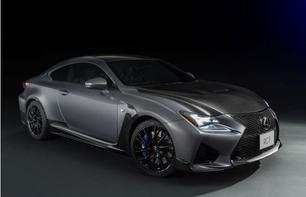
What's the difference?
Ford’s growling Mustang GT isn’t the only rear-wheel drive performance coupe powered by a naturally-aspirated 5.0-litre V8 engine on the Australian new car market.
Pfft! Those things are everywhere. If you’re willing to literally double-down and spend twice the pony car’s circa $65K asking price, the Lexus RC F comes into range; the Japanese luxury brand’s take on a two-door, four-seat, muscle car.
Rather than wrestling with the blue oval, it’s a challenger to the German ‘Big Three’, pitching its deep-breathing, high-revving atmo power against shove-in-back, low-down, turbo-torque.
We spent a week behind the wheel to see how this mature, but recently updated machine, measures up in 2020.
Hybrid campers tread the line between caravan comfort and camper trailer-manoeuvrability and are touted as somewhat of a new thing; almost an evolution of comfort as more people look for a perfect camping experience.
But camper-trailers like the Cub Longreach LE prove that the concept has been around for decades.
It hasn't always been called the Longreach, but this high-walled, super-sized, off-road camper-trailer was one of the first to offer caravan-like comfort and space in a product that'll go anywhere off-road*. (* In terms of reasonable use and having obviously scrutinised your camper's warranty conditions before setting off to make sure you're covered for that sort of usage.)
The 2019 LE takes the comfort levels even further, so we grabbed one for a night to check it out.
There’s so much to like about the Lexus RC F EP3. A glorious atmo V8 soundtrack, sharp dynamics, plus loads of standard features and safety tech in a beautifully engineered four-seat coupe package. It can’t match the turbos for mid-range thump, and if you need practicality look elsewhere, but it’s the type of performance car we’ll be looking back at in years to come as one of the last to proudly hold its head above a rising tide of turbos, hybrids, and electric hot rods.
This isn’t the camper for everyone – my guess is that plenty of people look at this and find it too sparse, too basic. I kinda get it.
But there are very few campers which offer the same amount of open, internal space, or that are as easy to set up.
That the Longreach, albeit with a few different names, has lasted so long on the Cub Campers' product roster is a testament to its versatility and ability to accommodate a small family on off-road camper trips.
It's arguably one of the forerunners of the hybrid camper scene, and it's now starting to evolve with campers' desires for more comfort.
Practicality is unlikely to be high on the priority list for anyone shopping for a car like this, but comfort and convenience certainly will be.
And the RC F delivers just that for its front seat passengers, providing lots of space, as well as numerous storage options, including long door bins with room for smaller bottles, two cupholders in the centre console, a large, lidded storage box/armrest between the seats (housing twin USB-A ports, an aux-in jack, and a 12V socket), as well as a decent glove box.
But that space we were just talking about pretty much evaporates when you move to the back. This is a classic ‘2+2.’ The electric folding and sliding front seats make access okay, however, sitting behind the driver’s seat, set for my 183cm height, headroom is tragic, legroom is tight, and toe room is bad.
So, let’s assume it’s a kids-only area, and once ensconced back there, they’ll appreciate a fold down centre armrest, two cupholders between the seats (with a roll-top cover), and adjustable air vents. But there isn’t a USB point in sight which may lead to friction when devices lose charge, or a plug-in negotiation with front-seaters.
Lexus claims a modest boot volume of 366 litres (VDA) and it’s important to note that although there’s a ‘ski-port’ door to accommodate lengthy things (like skis?) the rear seats don't fold down. So, flexibility is limited, although there are tie-down hooks at each corner of the floor to help secure tricky loads.
The Lexus RC F is a no-tow zone, and don’t bother looking for a spare of any description, a repair/inflator kit is your only immediate option. Good thing roadside assistance is included in the warranty package.
For a rear-fold camper-trailer, the space inside couldn't be more practical. The long body and high sides mean that when the camper is open and set up, it has a lot more space than most. Behind the bed, for instance, there is enough space for Cub to have fit a small dinette.
The dinette has cushioned benches for two and a swivel table that can also become a counter over the rear floor area.
The camper's length also means that the rear floor area is massive. It is easily big enough to lie a couple of kids on, or if your nest is empty, to set up some camp chairs and a table to enjoy a covered living area.
It is still a rear-fold camper-trailer, though so, despite the fact it has nearly twice the space of other hybrid-style campers, it's very sparsely furnished. There's no internal kitchenette or anything like that.
A performance car should excite the senses, but the RC-F leans on one a little harder than the rest… hearing.
With the addition of launch control in last year’s update the big V8 will reliably slingshot you from 0-100km/h in just 4.5sec, which is no mucking around quick. But it’s the combination of raucous induction noise, furious mechanical roar, and bellowing titanium exhaust that add extra drama to the experience.
Fact is though, while maximum torque of 530Nm is not to be sneezed at, that number is only available from 4800-5600rpm. Although the RCF starts to get into its stride at about 3000rpm, the twin-turbo BMW M2 CS smashes it for mid-range punch with its 550Nm on tap from just 2350rpm.
So, in everyday, even mildly enthusiastic driving, the RC F sounds amazing, and don’t get me wrong, this is a proper performance car, but it doesn’t have the low-down, kick-in-the-pants grunt of its turbocharged six and eight cylinder competitors.
Linear power delivery, and the crisp throttle response only a naturally aspirated engine can deliver go some way to evening things up, however, and there are multiple systems to help tune the drive experience to your exact preference.
‘Drive Mode Select’ offers five settings (Eco, Normal, Sport S, Sport S+, and Custom).
Eco lowers engine output, dampens the throttle, and dulls the air-con in the name of fuel efficiency and reduced emissions. But you’re not buying this car to save the planet, so don’t touch that button, Sport S is the sweet spot (and save Sport S+ for track days).
Quick gearshifts from the eight-speed auto (particularly using the wheel-mounted paddles), that rapid throttle response, and nice steering feel work seamlessly together to deliver a satisfying backroad experience. Sport S holds gears longer on the way up the ratios, and is quicker to shift on the way back down.
In a more civilised mode, with eight gears to play with, freeway cruising is relaxed, especially given the top two ratios are overdriven.
The ‘Adaptive Variable Suspension’ offers Normal and Sport S modes, and here normal is the go. The basic set-up is double wishbone front, multi-link rear, and Lexus says the SACHS-developed AVS shocks can adjust damping force across a range of 30 levels. But even in the default Normal setting the ride is firm.
According to Lexus, the standard Michelin Pilot Sport 4S tyres (255/35 fr / 275/35 rr) have been tailored specifically to the RC F and they grip hard, keeping the 1715kg coupe planted in quick corners. But their narrow profile no doubt contributes to the car’s less than limo-like feel around town.
Then the ‘Vehicle Dynamic Integrated Management’ system fine tunes the car’s stability control in Sport S+ and Expert modes. Expert only happens when you’re in Sport S+ and turn the stability control off. So again, best to go full racer at the circuit, and we didn’t explore VDIM this time around.
The electrically-assisted steering is not only accurate (the strength of the steering rack bushing has been increased by 150 per cent to boost response), but the wheel itself feels great, and the huge (380mm) Brembo carbon ceramic brakes are mega (working well from cold unlike some other carbon set-ups).
Under the heading of notable mentions, the digital instrument cluster is inspired by the V10-powered Lexus LFA supercar, switching between a blue economy indicator ring in Eco mode, a standard tachometer and digital speedometer in Normal, a white and red cluster in Sport S, and orange in SPORT S+ (with three-stage upshift indicator lights).
Plus, you can also switch between racy functions such as a lap timer and G-force display, and soft-trim knee pads on the sides of the front centre console improve comfort and seating stability if you’re having a crack.
Cub Campers are famously good to tow, and even the largest of them lives up to the reputation.
As big as it is, the Longreach LE is quite light thanks to the effort Cub puts into engineering. As a result, it's not a strain, even for older dual-cabs like the D22 Navara.
And because it isn't any higher or wider than a modern SUV, there was very little wind-drag or buffeting as we cruised along the highway.
Cub developed the camper's Australian-made and -designed independent, coil-spring suspension and the set-up yields excellent ride in any conditions.
For the LE, Cub has added an extra shock-absorber each side to improve its performance even on the most corrugated roads.
An AL-KO off-road ball hitch is standard but can be upgraded to the Click-Lock version if you'd prefer that or need a more low-profile hitch.
In reverse, the long drawbar makes it an easy camper to manoeuvre around a campsite, plus it has enough size that the tow-vehicle driver never really loses sight of it while positioning it.