What's the difference?
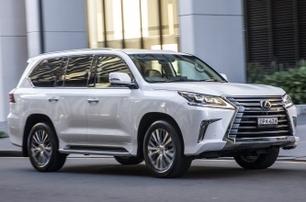
The price of fuel probably doesn't feature too highly on a 'Things to Worry About' list for people who can afford a luxury SUV. If you're spending more than $130,000 on a vehicle then, chances are, you glide on through service station forecourts with nary a concern about the cost of go-juice, but nevertheless Lexus has introduced its diesel-sipping LX 450d to the ever-growing arena of upmarket wagons. It has a claimed fuel consumption of 9.5L/100km – using just under five litres per 100km less than the eight-seater LX 570, its petrol stablemate.
But does this five-seater up-scale offering deliver much in the way of anything different to any other pricey people-mover, other than the fact it's an oil-burner? Read on.
Never talk to strangers. That's (hopefully) what your parents taught you. Luckily some people ignored that good advice when it came to the Toyota Granvia VX people mover and me.
As you'll see in the video above, I tested it on the public – people I didn't know from a cake of soap or whatever the saying is. Seriously, I drove a bus route and somehow talked people into not getting on their regular bus and letting me give them a lift to wherever they were going instead.
I don't often conduct social experiments like this, but I figured the Granvia VX was different. First, here was a new-generation people mover based on the Toyota HiAce that effectively replaces the long-serving Toyota Tarago. Second, it's different from the Tarago and rivals such as the Kia Carnival and Hyundai iMax in that it seems like it's purpose in life could be more of a hire car 'shuttle bus' as it is for a Mercedes-Benz Valente.
So, either way its job is to carry more than one person nearly all the time and that's what I did. You can watch the video above and below is the full review taking into account how I found the Granvia VX to drive, along with its practicality when it comes to cargo capacity, fuel economy and passenger comfort.
If you're in the market for the best-of-the-best SUV wagon, then you could do a lot of worse than get in a LX 450d. It looks good, is packed with standard features and is supremely comfortable. The 450d also has an suite of safety tech worthy of the hefty price-tag and it works well as a daily driver and has plenty of touring potential, even though we doubt it'll ever get anywhere near achieving those claimed fuel-consumption figures with real-world usage. Sure, you could instead climb in a second-hand, well-looked-after, never-been-off-road LandCruiser 200 Series and spend the money you save, by not buying this new Lexus, on aftermarket and camping gear, camping fees and also hiring a team of four people to follow you on mopeds everywhere and constantly tell you what a great driver you are – but that's not the point with vehicles of this ilk. They may not be aimed at hard-core off-roading buyers, but they are cushy, classy, and cityified – and, in that respect, they're incredibly well-built for purpose.
The Granvia VX is great at being plush, comfortable and easy to drive, but it's not as practical as a people mover should be. And while the engine provides a great driving experience, you'll be filling up the tank often if your trips are mainly urban and city focused.
It has that signature Lexus jagged space-age grille, chunky shoulders and beefy back end that suit a luxury SUV dreamed up by folks craving a significant presence and plenty of attention for their product.
Bulky side-steps, an upswept raked profile, scalloped side panels and moon roof all top what is a cool combination of eye-friendly design factors. It's a slick mix of low-level cool and high-end style.
Take a look for yourself and make up your own mind whether you like it or not.
The Granvia is a new-generation people mover based on the Toyota HiAce commercial van and arrived in Australia in 2019. The resemblance to the HiAce is obvious although dressed up in its Granvia clothes it's a handsome and professional looking little bus.
I'm a fan of the protruding nose (which helped it earn the five-star ANCAP rating, see more on safety below) and I even like its big, shiny Transformer face and the 'L-shaped' tail-lights which aren't to everybody's taste.
Also, when I say little bus that's only in comparison to actual buses, like the one I convinced people not to get on in my video. Compared to a seven-seater SUV such as the Kia Sorento or Toyota Kluger, the Granvia is enormous.
Look at the dimensions. The Granvia is 5300mm long, 1990mm tall (not counting the aerial) and 1970mm wide, not counting the wing mirrors (which can be folded in).
While the length was hardly ever a problem for me while driving it over the week, the height saw me just make it under the 2.0m clearance in our underground carpark and I had to fold the aerial down to do it. Beware, many carparks have a max headroom of just 1.9m.
The cabin of the VX is impressively plush from the quilted leather reclining second-row seats to the 'woodgrain-look' trim throughout.
During my test I played bus driver to a number of passengers (no, seriously I picked up random strangers off the side of the road – see the video) and all were impressed by the Granvia's premium-feeling interior.
It certainly feels like Lexus designers and engineers have maximised every last millimetre of interior space; there is stacks of room inside with plenty of real-world usable storage spaces, including cup-holders, door pockets and spots for keys, phones and other stuff.
The heated steering wheel, stylish analogue clock, wireless charger, Lexus climate concierge (coordinating all four-zone temperature controls), cavernous centre-console cooler box, and rear-seat entertainment system are all nice touches but pretty much assumed at price-points lower than this one.
The 12.3-inch high-definition media touchscreen is clear and bright and easy to operate, but the Remote Touch Interface, the control near the shifter, is very annoying to use. The toggle/selector is too sensitive, skipping past your actual choice over and over again, while you try to manipulate it just so, so it lands on the option you wanted.
The second-row seating is plush and the seat sections are easily slid forward and tilted.
Lexus claims the 450d offers 909 litres of cargo space if there are five occupants; and 1431 litres if there are only two occupants. If you have some casual weekend touring in mind, with a spot of camping, then this Lexus should cope with your gear, no worries.
The Granvia VX tested was an eight-seater (four rows of two seats) and being so tall and long would mean the space inside is going to be good, right? Nup. The Granvia doesn't seem to make the best use of its enormous cabin.
Seating, while undeniably comfortable and luxurious in the second and third rows, doesn't offer great legroom when you have a full load of people on board. I could only just sit behind my driving position in the second row and then behind that in the third row, but there was no way I could then fit in the fourth row.
And while cabin storage is great with the biggest centre console bin I've ever seen – I could fit my head in it (see the video) – and there are 10 cupholders, six coat hooks and a folding table, there isn't a boot or any room for cargo, not in the eight-seater (with all seats in use) I tested anyway. With all four rows in place there is only enough room for a few items no wider than a box of cereal (watch the video, to see what I mean).
Folding up the base on the fourth row seats means they can slide forward and that does free up a little bit of space for cargo, but if you are only going to be using the Granvia for six people, then my advice is to go with the six-seater and have a big boot at your disposal all of the time.
The Granvia VX is outfitted well with charging points – there are seven USB ports all the way back to the third row and two 12-volt outlets.
We'll get to what the Granvia is like to drive in a moment, but what I can say here is that the driver and passengers sit high, like looking-down-on-four-wheel-drive-utes high.
Access into the front seats is a bit of a climb up and proved tricky for my 75-year-old Dad with his gammy knee, but entry into the second-row seats was easy thanks to a wide step and a large aperture.
The small table between the second-row seats blocks the aisle, so the only way to get to the third row is by sliding the second row forward. Fourth row access is more difficult but compared to entry into the back row of most seven-seater SUVs it's a breeze.
Price as tested on our five-seat LX 450d is $136,000. The base RRP is $134,500 and our Lexus had premium paint (Sonic Quartz), which adds $1500; no other options were fitted.
It is absolutely packed to the rafters with high-quality stuff, which is no surprise really because, at this price, you’d expect nothing less. Standard features include a 12.3-inch high-definition screen with nine-speaker, seven-channel audio system (with “digital sound processing”), satellite navigation, and four-zone climate control air-conditioning with climate concierge function and nanoe technology (claimed to purify the air and moisturise hair and skin, according to Lexus). It also has heated front seats, leather-accented trim, a wireless phone charger, cool box, rear-door sunshades, 20-inch alloy wheels with 285/50R tyres, tyre-pressure warning, LED headlamps, daytime running lamps and sequential turn signals.
There are seven exterior colours and two leather-accented interiors from which to choose.
The LX 450d does not have any enhancement packs.
We tested the Toyota Granvia VX eight-seater which lists for $74,990, before on-road costs, and sits at the top of the range. That said, there are only two grades in the line-up – the entry point known simply as Granvia which comes in six- ($62,990) and eight-seat ($64,990) versions and the Granvia VX which also comes in those two seating configurations and costs the same for both.
Standard features on the VX eight-seater include LED head and tail-lights, proximity unlocking, auto sliding side doors, power retractable heated wing mirrors, 17-inch alloy wheels, sun shades for all rear side windows, a 7.0-inch touchscreen with sat nav, Apple CarPlay and Android Auto, and a 12-speaker Pioneer stereo.
A special shout-out goes to the seating. Coming standard are quilted leather seats for the first, second and third rows, while the rear (fourth row) is a vinyl bench seat with a 60/40 split.
The second row consists of power adjustable ottoman style recliners - think business class airline seats, while the third row is a pair of manually adjustable captain's chairs, similar to the front seats which are power adjustable. My passengers loved the second-row seats. One even said, "I've never flown business class by I feel like I have now."
Is it good value? Well, not really. See $75K is a lot to spend on a Toyota people mover, especially considering the Tarago (which has been axed and effectively replaced by the Granvia) at its priciest is $65,261.
The top-of-the-range Kia Carnival Platinum lists for $62,790 and a Hyundai iMax Elite is even cheaper at $48,490. But the Granvia is a more premium offering, up there with the likes of the Volkswagen Multivan Highline for $79,890 or Mercedes-Benz Valente for $59,850
The Lexus LX 450d has the LandCruiser's 4.5-litre twin-turbo direct-injection V8 engine, producing 200kW@3600rpm and 650Nm@1600-2800rpm. All of that power and torque arrives evenly and smoothly, helped no end by a slick six-speed sequential-shift transmission.
It has a full-time 4WD system, dual-range transfer case and off-road tech that includes multi-terrain anti-skid brakes, crawl control and a four-camera multi-terrain monitoring system with back guide and panoramic view.
The Granvia has a 2.8-litre four-cylinder turbo-diesel engine – the same one found in the Toyota HiAce van and with 130kW/450Nm I found there was more than enough grunt to handle city duties or overtaking on motorways.
Equipped with a diesel particulate filter there's a burn-off switch located near the driver's right knee. The Granvia will tell you when it's time to activate the burn-off function.
The 2.8-litre diesel is fairly quiet and responsive while the six-speed automatic shifts smoothly. There's not much to complain about in terms of the usability of the engine and transmission, they performed well – it's just that with it having to carry around a vehicle weighing nearly 2.7 tonnes fuel economy was never going to be great (you can read about this below).
Lexus claims the LX 450d will achieve a 9.5L/100km figure from combined-cycle driving (that's 4.9L/100km more frugal than the LX 570 is capable of). Lexus reckons, based on that figure, that the diesel LX has a potential range of almost 1000km on a full tank (93 litres) of fuel.
We recorded 12.7L/100km during daily driving (city and suburbs) and 13.5L/100km with some light off-roading thrown into the drive mix.
The specifications given by Toyota give the Granvia's combined fuel consumption as 8.0L/100km from the 2.8-litre four-cylinder turbo-diesel.
That sounds fantastic, but in reality after a combination of motorways and urban use the trip computer was reporting 12.9L/100km. A separate fuel test (carried out by myself) saw the Granvia use 21.4L over 127km of city and urban driving (measured at the fuel pump), which comes to 16.8L/100km.
That sounds like a lot, but it makes sense when you consider how heavy the Granvia is. It's 2660kg without anybody on board! If you're carrying eight people weighing 60kg your total mass is tipping the scales at 3140kg and your fuel economy is going to be significantly higher again. The GVM, by the way, is 3500kg.
Really, the Granvia is the perfect argument for a hybrid powertrain, because tour operators or parents ferrying their family around the city are going to want better fuel economy.
It’s supremely comfortable and very quiet, wth that customary cocoon-like enclosed sensation that you only ever truly get in a vehicle this far away from cheap.
The 450d is 5080mm long, 1980mm wide and 1865mm high. It has a 11.8m turning circle. It has an official kerb weight listed as between 2510kg and 2740kg.
For something with so many kegs onboard, it’s capable of punching off the mark with a respectable bit of pace; handy for city-street bursts to slip through traffic gaps.
It never feels cumbersome; it actually feels quite light on its toes. In fact this Lexus tends to be more than a little bit floaty at times. You can select different suspension settings – comfort, normal or sport – to suit your preference.
Visibility is generous all-round with clear sightlines in all directions; besides, the reversing monitor with 360-degree view helps if your views are hindered.
Steering is generally active but it does exhibit quite a lot of under-steer on twisting country roads. It has paddle-shifters if you’re that inclined.
The LX 450d rides on 20-inch alloys and 20-inch Dunlop Grandtrak PT2As (285/50F20 112V) – a combination which is fine for bitumen-based outings, but we’d ditch it for rubber with more sidewall to allow for greater freedom to adjust tyre pressures to suit rough terrain.
For a 5.3m long, 2.0m tall box on wheels the Granvia sure is easy to drive. I live in Sydney's Inner West (get your chai latte jokes out of the way now, please) and drove it daily through horrendous traffic on potholed roads, navigated through the tiniest streets and squashy car parks, went fishing in it and ate up motorway kays on the weekends.
There are going to be people who snort at that eight of 10, but I'm telling you it's down to three things: comfort, ease and engine.
The seats were comfortable and supportive (my passengers felt the same way – again see the video of me being a bus driver), the ride is composed thanks to the suspension and no doubt the weight and the wheelbase of the Granvia.
The visibility is excellent thanks to those giant windows, the ride height and tech such as that digital rear view mirror, while the steering is light, and the turning circle is excellent at 11.0m.
Finally, that 2.8-litre turbo-diesel engine. Yes, it's thirsty but from a driving perspective only it's great – smooth and responsive.
Often vans are prone to a booming sound reverberating around the cabin and the Granvia VX was also a victim of this phenomenon with road noise echoing around inside. It's not bad and I could still hear people in the second and third rows, however.
The LX 450d has a five-star ANCAP rating. It has the latest-generation Lexus pre-collision safety system with pedestrian detection, and 10 airbags. Other standard safety gear includes radar active cruise control, lane-departure warning, adaptive high-beam system, blind-spot monitor and rear cross-traffic alert, as well as clearance and back sonar, and reversing monitor with 360-degree view.
The Granvia scored the maximum five-star ANCAP rating when it was tested in 2019. The amount of standard safety equipment is outstanding, particularly for a van with commercial origins.
Coming standard are nine airbags including ones which go all the way back to cover the fourth row and for child seats there are four ISOFIX points (second and third rows) and four top tether points (second and third rows).
The level of advanced safety equipment is also outstanding. Coming standard is Toyota's 'Safety Sense' pack which brings AEB with cyclist and pedestrian detection, lane departure alert with steering assistance, road sign recognition, auto high beam and active cruise control.
A full-sized spare wheel is located under the Granvia VX.
Warranty is 4 yrs/100,000km. Service intervals with indicative pricing (exc GST) are: six months/10,000km: complimentary; 12 months/20,000km: $535.56; 18 months/30,000km: $598.11; 24 months/40,000km: $800.32; 30 months/50,000km: $502.44; 36 months/60,000km: $676.23.
The Granvia is covered by Toyota's five-year, unlimited kilometre warranty. Servicing is recommended by Toyota at six-month/10,000km intervals with capped price servicing of $240 per service for three years or 60,000km.