What's the difference?
Peter Anderson road tests and reviews the new Lexus IS200t F Sport with specs, fuel consumption and verdict.
Long ago, the Lexus IS overtook the LS as the most recognisable Lexus on the road. With strong, angular styling, sharp pricing and spec against the Germans, and a 2.0-litre straight six engine, it seems like Lexus sold a million of them and only one of them has broken down irretrievably and is now being used to prop up the Harbour Bridge, such was its solid build quality.
Hell, Lexus was even able to hide for a while that it was a rebadged Japanese Toyota Altezza, partly because Toyota didn't do funky rear-wheel drive sedans outside of Japan. The IS took the brand into many more homes than the ES or GS could ever hope to because it looked like it was a Lexus.
We're now three generations and one facelift into the IS and the big selling IS250 is no more, replaced some time ago by a 2.0-litre turbo four and renamed IS200t. You can now get an F Sport version, too, just like you can buy an Audi with S Line or a BMW with M Sport.
That turbo engine hopefully addresses one of the problems with the entry-level IS sedan - it was always a little on the slow side...
When it comes to choosing a family car, sedans are often overlooked for their long-legged wagon or beefy SUV cousins.
They're a bit of a forgotten hero but they'll always hold a piece of my heart for their practicality and (often) sexier kerb-side appeal.
If you can get used to your body cracking like a glow stick when you get in and out of them, the sedan may make a comeback!
The new Mercedes-Benz C-Class, in entry-level C200 form, has definitely tempted my family to consider a sedan in the future – it looks stately and refined but the driving experience also makes it fun.
Let's see what else it did right and if there was anything that could be improved.
Did I mention, I'm fond of sedans... ?
The Lexus range comes with a four year/100,000km warranty with roadside assist for the duration. Servicing is every 15,000km or twelve months, whichever comes first.
Sadly, there's no fixed or capped-price servicing regime, not even a pre-pay option like the stingy Germans. Lexus will only commit to indicative pricing, although the first service at 15,000km is priced keenly - it's free.
When you buy a Lexus, they don't like to let go of you. My father-in-law's original IS 200 is still fetched by the dealership - should he so desire - for its annual service. If he chooses to darken the dealership door himself, he'll drive out in a loan car. Nobody has ever stalked him at the dealership demanding he consider a new one.
The IS200t seems the pick of the IS bunch, despite pricing on par with a couple of the IS350s. It's a worthy alternative to the usual suspects, with its own look, feel and approach to luxury motoring. In fact, it's far more a luxury car than sports sedan, but manages to do both well. In the end, a BMW will edge it for handling and overall chassis grace, the Merc has that badge and the Audi is all-wheel drive and bang-up-to-date.
But none of them can touch the Lexus for after-sales service nor are any of them quite as well put together as the Japanese-built IS. It may not be as fast or as fun, but it's very, very good.
The Mercedes-Benz C-Class C200 is such a stylish sedan and I would totally have one. The driving performance, luxurious features and practical size made it a winning combo for my family. The price point is definitely up there but you do get a high-end build for the cash. I've seen bigger boots in other sedans and not being able to fit a third child seat will limit some families, but this still easily earns an 8.5/10 from me.
My son really loved this one. The ambient lighting was the highlight for him and he thought it looked like a "space car" inside. He gave it a 9/10.
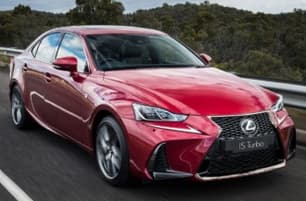
The current IS is by far the most distinctive of the three generations. With a couple of exceptions, it is a terrific looking car. It looks long and low slung, like the best sporting sedans, with an almost Maserati-like approach to its proportions. The loud and proud Lexus spindle grille - the object of such derision when it first arrived - looks utterly fantastic and draws attention away from the odd, squished headlights.
it is one of most comfortable cars you can buy, for both front and (short) rear seat passengers.
Inside is less impressive, with a weird stacked dash and integrated screen. The materials are top notch, however and while the designers have tried to do something interesting with the dash design, there are better ideas out there they might want to consider next time around.
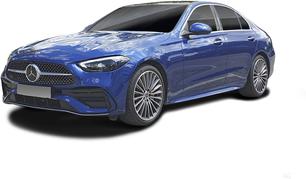
The C200 is a sleek and elegant steed.
Initially, you may think this is just a standard Merc showcase. There's the nice big badge on the pronounced nose. Beautiful sleek lines in the body... but it's the attention to detail that make this feel special.
There's a repeated badge motif in the grille and a cute cursive Mercedes logo tucked into the corner of the windscreen. The puddle lights on the doors project the badge at night time and you can often spot a badge etched into the LED lights.
However, it's the interior that's the highlight for me and I feel like it's a big step up from previous models I've been in.
Our model has the grey 'Artico' synthetic leather trim (says grey but it's really white) and a lovely mix of piano black and shiny chrome inserts that are set against soft touchpoints throughout.
The quality of the build oozes through every stitch and join. Don't even get me started on the cool customisable ambient lighting system inside, which makes this feel like you're on the set of Tron and really elevates the interior.
It's quite fun to build one of these in Mercedes' online configurator. You can customise your trims to make it feel like your own and their blue paintwork options are great (I do love a blue car).
The IS's cabin is probably the weakest point of the car, with limited storage for your bits and bobs. Front and rear seat passengers do get cupholders for a total of four, but the rear doors don't have bottle holders, limiting you to the two upfront.
On hot days like Sydney's 2017 summer, those cooled seats are heaven-sent.
The centre console bin is small and is the only place for your phone apart from the cupholders, which isn't an ideal spot, let's face it. The boot is a German-matching 480 litres and you can split fold the seats for more room.
Having said that, it is one of most comfortable cars you can buy, for both front and (short) rear seat passengers. The front seats are especially good and on hot days like Sydney's 2017 summer, those cooled seats are heaven-sent.
I'm not going to lie – there are sedans out there that have an almost limo-like space inside but the C200 isn't one of them.
It's not small by any means and all occupants enjoy the comforts of decent legroom and headroom but it's not cavernous considering the specs (1437mm high/1820mm wide/4751mm long).
The optional panoramic sunroof does cut into the headroom for back seat passengers, which is something to consider if your family is very tall.
The storage is maybe a tad leaner-than-average for a car of this size. The glove box and middle console aren't massive but will suffice.
The cupholders up front can be removed if you need extra storage space for larger items and back seat passengers enjoy retractable cupholders in the armrest.
The way the front doors curve out creates a larger than normal storage bin and drink bottle holder – which help make up the difference. There is a dedicated phone pocket, to tuck it out of the way.
The boot space is 455 litres (VDA), which isn't as large as some others on the market but it was plenty big enough for my family's needs.
There's a handy under-floor storage pocket for smaller items, like the puncture repair kit, because you don't get a spare tyre in this.
When it comes to ease of use, my six-year-old loved not needing my help to get into his seat and he still enjoyed a decent view out of the wide back window.
The amenities in each row are good but not class-defining. Still, creature comforts have be well-thought through.
Front occupants enjoy heated seats and fantastic lumbar and under thigh support. Dual-zone climate control sorts out the temp, and the cool circular air vents that make loud audible 'clicks' when manoeuvred give the interior a jet cockpit vibe.
While I've never had an issue opening or closing a sedan boot, the powered lid was a nice feature to have this week.
The tech throughout is great and intuitive to use. The massive 11.9-inch touchscreen multimedia system is cool and is easy to use once you become acclimatised to Mercedes system.
The customisable digital instrument panel makes the driving experiences feel individualised.
The interior is a chilled out space with gentle scrolling touchpads taking the place of most 'push' buttons and dials.
Think of each surface as being a bit like a touchscreen tablet in how you operate it. I was a little worried the touchpads would be laggy but they're very responsive.
There's only one USB port in the whole car, which limits charging for other passengers but I did enjoy the easy connectivity of the wireless Apple CarPlay.
The electric heated front seats are a nice touch but I was amused by the 'kinetic' function on both. It's what you might call a 'massage' function on another car but here they don't really work. It's best to think of them as a way to do some (very) gentle stretching on a long trip.
The 360-degree camera view is super clear and crisp but the dynamic guidelines (which tilt the camera angle) are a bit too dynamic for my liking and I relied mostly on the bird's eye view to park.
As I've mentioned, the ambient lighting system creates a stellar atmosphere inside. I've often wondered why other car manufacturers haven't jumped on that bandwagon because it's a relatively cheap way of creating wow factor. And it generates massive wow factor in here.
The IS range kicks off with the 200t Luxury at $59,340, closely followed by the hybrid 300h, the V6-powered 350 ($65,390) and then the $73,540 200t F Sport. Pricing then heads up into the mid-$80,000s for the IS350 Sports Luxury.
The 200t F Sport's almost $74,000 price tag fetches you a car with 18-inch alloys, dual-zone climate control, reversing camera, front and rear parking sensors, a hefty safety package, electronic dampers, auto LED headlights, auto wipers, electric heated and cooled front seats, digital instruments, sat nav, keyless entry and start, leather (some real, some not) interior, variable ratio steering rack and power everything.
The 10-speaker stereo is Mark Levinson branded and is controlled by Lexus' own connectivity and sat nav suite. The sound is fantastic, the control system less so. Commands come from a few shortcut buttons (good) and weird mouse-type arrangement on the centre console that is largely infuriating. The less said about the on-screen graphics, the better - they're low-res and on occasions, amateurish. You can connect via USB or Bluetooth but the app integration is limited. You also get an at-first unfathomable DAB+ radio.
Once on boost, the engine is smooth with a lovely flat torque curve.
Options are limited to $1500 for premium paint, which makes up eight out of ten colours.
Out of interest, $74,000 gets you a reasonably well equipped BMW 330i M Sport or Luxury Line and a few hundred dollars more will get you into a hybrid 330e M Sport. Audi will cheerfully sell you a loaded-up A4 quattro 2.0 TFSI and Mercedes might be tempted to sell you a C350e. Infiniti will probably throw themselves at you with a V6 twin-turbo Q50 Red Sport rocketship, or at the very least a V6 Hybrid Premium.
Herein lies the rub. There are four models for the C-Class sedan and ours is at the bottom of the pack.
But don't let its position fool you in thinking it'll be cheap because this model starts at $78,900... and that's before you start adding the option packs.
Our model is fitted with the 'Vision Package' which adds a host of features – like a panoramic sunroof, head-up display and heated front seats, to name just a few. This adds about $3000 to the price tag.
This also has the optional 'Sport Package' which adds 19-inch AMG alloy wheels and rear privacy glass, among other things, for an extra $1300.
Unfortunately, even without all of those options, this is still one of the most expensive 'entry-level' sedans in the luxury class!
The 200t denotes a 2.0-litre turbocharged four-cylinder under that long bonnet, delivering 180kW and 350Nm to the rear wheels via an eight-speed automatic transmission. This translates to seven seconds dead to 100km/h for the 1680kg sedan, which isn't hanging around.
The C200 has a 1.5-litre, four-cylinder, turbo-petrol engine with an integrated starter-generator.
What's that, you ask? So, glad you did. It's basically an electric battery that also acts as your starter... or alternator.
It smooths out vibrations from the engine and generates some power from braking. Making this a very mild hybrid. Note the 'mild'.
Is it powerful? Surprisingly, yeah. It has a maximum output of 165kW and 300Nm of torque. Combine that with the starter-generator and we have a powerful little engine that can push the C200 from 0-100km in 7.3 seconds, while still feeling like there's power in reserve.
The nine-speed auto transmission is damn smooth and there's no clunky gear changing at any speed. It's got great pick-up, too, for when you need to overtake or zip across traffic.
Try as we might - and we did - we couldn't get at all close to the claimed combined fuel figure of 7.5L/100km. We didn't even hit the standard plus 30%, but we did get 12.2L/100km. That's a fairly solid miss.
The official combined cycle fuel figure is 6.9L/100km. Real world testing saw my figure at 7.2L, which was awesome for the heavy driving I did this week on a combo of urban and open-roads.
The light regen braking probably helps this coast comfortably into being a very efficient sedan for its size.
Minimum fuel requirement is 95 RON premium unleaded and you'll need 66 litres of it to fill the tank.
Driving range using the official consumption figure is around 950km, and 915km using our real-world number.
After having the good fortune to step out of the IS350 and into the 200t, it was immediately apparent that the 200 is the better car. For a start, it feels so much more nimble. Sure, it doesn't have the seamless urge of that silky V6, but the 2.0 turbo does a fine impression of a bigger engine. Once on boost, the engine is smooth with a lovely flat torque curve. If you're off boost, though, you're in a bit of trouble - the eight-speed is reluctant to downshift and needed prodding from the steering wheel mounted paddles on occasion.
As with just about every Lexus, the ride is impeccable and refinement virtually unmatched in the class.
From a driving point of view, the fundamentals are better - less weight over the front wheels meaning the steering feels better, it turns in better and it moves more fluidly, which is impressive because the 350 isn't a slouch. Even the dashboard is better. The 350 has a traditional two clock arrangement where the 200t has a single dial in the middle that is digitally remastered. Press a button and it slides to the side to provide extra info on your choice of the available data. It leaves a fair amount of black space but it's easier to read and doesn't suffer as badly from reflections.
As with just about every Lexus, the ride is impeccable and refinement virtually unmatched in the class. There's something about the way a Lexus knocks the edge of all but the biggest bumps, sails over speed bumps and handles imperfections that is hard to beat and hard to find unless you're spending really big bucks. The adaptive damping never feels like it's doing anything which is exactly the point - even when switching to Sport+, there's an ease to the ride without it feeling loose.
You'll barely know the engine is there, and the way the transmission slurs around the gears means non-stop serenity.
The steering feels solid and concise. The tyres seem like they're glued to the road, making winding roads downright fun to tackle. Oh, and the sharp 11 metre turning circle is wonderful.
The handling makes this your best friend in a car park. The lower ground clearance did elicit some unladylike grunts when I parked on a hill, but otherwise the wide door apertures makes it easy to get in and out of.
The only thing I would note is the low-profile ground clearance. Just be aware of your speed and angle when you handle car park ramps or road bumps in this. They are not your friends.
Standard safety kit includes eight airbags (including knee bags for front seat occupants), ABS, stability and traction controls, blind spot sensor, lane departure warning, rear cross traffic alert, brake assist and driver attention detection.
The IS scored the maximum available five ANCAP stars when it was re-tested in October 2016.
The safety sheet is well-stocked and has the usual suspects you want in a family car, like: AEB with car, pedestrian, cyclist and junction turning assist (effective speed 7.0-90km/h); forward and back-over collision warning, lane keeping assist, lane departure warning and emergency lane keeping assist, as well as, blind-spot monitoring.
I quite like the 'Active Distance Assist' which helps to automatically slow your vehicle speed to keep a set distance to the car in front in stop-start traffic.
Perfect for those busy city commutes. And if you're not confident on parking, this also has a 'Park Assist' feature.
It's nice to see that this has nine airbags, which include a driver's knee airbag and the newer front centre airbag.
This has a maximum five-star ANCAP safety rating which is nice and new from testing done in 2022.
There are ISOFIX child seat mounts on the outboard rear seats and three top tether anchor points but because of the narrower rear seat, you'll only comfortably fit two side-by-side.
It was super easy to fit my seats and there's a good amount of room for front passengers when a 0-4 rearward facing child seat is installed.
The Lexus range comes with a four year/100,000km warranty with roadside assist for the duration. Servicing is every 15,000km or twelve months, whichever comes first.
Sadly, there's no fixed or capped-price servicing regime, not even a pre-pay option like the stingy Germans. Lexus will only commit to indicative pricing, although the first service at 15,000km is priced keenly - it's free.
When you buy a Lexus, they don't like to let go of you. My father-in-law's original IS 200 is still fetched by the dealership - should he so desire - for its annual service. If he chooses to darken the dealership door himself, he'll drive out in a loan car. Nobody has ever stalked him at the dealership demanding he consider a new one.
The C200 comes with a five-year/unlimited km warranty, which is standard for the market.
There are multiple servicing options and on the five-year plan, the services average $1090 annually, which is quite expensive.
Servicing intervals are pretty good at every 12 months or a longer than usual 25,000km, whichever comes first.