What's the difference?
Ah, yes, the Lexus GS. Toyota's luxury off-shoot had high hopes for the new big boy when I first saw it a few years ago. Not thousands-of-sales high hopes, but the company thought a rear-wheel drive luxury sedan stacked with gear you didn't even know you wanted would be a dead-set winner.
And to be fair, they were right. I ran a GS as a long-termer and it was impeccably-mannered. In hybrid form. It wasn't sparkling, but my goodness, it used barely any fuel; especially impressive given its size.
As the sun is surely setting on the GS, it's time to have a look and see if it's a match for the BMW 5 Series or the Mercedes E.
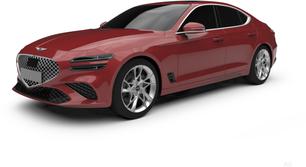
I’m family testing the updated Genesis G70 this week, which has seen some tweaks to its technology and safety systems.
The G70’s release also sees the line-up trimmed to one highly-specified Sport Luxury grade, available as a four-cylinder Shooting Brake wagon or the V6 sedan on test here.
It competes with other mid-size sedans like the Audi A4, BMW 3 Series and Mercedes-Benz C-Class. So, how does the G70 handle life with a small family of three? Keep reading to find out!
Weirdly, given all the good things I've had to say about the GS F Sport, it doesn't quite hang together. It's missing that certain something the Europeans have in their chassis, particularly the BMW 5 Series, and with ageing interior tech, it's struggling to keep up.
It's a car built for specific tastes, and they're more California than Straya. And that's perfectly okay, but unfortunately, that doesn't translate to a stampede of buyers. Having said that, none of its German rivals (or its beleaguered Japanese counterpart, Infiniti) could claim wild sales success either.
The GS is a terrific car, underrated but also just not quite there for my taste. The GS F, though, that's another thing altogether.
The updated Genesis G70 3.3T Sport Luxury is beautiful to look at and drive. It features premium features, trims and great power but the cabin is tight on space. Which makes it a little awkward to use, so this will suit a small family best or families where this may not be the primary mover. That said, I love the after-care program and it suited my small family of three, so it gets an 8.0/10 from us.
The GS is ageing well, but it's still a bit heavy-handed around the headlights and a little on the slabby side along the flanks. It doesn't look poised for action, even with the F Sport additions, but nor does it look frumpy, mostly due to the whopping blacked-out spindle grille, a Lexus signature.
The rear end is good looking but a bit bluff, again neither surprising or delighting.
Little has changed inside, but it's still a very nice cabin, and always will be apart from a couple of clangers (the gear shifter looks super-cheap).
What's more, it's welcoming, lots of very nice materials, comfortable, seats - it's exactly what it needs to be. Whatever you might think of the looks, one thing is absolutely certain - if anyone builds cars better than Lexus, it's a very, very short list.
The G70 sedan is absolutely gorgeous to look at and the our test vehicle's 'Kawah Blue' paintwork makes the crisp pleating across the body stand out.
The G70 has a muscular stance, much like its BMW rival, but the rear is softer in its shaping.
The front looks sophisticated with the wide-set LED lights and black air-intake vents. The sporty 19-inch alloy wheels and red calipers behind them hint at what the powerful V6 engine can do.
The interior looks high-end with our test vehicle’s white quilted Nappa leather upholstery and a soft-touch black headliner. The dashboard looks solid and robust but the slick looking 10.25-inch touchscreen multimedia system and digital climate control panel elevate the overall design.
The only thing I didn’t like about the design was the ambient lighting. It’s limited to two panels on the roof and is a little distracting when you drive at night. I think if it was scattered more throughout the cabin, it would be less intrusive.
Being a big car, there's plenty of room inside. Four passengers will be very comfortable although rear legroom was a bit on the skinny side given the car's size.
The cabin contains a good-sized console bin, four cupholders and each door pocket into which you could conceivably slot a bottle.
The 520-litre boot is a useful shape, with a sensible load height and a space-saver spare under the floor. The 5 Series and E Class both best the Lexus by 10 litres, so the GS isn't far off the norm.
The practicality is hurt a little by the space available for passengers. The front row benefits the most when it comes to head- and legroom but if you’re ferrying passengers in the back seat, you’ll have to scoot your seat forward to accommodate them.
Especially if they’re tall because my knees brush the back of the driver’s seat when it’s in my driving position and I’m only 168cm tall!
The individual storage options throughout the car are okay for the class with the front enjoying a small middle console and glove box, two cupholders and two small drink bottle holders in each door.
The rear gets map pockets, two cupholders in a fold down armrest and two very small storage bins in the doors.
The other amenities are great in both rows and a high-level of comfort will be found for adults with the heat and ventilation functions on the front seats and the heat function on the rear outboard seats.
However, the width of the rear seat and the tall transmission tunnel means the middle seat should be strictly reserved for a kid. Think of the G70 as more of a four-seater if you have adults to carry.
The boot has a 330-litre capacity and it’s not too hard to reach to the very back if items roll that way. The back seat has a 60/40 split and there is a temporary spare tyre underneath the floor.
In terms of technology, you get a USB-A and USB-C port up front, as well as, a 12-volt socket and wireless charging pad to choose from. Rear passengers get two USB-C ports and the boot features another 12-volt outlet.
The 10.25-inch multimedia system looks great and is easy to use with a responsive touchscreen. It also has built-in satellite navigation, wired Apple CarPlay and Android Auto and the system now features over-the-air updates and Genesis Connected Services functionality.
The digital climate panel is responsive and very simple to operate, which is handy when on the go. The 12.3-inch digital instrument cluster is semi-customisable and it’s handy that the 8.0-inch coloured head-up display pulls through satellite navigation directions and traffic sign information.
We had the pleasure of the GS 350 F Sport for the week, which is well over $10,000 cheaper than the Luxury and is therefore the 'default. If you're not sure what F Sport means, it's Lexus' answer to an M Sport or AMG pack, without all the high-powered engine shenanigans to go with it. If that's what you're after, the V8-powered Lexus GS F is definitely for you.
Starting at $95,300, the F Sport has a spectacular standard features list - 17-speaker stereo, 19-inch alloys, variable-geared four-wheel steer (!), adaptive suspension, dual-zone climate control (with moisturising function), hectares of leather trim, head-up display, electrically-operated heated and ventilated front seats, rear sunshade, F Sport instrument screen, auto LED headlights, keyless entry and start, sat nav, front and rear parking sensors with around-view cameras and a space-saver spare.
The media system is run from Lexus' 12.3-inch screen embedded in the dashboard and controlled from an infuriating console-mounted mouse-clicker with a couple of shortcut buttons. It really is spectacularly irritating and made worse by the rotary dial stationed next to it that acts as the drive mode selector. Why not use that instead?
As ever, the system is mildly baffling to use and hard to look at, but the sound is absolutely lovely from the Mark Levinson-branded speakers. Lexus is persisting with a DVD player but it also has DAB+.
The G70 3.3T Sport Luxury sedan on test here is priced at $88,000, before on-road costs, which is $7000 more expensive than the 2.0T Shooting Brake version. That positions it right in the middle of its nearest competitors and you get some fab features included.
The premium items include electric front seats with heat and ventilation functions, heated rear outboard seats, Nappa leather upholstery and other leather trims, a sunroof, a heated leather-wrapped steering wheel and a premium 17-speaker Lexicon by Harman sound system.
The update sees the G70 now have an intelligent speed limit assist feature, the 'Genesis Connected Services' app and over the air updates to its software.
Other standard features include keyless entry, keyless start, remote start from the key fob, a powered tailgate, 19-inch alloy wheels, a temporary spare wheel, dual-zone climate control and extendable sun visors.
Lexus fits a 3.5-litre (2GR-FKS) naturally-aspirated V6, delivering 232kW/380Nm to help shift the 1745kg GS. Power goes to the rear wheels via an eight-speed automatic. Lexus claims the sprint from 0-100km/h is completed in just six seconds.
The G70 3.3T Sport Luxury sedan has a 3.3-litre V6 turbo-petrol engine with a maximum power output of 274kW and 510Nm of torque. The G70 sedan is a rear-wheel drive and features an eight-speed auto transmission.
The V6 engine responds eagerly, being able to do a 0-100km/h sprint time in just 4.7-seconds. Suffice it to say it’s fun to drive.
A real world 13.7L/100km is a solid miss of the claimed 9.3L/100km, which itself is hardly earth-shattering. It's a big heavy car and that's the penalty. It drinks fuel fast, so the 66-litre fuel tank does drain quickly and it's worth knowing you have to fill it with the 95 RON or better.
The compromise for getting all of the power is that she’s a thirsty gal and the official combined cycle fuel consumption figure is 10.4L/100km and my real-world usage came to 10.6L/100km.
However, that’s after mostly doing open-roading – expect the fuel usage to be higher in an urban setting.
Based on the combined cycle and the 60L fuel tank, expect a driving range of around 577km on average. Which means you’ll be filling up more on a longer journey than more efficient sedans.
There are things you expect in a Lexus. Quietness. Composure. Smoothness. The GS delivers all three of those things effortlessly. But it has a few extra things in its bag that I can't say I was expecting.
For a start, the 3.5-litre V6 moves the car without any carry-on and in doing so, I was constantly amazed at how quickly the speed in the head-up display reached the posted limit. It just doesn't feel or sound like a six second car, but there you are. The transmission is virtually faultless, the engine sound distant and refined, the power impressive.
It's a heavy car, no question, but two things work to make it feel much lighter. First - and it doesn't matter which mode you choose - the adaptive suspension somehow knocks about 200kg out of how heavy the car feels. The brakes, while a little soft on pedal feel when you first step on them, are very effective and again help to make the car feel lighter than it is.
The four driving modes are quite distinct. As usual, Eco makes everything soft and doughy or as I prefer to say, unpleasant. Normal is great for every day, with just the right throttle response and steering weight.
Moving to sport ups the aggro slightly while Sport+, while never harsh, firms everything up to the point where it starts to feel like a different car. Sport+ makes the car feel race-car pointy, the suspension holds the body in check and the power seems readily available without jerky progression
The all-wheel steer is a big part of the change in feel. It's is especially sharp in Sport+ mode. The steering's gearing changes up quite a bit, meaning a lot less steering lock required for your favourite hairpin bend. Of course, at real speed it all calms down because neither you nor Lexus are fond of sneezy lane-changes or Armco-swiping. At first I thought it just made the big car feel a bit too nervous but as I got used to it (and was able to dial it down by switching back into a less racy mode) I found it fun but a little bit out of character with the car itself.
And just because it's the F Sport, that doesn't mean it can't do all the things you'd expect from a Lexus. You can still waft, you can still creep up on people and it's really very comfortable when you're cruising or stuck in traffic.
The G70 sedan is a lovely car to drive with graceful handling and a good well of power to dip into.
That oomph is there when you need it and it’s as easy to drive in the city as it is on the open-road.
The responsive steering makes the G70 sedan feel nimble and well-balanced in turns, even when you accelerate out of a hair-pin corner.
The suspension is on the firm side and that can lead to a few grunts when you hit bigger bumps but the ride is not unpleasant, even for back-seaters.
The cabin is generally quiet but you can get road/wind noise at higher speeds. It’s not enough to intrude on chatting but you don’t forget it’s there, either.
The G70 sedan is easy to park because it has an outstanding 11m turning circle. The 360-degree camera system is clear and the front and rear parking sensors make light work of a tight car park.
The GS scores 10 airbags, ABS, stability and traction controls, blind spot monitoring, rear cross traffic alert, forward AEB, active cruise, auto high beams and lane departure warning with lane keep assist.
The GS doesn't have an ANCAP or Euro NCAP rating while the USA's IIHS (Insurance Institute for Highway Safety) rating is good for each key crash-worthiness measure. The IIHS suite of tests is quite rigorous but differ from our ANCAP/Euro NCAP standards.
The Genesis G70 has a great suite of safety features and it’s almost a case of what doesn’t it have.
But a real highlight is the blind-spot view monitor which pops a video feed of your blind spot onto your instrument cluster. Very handy to have in a city setting!
The G70 has a maximum five-star ANCAP safety rating from testing done in 2018, with the update now featuring 10 airbags, which is fantastic for the class.
Other standard safety features include blind-spot monitoring, blind-spot collision avoidance assist, driver attention warning, forward collision warning, lane keeping aid, lane departure alert, rear cross-traffic alert, rear occupant alert, adaptive cruise control with stop and go function and a tyre pressure monitoring system.
A clear 360-degree camera system as well as front and rear parking sensors also come standard.
The G70 has AEB (operational from 10–180km/h) with pedestrian and cyclist detection.
There are ISOFIX child seat mounts on the rear outboard seats and three top tether anchor points but only two child seats will fit. Front passenger comfort may be compromised for front occupants when a 0-4 rearward facing child seat is installed.
There's one area where Lexus smashes the Germans and that's after-sales. While the warranty is hardly ground-breaking at four years/100,000km and service intervals are reasonable at 12 months/15,000km, it's how it all comes together.
For the duration of the warranty, when the car needs a service, Lexus will either come and get it then return it to you, or give you a loan car. Anecdotal evidence suggests this continues long after the warranty runs out. Like, 10 years after the warranty runs out.
This is a small thing, but if there's one thing I hate about car ownership, it's the servicing experience. If I was a betting man, I'd dare you to find someone who genuinely has a problem with Lexus after-sales care.
On top of that, you get a generous roadside assist package for four years.
The Genesis after-purchase program is hard to beat and such a treat because you get five years or up to 50,000km complimentary servicing with the G70. How good is that?
The G70 also comes with a five-year/unlimited km warranty and the servicing intervals are every at 12-months or 10,000km, whichever occurs first. The interval could be annoying if you travel a lot but any annoyance will be softened by the fact that the services are free.