What's the difference?
CT, IS, GS, LS, RC, LC. Yes, that list of letters looks like something you’d read when getting your eyes tested at an optometrist, but they are actually all Lexus models.
Ok, you may have known that already, but did you know that those are just their initials? They actually have full names, too; Compact Touring, Intelligent Sport, Grand Sport, Luxury Saloon, Racing Coupe, Luxury Coupe.
And so this review isn’t just on the new-generation ES, but on the Elegant Sedan, which made it to Australia in 2018. And, as if hinting at things to come, it’s available in ES300h petrol-electric hybrid guise only.
This is the seventh-generation of a model that has been part of the Lexus line-up since the very beginning, way back when the luxury arm of Toyota first stepped onto the world stage in 1989.
So, does the ES300h live up to its Elegant Sedan name? Does being hybrid-only in Australia mean it loses its powerful presence? And is there any reason why you’d get one over a Mercedes-Benz E-Class or BMW 5 Series?
So many questions, but after living with the ES300h in top-of-the-range Sports Luxury guise for a week, we now have all the answers.
It is hard to immediately think of a country more suited to the convertible life than Australia. Even our coldest states (you know who you are…) are blessed with more warming sun than almost anywhere else on the civilised parts of the planet, so you’d think we’d be swanning about in dropped-top bliss almost year round.
But it’s actually in the UK (despite being cold, grey and almost always underwater) that convertibles really fly out of dealerships, with sun-starved Brits buying more than anyone else in the world. Weird, right?
Still, here they remain something of an oddity, sold in small numbers to drop-top diehards. At least partly because the convertibles of old were almost always slightly worse than their hardtop equivalents.
But Mercedes - which makes more convertibles than most - claims to have mastered the soft-top formula with the E400 4Matic, a car it says offers all the perks of open-air motoring without any of the dynamic or practical downsides.
The ES300h is outstanding in terms of ride comfort, refinement and value. If you’re looking for a true driver’s car then a Lexus RCF is probably a better tree to bark up, but if you’re looking to ferry passengers in a serene, prestigious and fuel-efficient way, then look no further.
A convertible that doesn't feel like one when the roof is in place is no easy task to build, but it's one Merc's engineers have pulled off with the E400 4Matic Cabriolet. Effortless power, a tonne of technology and a comfy, leather-wrapped cabin all make Merc's drop-top E-Class a strong proposition.
If you think all Lexus models look the same, then pop on over to the Audi, BMW or Benz websites and take a peek at their line-ups. Compared to the ranges from those prestige car makers, Lexus models look wildly different from each other.
Opinions on that ‘Spindle Grille’ are as polarising as views on politics or religion. Personally, I like how upfront and brave the grille design is, but what seems odd to me is that it’s almost as if this was the only place on the exterior where designers were allowed to be a bit adventurous. The rear, while cleanly styled is a bit plain. The bottom just doesn’t match the face.
The ES300h’s roofline in side profile is beautiful as it sweeps almost fastback-style to the boot lid. Again, not the most dramatic styling, but it’s still pleasing in the sense that the design flows well together. The same can be said for the fit and finish – the panel gaps are near-perfect.
This perfection continues into the cabin, where the materials and craftsmanship matches German prestige rivals in places (the door handles, leather and digital instrument cluster, for example), only to be let down in other areas which disclose its budget Toyota family connection (the air vents, steering wheel and display screen).
The ES300h’s interior design isn’t going to set everybody’s world on fire, but there will be those who adore its asymmetrical styling with different textured surfaces that fold, swoop and jut up against each other’s space. Have a look at the images, they’re of the Sports Luxury which sits above the Luxury in the two grade line-up.
The differences visually between the grades is minimal. The Luxury has 17-inch alloys, while the Sport Luxury has 18-inch.
New colours for this generation include Glacial Ecru (the sandy hue of our test car in the images) and Radiata Green. Both grades’ interiors come in a variety of colour schemes, including Black, Chateau, and Topaz. Exclusively for the Sport Luxury cabin is Rich Cream, too. The Sports Luxury steering wheel has wood trim.
One of the more peculiar design elements of the ES300h’s cabin design, and there are a few, are the controls for the drive modes and traction control. They sit like horns on the instrument cluster hood, as though these are things the driver will constantly be reaching for, when in reality most people will never touch the traction control button.
A new-generation car means new foundations, and the ES300h is built on the GA-K platform which underpins the Camry. The platform is part of the latest global architecture which Toyota and Lexus are now using to build its vehicles.
The dimensions of the ES300h, if you’re wondering if it will fit in your garage, are just under 5.0m long, 1.9m wide and 1.4m tall.
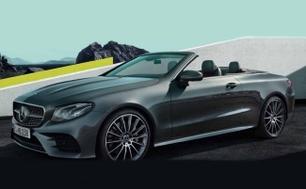
Elegance. That's the word that springs to mind when you first clamp eyes on the E400 Cabriolet. While the Coupe version has a crouched-over sportiness about its exterior design, the convertible is all about big and boat-like proportions, especially with the fabric roof opened.
Like nearly all drop-tops, the E400 looks best with the cabin open to the elements, and the side profile especially paints a picture of well-heeled wafting, with only the AMG alloys and body styling hinting at the performance on offer under the bonnet.
Inside, expect perfectly executed modern luxury, with soft leather seats, touchpoints that melt under the fingers and a sprinkling of woodgrain trim. All of which feel like old-world luxury, nicely juxtaposed by the huge twin-screen display that dominates the dash.
The Lexus ES300h is a five-seater sedan, but it’s really designed to sit two comfortably in the back, given there’s a large driveshaft hump in the floor and that the outboard seats are divided by a fold-down control panel/armrest.
Legroom in the second row is ample. I’m 191cm tall, and I had about 20mm of space between my knees and the seat back when it was in my driving position. Headroom gets tight with that sloping roofline, but there’s just enough space thanks to the low hip point of the rear seats.
Cabin storage is excellent. The fold-down armrest for the rear seats has a storage tray and two cup holders, while the large centre console bin has a lid which can open towards the driver and also to the front passenger (I spent way too long marvelling at how it worked). There are two cup holders up front and decent-sized door pockets, too. Those rear doors open wide for easy exit and entry.
Boot space in the ES300h is 454 litres (VDA), beating the 410-litre cargo capacity of the BMW 530e.
As far as power outlets, you’ll find two USB chargers in the centre console storage bin and a Qi wireless charging pad, which is awkwardly situated making it hard to place larger phones onto it.
It's a two-door, four-seat convertible, so practicality isn't at the very top of its list of strengths.
That said, life is peachy for upfront riders, both of whom will travel in spacious luxury. There are two cupholders hidden beneath a woodgrain cover underneath the climate controls - also home to a power outlet - as well as a clever double-hinged central storage bin that can be opened by either the passenger or driver, and which opens to reveal two USB points.
There's room in the doors for bottles, too, and the entertainment system can be controlled via a touchpad controller mounted above the traditional click wheel - although, to be honest, using it is harder and more time consuming than simply pretending it doesn't exist.
Climbing into the back (and we mean climb - there are no rear doors) is made easier by the fact you can fold and slide the front seats automatically by pulling a lever mounted near the headrest. Once there, though, you'll find space is a little tighter, and you feel weirdly cocooned, owing to the huge raised tunnel that runs through the middle of the cabin, and the low roof line.
There are two cupholders that live in the space where the middle seat would normally go, and there's a little bottle-holder cubby to the left of both backseat riders. There are air vents back there, too, but no temperature controls.
The front doors are huge and really very heavy, requiring considerable heft to open them.
The boot space is predictably a little limited, with 385 litres on offer. There's also a little flip-down separator, which shows you how much room the roof will need to come down, reducing boot space to 310 litres. Speaking of which, the soft-top can be lowered in just 20 seconds, and at speeds up to 50km/h.
One practicality quirk, though. The front (and only) doors are huge and really very heavy, requiring considerable heft to open them, especially if you're parked on a slight angle. Honestly, I was reduced to kind of pushing them open with my foot at times.
Yes, and don’t let anybody tell you any differently. The Luxury lists for $59,888 and the Sports Luxury is $74,888. Both are bargains when you consider the quality and features.
If it was my money, I’d go for the Luxury which is almost indistinguishable visually but doesn’t come with as many tech and convenience features as the Sport Luxury.
Still, the Luxury gets the 12.3-inch screen with sat nav, a 10-speaker Pioneer stereo system with digital radio, a head-up display, dual-zone climate control, wireless charging, 10-way power adjustable front seats, privacy rear windows, a moonroof, proximity key and LED headlights.
The Sports Luxury takes all of that and adds a Mark Levinson 17-speaker sound system, leather seats, heated and ventilated 12-way power adjustable front seats, heated and power reclining rear seats, three-zone climate control, heated steering wheel, power rear sunshade and manual side rear window shades, gesture-open boot and cornering LED headlights.
The Sports Luxury also comes with noise reducing 18-inch wheels – they contain what’s called a Helmholtz resonator which cancels out the drone that can be produced when driving.
Is there anything missing? When I saw the rear fold-down armrest with the control panel I instantly thought the ES300h must have had seat-back screens, but nope. Also, it’s annoying that Lexus still doesn’t have Apple CarPlay and Android Auto as part of its package. This will change we hear, but it has been slow on the uptake.
The Lexus ES300h’s direct rival is the Infiniti Q70 Hybrid GT Premium for $82,900, but it also challenges the likes of Mercedes-Benz E-Class, which starts at $91,900, BMW’s 5 Series, which begins at $92,990, and the Audi A6, which kicks off at $81,900.
Given that the ES300h is hybrid-only, if you’re specifically looking for something with a petrol-electric powertrain, then there’s the BMW 530e or the Mercedes-Benz E350e.
At $157,400, the Cabriolet is the most expensive model in the E400 family, and is roughly $20k more than the sedan and $10k more than the coupe variants.
That money buys you a comprehensively kitted-out ride - as it really should - with the E400 Cabriolet arriving with 20-inch AMG alloys, LED headlights (made up of 84 LEDs) with high-beam assist, proximity unlocking with push-button start, air suspension and Merc's AIRCAP - a lip above the windscreen that's designed to push air up and over the cabin when the roof is down.
Inside, you'll find leather seats, dual-zone climate control and the clever 'AirScarf' system, which pumps hot air onto your neck when the roof is down (and it's cold out). You'll also nab heated front seats, power windows front and back and an automatic belt feeder, which saves you reaching over your shoulder to get to your seatbelt. So exhausting.
On the tech front, expect a killer 590W, 13-speaker Burmester stereo, controlled by the seriously impressive widescreen cockpit; two 12.3-inch screens that spill from about the centre of the dash all the way to the driver's binnacle, and control everything from navigation to Apple CarPlay and Android Auto.
There's a whole bunch of safety stuff, including semi-autonomous technology, but we'll drill down on that under the Safety sub-heading.
As mentioned at the start of this review, in Australia the Lexus ES is only available with one powertrain variant – a petrol-electric hybrid.
This combines a 2.5-litre four-cylinder petrol engine making 131kW and 221Nm, with an electric motor that has an output of 88kW and 202Nm. The 244.8V nickel-metal hydride battery has been moved from under the boot floor in the previous generation car to under the rear seats, so it no longer eats into the cargo space.
The ES300h isn’t a plug-in hybrid, so battery recharging is done through regenerative braking.
A continuously variable transmission means seamless and smooth low-speed driving using just the motor, but under heavy acceleration the engine activates and you’ll hear that drone associated with CVTs.
It's a fabulous engine, this twin-turbocharged V6 - even if it doesn't feel quite so lively in Cabriolet form as it does in the hardtop equivalents.
The 3.0-litre unit produces 245kW/480Nm, sending it to all four wheels via a nine-speed automatic transmission, linked to the standard 4Matic all-wheel drive system.
This is the point of a hybrid, right? To save fuel? The electric motor can power the car at low speeds around car parks or in bumper-to-bumper traffic, and I found that after 104km of both urban and open road usage my fuel economy in the Sport Luxury was 5.4L/100km.
Lexus’ official combined fuel economy figure for both the Luxury and Sports Luxury is 4.6L/100km.
Mercedes claims 7.4L/100km on the combined cycle (but you can expect to be pushing nine litres in real-world conditions), with emissions pegged at 170g per kilometre of CO2.
The 66-litre tank will only accepts 95RON fuel.
Two words: quiet and comfortable. Well that’s three words, but that sums up the ES300h on the road. Yes, rivals may have intelligent adaptive air suspension and leather made from free range cows, and they are supremely tranquil and sumptuous places, but challenging them is this ES300h.
Even with its regular shock absorbers and steel-spring suspension, the ride was outstanding for its comfort and composure on the worst roads Sydney could throw at it over the week we tested the car.
Front and rear seats were supportive and comfortable over long distances, too. From a driver’s perspective the experience was serene – this was an easy and relaxing car to pilot.
I’m not a huge fan of petrol-electric hybrid powertrains, but it suits the seamless personality of the ES perfectly, adding to the smoothness of the ride as it slipped silently through traffic.
Just don’t expect the ES300h to be rewarding from a dynamic driving perspective. The steering was heavy and a little numb, and while the handling was good, I felt disconnected from the road. And whenever I needed to move quickly the combustion engine would splutter to life and the CVT would begin to drone.
Sure, the E400 Cabriolet can drive itself, but we’re equally pleased to note that it’s still a lot more fun handling the steering duties yourself.
And that is mostly due to that fabulous engine; quiet and effortless at city speeds, rorty and enthusiastic at pace, and genuinely angry with the drive setting switched to their most hardcore Sport+ mode.
We’ve already spent time in the sedan version, and while this Cabriolet is heavier (1935kg vs 1820kg) and slightly slower to 100km/h (5.5sec vs 5.2sec) it doesn’t immediately feel it behind the wheel, with a similar and satisfying lurch into the future when you plant your foot.
But hard charging is not what this car is about, and the E 400 is at its peachy best when rolling about the city or the ‘burbs with the top down, and the warm summer air washing through the cabin.
In its normal drive settings, the steering is light but engaged, and the ride on offer from the standard air suspension is outstanding, cosseting the cabin from all but the very worst road imperfections, while the torque from the V6 serves up effortless, unobtrusive acceleration.
With the roof up, Merc’s designers have done a stellar job of hiding the fact this thing is a convertible at all. It’s a solid-feeling cabin with the fabric roof fastened, and the cabin is quiet and free from wind noise.
The Lexus ES300h was awarded the maximum five-star ANCAP rating when it was tested in September 2018. Coming standard on both the Luxury and Sports Luxury grades are 10 airbags, AEB with pedestrian detection, lane keeping assistance and adaptive cruise control.
By stepping up to the Sports Luxury you’ll also get adaptive high beams which is fair enough, but you’ll also gain equipment which really should be on the base grade, too, such as blind spot warning and rear cross-traffic alert - which come standard on a Camry SL for half the price.
While there’s absolutely no doubt the ES300h is safe, it lags behind in autonomous technology which is present in cars such as the E-Class.
You’ll find two ISOFIX mounts and three top-tether anchor points across the second row which we used for our four year old and his car seat.
There are few cars on the road as overloaded with safety technology as the E400 Cabriolet.
The standard stuff is all there, of course. There's a 360-degree parking camera, as well as nine airbags (dual front, dual pelvic/thorax for front-seat passengers, dual sidebags for rear passengers, dual head bags in the doors and a knee airbag for the driver), rollover protection and tyre-pressure monitoring, as well as braking and traction aids.
But the E400 adds some really clever technology, including Merc's Driving Assistance Package Plus, which adds active lane keeping, blind-spot assist, cross-traffic alert and evasive steering assist.
It's this suite of systems that allows the E400 to navigate freeways autonomously, including changing lanes on demand. At the moment, the system will warn you to keep your hands on the wheel every so often, but you can sense a time when that will no longer be required. And that time is soon.
The E-Class range scored the maximum five-star ANCAP safety rating when crash tested in 2016.
The ES300h is covered by Lexus’ four-year/100,000km warranty. Servicing is recommended every 15,000km or 12 months. There is no capped-price servicing scheme.
Expect the usual three-year, unlimited-kilometre warranty, with service intervals pegged at 12 months or 25,000km. Mercedes' capped-price servicing scheme limits maintenance costs to $2280 for the first three years of ownership.