What's the difference?
CT, IS, GS, LS, RC, LC. Yes, that list of letters looks like something you’d read when getting your eyes tested at an optometrist, but they are actually all Lexus models.
Ok, you may have known that already, but did you know that those are just their initials? They actually have full names, too; Compact Touring, Intelligent Sport, Grand Sport, Luxury Saloon, Racing Coupe, Luxury Coupe.
And so this review isn’t just on the new-generation ES, but on the Elegant Sedan, which made it to Australia in 2018. And, as if hinting at things to come, it’s available in ES300h petrol-electric hybrid guise only.
This is the seventh-generation of a model that has been part of the Lexus line-up since the very beginning, way back when the luxury arm of Toyota first stepped onto the world stage in 1989.
So, does the ES300h live up to its Elegant Sedan name? Does being hybrid-only in Australia mean it loses its powerful presence? And is there any reason why you’d get one over a Mercedes-Benz E-Class or BMW 5 Series?
So many questions, but after living with the ES300h in top-of-the-range Sports Luxury guise for a week, we now have all the answers.
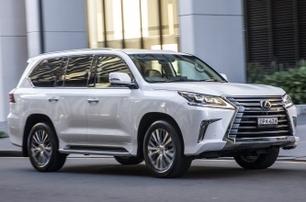
The price of fuel probably doesn't feature too highly on a 'Things to Worry About' list for people who can afford a luxury SUV. If you're spending more than $130,000 on a vehicle then, chances are, you glide on through service station forecourts with nary a concern about the cost of go-juice, but nevertheless Lexus has introduced its diesel-sipping LX 450d to the ever-growing arena of upmarket wagons. It has a claimed fuel consumption of 9.5L/100km – using just under five litres per 100km less than the eight-seater LX 570, its petrol stablemate.
But does this five-seater up-scale offering deliver much in the way of anything different to any other pricey people-mover, other than the fact it's an oil-burner? Read on.
The ES300h is outstanding in terms of ride comfort, refinement and value. If you’re looking for a true driver’s car then a Lexus RCF is probably a better tree to bark up, but if you’re looking to ferry passengers in a serene, prestigious and fuel-efficient way, then look no further.
If you're in the market for the best-of-the-best SUV wagon, then you could do a lot of worse than get in a LX 450d. It looks good, is packed with standard features and is supremely comfortable. The 450d also has an suite of safety tech worthy of the hefty price-tag and it works well as a daily driver and has plenty of touring potential, even though we doubt it'll ever get anywhere near achieving those claimed fuel-consumption figures with real-world usage. Sure, you could instead climb in a second-hand, well-looked-after, never-been-off-road LandCruiser 200 Series and spend the money you save, by not buying this new Lexus, on aftermarket and camping gear, camping fees and also hiring a team of four people to follow you on mopeds everywhere and constantly tell you what a great driver you are – but that's not the point with vehicles of this ilk. They may not be aimed at hard-core off-roading buyers, but they are cushy, classy, and cityified – and, in that respect, they're incredibly well-built for purpose.
If you think all Lexus models look the same, then pop on over to the Audi, BMW or Benz websites and take a peek at their line-ups. Compared to the ranges from those prestige car makers, Lexus models look wildly different from each other.
Opinions on that ‘Spindle Grille’ are as polarising as views on politics or religion. Personally, I like how upfront and brave the grille design is, but what seems odd to me is that it’s almost as if this was the only place on the exterior where designers were allowed to be a bit adventurous. The rear, while cleanly styled is a bit plain. The bottom just doesn’t match the face.
The ES300h’s roofline in side profile is beautiful as it sweeps almost fastback-style to the boot lid. Again, not the most dramatic styling, but it’s still pleasing in the sense that the design flows well together. The same can be said for the fit and finish – the panel gaps are near-perfect.
This perfection continues into the cabin, where the materials and craftsmanship matches German prestige rivals in places (the door handles, leather and digital instrument cluster, for example), only to be let down in other areas which disclose its budget Toyota family connection (the air vents, steering wheel and display screen).
The ES300h’s interior design isn’t going to set everybody’s world on fire, but there will be those who adore its asymmetrical styling with different textured surfaces that fold, swoop and jut up against each other’s space. Have a look at the images, they’re of the Sports Luxury which sits above the Luxury in the two grade line-up.
The differences visually between the grades is minimal. The Luxury has 17-inch alloys, while the Sport Luxury has 18-inch.
New colours for this generation include Glacial Ecru (the sandy hue of our test car in the images) and Radiata Green. Both grades’ interiors come in a variety of colour schemes, including Black, Chateau, and Topaz. Exclusively for the Sport Luxury cabin is Rich Cream, too. The Sports Luxury steering wheel has wood trim.
One of the more peculiar design elements of the ES300h’s cabin design, and there are a few, are the controls for the drive modes and traction control. They sit like horns on the instrument cluster hood, as though these are things the driver will constantly be reaching for, when in reality most people will never touch the traction control button.
A new-generation car means new foundations, and the ES300h is built on the GA-K platform which underpins the Camry. The platform is part of the latest global architecture which Toyota and Lexus are now using to build its vehicles.
The dimensions of the ES300h, if you’re wondering if it will fit in your garage, are just under 5.0m long, 1.9m wide and 1.4m tall.
It has that signature Lexus jagged space-age grille, chunky shoulders and beefy back end that suit a luxury SUV dreamed up by folks craving a significant presence and plenty of attention for their product.
Bulky side-steps, an upswept raked profile, scalloped side panels and moon roof all top what is a cool combination of eye-friendly design factors. It's a slick mix of low-level cool and high-end style.
Take a look for yourself and make up your own mind whether you like it or not.
The Lexus ES300h is a five-seater sedan, but it’s really designed to sit two comfortably in the back, given there’s a large driveshaft hump in the floor and that the outboard seats are divided by a fold-down control panel/armrest.
Legroom in the second row is ample. I’m 191cm tall, and I had about 20mm of space between my knees and the seat back when it was in my driving position. Headroom gets tight with that sloping roofline, but there’s just enough space thanks to the low hip point of the rear seats.
Cabin storage is excellent. The fold-down armrest for the rear seats has a storage tray and two cup holders, while the large centre console bin has a lid which can open towards the driver and also to the front passenger (I spent way too long marvelling at how it worked). There are two cup holders up front and decent-sized door pockets, too. Those rear doors open wide for easy exit and entry.
Boot space in the ES300h is 454 litres (VDA), beating the 410-litre cargo capacity of the BMW 530e.
As far as power outlets, you’ll find two USB chargers in the centre console storage bin and a Qi wireless charging pad, which is awkwardly situated making it hard to place larger phones onto it.
It certainly feels like Lexus designers and engineers have maximised every last millimetre of interior space; there is stacks of room inside with plenty of real-world usable storage spaces, including cup-holders, door pockets and spots for keys, phones and other stuff.
The heated steering wheel, stylish analogue clock, wireless charger, Lexus climate concierge (coordinating all four-zone temperature controls), cavernous centre-console cooler box, and rear-seat entertainment system are all nice touches but pretty much assumed at price-points lower than this one.
The 12.3-inch high-definition media touchscreen is clear and bright and easy to operate, but the Remote Touch Interface, the control near the shifter, is very annoying to use. The toggle/selector is too sensitive, skipping past your actual choice over and over again, while you try to manipulate it just so, so it lands on the option you wanted.
The second-row seating is plush and the seat sections are easily slid forward and tilted.
Lexus claims the 450d offers 909 litres of cargo space if there are five occupants; and 1431 litres if there are only two occupants. If you have some casual weekend touring in mind, with a spot of camping, then this Lexus should cope with your gear, no worries.
Yes, and don’t let anybody tell you any differently. The Luxury lists for $59,888 and the Sports Luxury is $74,888. Both are bargains when you consider the quality and features.
If it was my money, I’d go for the Luxury which is almost indistinguishable visually but doesn’t come with as many tech and convenience features as the Sport Luxury.
Still, the Luxury gets the 12.3-inch screen with sat nav, a 10-speaker Pioneer stereo system with digital radio, a head-up display, dual-zone climate control, wireless charging, 10-way power adjustable front seats, privacy rear windows, a moonroof, proximity key and LED headlights.
The Sports Luxury takes all of that and adds a Mark Levinson 17-speaker sound system, leather seats, heated and ventilated 12-way power adjustable front seats, heated and power reclining rear seats, three-zone climate control, heated steering wheel, power rear sunshade and manual side rear window shades, gesture-open boot and cornering LED headlights.
The Sports Luxury also comes with noise reducing 18-inch wheels – they contain what’s called a Helmholtz resonator which cancels out the drone that can be produced when driving.
Is there anything missing? When I saw the rear fold-down armrest with the control panel I instantly thought the ES300h must have had seat-back screens, but nope. Also, it’s annoying that Lexus still doesn’t have Apple CarPlay and Android Auto as part of its package. This will change we hear, but it has been slow on the uptake.
The Lexus ES300h’s direct rival is the Infiniti Q70 Hybrid GT Premium for $82,900, but it also challenges the likes of Mercedes-Benz E-Class, which starts at $91,900, BMW’s 5 Series, which begins at $92,990, and the Audi A6, which kicks off at $81,900.
Given that the ES300h is hybrid-only, if you’re specifically looking for something with a petrol-electric powertrain, then there’s the BMW 530e or the Mercedes-Benz E350e.
Price as tested on our five-seat LX 450d is $136,000. The base RRP is $134,500 and our Lexus had premium paint (Sonic Quartz), which adds $1500; no other options were fitted.
It is absolutely packed to the rafters with high-quality stuff, which is no surprise really because, at this price, you’d expect nothing less. Standard features include a 12.3-inch high-definition screen with nine-speaker, seven-channel audio system (with “digital sound processing”), satellite navigation, and four-zone climate control air-conditioning with climate concierge function and nanoe technology (claimed to purify the air and moisturise hair and skin, according to Lexus). It also has heated front seats, leather-accented trim, a wireless phone charger, cool box, rear-door sunshades, 20-inch alloy wheels with 285/50R tyres, tyre-pressure warning, LED headlamps, daytime running lamps and sequential turn signals.
There are seven exterior colours and two leather-accented interiors from which to choose.
The LX 450d does not have any enhancement packs.
As mentioned at the start of this review, in Australia the Lexus ES is only available with one powertrain variant – a petrol-electric hybrid.
This combines a 2.5-litre four-cylinder petrol engine making 131kW and 221Nm, with an electric motor that has an output of 88kW and 202Nm. The 244.8V nickel-metal hydride battery has been moved from under the boot floor in the previous generation car to under the rear seats, so it no longer eats into the cargo space.
The ES300h isn’t a plug-in hybrid, so battery recharging is done through regenerative braking.
A continuously variable transmission means seamless and smooth low-speed driving using just the motor, but under heavy acceleration the engine activates and you’ll hear that drone associated with CVTs.
The Lexus LX 450d has the LandCruiser's 4.5-litre twin-turbo direct-injection V8 engine, producing 200kW@3600rpm and 650Nm@1600-2800rpm. All of that power and torque arrives evenly and smoothly, helped no end by a slick six-speed sequential-shift transmission.
It has a full-time 4WD system, dual-range transfer case and off-road tech that includes multi-terrain anti-skid brakes, crawl control and a four-camera multi-terrain monitoring system with back guide and panoramic view.
This is the point of a hybrid, right? To save fuel? The electric motor can power the car at low speeds around car parks or in bumper-to-bumper traffic, and I found that after 104km of both urban and open road usage my fuel economy in the Sport Luxury was 5.4L/100km.
Lexus’ official combined fuel economy figure for both the Luxury and Sports Luxury is 4.6L/100km.
Lexus claims the LX 450d will achieve a 9.5L/100km figure from combined-cycle driving (that's 4.9L/100km more frugal than the LX 570 is capable of). Lexus reckons, based on that figure, that the diesel LX has a potential range of almost 1000km on a full tank (93 litres) of fuel.
We recorded 12.7L/100km during daily driving (city and suburbs) and 13.5L/100km with some light off-roading thrown into the drive mix.
Two words: quiet and comfortable. Well that’s three words, but that sums up the ES300h on the road. Yes, rivals may have intelligent adaptive air suspension and leather made from free range cows, and they are supremely tranquil and sumptuous places, but challenging them is this ES300h.
Even with its regular shock absorbers and steel-spring suspension, the ride was outstanding for its comfort and composure on the worst roads Sydney could throw at it over the week we tested the car.
Front and rear seats were supportive and comfortable over long distances, too. From a driver’s perspective the experience was serene – this was an easy and relaxing car to pilot.
I’m not a huge fan of petrol-electric hybrid powertrains, but it suits the seamless personality of the ES perfectly, adding to the smoothness of the ride as it slipped silently through traffic.
Just don’t expect the ES300h to be rewarding from a dynamic driving perspective. The steering was heavy and a little numb, and while the handling was good, I felt disconnected from the road. And whenever I needed to move quickly the combustion engine would splutter to life and the CVT would begin to drone.
It’s supremely comfortable and very quiet, wth that customary cocoon-like enclosed sensation that you only ever truly get in a vehicle this far away from cheap.
The 450d is 5080mm long, 1980mm wide and 1865mm high. It has a 11.8m turning circle. It has an official kerb weight listed as between 2510kg and 2740kg.
For something with so many kegs onboard, it’s capable of punching off the mark with a respectable bit of pace; handy for city-street bursts to slip through traffic gaps.
It never feels cumbersome; it actually feels quite light on its toes. In fact this Lexus tends to be more than a little bit floaty at times. You can select different suspension settings – comfort, normal or sport – to suit your preference.
Visibility is generous all-round with clear sightlines in all directions; besides, the reversing monitor with 360-degree view helps if your views are hindered.
Steering is generally active but it does exhibit quite a lot of under-steer on twisting country roads. It has paddle-shifters if you’re that inclined.
The LX 450d rides on 20-inch alloys and 20-inch Dunlop Grandtrak PT2As (285/50F20 112V) – a combination which is fine for bitumen-based outings, but we’d ditch it for rubber with more sidewall to allow for greater freedom to adjust tyre pressures to suit rough terrain.
The Lexus ES300h was awarded the maximum five-star ANCAP rating when it was tested in September 2018. Coming standard on both the Luxury and Sports Luxury grades are 10 airbags, AEB with pedestrian detection, lane keeping assistance and adaptive cruise control.
By stepping up to the Sports Luxury you’ll also get adaptive high beams which is fair enough, but you’ll also gain equipment which really should be on the base grade, too, such as blind spot warning and rear cross-traffic alert - which come standard on a Camry SL for half the price.
While there’s absolutely no doubt the ES300h is safe, it lags behind in autonomous technology which is present in cars such as the E-Class.
You’ll find two ISOFIX mounts and three top-tether anchor points across the second row which we used for our four year old and his car seat.
The LX 450d has a five-star ANCAP rating. It has the latest-generation Lexus pre-collision safety system with pedestrian detection, and 10 airbags. Other standard safety gear includes radar active cruise control, lane-departure warning, adaptive high-beam system, blind-spot monitor and rear cross-traffic alert, as well as clearance and back sonar, and reversing monitor with 360-degree view.
The ES300h is covered by Lexus’ four-year/100,000km warranty. Servicing is recommended every 15,000km or 12 months. There is no capped-price servicing scheme.
Warranty is 4 yrs/100,000km. Service intervals with indicative pricing (exc GST) are: six months/10,000km: complimentary; 12 months/20,000km: $535.56; 18 months/30,000km: $598.11; 24 months/40,000km: $800.32; 30 months/50,000km: $502.44; 36 months/60,000km: $676.23.