What's the difference?
The B10 isn’t Leapmotor’s first car in Australia - the C10 has been here for more than a year now - but for many it might bring about the first time they hear about the Chinese brand.
The 2026 Leapmotor B10 lands in Australia promising to be the most European of its Chinese compatriots, with the brand’s connection to Stellantis giving it access to other brands under the company umbrella like Alfa Romeo, Maserati and Peugeot.
At its local launch, we get behind the wheel in scorching south-east Queensland to find out if that holds true for this electric small SUV, and to see if the B10 can bring with it a better first impression than the already-arrived mid-size C10.
Jeep's Renegade might be late to the mini-SUV party but it comes with a pretty impressive back catalogue to suggest that this is a SUV that can cash the cheques its name can write.
The top of the range Trailhawk can write even bigger cheques than the lower models, bringing with it a range of off-road tech toys to let you really get down and dirty.
I’ll be a shame if the B10 doesn’t sell well, because it doesn’t suffer from many of the downfalls of its compatriots and its price is extremely competitive for what you get.
As a comfortable smallish SUV, it meets par, and it’s on the better side of tech when it comes to cars from China, and it doesn’t have any major on-road red flags.
You really wouldn’t be disappointed with this having paid $40K, just skip the base model and go for the Design.
Note: CarsGuide attended this event as a guest of the manufacturer, with travel, accommodation and meals provided.
Rugged, dependable and good off-road are the most obvious qualities of the Trailhawk. It stands out from the rest of the mini-SUVs by being able to do the S and the U with plenty of vigour.
It's just a shame that its on-road manners can't match that of its big brother, the Cherokee. Unless you're planning on proper off-roading, the Trailhawk might not be quite what you're looking for.
Right after we praise the B10 for its value, we need to talk about its looks. A slight drop in tone as the second Leapmotor to land in Australia looks an awful lot like the first, and it’s relatively bland.
It’s not ugly, but it’s not particularly inspiring and there’s not much character to this little electric SUV.
It’s got a very upright silhouette at the front with a slightly sloping roofline at the rear, so the overall shape is appealing, but the lack of distinct features makes the B10 an anonymous commuter for now, especially with its similarities to the C10.
You can tell them apart by the C10’s slightly larger size if they’re near each other, or the B10’s more in-line headlight bar, where the C10’s have a ‘droop’ at the sides.
The large section of black at the lower half of the front is also unappealing, though darker colours like the optional 'Starry Night Blue' or 'Dawn Purple' (both $990) blend into it better than standard 'Light White'.
To its credit, at least the B10 doesn’t fall victim to the design crutch of adding trim and plastic for no reason.
In terms of the specifics, the B10 is 4515mm long, 1885mm wide and 1665mm tall with a 2735mm wheelbase, making it quite the large small SUV.
Inside, the cabin looks and feels roomy thanks to the test car’s light interior, decent windows and the light from the sunroof, as well as the fact the EV powertrains are compact and generally don’t interfere with cabin space.
Materials aren’t all scratchy hard plastic, though it is dotted around, and the general look of the B10 inside feels more premium than its price would have you thinking, despite the simplicity of the layout and design.
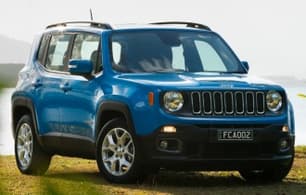
In what is absolutely not a coincidence, the Renegade immediately conjures up the Wrangler. Upright grille from the Willys Jeep (references abound here), round headlights, squared off wheel arches to mimic the Wrangler's guards, short overhangs and big rear view mirrors.
The 17-inch wheels look completely lost in the wheelarches which are even more cavernous owing to the Trailhawk's 50mm of extra ride height. The wheels are also a bit cheap looking but will probably survive the belting the car is intended to take.
Less rugged is the interior, despite a fairly self-conscious effort to make it look and feel chunky. The front seats are flat and unsupportive with the rears just as lacklustre making sure everyone is sliding around together. Luckily, front passengers get a dash-mounted grab handle.
It seems quite well put together, however, but with carpets and easily-marked plastics, you'll hope your passengers don't bring the mud in with them too often. And the "Since 1941" stamped into the steering wheel can go.
The dashboard is reasonably clear and has plenty of information to share via the screen between the dials but whoever thought marking the redline with a water splash graphic in bright orange should probably rethink their design decisions.
Storage is limited to two cupholders up front, door pockets in each door and nets on the front seat backs.
Talking about the price may well be us highlighting the Leapmotor B10’s strongest point right up top, because you can get into one for less than $40K, drive-away, before the end of March 2026.
While regular pricing for the B10 starts from $37,888, before on-road costs, for the base Style and $40,888 for the kitted-out Design LR, Leapmotor has a limited-time deal starting from $38,990, drive-away, for the B10 Style and $41,990 for the Design LR. LR for Long Range, by the way.
That runs until the end of March, 2026, but even its standard pricing is impressive for what you get.
The entry-grade B10 Style comes with plenty of kit, including an 8.8-inch LCD driver display and large 14.6-inch central multimedia touchscreen, a wireless phone charger, auto climate control, a panoramic sunroof with retractable shade, heated mirrors, auto LED headlights, a set of 18-inch wheels, surround-view parking cameras with dashcam recorder capability, over-the-air (OTA) updates and Level 2 advanced driver assistance (ADAS).
That’s a list of inclusions that can, on paper, rival much more expensive models.
The Design LR, for not much more money, adds heated and ventilated synthetic leather seats with electric adjustment (six-way for the driver, four-way for the passenger), a heated steering wheel, a 12-speaker sound system, ambient lighting, a power tailgate, tinted privacy glass, LED tail-lights and auto folding mirrors.
You’d hate to be in the product planning team of a legacy manufacturer trying to put together a competitive spec for a small electric SUV to sell in Australia against that.
Even other small electric SUVs from China come with much smaller batteries or fewer features around the $40K mark, like the MG S5 EV Essence RWD with its 49kWh battery ($42,990 D/A) or the base Geely EX5 Complete FWD ($40,990 BOC) and the higher Inspire variant is $4000 more.
The Renegade range starts at $28,000 for the 1.6-litre Renegade Sport manual front-wheel drive, climbing between $2000 and $3000 through the Sport Auto, Longitude Auto, Limited Auto with a final jump of $4000 to the 2.4-litre auto-only Trailhawk.
Standard is a nine-speaker stereo with Bluetooth and USB, 17-inch alloys, dual-zone climate control, reversing camera, rear parking sensors, keyless entry and start, cruise control, electric front seats with heating, satellite navigation, automatic bi-xenon headlights, auto wipers, leather trim, roof rails, front and middle bash plates, full size spare, heated leather steering wheel, privacy glass, trailer sway control and tyre pressure monitoring.
The lairy Omaha orange is $500, part of an eleven colour palette with only two no-cost paint options (black and white).
You can add lane departure warning, auto-parking and a black painted roof for $500 each, a removable and retractable roof called My Sky Roof for $2200 or a more conventional electric sunroof for $1900.
The Beats-branded nine-speaker stereo is run via Fiat-Chryser's UConnect system, accessible through the 6.5-inch touchscreen. While it improves with every attempt, it's still quite clunky and when the sat-nav is added, becomes a bit of a mess.
Thankfully, not every function has been crammed into the touchscreen interface, so you'll spend more time with your hands on the wheel rather than working out which bit of the screen has the climate control.
There’s only one powertrain option for the Leapmotor B10, a single, rear-mounted electric motor that produces 160kW and 240Nm, which makes the electric SUV good for a claimed 0-100km/h time of 8.0 seconds in both variants.
Top speed is a claimed 170km/h, also regardless of the variant.
The Trailhawk is powered by Fiat's 2.4-litre four naturally-aspirated four-cylinder producing 129 kW and 230 Nm. Jeep reckons you'll get 7.5L/100km on the combined cycle. Our mostly city driving with a longish motorway run produced an 11.0L/100km average over a week.
The transmission is a nine-speed ZF automatic driving all four wheels.
The Trailhawk also has Jeep's five mode Selec-Terrain system which should cover pretty much every eventuality – Auto, Sport, Mud, Sand and, just for the Trailhawk, Rock. The Trailhawk is rated to tow 400kg unbraked and 907kg braked.
The Leapmotor B10 was developed with testing at Stellantis’ European proving ground in Italy. This is because despite Leapmotor being its own brand within China, its international operations are a joint-venture between itself and Stellantis.
There are some on-paper shreds of evidence for this, a rear-wheel drive layout and a claimed 50/50 weight distribution help, but get the B10 on the road and it’s clear this isn’t a car that’s relying entirely on price, a long list of features and some showroom shine to sell.
After the initial familiarisation that comes with many new electric cars, particularly from China, the Leapmotor B10 becomes easy to settle into a rhythm with, especially if you turn off some of its more intrusive ADAS features like lane-keep, driver monitoring and speed limit warning. The latter can sometimes get a limit wrong, and though the B10’s chimes aren’t audibly overbearing, they are persistent.
While the B10 doesn’t excel in any areas on the road, it doesn’t fall down significantly in any either.
Its suspension soaks up bumps relatively well, and despite some vibrations on rougher roads the B10 is pretty comfortable. The tyres it rides on as standard, however, are rather noisy, so if there’s an opportunity to swap out the Linglong defaults to something better, we’d advise it.
The tyres also squeal rather quickly when cornering, not necessarily because the B10 is about to let go, but just because the weight of the car appears to be pushing on the front outside tyre in cornering.
The B10 holds up better than\ a family car really needs to in dynamic driving, but we wouldn’t be doing mountain runs or track days in one.
There’s a little body roll in corners, but not nearly as much as has been in other models riding on the apparently soft suspension preferred in China.
The steering, braking and acceleration all have a mild vagueness to them, but once you’re honed in they’re all predictable. The steering can be adjusted for weight, and its lightest setting is too light, while the acceleration feels lethargic in its lowest setting and too aggressive in its highest.
There’s not a lot of regenerative braking strength, but it’s enough to help regulate speed once you’re used to how mildly it comes in - again, depending on your preferences and settings.
The good news here is that the B10 is easy to drive, and only very serious road bumps on fast corners unsettled it on test - the kind you’d expect to upset any car.
The Trailhawk name suggest that things are going to get muddy – compared to the rest of the range, the range-topper rides 50mm higher and has exposed, easy-to-reach tow hooks in the fairly unlikely event you get stuck. It also has a 20:1 low-range crawl ratio and Active Drive 4x4 which means it can switch between front and all-wheel drive. It'll also wade through almost half a metre of water. It's a genuine mud-plugging proposition and will take on some much bigger machinery out in the bush.
On the road, where we spent all our time in the Renegade, it's not what you'd call particularly inspiring. There's a number of sources of noise that contribute to a less than quiet cabin and having to constantly correct your course at freeway speeds adds to the tiring nature of the Renegade.
It's much better at lower speeds, pottering around but then again, its nine-speed transmission needs a lot more work on the shift mapping because it seems to forget which gear it needs to be in when you sink the right foot. If you don't need the Trailhawk's extra off-road goodies, consider the 1.4 litre Limited or Longitude.
The Leapmotor B10 was bestowed a five-star ANCAP rating in early February 2026 under the body’s most recent criteria.
There are seven airbags, including an important centre airbag, plus the B10 boasts 17 ADAS systems with 12 cameras and sensors helping monitor the road, surroundings and the driver.
As mentioned, those systems can be a little intrusive sometimes, but less than other new models from brands new to Australia.
The B10’s list of safety features includes multi-collision braking, collision sensors, an emergency data recorder, the aforementioned dashcam-style surround-view recording system, belt pretensioners, plus all the elements of the ADAS suite Leapmotor calls 'Leap Pilot'.
This includes adaptive cruise and lane centring, lane departure warning and emergency intervention, collision avoidance and warnings, blind-spot detection, rear cross-traffic alert and brake, speed assist, and driver monitoring and distracted driver warnings.
For baby capsules and child seats there are three top tethers across the second row with ISOFIX anchors on the two outer positions.
Seven airbags (including driver's knee bag), traction and stability controls, roll mitigation, blind spot monitoring, ABS and brake assist.
The Renegade does not yet have an ANCAP star rating although it scored five EuroNCAP stars in 2014.