What's the difference?
The LDV G10 arrived on the scene in the van segment a few years ago, with the aim of upsetting the equilibrium.
It was a budget-priced, Chinese-made mid-size van with its target set squarely on appealing to customers who might have wanted a HiAce, but couldn’t afford one.
After almost four-and-a-half years on the market in Australia, the LDV G10 is better than ever. It has seen new additions in the cabin, more comfortable seats, and still offers big value for money.
But with the van market moving forward at pace, does the LDV G10 offer appeal beyond the sticker price? We tested the diesel auto model to find out.
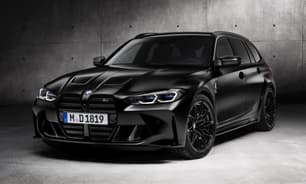
There’s no point waxing too lyrical here, because the facts surrounding the M3 Touring are more than exciting enough.
It’s a (kind of) family friendly wagon with oodles of space and practicality. It’s also an unhinged performance weapon with a thumping 3.0-litre twin-turbo-petrol inline six-cylinder engine.
And it has been years — decades, even — in the making. So, has it been worth the wait? Let’s strap in and find out.
The LDV G10 is a solid option for those buyers who just want a van that gets the job done. It was decent with weight on board, but is probably better suited to parcel carriers rather than pallet shifters.
Safety levels are the biggest concern, as it is falling behind in the class when it comes to active safety tech, and its weak crash test score could be enough to rule it out for some customers.
Long live the mighty wagon. The BMW M3 Touring is treat to look at, and an even bigger treat to drive.
If you want one, act fast. We waited a long time for a wagon-shaped M3, and with electrification increasing in the automotive industry, this will likely be your last chance.
The more you see LDV G10 vans, the more regular they look. Familiarity breeds ignorance, I guess, but I still think the G10 looks smart.
It isn’t quite as boxy as some, with its sleeker front-end styling and almost sedan-like tail-lights helping it stand out from the ‘box-on-wheels’ stigma. It gets 16-inch alloy wheels as standard, and has halogen headlights and misses out on daytime running lights.
But it still is a box on wheels, measuring 5168mm long (on a 3198mm wheelbase), 1980mm wide and 1928mm tall. That makes it a darn sight smaller than the new HiAce, which stepped up significantly in size, and about on par with a Renault Trafic SWB or Ford Transit Custom 300S SWB.
The perceived build quality is mostly okay, though our test car had a few loose plastics on the outside and a seemingly mis-fit windshield rubber.
It looks spectacular, this M3 Touring, and even more so given a) wagons are so rare, and b) proper low-riding performance wagons with massive alloys are even rarer.
That said, I expect it will be polarising – and possibly too shouty for some – but I've got to say, I like it.
I’ve seen it described elsewhere as a bit of a sleeper, but for mine, you’d need painted-on eyes to not see there’s plenty going on with the Touring, especially one finished in the same Frozen Black paint as our test car.
It is at once sleek and swept back, and bulging and aggressive, especially at the flared wheel arches and fat exhausts poking from its diffuser-filled rump.
Inside, it’s mostly business as BMW usual, though with more carbon-fibre elements — our vehicle was equipped with the M Carbon Experience pack — but snug-fitting seats aside, it’s a premium, if performance-focused, place to spend time.
Those dimensions translate to a cargo space of 5.2 cubic metres, with a load space spanning 2500mm long, 1590mm wide (1270mm between the arches) and 1270mm tall. That mightn’t be big enough for you, and that’s too bad - there is no high roof version, nor a long-wheelbase model; but you could get an LDV V80 if you really need to step up in size… but we wouldn’t suggest you do that.
The payload for this model is 1010kg, which is decent but not benchmark-setting. It has a gross vehicle mass of 3000kg, meaning a kerb weight of 1990kg. The gross combination mass depends on the model: the GCM for diesel models is 5000kg for a braked trailer, while petrol models have a GCM of 4750kg for a braked trailer (auto) and 4500kg (manual). All models have a GCM of 3750kg for unbraked trailers.
The petrol versions have 1093kg of payload, if you prefer that fuel type. Interestingly, the manual versions have leaf spring rear suspension, while the auto models have coil springs as part of a five-link suspension architecture.
The load area has a six floor-mounted and four wall-mounted tie-down hooks, and the floor is lined with a vinyl covering while up to half-height the inner walls are lined, too. There are four lights mounted on the walls, which is handy for after-hours work.
And every LDV G10 comes with dual sliding side doors (some brands charge thousands more for this convenience), while the back door is a tailgate as standard, with the option of barn doors for diesel models.
For those who need to fork loads in, the barn doors are a no brainer, because the side door apertures (at 820mm wide) aren’t broad enough to load in using a lift. The tailgate also makes it very difficult to load weight in, as we found on test, as our mates at Crown Lifts had to use long tines to fork in our 750kg ballast.
When it comes to creature comforts up front, there is a pair of low-mounted pop-out cupholders, and an open storage area between the seats. There isn’t much covered storage, so if you often carry valuables, you may need to keep that in mind.
The seats are comfortable and offer good adjustment, and they’ve been changed since the diesel auto model launched. They’re no longer a cheap-feeling fabric, but rather a faux-leather accented, mesh-lined set of seats, and both have armrests. Nice.
The presentation is okay, but the ergonomics could be better. The touchscreen is mounted down lower than most, and means you may need to take your eyes away from the road because the controls are down even lower. And the USB? Near the floor.
That screen is still a 7.0-inch display, but now has the same software system as the newer models in the LDV range. That means a nice crisp colourful display with the added advantage of Apple CarPlay… if you can get it to work. We had a few issues when reconnecting a phone without re-starting the car.
A performance-focused wagon is still a wagon, right? And that means there is oodles of space in the boot, though the seating choices in our test cars made the front seats less comfortable than they could, and should, be.
But first, the boot. The M3 Touring is a 4.8m-long wagon, which pays dividends when it comes to cargo. BMW says you'll find a minimum 500L of storage space, which grows to 1510L with the rear seat folded.
In the back, you’ll find seating for three, with the requisite ISOFIX attachment points, and with enough head and leg room to get comfortable.
But those carbon front seats are an option I wouldn’t be springing for. They arrive carved out of the rock-hard material, though with big holes throughout to reduce their overall weight, and they’re not only challenging to climb in and out of, but they’re awkward and hard to sit behind.
Stick with the regular seats and both rows will be happier.
If you’re buying an LDV G10, it’s because of the price. The cost of the diesel automatic model we’ve got is usually $32,490 drive-away for ABN holders, but there are promotions running listing it at $29,990 drive-away for ABN holders at the time of writing. If you’re not an ABN holder, just get one, because you’ll save heaps (the G10 diesel auto is $34,147 drive-away for non-ABN holders).
You can get other vans for around this money - the Renault Trafic Trader Life manual, with its gutless 66kW turbo-diesel engine, is $30,990 d/a. But you won’t find a diesel Hyundai iLoad, Peugeot Partner or Toyota HiAce within $10,000 of the LDV.
As for standard spec, you get 16-inch alloy wheels, tyre pressure monitoring, climate control air-conditioning, a 7.0-inch touchscreen with USB connectivity, Apple CarPlay, Bluetooth phone and audio streaming, CD player and AM/FM radio, a digital speedometer, two part fake-leather seats with arm-rests (driver’s side with height adjust), carpet flooring up front, and vinyl floor protective liner in the rear, and a reversing camera.
Standard body fit out is dual sliding side doors and a lift tailgate, though you can get barn doors fitted on diesel models. Unlike some competitors, there is no option for glazing in the rear doors or side panels.
There are also no auto headlights, no auto wipers, push-button start, keyless entry, leather-lined steering wheel, reach adjustment for the steering, and there’s quite a bit missing in the safety section of this review - see below.
The BMW M3 Touring lists at $180,100, which isn’t chump change, and positions the wagon body shape a fair way above a regular M3 sedan.
That’s before on-road costs, of course. According to BMW’s website, putting an M3 Touring on the road in NSW will be more like $194,039 — before you start ticking option boxes.
The 'M Carbon Experience' adds $17,500, and reduces overall weight by close to 10kg through carbon bucket seats, and adds more visible carbon and even more possible headroom to fit a helmet
The 'M Carbon ceramic brakes' add another $16,500, and while there are plenty of free paint colours, you can pay up to $7000 for the 'Frozen White' paintwork.
Our test car was finished in 'Frozen Black', a bargain at $5K.
Elsewhere, there is plenty of equipment on a stacked standard features list.
That includes staggered 19- and 20-inch alloys, BMW’s digital 'Laserlight' headlights, and an automatic boot.
Inside, there’s a 'BMW Live Cockpit' with a 12.3-inch instrument display, a 14.9-inch central screen, a head-up display, wireless device charging, Apple CarPlay and Android Auto and a premium Harman Kardon surround sound stereo.
You also get three-zone climate, leather seats, an 'Active M Differential' and 'Adaptive M Suspension', and seat heating up front.
Oh, and there is lots — lots — of performance, but we’ll come back to that shortly.
Under the bonnet of the diesel G10 is a 1.9-litre four-cylinder turbo-diesel with 106kW of power and 350Nm of torque. There’s the choice of a six-speed manual or six-speed automatic, and the G10 is rear-wheel drive. It has a diesel particulate filter, but not stop-start or AdBlue.
Prefer petrol? There’s a 2.4-litre five-speed manual model (105kW/200Nm) or a 2.0-litre turbocharged six-speed auto (165kW/330Nm). Those models are cheaper - $25,990 for the manual for ABN holders, while the turbo-petrol auto is $30,990 d/a.
The M3 Touring’s engine might well be one of the best in the business – a hard-charging 3.0-litre twin-turbo-petrol inline six-cylinder engine that produces a sizeable 375kW and 650Nm.
That power is sent to all four wheels via BMW’s 'M xDrive' with Active M Differential, producing a sprint to 100km/h of just 3.6 seconds.
The combined cycle fuel use claim for the LDV G10 diesel auto is 8.6 litres per 100 kilometres. The manual version uses 8.3L/100km according to the brand.
On test we saw a fuel use return of 9.7L/100km at the pump, across a mix of urban, highway and freeway driving, with and without a load.
Petrol models use a claimed 11.5L (manual) and 11.7L (auto) per hundred.
Officially, you should see a claimed 10.4L/100km on the combined cycle, but as is often the case in cars with engines that tempt you to be aggressive with the accelerator, the reality can be a little different.
We saw more like 16.4L/100km, but in the big bruiser’s defence, we spent a lot of time in city and suburbs, and a lot more time standing on the accelerator.
The M3 Touring is fitted with a 59-litre tank, and will only accept 98RON premium fuel.
Range is close to 570km using the official consumption figure and around 360km using our real-world number.
You probably wouldn’t choose an LDV G10 as a daily driver if you didn’t intend to use the cargo zone at least 80 per cent of the time.
But if - for whatever reason - you really want to use a van like this on a day-to-day basis, you won’t hate it.
The G10 drives pretty nicely for this type of vehicle. It isn’t as bouncy when unladen as some of the other vans out there, with the suspension proving very quick to settle and mostly very compliant across mixed surfaces.
The steering wheel can jostle a bit over sharp edges, but it steers well, with decent (not too heavy) weighting and predictable response at all speeds.
Without weight on board the engine feels reasonably urgent in its response, which is a bit of a surprise because it’s not a powerhouse based on its outputs. It revs smoothly and pulls with good strength, with little turbo lag to contend with. While it is a bit of a grumbly engine at times, the response is better than adequate.
Plus the transmission is well sorted, with smooth shifts that are predictable.
The braking response is definitely better without weight on board, with a decent progression to the pedal and decent bite when you press hard on the anchors.
In a word? Delightful.
Don’t get me wrong, it’s not the easiest car in the world to daily drive. The carbon-fibre seats fitted to ours, for example, made getting in and out a slightly embarrassing challenge, and there’s a surging eagerness to the delivery of power that makes you look a little like you're showing off.
But the adaptive suspension serves up a far more comfortable ride than you might be expecting (more comfortable, in fact, than lesser, cheaper M models), making tootling around town easier and less chiropractic than I was expecting.
But it’s away from the city, with its traffic and red lights, that owning the M3 Touring becomes a delight, from its potent and punchy powertrain to the thrum of its exhaust, and the EV-like immediacy of its power delivery.
This is a driver’s wagon, there’s no doubt about it, with proper seatback-pushing acceleration, direct and confident steering and enough body stiffening and bracing that you really would have no idea you’re driving a wagon when cornering.
Engage its sportiest settings, and disengage its electronic nanny systems, and you can even set to work judging your drifting skills, courtesy of the (as yet untested, honestly) 'M Drift Analyser'.
A family car like few others, then. That you can also take it to Bunnings and throw some sleepers in the back is just a very welcome bonus.
If safety matters to you, this could be your reason not to buy an LDV G10.
The van scored a mediocre three-star ANCAP crash test safety score - which would be more acceptable if that was under the current, strictest criteria, but it was actually tested in 2015. Which means it would be even lower if tested today.
One of the reasons is the safety equipment - there’s not a lot of it. You get dual front airbags, but no side airbags or curtains. There is no advanced tech like auto emergency braking (AEB), no lane keeping assistance or lane departure warning, no blind spot monitoring or rear cross-traffic alert… But you do get a reversing camera and rear parking sensors.
Neither the M3 or M3 Touring have been independently crash tested to date, but it’s worth pointing out the 3 Series and 4 Series received maximum five-star scores from Euro NCAP.
Standard safety kit includes AEB with pedestrian detection, active lane keeping assist, blind spot monitoring, adaptive cruise control and rear cross-traffic alert.
You’ll also find six airbags on board.
LDV isn’t close to the leaders in the segment for ownership, with a behind-the-times three-year/100,000km warranty (admittedly with the same cover for roadside assist), and no capped price servicing plan.
Service intervals are every 12 months/10,000km, which is short, and you need to get an initial service done at 5000km, too.
If you’re worried about long-term longevity, you can check out our LDV G10 problems page.
The BMW M3 Touring is covered by a five-year, unlimited kilometre warranty, and servicing is "condition based", in that the vehicle will tell you what maintenance is required, and when.
You can prepay your service costs at the time of purchase for all BMW vehicles, covering the first five years of ownership.