What's the difference?
This might be Kia's best defence yet against the wave of cheap Chinese SUVs currently crashing against our shores.
It's the Kia Stonic, and this update brings mild hybrid technology, which lowers your fuel bill while upping your power. There's also some new tech stuff and some new safety stuff, as well as a refreshed front-end look.
Critically, though, it's not actually new. The Stonic launched globally back in 2017, before an updated version arrived in Australia around 2021. This is yet another update, albeit a significant one, which means the Stonic has been given dual-cab ute levels of longevity in the market.
All of that should be helping Kia to keep the pencil sharp, with the new range kicking off at $28,180, plus on-road costs.
Not quite China cheap, but not too far off it.
Jeep's Renegade might be late to the mini-SUV party but it comes with a pretty impressive back catalogue to suggest that this is a SUV that can cash the cheques its name can write.
The top of the range Trailhawk can write even bigger cheques than the lower models, bringing with it a range of off-road tech toys to let you really get down and dirty.
Unlike a lot of rivals in this segment, the Stonic's actually quite a bit of fun to drive, and that alone earns it a tick from me.
Yes, it can feel underpowered in places, especially when you're trying to do high-speed overtakes or if you're on a really engaging road and on and off the accelerator. But just cruising around, the little powertrain gives you plenty to get around the city.
And I guess that is the point. This does feel like a very city-friendly vehicle, even if it is undeniably showing its age in places.
Note: CarsGuide attended this event as a guest of the manufacturer with meals provided.
Note: The author, Andrew Chesterton, is a co-owner of Smart As Media, a content agency and media distribution service with a number automotive brands among its clients. When producing content for CarsGuide, he does so in accordance with the CarsGuide Editorial Guidelines and Code of Ethics (https://www.carsguide.com.au/ethics), and the views and opinions expressed in this article are solely those of the author.
Rugged, dependable and good off-road are the most obvious qualities of the Trailhawk. It stands out from the rest of the mini-SUVs by being able to do the S and the U with plenty of vigour.
It's just a shame that its on-road manners can't match that of its big brother, the Cherokee. Unless you're planning on proper off-roading, the Trailhawk might not be quite what you're looking for.
I'm not gonna spend too much time on the exterior design, because from most angles it largely looks a lot like a Kia Stonic, right? The big exterior change occurred up front, where the old Kia 'face' was retired, and replaced with an LED-trimmed front-end more in keeping with modern Kia models.
It is a tale of good and bad in the cabin of the Stonic. The good is the fact that it all feels very familiar and very Kia, which isn't a bad thing.
Th bad is some of the door materials aren't just cheap and hard plastic, but they feel a bit flimsy in places as well. Same with the centre console plastics. There are some elements where you could definitely lift up the ambience in the interior.
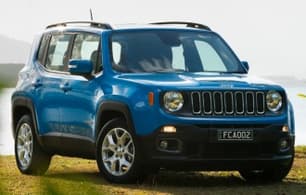
In what is absolutely not a coincidence, the Renegade immediately conjures up the Wrangler. Upright grille from the Willys Jeep (references abound here), round headlights, squared off wheel arches to mimic the Wrangler's guards, short overhangs and big rear view mirrors.
The 17-inch wheels look completely lost in the wheelarches which are even more cavernous owing to the Trailhawk's 50mm of extra ride height. The wheels are also a bit cheap looking but will probably survive the belting the car is intended to take.
Less rugged is the interior, despite a fairly self-conscious effort to make it look and feel chunky. The front seats are flat and unsupportive with the rears just as lacklustre making sure everyone is sliding around together. Luckily, front passengers get a dash-mounted grab handle.
It seems quite well put together, however, but with carpets and easily-marked plastics, you'll hope your passengers don't bring the mud in with them too often. And the "Since 1941" stamped into the steering wheel can go.
The dashboard is reasonably clear and has plenty of information to share via the screen between the dials but whoever thought marking the redline with a water splash graphic in bright orange should probably rethink their design decisions.
Storage is limited to two cupholders up front, door pockets in each door and nets on the front seat backs.
You can have your Stonic in three flavours, the S, Sport and GT-Line, with retail pricing stepping from $28,180, to $32,290, to the range-topping $35,740 respectively.
The S is pretty basic in terms of kit, riding on 16-inch alloys, nabbing LED lights and daytime running lights, cloth seats, manual air-con and a six-speaker stereo. Tech comes via an 8.0-inch central screen with wired Apple CarPlay and Android Auto (but make sure you pack a USB-A cable to make it work, which feels very old school), as well as a 4.2-inch driver display and a smart key with push-button start.
The Sport packs in plenty more. Your alloys are now 17 inches, you get LED front fog lights, and your cloth seats now have synthetic leather trim. You also get centre console storage, single-zone climate control, a better feeling steering wheel and shifter, and rain-sensing wipers. You also get a bigger 12.0-inch central screen, extra USB-C ports and access to the Kia Connect app and over-the-air updates.
Finally, the GT-Line rides on a unique 17-inch alloy wheel design, and nabs a sunroof, heated front seats, a heated steering wheel and ambient interior lighting. It gets the full Kia twin-screen treatment, with two 12.3-inch displays handling infotainment and driving data, and you get a wireless charger.
The Renegade range starts at $28,000 for the 1.6-litre Renegade Sport manual front-wheel drive, climbing between $2000 and $3000 through the Sport Auto, Longitude Auto, Limited Auto with a final jump of $4000 to the 2.4-litre auto-only Trailhawk.
Standard is a nine-speaker stereo with Bluetooth and USB, 17-inch alloys, dual-zone climate control, reversing camera, rear parking sensors, keyless entry and start, cruise control, electric front seats with heating, satellite navigation, automatic bi-xenon headlights, auto wipers, leather trim, roof rails, front and middle bash plates, full size spare, heated leather steering wheel, privacy glass, trailer sway control and tyre pressure monitoring.
The lairy Omaha orange is $500, part of an eleven colour palette with only two no-cost paint options (black and white).
You can add lane departure warning, auto-parking and a black painted roof for $500 each, a removable and retractable roof called My Sky Roof for $2200 or a more conventional electric sunroof for $1900.
The Beats-branded nine-speaker stereo is run via Fiat-Chryser's UConnect system, accessible through the 6.5-inch touchscreen. While it improves with every attempt, it's still quite clunky and when the sat-nav is added, becomes a bit of a mess.
Thankfully, not every function has been crammed into the touchscreen interface, so you'll spend more time with your hands on the wheel rather than working out which bit of the screen has the climate control.
All Stonics get the same powertrain. A clever three-cylinder, 1.0-litre turbocharged petrol engine with 48-volt mild hybrid assistance. That means 88kW and 172Nm (up from 74kW). It has a seven-speed dual-clutch transmission.
We don’t have an official zero-to-100km/h time, but I’m estimating in excess of 10 seconds.
The Trailhawk is powered by Fiat's 2.4-litre four naturally-aspirated four-cylinder producing 129 kW and 230 Nm. Jeep reckons you'll get 7.5L/100km on the combined cycle. Our mostly city driving with a longish motorway run produced an 11.0L/100km average over a week.
The transmission is a nine-speed ZF automatic driving all four wheels.
The Trailhawk also has Jeep's five mode Selec-Terrain system which should cover pretty much every eventuality – Auto, Sport, Mud, Sand and, just for the Trailhawk, Rock. The Trailhawk is rated to tow 400kg unbraked and 907kg braked.
It is a really interesting drive proposition, this Stonic.
First and foremost, it does feel really well sorted in places. The steering has a nice weight to it. It's nice and direct. The ride is comfortable. It can get a little bit crashy over the harsher bumps, which actually isn't all that common in Kia products – like if you hit a cat's eye at speed, for example, you can definitely feel it in the cabin – but generally it's an engaged and comfortable drive.
Similarly, going around corners, even at speed, there's not a huge amount of body roll. The tires grip up pretty well, and it's really not a bad thing to throw around corners.
Where it gets interesting, though, is in its power delivery. At city speeds, so 50 or 60km/h, it's nice and easy and quiet. If you're gentle with the accelerator, and patient, it accrues speed in quite a calm, considered manner, without feeling overly sluggish.
Where it does start to fall apart a little bit, which is when you're at speed, say on a freeway for example, and you pull out to overtake and really plant your foot, and find there's really not a lot there. It can mean overtaking takes a lot longer than you might think.
If you're on a really challenging road and you're kind of on the gas, on the brakes, on the gas and on the brakes, it can feel a little bit wheezy and uncertain, too, which is no doubt a byproduct of that relatively tiny powertrain.
We're definitely not talking rocket ship acceleration, and nor is it all that quiet in the cabin when you really start to wring its neck, which you will do occasionally.
But I think I've really stepped away from what this vehicle is supposed to be and what it's supposed to do. If you are easy with the accelerator, it can be a really calm, quiet cabin experience. And if you do find yourself on a twisting road, it actually sits and grips better than you might be thinking as well.
But there is no doubt the Stonic shines brightest in the city.
The Trailhawk name suggest that things are going to get muddy – compared to the rest of the range, the range-topper rides 50mm higher and has exposed, easy-to-reach tow hooks in the fairly unlikely event you get stuck. It also has a 20:1 low-range crawl ratio and Active Drive 4x4 which means it can switch between front and all-wheel drive. It'll also wade through almost half a metre of water. It's a genuine mud-plugging proposition and will take on some much bigger machinery out in the bush.
On the road, where we spent all our time in the Renegade, it's not what you'd call particularly inspiring. There's a number of sources of noise that contribute to a less than quiet cabin and having to constantly correct your course at freeway speeds adds to the tiring nature of the Renegade.
It's much better at lower speeds, pottering around but then again, its nine-speed transmission needs a lot more work on the shift mapping because it seems to forget which gear it needs to be in when you sink the right foot. If you don't need the Trailhawk's extra off-road goodies, consider the 1.4 litre Limited or Longitude.
There’s no immediate plan to crash test the new Stonic, meaning its five-star rating has now expired.
All models get things like lane keeping assist with lane follow assist, and blind spot collision avoidance and front and rear parking sensors. The S also gets auto emergency braking (AEB) with car, pedestrian and cyclist avoidance, but the Sport and GT-Line both add junction turning to the system.
Seven airbags (including driver's knee bag), traction and stability controls, roll mitigation, blind spot monitoring, ABS and brake assist.
The Renegade does not yet have an ANCAP star rating although it scored five EuroNCAP stars in 2014.