What's the difference?
It's rare to see a Kia Rondo on the road. Spotting one is like when you get a commemorative 50-cent coin in your change, only not as exciting. Yup of the 219,270 cars sold so far this year 59 of them were Rondos. But the more I've driven the base-spec Rondo S - the more I think 219,211 people may have missed out on something quite good.
So what is a Rondo? Is it a van? Is it a hatch? Is it a wagon? Well, Kia calls it a people mover, but while the top-spec Rondo Si has seven seats, the five-seater Rondo S which arrived late in 2016 only has seating for five. Is that enough people to count as a people mover?
As for rivals to the Rondo S, well there's the Citroen C4 Picasso, the Mercedes-Benz B-Class and the BMW 2 Series… aaaaaaand that's about it.
So what is it about the Rondo S that makes me think that many of the 220,000 people may have the wrong choice and bought a SUV when what they really needed was a Rondo, but just never knew it? Oh and what is it about the Rondo that dogs really like? And what's bigger about the five-seater Rondo S than the seven-seater Rondo Si?
The humble station wagon has fallen by the wayside in favour of the ever-popular SUV, however, it was once more common for a very good reason.
It offers the space many families crave without having to upsize into a vehicle that can feel big and bulky.
A lot of drivers enjoy the sportier on-road feel and the good-looking styling that often accompanies a wagon. Enter the Peugeot 508 Sportswagon. A model that proves wagons can be hot.
I’m family-testing the top GT plug-in hybrid model this week but there’s not a lot to compare it to because of the interesting engine specs.
So, we’re being a bit cheeky and doing an ‘apples with oranges’ comparo instead.
Being on the premium end, the 508 Sportswagon faces competition from the Audi A4 Allroad 45 TFSI, Genesis G70 Shooting Brake and Volvo V60 Cross Country Ultimate.
It certainly has the looks to turn heads but we’re sussing out whether it’s a practical alternative for families, too.
If you're thinking of getting an SUV because you like to sit a little higher up and want a car with plenty of room and a big boot, but don't head off-road ever, then you may be better off in a Rondo S which drives more like a car and has much of the benefits of an SUV.
The Peugeot 508 Sportswagon GT PHEV proves wagons can be extremely stylish but looks aren’t everything and it is an expensive option compared to its luxury rivals. It earns its place with the premium interior but the safety could be improved on and the tech is more confusing than it needs to be. But this wagon offers an alternative for families who are sick of being in an SUV yet still need a little extra space.
My son didn’t go nuts over this and complained about his view.
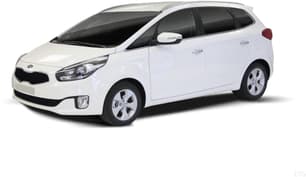
The Rondo has a mini-people mover shape with a horizontal and high roof, an upright back and a heavily raked windscreen and pointy nose. The headlights look too big for its face but that's kind of cute in a manga-cartoon way.
Take a look at the dimensions for the Rondo S - it's bigger than you might think. At 4525mm end to end it's 45mm longer than a Kia Sportage mid-sized SUV, and 35mm shorter in height at 1610mm tall. It's 35mm narrower than the Sportage, too, at 1805mm across.
Clearance is about the same as a regular car at 151mm but the driving position is higher – though not as high as the Sportage's.
Inside the dashboard and steering wheel are low, the windscreen is enormous and those A-pillars either side of it are long.
On the outside you can tell a Rondo S from the top spec Rondo Si by the wheels – the S has plastic hubcaps and the Si has alloys. You can spot a Rondo S from the inside by the tiny media screen and the chunky plastic steering wheel – the Si gets a bigger screen and sleeker looking wheel.
The cabin is stylish with the brushed aluminium look trim and dark materials. The CarsGuide photographer told me he liked its '80s retro look – thing is I'm pretty sure the designers weren't trying to go for an ironic retro feel.
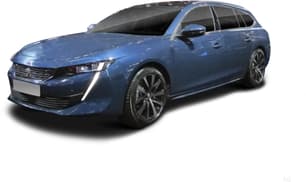
The design of this wagon is what wins it the most points. It is a damn fine specimen with the sleek lines in the body panelling and the sexy rear that looks well-proportioned for its 4790mm length.
Dark, narrow windows, 18-inch alloy wheels and a minimalist-looking nose, with fang-like daytime-running lights, all enhance its sporty look.
The rear lights have Peugeot’s signature ‘claw’ design and there’s something suggestively fun about seeing a twin-exhaust on a wagon!
On the interior, the multimedia system takes centre stage and the dashboard looks quite sleek, despite all of the deep cutaways.
The steering wheel is in the compact style that Peugeot is known for but it makes the cockpit feel driver orientated.
The quilted Nappa leather trims and shiny piano-black accents (with the piano-key controls) make for a refined cabin space.
The Rondo has enormous rear doors that are light and easy to swing open and when they do you have a wide and tall entrance which makes getting in and out easy. That's good news if you're not as agile or young as you used to be or if you're a parent putting kids into car seats. I find I almost double over when putting my toddler into his car seat in small cars, but the Rondo's seat height is elevated enough that there's less of a bend needed. The step to get in is low, too.
The second row is made up for three individual seats rather than a single bench seat. The legroom in all of them is excellent and even at 191cm tall I can sit behind my driving position with two finger-gap between my knees and the seatback.
Headroom is outstanding and even with my big hair I still have about 20cm of clearance.
The Rondo was already so impressively practical and roomy that it could have been terrible to drive and it still would be worth buying.
The cargo volume of the Rondo S is 536 litres, and that's 44 litres more than the boot space in the seven-seater Rondo Si which loses luggage capacity because of the foldable third row seats and 130 litres more than the Sportage's boot.
Under the boot floor is like a giant bento box of storage compartments with three equal-sized large rectangular areas big enough for handbags, shoes and laptops, a smaller shoe boxed-sized area and a tiny hidey hole big enough for my phone. Also in the boot on the right-hand side wheel are elasticised straps for – picnic blankets or whatever else you don't want flapping about in there.
There's shoe-boxed sized storage under the floor in the second row, on both sides, too.
The centre seat in the back folds flat and being hard-backed can act as a table, it also has three cup holders moulded into it. There's another two cup holders up front and giant bottle holders in all doors.
The Rondo is just as practical as many SUVs if not more so.
And here's a random Rondo fact for you – the Rondo is pretty popular with dog owners because the height of the roof means their hounds can stand up and turn around. Yup dogs love the Rondo.
The front row gets the most space and you’ll be able to get into a comfortable position even if you’re tall.
However, it is a low car with its 142mm ground clearance and there may be a few grunts as you get in and out (or is it just me?).
My seven-year old loves how easy it is to climb in, though he didn’t have the best view out of the windows because the sills sit high.
The footwell lip also sits quite high, which isn’t an issue until you can’t open your door very wide and then it’s clumsy in a tight parking space.
The electric front seats are very comfortable and the extendable under-thigh support helps to minimise leg fatigue on a longer journey.
Surprisingly, for my 168cm (5'6") height, I have to sit much further back than I ordinarily would to get a comfy driving position.
In the back, you have plenty of headroom but behind my driving position, the legroom could be better.
An adult would still find it fairly comfortable on a longer journey so long as they aren’t behind someone tall. The seats themselves are well-cushioned and you sit in, rather than on top of them.
Individual storage options are good for this class with a dual-opening middle console, glove box and a great utility cubby next to the transmission shifter.
There is also a shelf underneath the centre console that houses the wireless charging pad and two USB-A ports but it’s a tad awkward to use and even see the ports when you're seated.
The amenities are good in the rear but for a top-spec model it’s lacking the luxury items you might expect, like heated seats and climate control but you’ll enjoy map pockets, reading lights, two USB-A ports and directional air vents.
It also has a fold-down armrest with two shallow cupholders, that in a quick turn, might spill their cups!
The boot is a great size at 530L with all seats in use and you can bump it to 1780L with the rear seats folded.
You get a level loading space and a 60/40 split with a ski-port in the back seat, which opens up your storage options.
There is a tyre repair kit rather than a physical spare but the tailgate is powered, which I always like.
The technology is a mixed bag. It looks sharp and the touchscreen multimedia system is responsive but isn’t as easy to use as others I’ve sampled.
It doesn’t have a lot of accessible information or customisations available but it is easy to connect to the wired Apple CarPlay. There is also wired Android Auto for those users and built-in satellite navigation.
The 12.3-inch digital instrument panel is the prettiest piece of tech in the car and there is more customisation available to make it feel yours.
Considering its price point and top-model status, it's more obvious that you miss out on premium items like three-zone climate control, faster USB-C connections and a head-up display.
The Rondo S lists for $26,990. The $40,990 Citroen C4 Picasso is the closest in price to the Rondo S, while the Mercedes-Benz B180 is $42,400 and BMW 2 Series Active Tourer starts at $49,100.
It has to be said, the Rondo S isn't a prestigious as those rivals and the standard features aren't as extravagant. Still the basics are covered with a 4.3-inch touch screen with reversing camera, rear parking sensors, six-speaker stereo, Bluetooth connectivity, CD player, cloth seats, auto headlights, tinted glass, cruise control, and air conditioning with vents in the second row.
That screen is pretty small – like business card small, and that means the image for the reversing camera is a bit hard to make out at times.
The Rondo S is still good value though at this price.
Keeping things simple, there are only two variants for the 508 Sportswagon and our test vehicle is the top GT plug-in hybrid model that will cost $82,915 before on road costs.
That’s a $1000 price hike from last year and sets it well above its rivals with the Audi A4 coming closest at $78,169 (MSRP).
Given its rivals are well known for their luxury, the 508 has a fair bit to live up to but its styling and use of premium materials, like the quilted Nappa-leather trims, help it earn its position within the ranks.
The interior gets some other lovely big-ticket items with the eight-way electric front seats and a two-way memory position function on the driver’s seat.
Both front seats feature a heat function, adjustable lumbar support and a fabulous massage function. The ‘Cat Paw’ option is particularly nice!
However, the back seat misses out on these ‘top-end’ creature comforts.
There is a sunroof optioned on our test vehicle which adds $2500 to the price tag but creates an airy cabin in what would ordinarily be a bat-cave-esque space with that black headliner.
Only one colour is included in the price and our ‘Pearl White’ costs an extra $1050.
Technology has been revitalised with a new 10-inch touchscreen multimedia system and a 12.3-inch digital instrument cluster.
Dual-zone climate control, push-button start, keyless entry and a powered tailgate all add some practicality to every day life, too.
Phone mirroring tech like wired Apple CarPlay and Android Auto are easy to connect to and there are a bunch of charging options available throughout the car, including a wireless charging pad up front.
All-in-all, though, the features list isn’t as long as the price point might suggest.
There's one engine in in the Rondo range – it's a 122kW/213Nm 2.0-litre four-cylinder petrol and it comes with a six-speed automatic transmission. A manual gearbox isn't available.
You may hear the engine called a GDI, don't let then name throw you – it's not a diesel. The acronym stands for Gasoline Direct Injection.
The GT plug-in hybrid model has a 1.6-litre, four-cylinder turbo-petrol engine, as well as an electric motor that sits on the front axle. It has an eight-speed automatic transmission that produces smooth gear changing driving the front wheels.
The combined outputs are 165kW and 360Nm which means you have a good amount of power for this sized car but it’s not a performance wagon as its 0-100km/h sprint time is 8.3 seconds.
The lithium-ion battery has a small 11.8kWh capacity and will get from 0-100 per cent in three and a half hours on an 11kW system. On my standard house plug, it took closer to six and a half hours.
Kia says the Rondo's average combined fuel consumption is 7.9L/100km or 10.8L/100km if you're keeping it urban. Our test vehicle was thirstier and was driving at a rate of 10.1L/100km according to the trip computer over a week of highway and urban use, while our city commuting saw usage jump to 17.4L/100km.
Peugeot says you can travel up to 55km on pure electric function, however my morning (return) school run is 38.4km and the electric range was spent by the time I parked in my garage after starting on a full charge.
Under optimal conditions, where you’re utilising both the engine and motor, the GT PHEV has an official fuel cycle consumption of 1.5L/100km.
After charging it three times, travelling 444km on a mix of open/urban roads and using 33 litres of fuel, my real-world usage came to 7.4L/100km.
You absolutely get the best economy when you regularly charge it but sometimes you just don’t get the time to!
You'll need 43 litres of premium 95 RON unleaded fuel to fill the tank which, using our real-world average consumption figure, translates to a driving range of around 580km.
You know what? The Rondo was already so impressively practical and roomy that it could have been terrible to drive and it still would be worth buying, but its on-road performance was pretty impressive.
Look, the brakes can be a bit bitey, acceleration on take-off is sharp and then the engine seems to run out of oomph and just get noisier at higher speeds, but those are my only real complaints, because the ride is composed and comfortable, the steering feels smooth and light, while the handling is impressive. I took the Rondo through the same test loop as all my test cars and it performed better than many in this price range.
Being lower to the ground gives the Rondo better dynamics than many SUVs, too. Corners that cause a good degree of body roll and tyre chirp in a Sportage or RAV4 saw the Rondo coast through perfectly stable and unfussed.
The A-pillars do obstruct visibility and at one set of traffic lights, the only way I knew I had a green arrow was because the bloke behind me was leaning on his horn. But there are small port-hole windows integrated into the A-pillars that help with visibility.
The 508 Sportswagon is an odd car to drive. Around the city, the steering makes it feel like you’re in a go-kart and you may over-correct until you get used to it.
On the open-road, it feels like it gets into its groove but the power reserves feel a tad too shallow as the engine can complain with only a light load.
The suspension is well padded and you won’t notice too many bumps but you do get a fair bit of wind and road feedback at higher speeds.
Because of the narrow windows, I am surprised by how great the visibility is but you feel tiny when you sit next to a big SUV in traffic!
That said, it corners beautifully and taking this on a winding coastal road is super fun.
The brakes are very responsive, which is great in stop-start city traffic but can make it feel a little jerky while navigating a car park.
And on that note, because of the funky steering feel, it takes a moment to calibrate your senses with what the car is doing.
Once you get used to it, it’s simple to park but the quality of the 180-degree camera system is pretty rubbish for where this car sits in the market.
The Rondo has the maximum five-star ANCAP rating. There's nothing in the way of advanced safety equipment – that means no AEB, blindspot or rear cross traffic warning. But there is the expected traction and stability control, plus ABS.
In the second row you'll find three top tether anchor points and two ISOFIX points for child seats.
The 508 has most but not all of the safety features you expect to see in a family car.
The active bonnet is a great feature as it lifts up in a collision to help minimise pedestrian injuries.
However, in the modern market and this being a top-spec model, I am surprised it's lacking a few safety features, namely rear cross-traffic alert.
Other standard safety equipment includes blind-spot monitoring, LED daytime running lights, forward collision warning, lane keeping aid, lane departure warning, intelligent seat belt reminders, front and rear parking sensors, a 180-degree view reversing camera, traffic sign recognition, a driver attention monitor, and adaptive cruise control with stop and go functionality.
The 508 has a maximum five-star ANCAP safety rating from testing done way back in 2018 and it only sports six airbags, which is low for a family vehicle.
The 508 has autonomous emergency braking with car, pedestrian and cyclist detection and is operational from 10.0– 80km/h (5.0 – 140km/h for car).
There are ISOFIX child seat mounts on the outboard rear seat positions and three top tethers in the second row but two child seats will fit best. Front passenger comfort may be compromised when a 0-4 rearward facing child seat is installed.
The Rondo is covered by Kia's seven year/unlimited kilometre warranty. There's capped price servicing for seven years, too. Servicing is recommended every 12 months or 15,000km and is capped at $299 for the first service, $375 for the second, $361 for the third, $398 for the fourth, $336 for the fifth, $470 for the sixth and $357 for the seventh.
On the 508 you’ll enjoy a five-year/unlimited km warranty and the battery is covered by an eight-year or up to 160,000km warranty, which is great.
You can pre-purchase either a three- or five-year servicing plan and the five-year plan costs a flat $2100 or an average of $420 per service which is very reasonable for this class.
Servicing intervals are at every 12months or 20,000km, whichever occurs first.