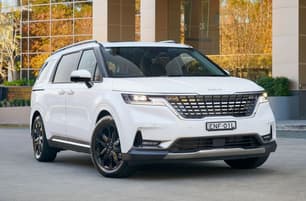
What's the difference?
This is actually the Carnival that Kia always wanted.
See, the last Carnival, the one this replaces, was Covid compromised, missing out on key technologies, as well as skipping an in-depth ride and handling localisation program, due to part supply issues and a freeze on international travel.
This one, though, addresses all of that, which is why you get a new cabin experience, new tech, and a complete overhaul of the steering and handling.
It is, however, significantly more expensive, right across the range.
So, is the Carnival still worth it? Let’s find out.
Cub Campers is Australia’s oldest camper-trailer manufacturer and one of the oldest businesses in the caravan and camping industry, having just celebrated 50 years of operation in 2018.
The company can lay claim to inventing the soft-floor camper trailer, pioneering the rear-fold and championing off-road campers when everyone else was concerned with the on-road market. Amongst all that, though, it was late to the game when it comes to forward-fold campers, not releasing the Frontier until early in 2016, well after the flood of Chinese manufactured versions became immensely popular. So why did Cub wait so long and was it worth it?
Ok, here's the rub. Everything you just read could well be pointless. You like the Carnival. In fact, it sometimes makes up close to 90 per cent of the sales in its segment, and outsells all of its competitors combined.
So whether I like it or not, I suspect you'll be buying one anyway.
But I can say this - the new Carnival improves the formula right across the board. Well, everything except for price.
All in all, the Frontier is the best forward-fold camper on the market, although it is also the most expensive. If you were making a buying decision purely based on features, you’d probably look elsewhere, but if you are prepared to pay a little more because this camper-trailer is Australian made, you get a very functional camper that’s easy to set up, reliable, strong and light.
The Carnival measures 5115mm in length, 1995mm in width and 1775mm in height, and it rides on a sizeable 3092mm wheelbase.
And those mini-van dimensions have a predictably positive impact on luggage space, with room growing from 627 litres with all seating rows in place, to a massive 2827 litres with the third row stowed.
The key practicality perk here, though, is space, and lots of it. At 175cm, there was ample room for me in the middle row, and you can configure the cabin to your liking, too. You can slide the row on rails, for example, to prioritise leg room where you need it, and the middle seat folds down to reveal cupholders in a kind of hard plastic travel tray.
But even in the third row I could easily get comfortable, though head room begins to get a little tighter. There are cupholders and USB connection points, too, and I can honestly say you could send full-size humans back there and not feel overly guilty about it.
The Carnival will tow 2000kgs braked, too.
The real appeal of a forward-fold camper-trailer is the internal configuration. Because the bed folds out over the front of the camper, the trailer body is configured with a wrap-around lounge and dinette area, that also converts into a bed. It brings a certain level of caravan comfort to a camper-trailer-sized package. Cub’s execution is quite good. The lounge is comfortable and the dinette table is highly adjustable up and down or around and around. It converts into a bed more simply than any other on the market I’ve seen.
The downside of the forward-fold concept is the quantity and access of storage. Very little of the internal storage is easy to get to, and in truth there’s very little of it. That’s what happens when you put a couch in a trailer, sorry. There are hatches under the seats, but even they are limited by the slide-out kitchen and battery box across the back, plus, they’re not as easy to get to as a drawer. It’s the same in every manufacturers version, though. However, the Frontier has one unique features that makes it stand out – a series of pigeon holes under the foot of the bed which provide the only easy-to-access internal storage in any forward-fold I’ve come across so far.
Forgive the horrific paraphrasing, but it seems rumours of the death of diesel have been greatly exaggerated, at least when it comes to the Kia Carnival.
Get this – diesel sales make up some 90 per cent of the Carnival's total haul, with petrol providing a pittance towards the sales total, presumably being picked up by fleet buyers.
And to be honest, that means nine out of 10 people are making the right choice here. Yes, the petrol makes more power, but it's the torque on offer from the diesel that makes pushing the Carnival around feel far more effortless.
The petrol engine can definitely get you moving, but it feels a bit too rev-happy and thrashy when you really put your foot down, and its significantly thirstier to boot.
The diesel isn't perfect – the thrum of the engine is a constant companion whenever you put your foot down, and there's actually too much torque on offer at times, like if you're accelerating up hill from a standstill on a damp road, and so the front tyres can scrabble and scramble for grip.
But it otherwise so perfectly suits the nature of the Carnival that it is definitely the best and most satisfying choice.
Another big change for this update is the fact that Kia's complete ride and handling program has been rolled out here. Kia says local work done on the outgoing car, the one this replaces, was curtailed by Covid and bushfires, and so ended up being done by correspondence.
This one, though, has had the whole enchilada thrown at it, and it shows. They've succeeded in making a bigger car feel smaller around you. It's not a sports car by any measure, but nor does it ever feel too big and unwieldily.
Part of that is down to the steering, which is direct and confidence inspiring, but mostly I suspect it's because of the ride, which is firmer than you might expect in a family hauler, but also offers a connection to that road below that makes you feel in control.
Whether a firm-ish ride is a perk or negative is up to you, but it definitely works for me.
The Frontier is quite good under tow. Cub designed and manufactures its own coil-spring independent suspension and has paid quite close attention to the balance and dynamics of the trailer.
As it’s not overly heavy, it’s not a handful, even on the beach, and behind the Mitsubishi Triton I tested it with, it was barely a struggle. On the road, the camper is well behaved, easy to see over and around and because it’s not very long, it’s not very daunting.