What's the difference?
Jeep's Renegade might be late to the mini-SUV party but it comes with a pretty impressive back catalogue to suggest that this is a SUV that can cash the cheques its name can write.
The top of the range Trailhawk can write even bigger cheques than the lower models, bringing with it a range of off-road tech toys to let you really get down and dirty.
That the 2020 Mini Clubman John Cooper Works is the most powerful Mini to have landed in Australia isn’t all that surprising. After all, parent company BMW has squeezed the thumping four-cylinder engine from the M135i under its bonnet, and that thing creates a snarling beast of any vehicle it finds a home in.
What is a surprise, though, is that having now driven this angry, crackling, snarling hot hatch, what with its burbling exhaust and properly rapid acceleration, is that it took Mini this long to get around to doing it.
So does the engine upgrade now put the Clubman JCW on the same pedestal as the best European hot hatches? There's only one way to find out.
Rugged, dependable and good off-road are the most obvious qualities of the Trailhawk. It stands out from the rest of the mini-SUVs by being able to do the S and the U with plenty of vigour.
It's just a shame that its on-road manners can't match that of its big brother, the Cherokee. Unless you're planning on proper off-roading, the Trailhawk might not be quite what you're looking for.
The Mini Clubman JCW is quirky in a lot of the right ways, and now has a hard-charging engine to up the adrenalin factor. If you were already sold on the idea of joining the Clubman club, this one will steal your heart more than any other.
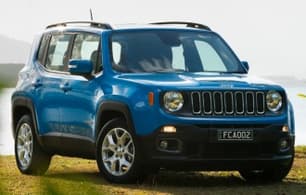
In what is absolutely not a coincidence, the Renegade immediately conjures up the Wrangler. Upright grille from the Willys Jeep (references abound here), round headlights, squared off wheel arches to mimic the Wrangler's guards, short overhangs and big rear view mirrors.
The 17-inch wheels look completely lost in the wheelarches which are even more cavernous owing to the Trailhawk's 50mm of extra ride height. The wheels are also a bit cheap looking but will probably survive the belting the car is intended to take.
Less rugged is the interior, despite a fairly self-conscious effort to make it look and feel chunky. The front seats are flat and unsupportive with the rears just as lacklustre making sure everyone is sliding around together. Luckily, front passengers get a dash-mounted grab handle.
It seems quite well put together, however, but with carpets and easily-marked plastics, you'll hope your passengers don't bring the mud in with them too often. And the "Since 1941" stamped into the steering wheel can go.
The dashboard is reasonably clear and has plenty of information to share via the screen between the dials but whoever thought marking the redline with a water splash graphic in bright orange should probably rethink their design decisions.
Storage is limited to two cupholders up front, door pockets in each door and nets on the front seat backs.
It's no real secret that earlier iterations of the Clubman were, well, a little challenging on the eye (Mini itself says “It was cool - if you were built that way…").
But this face-lifted version is much easier on the eye, if not as a cute a package as the three-door hatch variants. It's dimensions - long, smooth sides, a squared-off rump and bulging grille - somehow work as one to create car that is undoubtedly unique, but also rather fetching.
Inside, it’s all pretty familiar Mini, what with the circle screens and jet-style switches. And it is a stylish space in the cabin, with a good material mix and the addition of wireless Apple CarPlay and Android Auto making the centre screen far more functional.
The only downside is that, for mine, it favours that style over substance. It’s not the most user-friendly space I’ve ever sat in, though I imagine you’d get a little more used to it the more time you spent in there.
The Renegade range starts at $28,000 for the 1.6-litre Renegade Sport manual front-wheel drive, climbing between $2000 and $3000 through the Sport Auto, Longitude Auto, Limited Auto with a final jump of $4000 to the 2.4-litre auto-only Trailhawk.
Standard is a nine-speaker stereo with Bluetooth and USB, 17-inch alloys, dual-zone climate control, reversing camera, rear parking sensors, keyless entry and start, cruise control, electric front seats with heating, satellite navigation, automatic bi-xenon headlights, auto wipers, leather trim, roof rails, front and middle bash plates, full size spare, heated leather steering wheel, privacy glass, trailer sway control and tyre pressure monitoring.
The lairy Omaha orange is $500, part of an eleven colour palette with only two no-cost paint options (black and white).
You can add lane departure warning, auto-parking and a black painted roof for $500 each, a removable and retractable roof called My Sky Roof for $2200 or a more conventional electric sunroof for $1900.
The Beats-branded nine-speaker stereo is run via Fiat-Chryser's UConnect system, accessible through the 6.5-inch touchscreen. While it improves with every attempt, it's still quite clunky and when the sat-nav is added, becomes a bit of a mess.
Thankfully, not every function has been crammed into the touchscreen interface, so you'll spend more time with your hands on the wheel rather than working out which bit of the screen has the climate control.
Mini is rolling the dice on a new specification strategy designed to take the endless questions and options out of buying a new car.
And so the Clubman JCW is the first Mini to be offered in the Pure trim ($57,900), which seriously limits the personalisation options to get you out of the dealership and behind the wheel as quickly as possible. You can choose from two wheel choices, four exterior paint choices, a back roof or a sunroof, and, well, that's about it.
Outside, your money buys you 18-inch alloys wrapped in Michelin rubber, adaptive suspension, roof rails and LED head and taillights. Inside, expect cloth sports seats, an 8.8-inch screen that's both (wireless) Apple CarPlay and Android Auto equipped, standard navigation, climate control with rear vents and push-button start.
If the Pure doesn't give you enough options, then the regular Clubman JCW ($62,900) will add 19-inch alloys, leather seats, a 12-speaker Harman Kardon stereo, a head-up display and heated front seats. Oh, and all the personalisation options you shake your credit card at.
The Trailhawk is powered by Fiat's 2.4-litre four naturally-aspirated four-cylinder producing 129 kW and 230 Nm. Jeep reckons you'll get 7.5L/100km on the combined cycle. Our mostly city driving with a longish motorway run produced an 11.0L/100km average over a week.
The transmission is a nine-speed ZF automatic driving all four wheels.
The Trailhawk also has Jeep's five mode Selec-Terrain system which should cover pretty much every eventuality – Auto, Sport, Mud, Sand and, just for the Trailhawk, Rock. The Trailhawk is rated to tow 400kg unbraked and 907kg braked.
This is a cracking engine; a twin-charge, 2.0-litre, four-cylinder weapon that sends 225kW and 450Nm thundering to all four tyres.
That power is funnelled through an eight-speed automatic transmission, and will see the Clubman JCW clip 100km/h in 4.9 seconds before pushing on to a 250km/h.
The Trailhawk name suggest that things are going to get muddy – compared to the rest of the range, the range-topper rides 50mm higher and has exposed, easy-to-reach tow hooks in the fairly unlikely event you get stuck. It also has a 20:1 low-range crawl ratio and Active Drive 4x4 which means it can switch between front and all-wheel drive. It'll also wade through almost half a metre of water. It's a genuine mud-plugging proposition and will take on some much bigger machinery out in the bush.
On the road, where we spent all our time in the Renegade, it's not what you'd call particularly inspiring. There's a number of sources of noise that contribute to a less than quiet cabin and having to constantly correct your course at freeway speeds adds to the tiring nature of the Renegade.
It's much better at lower speeds, pottering around but then again, its nine-speed transmission needs a lot more work on the shift mapping because it seems to forget which gear it needs to be in when you sink the right foot. If you don't need the Trailhawk's extra off-road goodies, consider the 1.4 litre Limited or Longitude.
Yes, this is the most powerful Mini to have landed in Australia. And even better, it’ll remain so, or at least equal first, when the Mini GP arrives next year. That car gets this same thumping engine, and the outputs are the same, though the smaller, lighter hatch will no doubt be faster.
It means Clubman JCW shoppers aren't about to lose their street credit, with this engine likely to remain the king of the castle for some time yet.
The Clubman It might tip the scales at 1550kg, but the kilos don’t hurt its straight line speed much. Whack it in sport mode, which also adds this deep bass to the exhaust, plant your right foot and the Clubman positively pounces forward.
Better still, it feels - and sounds - quick, too, There’s this angry snap and crackle on the overrun, and the exhaust genuinely booms in the cabin when you really bury your foot.
You’ve heard the cliches before, of course, about Minis feeling like they’re on rails, and we won’t waste your time with those here. Suffice to say we have pushed Clubman around some pretty tight corners at some pretty decent speeds, and while it doesn’t feel like a featherweight, it also picks and sticks to a line with absolutely no nonsense from the tyres and very little in the way of body roll.
That’s the good, now the not so good. The impressive handling feels like it’s been achieved by hardening up the suspension as much as possible, and the downside of that is that it can feel plenty sharp and bouncy over big bumps. On the right road, it kind of adds to the experience, but I'd imagine the daily commute would start to fray your patience fairly quickly.
There’s also a kind of skittishness to the way it drives fast too, which I actually don’t mind, but others might say isn’t as natural and flowing as others in the segment.
But this is the hardest, fastest clubman you can buy, and so you’re going into it knowing there’s going to be some comfort compromises. And if you’re looking a loud and rorty hot-hatch experience, this thing delivers in spades.
And on the right stretch of road, it’s an absolute hoot.
Seven airbags (including driver's knee bag), traction and stability controls, roll mitigation, blind spot monitoring, ABS and brake assist.
The Renegade does not yet have an ANCAP star rating although it scored five EuroNCAP stars in 2014.
The Clubman JCW arrives with six airbags, a reversing camera, AEB, active cruise, forward collision warning and front and rear parking sensors and what Mini calls Performance Control, which it promises will reduce understeer and increase traction in corners.
The Mini Clubman was awarded the full five-star ANCAP safety rating when tested in 2017.