What's the difference?
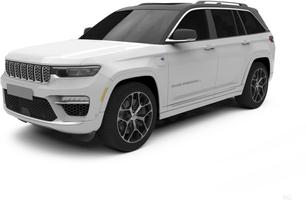
Jeep Australia's first plug-in hybrid, the Grand Cherokee 4xe, has arrived at a time when the company’s sales figures need a decent shot in the arm.
Though it’s seemingly spearheading a large and extra-large SUV hybrid push into the Aussie market, with the likes of a Toyota LandCruiser 300 Series hybrid on its way, the marque’s debut PHEV is only available here in the range-topping Summit Reserve spec, and only as a five-seater.
So, does the 4xe have enough of a jump on any large SUV hybrid rivals – including a rumoured but postponed Ford Everest hybrid – and is it enough to give the brand a much-needed boost?
Read on.
Toyota’s legendary LandCruiser 70 Series has built a loyal following as rock-solid as Uluru across remote regions of Australia, thanks to a combination of back-to-basics ruggedness, bulletproof dependability and heavy load-hauling ability.
However, Ford has recently launched a compelling alternative with the Ranger Super Duty, which it claims has been engineered from the ground up to meet the toughest demands of remote work environments. And with 2.0-tonne payload and 4.5-tonne tow ratings superior to Toyota’s outback legend, the Super Duty is in a class of its own that did not previously exist.
We recently spent a working week aboard the new Ford to assess if it’s worthy of the revered Super Duty nameplate and how it measures up for urban and regional tradies alike.
A wise man* once said "Being first can sometimes feel like being wrong" and perhaps that's how it is with the 4xe, but at least Jeep Australia is giving the large SUV hybrid realm a good ol' try.
* Former CarsGuide Big Kohuna, Glen Knowles.
The company's first plug-in hybrid, the Grand Cherokee 4xe, is not perfect by anyone's standards, however, it is a definite move in the right direction.
It's a quiet and refined drive, it retains the brand's renowned 4WD capability, and even its hefty price-tag likely won't dissuade Jeep loyalists from giving it a go.
The Super Duty is the most formidable workhorse in the Ranger fleet. It projects a feeling of immense strength each time you drive it, reflecting payload and tow ratings well beyond traditional limits for vehicles of this size combined with formidable all-terrain capabilities. For tradies wanting the ultimate Ranger workhorse, the Super Duty is clearly in a class of its own - a class which it created.
The Super Duty, originally based on Ford’s F-series full-size US pickup range, has been a mainstay on farms, building sites and in remote terrain since its inception as a standalone model in 1998, but this is the first time the nameplate has been applied to the Aussie designed and developed Ranger.
Ford claims the Ranger Super Duty resulted from extensive consultation with workers in industries that depend on their trucks in the harshest remote environments, from forestry crews and emergency service workers to land managers and fleet teams.
The challenge was to create a medium-sized truck with higher payload/tow ratings and greater all-terrain capability, as the only vehicles strong enough to carry their gear were too big and unwieldy to access critical locations.
In response, the Ranger Super Duty features a unique reinforced version of the Ranger’s chassis frame, incorporating readily accessible mounting points for a variety of aftermarket accessories and specialised equipment.
There’s also a new heavy-duty rear axle assembly with the largest and strongest differential ever fitted to a production Ranger for enhanced load-carrying capacity, paired with a unique uprated version of the US Bronco Raptor’s front diff.
The two-speed transfer case also has larger and stronger components than the regular Ranger and its low-speed gearset has been upgraded to match the F-series Super Duty.
Other chassis enhancements include uprated eight-stud wheel hubs with stronger bolts, improved cooling system to manage engine temps under heavy loads and during sustained off-road driving, a sealed engine snorkel and high-mounted breathers for the drivetrain/fuel system to enable its 850mm wading depth (50mm deeper than standard Ranger) and more. There was also a brutal and prolonged durability testing program to validate its Super Duty status.
Off-road credentials include steep 36.3 degrees approach, 26.9 degrees ramp breakover and 29.3 degrees departure angles, 299mm ground clearance and an expansive 13.6-metre turning circle which is the largest of all Ranger variants including the wide-tyred Raptor.
The Jeep Grand Cherokee Summit Reserve 4xe PHEV retains the regular model’s level of functionality but adds a reasonably classy touch to everything.
All seats offer adequate comfort, support and room.
There are plenty of storage spaces, cupholders etc, and charging points - two USB-A and two USB-C plus a 12V socket in the front and two USB-A and two USB-C plus a 230V point in the back.
Controls are generally easy enough to locate and operate although some buttons are positioned in awkward places – including drive-mode buttons under the steering wheel – and it sometimes takes a few finger-stabs at the multimedia touchscreen to get to where you want to go in the operating system.
In terms of packability, the rear cargo area has a listed 1067 litres of space, and, with the second row folded and out of the way, that space opens up to 2004 litres.
Proof of the increased solidity of the Ranger Super Duty single cab-chassis is its hefty 2518kg kerb weight, which in bare cab-chassis form (without tray) is 625kg more than a standard 2.0L Ranger XL single cab-chassis 4x4 equivalent.
The Super Duty’s 4500kg GVM results in a huge 1982kg payload limit. It’s also rated to tow up to 4500kg of braked trailer and with its towering 8000kg GCM (or how much it can legally carry and tow at the same time) it can tow its maximum 4.5 tonne trailer weight while hauling almost one tonne of payload.
These are big numbers when compared to our standard XL Ranger example, given that the Super Duty has a 645kg higher payload rating, 1000kg higher tow rating and 1650kg higher GCM rating.
The galvanised full steel tray is equipped with six internal load anchorages, each rated up to 1800kg, which lie flush with the checker-plate floor when not in use.
There’s also external rope rails beneath the tray along each side and a sturdy front bulkhead with wire-mesh rear window protection.
As previously highlighted, this tray ensemble includes a driver-side lockable toolbox and passenger-side water tank (complete with handwash pump bottle) mounted behind their respective rear wheels.
Its work-focused interior is a comfortably familiar place for Ranger single cab-chassis workhorse owners, with fabric bucket seats, wipe-clean vinyl floor and large ‘Super Duty’ lettering embossed in the passenger side dash.
Cabin storage includes a bottle-holder and bin in each door, pop-out cupholders on each side of the dash, an overhead glasses holder, upper/lower glove boxes plus a well-equipped centre console with wireless phone charging, USB ports, two cupholders, 400W (230V) inverter and a storage box with internal 12V socket and padded lid that doubles as an elbow rest.
The five-seat Jeep Grand Cherokee Summit Reserve 4xe PHEV has a MSRP of $129,950 (excluding on-road costs).
Standard features include a 10.1-inch multimedia system (with Apple CarPlay and Android Auto), a 10.25-inch digital instrument cluster, 19-speaker audio system, quilted Palermo leather-trimmed seats, air suspension and 21-inch alloy wheels.
It also has a heated steering wheel, 12-way power-adjustable seats and four-way power lumbar adjustment with memory for driver and front passenger, driver and front passenger seat massage function and heated and ventilated seats (driver, front passenger and rear outboard passengers).
A Mode 2 charging cable is also included.
An 'Advanced Technology Group' pack is available as a $5500 option and that includes a head-up display, a 10.25-inch screen for the front passenger, wireless phone charger, and night vision camera.
Exterior paint options include 'Bright White', 'Diamond Black', 'Silver Zynith', 'Velvet Red', 'Baltic Grey', 'Rocky Mountain', 'Midnight Sky' and 'Hydro Blue'.
The Ranger Super Duty is currently available in a trio of cab-chassis configurations comprising single cab, extended cab and dual cab body styles, with a dual cab ute variant and higher-grade XLT trim option due in mid-2026.
Our test vehicle is the single cab-chassis, which like all Super Duty variants comes standard with a 3.0-litre V6 turbo-diesel, 10-speed automatic and full-time 4WD, for a list price of $82,990 plus on-road costs.
Its standard equipment list includes rugged 18-inch steel wheels with 33-inch tall General Grabber 275/70 R18 all-terrain tyres and a full-size spare.
There’s also LED headlights/front fog lights/daytime running lights, zone lighting (360-degree lighting around the vehicle), a sealed engine snorkel, 4500kg tow-bar with integrated trailer brake controller and towing assistance features, onboard scales to help calculate payloads, composite side steps, heated door mirrors with puddle lamps, a frame-mounted steel bumper, twin recovery points front and rear, high-strength steel underbody armour, a big 130-litre fuel tank and more.
The work-focused interior features smart key entry and push-button start, an electric parking brake, 400W (230V) inverter, 12V socket, three USB ports, wireless phone charging, overhead auxiliary switch bank, dual-zone climate and more.
The driver is treated to a configurable 8.0-inch colour digital instrument cluster plus a big 12-inch central touchscreen for a multimedia system that includes 'SYNC' voice activation, wireless 'FordPass'/Apple/Android connectivity and digital radio.
Factory options and accessories can be ordered individually but Ford also offers three optional equipment packs tailored for different vehicle applications comprising the 'Work Pack', 'Farm Pack' and 'Adventure Pack', with pricing dependent on cab type and tray finish.
Our example showcases the heavy-duty galvanised steel tray, water tank with handwash bottle, lockable toolbox and all-weather floor mats shared by all three packs, plus the Work Pack’s 'Integrated Device Mounting System' (IDMS) and wheel nut (tension) indicators, the Farm Pack/Adventure Pack’s ARB Summit bull bar and the Adventure Pack’s rock sliders and high capacity Warn winch.
It’s also fitted with a rear ladder rack from Ford’s genuine accessories range, so depending on what combination of options and/or accessories are ordered (combined with on-road costs) you could pay more than $100K, drive-away.
The Jeep Grand Cherokee Summit Reserve 4xe PHEV has a 2.0-litre four-cylinder turbo-charged petrol engine, two electric motors (one on each axle) and a 17.3kWh battery.
Combined engine and electric outputs for power and torque are 280kW and 637Nm, respectively. The 4xe has it over any of its stablemates equipped with the 3.6-litre Pentastar V6 petrol engine because that yields 210kW and 344Nm.
The 4xe has an eight-speed automatic torque-converter transmission and regenerative braking.
Drive modes include 'Hybrid' (with combined engine and electric motor providing “maximum instant torque and impressive acceleration”, according to Jeep), 'Electric' (“zero emissions”) and 'eSave' (aims to save battery power).
There are a few options available when it comes time to charge the 4xe.
The 4xe vehicle has a Mode 2 charging cable so you can charge it at home in less than 10 hours, according to Jeep.
With a full charge, the 4xe has a claimed driving range, on electric charge alone, of 52km.
Jeep reckons a Mode 3 (wall box) single-phase electric vehicle charger will fully charge the 4xe in less than three hours.
If out and about and looking for a charge, a 4xe driver can use the onboard 'UConnect' system to locate an appropriate public charging station.
All Ranger Super Duty models are powered by the same 3.0-litre V6 turbo-diesel, which meets tough Euro 6.2 emission standards using AdBlue. It produces 154kW of power at 3250rpm and a towering 600Nm of torque at 1750rpm.
This is paired with a 10-speed torque converter automatic with the choice of sequential manual-shifting using a toggle switch on the shift knob. It also offers seven drive modes to optimise performance in different terrain applications.
The full-time 4WD transfer case allows drivers to switch between high and low ranges and access other technologies when tackling difficult terrain including 'Trail Control' (low-speed off-road cruise control), 'Trail Turn Assist' (applies braking to the inside rear wheel to tighten turning radius), front and rear diff locks and more.
As mentioned, the 4xe has a listed electric-only driving range of 52km.
On our official test day, we drove just under 50km on a full electric charge and then the rest of the trip was courtesy of the good ol’ petrol engine.
Jeep's official figure for the combined cycle is just 3.2L/100km, but that's predicated on keeping the hybrid battery charged at all times. On fuel-only we recorded 11.6L/100km.
The 4xe has a 72-litre fuel tank (you need 95RON premium to fill it), so going by that on-test fuel-consumption figure, you could reasonably expect to get a driving range of about 620km out of a full tank.
Add an approximate electric range of about 50km on a full charge to that figure and you have a total estimated driving range of 670km.
Vehicles in this GVM class do not come with official fuel consumption figures. Even so, we clocked up 385km during our tradie-focused test which included our usual mix of suburban, city, highway and unsealed road driving, of which about one quarter was hauling its near maximum payload.
When we stopped to refuel at the end of our test, the dash display was showing average combined cycle (urban/extra-urban) consumption of 13.4L/100km which was lower than our own figure of 15.5 calculated from fuel bowser and tripmeter readings.
That’s still decent economy for a heavy-duty off-roader driven in the daily grind of metro traffic, during which it hauled more than one tonne of payload for a day.
Therefore, based on our own test figures, you could expect a real-world driving range of more than 800km from its big 130-litre diesel tank.
We’re all time-poor, right? So, why should I take up your time and rattle on about the 4xe for a thousand words when I can get the essence of it across to you, the reader, in a few sentences? Call me, Mr Thoughtful.
This is generally a big, quiet and refined, easy-steering large SUV, but it feels bulky at times and tends to be quite fussy on irregular surfaces, exhibiting a jittery ride on even brief sections of light corrugations on dirt tracks.
The 4xe’s PHEV set-up is smooth and highly responsive on-road and you can switch between the aforementioned drive modes to suit the circumstance.
Driving range on electric only is listed as 52km. I only recorded a total distance of just under 50km, and it’s a very quiet and smooth drive while relying on electric power.
It regenerates power rather quickly down big hills and via braking, but we’d exhausted all electric charge by the time we’d reached our 4WD test track.
As expected, this Grand Cherokee tackled every off-road challenge without any strife.
The air suspension, set to full off-road height, is a bonus.
Our 4WD test track consists of difficult set-pieces, including one small steep rocky hill that I’ve seen heavily modified vehicles struggle to conquer and, to the Jeep’s credit, it climbed the incline, no sweat.
The 4xe’s efforts were only ever hampered by its 'all-season' Continental CrossContact tyres (275/45R21) which are much better suited to blacktop driving and the fact the 4xe costs upwards of $129,950 and I didn’t want to risk any damage to it.
The 4xe has a listed wading depth of 610mm but our test track was dry so I never had the chance to do any water crossings.
The Grand Cherokee has a solid enough rep as a towing vehicle but, take note, the 4xe is rated to tow 2722kg.
It has a comfortable driving position with huge door mirrors providing commanding views. There’s also plenty of headroom for blokes my size (186cm) plus manual adjustment of the steering wheel and seat (including lumbar support) and a big left footrest for additional support.
The steering feels great like all Rangers, backed by sure-footed handling and strong braking response. The unladen ride quality is surprisingly supple for such a heavy lifter, given the combined effect of its baggy tyre sidewalls and the vehicle's substantial sprung weight helping to iron out the bumps.
Given its hefty kerb mass, acceleration feels slightly subdued compared to a standard V6 Ranger, as you’d expect. However, it still provides a satisfying surge of response in urban use thanks to 600Nm of torque and gearing that keeps the engine operating at or near its peak torque output at around 1800rpm.
It’s a relaxed highway cruiser with low engine and tyre noise. The most noticeable ingress at these speeds is mild wind buffeting around bulky fixtures like the engine snorkel, door mirrors and tray bulkhead, but it’s not overly intrusive with conversation not requiring raised voices.
To test its payload rating we firstly put our test vehicle on a public weighbridge. Unladen and with a full tank of fuel, it tipped the scales at 3130kg which after deducting the 2518kg base kerb weight revealed a sizeable combined accessory weight of 612kg.
So, given accessories are included in kerb weight, the Super Duty’s 'naked' 1982kg payload rating drops by the same amount to 1370kg, which is still a mighty capacity for a vehicle of this size.
We strapped 975kg on the tray, which combined with our crew of two equalled a total payload of 1150kg (still more than 200kg under its limit) which the onboard scales vaguely confirmed. The robust rear leaf springs compressed a mere 30mm in response, leaving ample bump-stop clearance that ensured no bottoming out on our test route.
The Super Duty carried this payload with arrogant ease, maintaining its surefooted handling and scoffing at our 13 per cent gradient, 2.0km set climb. It also displayed strong engine braking on the way down, in a convincing demonstration of its heavy load hauling ability.
The Jeep Grand Cherokee Summit Reserve 4xe PHEV has the maximum five-star ANCAP safety rating from assessment this year.
Safety gear includes AEB with pedestrian detection, blind-spot monitoring with rear cross-traffic alert, adaptive cruise control, lane-keep assist, driver monitoring, traffic sign recognition, intersection collision assist, and a surround-view parking camera.
The Summit Reserve spec brings with it 'ParkSense' parallel and perpendicular park assist and (low-level autonomous) 'Active Driving Assist'.
It has eight airbags including front, side, and knee (for driver and front passenger), sides (for second-row passengers) and full curtain airbags.
ANCAP safety ratings do not apply to vehicles in this GVM class but it has a suite of passive and active features including nine airbags, AEB with pedestrian detection, traffic sign recognition, tyre pressure monitoring, lane keeping and adaptive cruise control.
A new feature under the rear of the tray not previously available on Ranger cab-chassis variants is what Ford calls the ‘rear driver assistance technology bar’ which delivers numerous safety functions including front/rear parking aids, 360-degree camera, blind-spot monitoring with trailer coverage and reverse brake assist with cross-traffic alert.
The Jeep Grand Cherokee Summit Reserve 4xe PHEV has a five-year/100,000km warranty and a lifetime roadside assist service.
Servicing is set at 12-month/12,000km intervals and capped price servicing keeps what you pay for each appointment at $399 for the first five.
The Ranger Super Duty comes with the same five years/unlimited km warranty shared by all Ranger models, with up to seven years of conditional roadside assist available if serviced at Ford dealerships.
Scheduled servicing is every 12 months/15,000km whichever occurs first.
Ford offers a pre-paid service plan that provides capped price servicing for the first five scheduled services up to five years/75,000km, which totals $2100 or a reasonable average of $420 per service.
Ford has a long-established network of around 180 dealers spanning all states and territories including key rural and regional areas.