What's the difference?
This Jeep isn’t a 4WD, it’s electric, front-wheel drive and built on the same platform as cars from France.
It’s not sounding very ‘Jeep’ so far, but the Avenger isn’t trying to be a traditional Jeep in that sense.
What it is trying to do is draw in a new kind of Jeep owner, and lead the brand into the electric era without being all ‘EV-ish’ - just a car that happens to be electric.
So can Jeep do it? We’re jumping in the light SUV as it hits our shores to find out.
Jeep's Renegade might be late to the mini-SUV party but it comes with a pretty impressive back catalogue to suggest that this is a SUV that can cash the cheques its name can write.
The top of the range Trailhawk can write even bigger cheques than the lower models, bringing with it a range of off-road tech toys to let you really get down and dirty.
The Jeep Avenger is a strong move for the brand as a city-focused offering, and particularly as its first EV.
The styling and easy driving experience should be a draw, but its price in an increasingly competitive small SUV (and electric car) market could be a turn-off for some - even if it is only few thousand dollars more expensive than the slightly larger Compass.
Despite a couple of small flaws and a lacklustre safety rating overseas, the Avenger is ultimately one of the best-driving cars the brand has put out in years, and deserves a look if you’re keen on a practical but stylish EV.
Rugged, dependable and good off-road are the most obvious qualities of the Trailhawk. It stands out from the rest of the mini-SUVs by being able to do the S and the U with plenty of vigour.
It's just a shame that its on-road manners can't match that of its big brother, the Cherokee. Unless you're planning on proper off-roading, the Trailhawk might not be quite what you're looking for.
One of the Avenger's biggest draws for me is its style.
Those who like the Jeep brand for its rugged off-road vibes, but don’t actually want or need to go off-road might enjoy that it still looks very Jeep.
We’re told that the decisions made in this car’s design are all for a purpose, and some of them are very clear.
For a start there’s a deliberate plastic barrier wrapped around the full 360 degrees of Avenger to protect the paintwork and body panels in low-speed collisions that can be just as likely off-road as in a carpark.
There’s also the sunken headlights, which sit far enough back that they’re less likely to be damaged in an impact, being one of the most expensive and breakable parts at the front of a car.
But there’s also a series of little hidden ‘easter eggs’ that the Avenger’s head designer Daniele Calonaci left up to us to find for ourselves.
For a start, the tail-lights feature an ‘X’ shape that’s inspired by the jerry cans used to carry spare fuel and liquids in World War 2.
The ‘X’ theme continues in other places on the Avenger, though there are some more cutesy design features like a series of seven-slot grille motifs around the car in places like the wheels, tail-light, and even a small one under the front grille.
There’s a 3D ladybug in the roof rail up top, too. But perhaps the most ‘aww’-inspiring is the silhouette of a child looking through a telescope in the lower passenger side of the windshield, up at some stars in the upper driver’s side. The child? That’s Calonaci’s son.
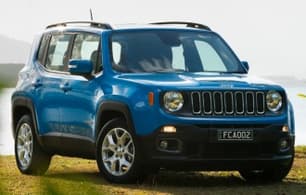
In what is absolutely not a coincidence, the Renegade immediately conjures up the Wrangler. Upright grille from the Willys Jeep (references abound here), round headlights, squared off wheel arches to mimic the Wrangler's guards, short overhangs and big rear view mirrors.
The 17-inch wheels look completely lost in the wheelarches which are even more cavernous owing to the Trailhawk's 50mm of extra ride height. The wheels are also a bit cheap looking but will probably survive the belting the car is intended to take.
Less rugged is the interior, despite a fairly self-conscious effort to make it look and feel chunky. The front seats are flat and unsupportive with the rears just as lacklustre making sure everyone is sliding around together. Luckily, front passengers get a dash-mounted grab handle.
It seems quite well put together, however, but with carpets and easily-marked plastics, you'll hope your passengers don't bring the mud in with them too often. And the "Since 1941" stamped into the steering wheel can go.
The dashboard is reasonably clear and has plenty of information to share via the screen between the dials but whoever thought marking the redline with a water splash graphic in bright orange should probably rethink their design decisions.
Storage is limited to two cupholders up front, door pockets in each door and nets on the front seat backs.
Before the Avenger had even landed, Jeep announced a $3000 reduction to the original pricing. While it might seem like this move stems from an increasingly competitive small-SUV market, Jeep says production costs dropped after the pricing was initially set, and the decision was made to pass it along to customers.
In any case, the Avenger now starts from $49,990 before on-road costs for the entry-level Longitude, with a mid-spec Limited costing $54,990 and the appropriately named Summit set at $60,990.
This puts the Avenger among the most expensive offerings in the 'Light SUV' category along with the electric Mini Aceman (from $55,990) and hybrid Lexus LBX (from $47,550), but around the same price as the slightly larger Hyundai Kona Electric (from $54,000) and Renault Megane E-Tech (from $54,990).
It also looks like brilliant value compared to the much smaller and lower-ranged Fiat 500e (from $52,500). Style comes at a cost.
For the Avenger, there’s a bunch of kit that’s standard across the range, plus only one cost-option - premium paint at $990.
Each Avenger gets dual 10.25-inch screens inside, one for the driver instrument display and the other a touchscreen for the multimedia controls, centred on the dash so it can be reached by both front occupants.
Satellite navigation, keyless start, adaptive cruise control and Jeep’s Selec-terrain drive mode system are all also standard features.
The Limited adds partial synthetic leather trim to the seats, keyless entry, more safety features like blind-spot assist and parking sensors, plus a height-adjustable boot floor and more powerful AC charger, with an 11kW version replacing the 7kW of the Longitude. The Limited also has optional two-tone roof paint in black for $495.
Climbing to the Summit means you get the two-tone roof as standard, plus LED projector headlights and LED tail-lights, 18-inch alloys, leather accented heated seats with power adjustment and lumbar massage for the driver, plus it also gets a sunroof over the front occupants.
The Renegade range starts at $28,000 for the 1.6-litre Renegade Sport manual front-wheel drive, climbing between $2000 and $3000 through the Sport Auto, Longitude Auto, Limited Auto with a final jump of $4000 to the 2.4-litre auto-only Trailhawk.
Standard is a nine-speaker stereo with Bluetooth and USB, 17-inch alloys, dual-zone climate control, reversing camera, rear parking sensors, keyless entry and start, cruise control, electric front seats with heating, satellite navigation, automatic bi-xenon headlights, auto wipers, leather trim, roof rails, front and middle bash plates, full size spare, heated leather steering wheel, privacy glass, trailer sway control and tyre pressure monitoring.
The lairy Omaha orange is $500, part of an eleven colour palette with only two no-cost paint options (black and white).
You can add lane departure warning, auto-parking and a black painted roof for $500 each, a removable and retractable roof called My Sky Roof for $2200 or a more conventional electric sunroof for $1900.
The Beats-branded nine-speaker stereo is run via Fiat-Chryser's UConnect system, accessible through the 6.5-inch touchscreen. While it improves with every attempt, it's still quite clunky and when the sat-nav is added, becomes a bit of a mess.
Thankfully, not every function has been crammed into the touchscreen interface, so you'll spend more time with your hands on the wheel rather than working out which bit of the screen has the climate control.
The Avenger has one drivetrain for now, a front-wheel drive electric motor, though it sounds like we shouldn’t rule out the possibility of other petrol hybrid drivetrains in the future.
The EV Avenger we’ve got is built on a 400-volt electric architecture, with a single motor delivering 115kW of power and 260Nm of torque.
It’s got a a mode that increases the regenerative braking, though isn’t quite a one-pedal driving experience.
Jeep says it’ll hit 100km/h in 9.0-seconds, but apparently tops out at 150km/h.
The Trailhawk is powered by Fiat's 2.4-litre four naturally-aspirated four-cylinder producing 129 kW and 230 Nm. Jeep reckons you'll get 7.5L/100km on the combined cycle. Our mostly city driving with a longish motorway run produced an 11.0L/100km average over a week.
The transmission is a nine-speed ZF automatic driving all four wheels.
The Trailhawk also has Jeep's five mode Selec-Terrain system which should cover pretty much every eventuality – Auto, Sport, Mud, Sand and, just for the Trailhawk, Rock. The Trailhawk is rated to tow 400kg unbraked and 907kg braked.
The mix of a fun exterior and practical interior for the Jeep seem to blend into the Avenger’s driving experience. It doesn’t feel too much like an EV, but it is still playful and capable on the road.
Jeep wanted the Avenger to come across like a normal car that just happens to be electric, and the relatively calm take-off (rather than the usual immediate torque push electric cars are capable of) seems to prove that.
Though 115kW doesn’t sound like much on paper, it feels brisk enough for what the little Jeep is built for, and its delivery means even on a wet day like what we copped during the launch drive, wheelspin and torque steer were minimal.
Once up to speed, the Avenger feels pretty light for an EV, and it’s playful enough in corners without feeling like it’s becoming unstuck or hard to handle.
The suspension and steering are clearly aiming for comfortable driving more than sporty performance, and so while both feel well-sorted, neither are particularly communicative. But the steering is accurate and feels nice and light, making the Avenger easy to point into a corner and you can trust it to hold on.
Perhaps the biggest downside is the brake pedal, which is soft and doesn’t grab as quickly or progressively as you’d expect. It takes a few presses to work out how much pressure you need to stop the car.
But a drive mode that adds a bit of regenerative braking helps out there, even if it’s not proper single-pedal driving.
At higher speeds, the Avenger settles well over big bumps and undulations, feels comfy on most surfaces, and despite a bit of road noise and a small rattle in the dash on one of our test cars, it feels pretty easy and confidence-inspiring.
Jeep says the Avenger is built to handle some light off-road driving but I imagine its front-wheel-drive setup would be limiting in some circumstances, especially in the rainy, muddy weather we faced. Despite that, some unsealed mud and gravel driving proved the Avenger capable of gentle inclines at low speeds without risk of sliding.
For reference, ground clearance is 200mm, while the approach and departure angles are 20 and 32 degrees, respectively.
The Trailhawk name suggest that things are going to get muddy – compared to the rest of the range, the range-topper rides 50mm higher and has exposed, easy-to-reach tow hooks in the fairly unlikely event you get stuck. It also has a 20:1 low-range crawl ratio and Active Drive 4x4 which means it can switch between front and all-wheel drive. It'll also wade through almost half a metre of water. It's a genuine mud-plugging proposition and will take on some much bigger machinery out in the bush.
On the road, where we spent all our time in the Renegade, it's not what you'd call particularly inspiring. There's a number of sources of noise that contribute to a less than quiet cabin and having to constantly correct your course at freeway speeds adds to the tiring nature of the Renegade.
It's much better at lower speeds, pottering around but then again, its nine-speed transmission needs a lot more work on the shift mapping because it seems to forget which gear it needs to be in when you sink the right foot. If you don't need the Trailhawk's extra off-road goodies, consider the 1.4 litre Limited or Longitude.
The Jeep Avenger hasn’t been tested by ANCAP, but comes with a disappointing three-star score from Euro NCAP.
Jeep Australia says it’s currently working with ANCAP regarding a potential local score, but wouldn’t detail what that could mean. A small SUV’s score dropping below four stars might concern some young family-type buyers, though most of its poor scoring comes in the categories of Vulnerable Road Users (pedestrians and cyclists) and Safety Assist (active tech).
In terms of what the Avenger offers as standard, there’s auto emergency braking (AEB), lane-keep assist, traffic sign recognition, driver monitoring, a reversing camera and six airbags (no front-centre bag, though).
It’s notably missing rear-cross traffic alert, and the base Longitude makes do with regular adaptive cruise control and parking sensors at the rear only, while higher variants get blind-spot assist, surround parking sensors, and intelligent cruise control.
Seven airbags (including driver's knee bag), traction and stability controls, roll mitigation, blind spot monitoring, ABS and brake assist.
The Renegade does not yet have an ANCAP star rating although it scored five EuroNCAP stars in 2014.