What's the difference?
For off-road adventurers, having the flexibility to be able to tow your camper-trailer off the beaten track, out bush and along a beach, opens up a whole new realm of fun and possibility – and that's why Jayco's Outback versions of the company's mainstream camper range have a growing legion of fans.
But the question for camper buyers is: should they upsize? Bigger is often better, but does that hold true in the camper-trailer world? Is a big camper actually worth the extra cash? And is it more difficult to tow?
We take the Jayco Swan Outback (from $30,490), the biggest camper in the Outback range, on a trip into the bush to answer these questions and plenty more.
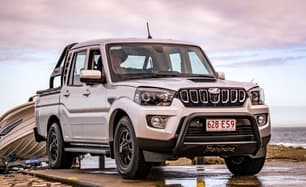
The current generation Mahindra PikUp has been with us since 2007, which is a long time given major players in this market tend to introduce a new generation every decade, or close to it.
However, with Mahindra reportedly developing an all-new ute, based on the underpinnings of its latest Scorpio SUV, the budget-priced PikUp is destined for retirement within a few years.
Better late than never, the latest MY23 version of the S11 dual-cab has for the first time been equipped with an automatic, which is sure to increase buyer appeal in a market in which self-shifting transmissions rule.
We recently revisited this Indian-built dual cab to see how it measures up for tradies in such a competitive market.
The Jayco Swan Outback is a nice solid camper, packed with features and suited for most trips away.
Sure, it's not the roomiest or flashiest camper around and – you've been warned – it is definitely not up to hard-core 4WDing, but it does come from a company responsible for sharply priced units with plenty of flexibility regarding optional add-ons so that counts for a lot.
Its sub-$40K pricing undercuts the cheapest Ford Ranger or Toyota HiLux 4x4 equivalents by $10-15K and it’s backed by a decent warranty and 60-strong dealer network (mostly regional). It’s also largely absent from the federal government’s vehicle-recall listings, which suggests solid build quality.
However, it’s also short on safety, has relatively high servicing costs and numerous design quirks. Fact is, such low pricing comes with compromises, so, if you can learn to live with those, this sturdy and willing auto-equipped workhorse could represent good value for those shopping on a budget.
Correct me if you reckon I'm wrong, but no camper-trailer from any company will ever be in the running for a 'Gorgeous Temporary Home' award. But that's part of this camper's appeal; it's highly practical and functional, not pretty and useless.
The forward bed is to the left as you step inside; the rear bed is to the right. Its kitchen is in front and to the right of the door as you enter the camper.
Interior height is a standard 2070mm and inside is spacious, but tempers will likely fray if all four adults and two kids are standing or sitting around inside at the same time. Hope for no rain.
The interior includes a four-burner stove, Dometic 95-litre fridge (Touring models get the 90-litre fridge), stainless-steel sink, dinette seat, table, club lounge, and the two beds plus the dinette-convertible bed.
If you can't find some places in which to stow away your gear in this Outback, then you're not looking hard enough.
The 'Ezi glide' pull-out drawers include room enough for your large pots, cutlery, kitchen gear and numerous other bits and pieces.
Interior lighting includes overhead LEDs for the dining/entertainment area and reading lights for the beds. There’s a fan for the beds.
With its 2115kg kerb weight and 3150kg GVM, the S11 PikUp offers a 1035kg payload rating so it’s a genuine one-tonner.
It’s also rated to tow up to 2500kg of braked trailer but given Mahindra doesn't publish a GCM rating (or how much it can legally carry and tow at the same time) we don’t know if it can retain its maximum payload while towing that weight.
Strangely, the load tub does not have any internal load-anchorage points. The only option for securing ropes or straps are external hooks, which are located along both upper sides of the tub and across the tailgate.
However, these would be ineffective in securing loads that are lower than the tub sides.
Front cabin storage is limited, as there are only narrow bins and no bottle holders in the front doors and you won’t find any cup/bottle holders or storage for small items in the dash, either. However, there is a single glove box and an overhead glasses holder.
The centre console has an open storage tray at the front and single cup and bottle holders in the centre, which are fine for one occupant but not two.
In contrast to the front doors, there are no bins in the base of each rear door, but they do get a large-bottle holder and what looks like a phone holder at mid-height.
There are also pockets on each front seat backrest, but the fold-down centre armrest does not have any cup/bottle holders.
The rear bench seat’s base cushion is fixed, so it can’t swing up and be stored vertically (like many dual cabs) if more internal cargo space is required.
However, it does at least provide some open storage space underneath for soft items like jackets etc.
Jayco campers are easy to tow and the Swan Outback is no different. It towed steady and stable – no worries – behind our long-termer 2019 2.0-litre four-cylinder bi-turbo Ford Everest 4WD (157kW/500Nm).
We did decent stretches of highway, country back-road and gravel track, deeply rutted in places, with no strife.
The extra length (305mm) over its top-tier stablemates – Hawk and Eagle – was hardly noticeable and only took a little adjustment and increased vigilance when turning in between trees on pinched bush tracks.
With a 130kg towball weight, it feels marginally livelier than Hawk (145kg) and Eagle (150kg), but nothing drastic – again, as long as the driver pays attention there's no issue.
Visibility back along both sides and over the top is good without need for towing mirrors.
The single-axle Swan Outback has a hot dip galvanised 'Endurance' chassis on Jayco’s 'JTech' coil-spring suspension with a little extra ground clearance over road-focussed Touring models. (Note: Jayco’s Outback models are made for dirt tracks and gravel roads, not 4WD-only tracks. They are not built for hard-core off-roading.)
The fold-down inboard armrest combined with the door’s armrest allows the driver to evenly rest both elbows, which reduces strain on shoulders and arms particularly during long highway hauls.
This set-up could work even better if the wheel had reach adjustment in addition to its adjustable height.
There’s no rake adjustment in the seat’s base cushion, either, but fortunately there’s a big left footrest to help the driver to maintain a comfortable posture.
The driving position is high relative to the bonnet and the tops of the doors, which is ideal for vehicle placement when off-road driving as it provides commanding views over the front and out the sides.
Unladen ride quality is quite firm, as you’d expect of a 4x4 designed to carry one tonne of payload, but is supple enough to provided acceptable comfort.
The steering weight is linear with easy turning effort; handling and braking response is satisfactory and engine and tyre noise are pleasantly low.
Our only major gripe is the huge turning circle, which is nudging that of a full-size American pick-up. The need to often do three-point turns, in situations that you really shouldn’t have to in a vehicle of this size, is annoying (and in some situations embarrassing).
Although its 2.2-litre diesel has modest outputs, it provides decent performance in city and suburban driving with its smooth-shifting auto.
It’s also a low-stressed highway cruiser, requiring less than 2000rpm to maintain 110km/h which is comfortably within its peak torque band.
We didn’t get to do our usual GVM test due to a hiccup with our weight supplies, but we have previously tested a cab-chassis PikUp with just under one tonne of payload (990kg) which it hauled with an all-round competence that belied its relatively small engine output.