What's the difference?
For off-road adventurers, having the flexibility to be able to tow your camper-trailer off the beaten track, out bush and along a beach, opens up a whole new realm of fun and possibility – and that's why Jayco's Outback versions of the company's mainstream camper range have a growing legion of fans.
But the question for camper buyers is: should they upsize? Bigger is often better, but does that hold true in the camper-trailer world? Is a big camper actually worth the extra cash? And is it more difficult to tow?
We take the Jayco Swan Outback (from $30,490), the biggest camper in the Outback range, on a trip into the bush to answer these questions and plenty more.
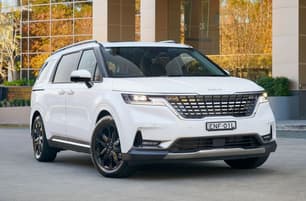
This is actually the Carnival that Kia always wanted.
See, the last Carnival, the one this replaces, was Covid compromised, missing out on key technologies, as well as skipping an in-depth ride and handling localisation program, due to part supply issues and a freeze on international travel.
This one, though, addresses all of that, which is why you get a new cabin experience, new tech, and a complete overhaul of the steering and handling.
It is, however, significantly more expensive, right across the range.
So, is the Carnival still worth it? Let’s find out.
The Jayco Swan Outback is a nice solid camper, packed with features and suited for most trips away.
Sure, it's not the roomiest or flashiest camper around and – you've been warned – it is definitely not up to hard-core 4WDing, but it does come from a company responsible for sharply priced units with plenty of flexibility regarding optional add-ons so that counts for a lot.
Ok, here's the rub. Everything you just read could well be pointless. You like the Carnival. In fact, it sometimes makes up close to 90 per cent of the sales in its segment, and outsells all of its competitors combined.
So whether I like it or not, I suspect you'll be buying one anyway.
But I can say this - the new Carnival improves the formula right across the board. Well, everything except for price.
Correct me if you reckon I'm wrong, but no camper-trailer from any company will ever be in the running for a 'Gorgeous Temporary Home' award. But that's part of this camper's appeal; it's highly practical and functional, not pretty and useless.
The forward bed is to the left as you step inside; the rear bed is to the right. Its kitchen is in front and to the right of the door as you enter the camper.
Interior height is a standard 2070mm and inside is spacious, but tempers will likely fray if all four adults and two kids are standing or sitting around inside at the same time. Hope for no rain.
The interior includes a four-burner stove, Dometic 95-litre fridge (Touring models get the 90-litre fridge), stainless-steel sink, dinette seat, table, club lounge, and the two beds plus the dinette-convertible bed.
If you can't find some places in which to stow away your gear in this Outback, then you're not looking hard enough.
The 'Ezi glide' pull-out drawers include room enough for your large pots, cutlery, kitchen gear and numerous other bits and pieces.
Interior lighting includes overhead LEDs for the dining/entertainment area and reading lights for the beds. There’s a fan for the beds.
The Carnival measures 5115mm in length, 1995mm in width and 1775mm in height, and it rides on a sizeable 3092mm wheelbase.
And those mini-van dimensions have a predictably positive impact on luggage space, with room growing from 627 litres with all seating rows in place, to a massive 2827 litres with the third row stowed.
The key practicality perk here, though, is space, and lots of it. At 175cm, there was ample room for me in the middle row, and you can configure the cabin to your liking, too. You can slide the row on rails, for example, to prioritise leg room where you need it, and the middle seat folds down to reveal cupholders in a kind of hard plastic travel tray.
But even in the third row I could easily get comfortable, though head room begins to get a little tighter. There are cupholders and USB connection points, too, and I can honestly say you could send full-size humans back there and not feel overly guilty about it.
The Carnival will tow 2000kgs braked, too.
Jayco campers are easy to tow and the Swan Outback is no different. It towed steady and stable – no worries – behind our long-termer 2019 2.0-litre four-cylinder bi-turbo Ford Everest 4WD (157kW/500Nm).
We did decent stretches of highway, country back-road and gravel track, deeply rutted in places, with no strife.
The extra length (305mm) over its top-tier stablemates – Hawk and Eagle – was hardly noticeable and only took a little adjustment and increased vigilance when turning in between trees on pinched bush tracks.
With a 130kg towball weight, it feels marginally livelier than Hawk (145kg) and Eagle (150kg), but nothing drastic – again, as long as the driver pays attention there's no issue.
Visibility back along both sides and over the top is good without need for towing mirrors.
The single-axle Swan Outback has a hot dip galvanised 'Endurance' chassis on Jayco’s 'JTech' coil-spring suspension with a little extra ground clearance over road-focussed Touring models. (Note: Jayco’s Outback models are made for dirt tracks and gravel roads, not 4WD-only tracks. They are not built for hard-core off-roading.)
Forgive the horrific paraphrasing, but it seems rumours of the death of diesel have been greatly exaggerated, at least when it comes to the Kia Carnival.
Get this – diesel sales make up some 90 per cent of the Carnival's total haul, with petrol providing a pittance towards the sales total, presumably being picked up by fleet buyers.
And to be honest, that means nine out of 10 people are making the right choice here. Yes, the petrol makes more power, but it's the torque on offer from the diesel that makes pushing the Carnival around feel far more effortless.
The petrol engine can definitely get you moving, but it feels a bit too rev-happy and thrashy when you really put your foot down, and its significantly thirstier to boot.
The diesel isn't perfect – the thrum of the engine is a constant companion whenever you put your foot down, and there's actually too much torque on offer at times, like if you're accelerating up hill from a standstill on a damp road, and so the front tyres can scrabble and scramble for grip.
But it otherwise so perfectly suits the nature of the Carnival that it is definitely the best and most satisfying choice.
Another big change for this update is the fact that Kia's complete ride and handling program has been rolled out here. Kia says local work done on the outgoing car, the one this replaces, was curtailed by Covid and bushfires, and so ended up being done by correspondence.
This one, though, has had the whole enchilada thrown at it, and it shows. They've succeeded in making a bigger car feel smaller around you. It's not a sports car by any measure, but nor does it ever feel too big and unwieldily.
Part of that is down to the steering, which is direct and confidence inspiring, but mostly I suspect it's because of the ride, which is firmer than you might expect in a family hauler, but also offers a connection to that road below that makes you feel in control.
Whether a firm-ish ride is a perk or negative is up to you, but it definitely works for me.