What's the difference?
The days of very short caravans are over – almost no one would consider buying even a 14-foot caravan in today's age – but despite that, Jayco's simplest camper-trailer almost mimics the layout of a regular-sized vintage caravan.
At just 14-foot long, the Penguin encloses its bed, dinette and kitchen without any extensions, and does it quite smartly, too.
The world is full of shock brand announcements.
Remember the time Coke suddenly changed its cola recipe? Or when Apple decided to take on Nokia with iPhone? Nobody saw those coming.
We all know how the latter turned out and even the former eventually became a marketing masterstroke.
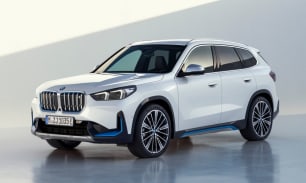
Now here's another super-surprise – a German electric luxury SUV that’s actually comparatively inexpensive. And not stingily equipped. Yep, we’re talking about the iX1.
Based on the really rather impressive third-generation X1, it decisively undercuts similarly-specified rivals from Mercedes-Benz (EQA, EQB) and Genesis (GV60).
But is the Bavarian EV SUV worth paying that little bit extra for against (only very slightly) cheaper alternatives like the Hyundai Ioniq 5, Kia EV6, Tesla Model Y, Polestar 2 and Volvo XC40 Recharge?
Let’s see.
At nearly $25,000 the Penguin can't really be called cheap, but what does make it worth a look is the completely contained living space – the sitting, sleeping and cooking are all done inside, and that's a boon when the weather turns.
It's ideal if you want the comfort of a caravan without the bulk of one, and the ease of towing a more traditional camper-trailer offers, without the struggle of set-up.
BMW is a true EV pioneer, as the 2014 i3 and subsequent models prove. There’s never been one that we didn’t like. The only problem was that all were expensive. And at times, prohibitively so.
Astoundingly, the iX1 breaks that cycle, comparatively speaking, while impressing us with its design, quality, packaging, dynamics and equipment levels.
As it stands, the xDrive30 is one of the most convincing and best-value medium-sized luxury SUV EVs on the market right now.
Who’d have thought it from a BMW?
Inside, the layout is simple, but comfortable for two people. The rear of the camper is dominated by the east-west oriented bed.
The dinette, to the front of the camper, is cosy and only good for two people. It does actually fold down into a second bed for a third body (or a second body who's not allowed in the first bed), but although there's sleeping for three, seating that many would be difficult. Maybe a small grandchild, occasionally. It's comfortable, though and both seats lift up to reveal a little extra storage. There's even a hidey-hole behind the driver's side back-rest.
Typical of all campers of this sort, the bench heights are low and will frustrate taller people who need to stoop to use them.
This camper has a canvas skirt, but really there's more see-through plastic window than actual canvas, so it's quite panoramic inside. It's not hard to gain a bit of privacy, though; there's a dark tint to them so it's hard to see through during the day, and all the windows have curtains, so you can shut everything out, easily enough.
Lighting is simple, with just two LED lights in the roof, although unless you pay extra for a battery, they'll only work at powered sites.
BMW also says the iX1’s cabin is almost as roomy in some ways as the larger X3.
Large doors allow for easy entry and egress, onto sumptuous front seats that provide exceptional comfort and support even on longer journeys.
Surrounded by an expansive feeling of space, the interior feels light and airy, as well as fresh, inviting and premium looking – something previous-gen X1s were rarely accused of being.
We’re talking on-brand stuff here, beginning with the excellent driving position, ahead of a crisp and attractive dash that’s pleasing to behold. Push-button starting and a small toggle lever operates the transmission.
An ever-so-slightly curved (towards the driver in the best-BMW old-school way) rectangular binnacle houses two digital displays – a 10.25-inch one ahead of the driver offering an array of configurable electronic dials, as well as a 10.7-inch multimedia touchscreen.
BMW pioneered the multimedia controller more than 20 years ago with iDrive, and this descendent of that system reveals all that expertise gained by being intuitive to operate and quick to respond to commands once familiarised. Which shouldn’t take too long.
It’s all very-EV centric, as the industry inexorably moves to total electrification, but there were a couple of voice-command errors in the iX1, revealing that such systems are still far from perfect. BMW does provide audio volume and climate hard buttons, thankfully, so the basics are looked after.
Speaking of which, the iX1 offers decent levels of vision out, superb ventilation and ample storage in the doors, on the dash and between the front seats. And, as we’ve noted previously in BMWs, the upright smartphone charger is a clever idea. Keeps it in position and is handy to glance at.
Out back, backrest comfort and support is A-OK, and even with the optional sunroof, our test iX1 provided sufficient space for taller bodies, while expected items like ventilation grilles, USB ports and cupholders are fitted.
Note that, though the 40/20/40-split backrests recline slightly, they do not slide as per in the ICE X1, as this is a desirable option.
Nor is the cargo capacity as good in the iX1, due to the inevitable space demanded by that rear-axle-mounted electric motor and battery pack. For the record, ranges from 490 litres to 1495L instead of 540-1527L. Plus, there’s no spare tyre, with just a tyre repair kit fitted.
These aside, the iX1’s spacious and inviting interior remains one of the compact SUV segment’s best.
Because the Penguin is so light – as mentioned above – and because the towing height is just 1660mm, lower than the roof of most cars and certainly below that of SUVs, it's easy to tow, even if you don't have the largest 4WD to haul it around.
The Subaru Forester I tested this camper with, for instance, did the job quite well and would be ideal if you towed the camper down the coast a few times a year.
Underneath, the camper's got a simple beam axle with leaf slipper springs and shock absorbers. They do a commendable job and, as this is a purely on-road camper, there's no need for it to be anything else.
One of the best things about the iX1 xDrive30 is that it has just enough EV smoothness, refinement and speed to feel special, yet still drives and behaves as a BMW should.
Which hasn't always been the case with previous-gen X1s.
It helps that, from the driver’s seat, everything falls into place: the bracing seats, thoughtfully positioned relative to all controls; and the overall sporty/quality ambience that puts you into the brand mindset.
Select Drive, and the iX1 leaps away sweetly and silently, accompanied by an electric motor whir that's quite pleasing. At speed, acceleration is instant for fast overtaking and there’s plenty more in reserve if you really need to hustle along.
For a 2.0-tonne compact SUV, the steering is remarkably responsive, providing nimble yet secure handling. Maybe it’s all the low-slung weight and near-50:50 weight distribution, but the iX1 displays impressive cornering and road grip. It’s an enjoyable drive.
Initially, novices might find the brakes a bit sudden, but they’re actually pretty progressive once you get used to them, and they feel and stop with a more natural pedal feel than many hybrids we’ve experienced. Again, BMW has tuned the xDrive30 to feel inclusive.
Speaking of the stoppers, there are no paddle shifters to control the amount of single-pedal off-accelerator braking as per many other EVs, but putting the transmission from ‘D’ to ‘B’ brings a decent level of deceleration if not a full stop – as if you’re lighting resting your foot on the pedal. We’d like the option of a heavier self-braking function, though.
The launch program avoided city roads and heavy traffic, but we still found plenty of bad, pot-holed surfaces to favourably judge the adaptive dampers’ ability to help soak up the bumps.
While not super-soft or supple, the suspension is cushy enough for a comfy ride. And certainly better than many past BMW SUVs.
A bit too much road and tyre noise intrusion aside, the xDrive30 is dynamically very sorted indeed.
Which, when you consider all the other positive aspects of the iX1, you end up with a BMW offering an impressively broad band of capabilities.
It’s rapid, nimble and reactive to driver inputs, as you’d expect an SUV from this brand to be, without the compromise of harshness or discomfort.
What it’s like around town in a peak-hour crawl, or how far you can really get from a fully-charged battery, is something we’ll find out when we can conduct a full road test, so please watch this space.
Until then, as it stands, things are looking promising indeed for the xDrive30. Especially factoring in the value pricing.