What's the difference?
People with camper-trailers are increasingly looking to push their travel boundaries and so they head off the bitumen, onto dirt roads and go bush.
But on-road camper-trailers are not suited to cope with the extra stresses that dirt-road or gravel-track driving bring, which is why campers better equipped for light-duty bush driving, such as Jayco’s Outback versions of its models, are finding favor with buyers.
We took an Eagle Outback into the bush to check it out.

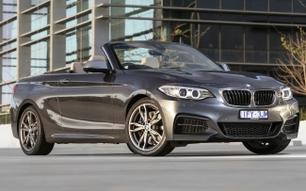
If one is good, two must be better, right? Or twice as good. The question is whether that simple equation adds up for BMW's upgraded 1 and 2 Series siblings – the former, a range of five-door hatches, the latter, a line-up of cabriolets and coupes, with a major addition in the shape of the full-house, performance-focused M2.
Prices are up, and changes are mostly under the skin, so you're not getting big visual bang for your extra bucks. But the new and improved 2 has plenty to offer when it comes to added spec and tech.
BMW invited us to the new car's Australian launch program along Tasmania's wet and wild west coast.
The Jayco Eagle Outback, for me, is an example of a camper-trailer getting closer to what I reckon a truly off-road-capable Jayco camper will be like.
There's nothing in Jayco's current line-up that offers comfort and full functionality and is also capable of tackling decent off-roading, so we're looking forward to testing Jayco's first line-up of dedicated off-road campers, including the JTrak Outback and Outback X.
The BMW 2 Series coupes and convertibles combine understated good looks with great dynamics and top-shelf quality. Extra equipment, especially the iDrive6 multimedia system, has brought it up to speed in terms of tech and value, while the M240i sets the compact performance benchmark. And if you really want to push the envelope, the M2 is right there at the top of the under $100k performance pyramid.
These Jayco camper-trailers have a familiar touring-friendly floor-plan – check out the accompanying photos for proof of that – and most adhere to a similar approach to interior functionality – neat and simple – and that’s well suited to those who venture off the blacktop and hit the dirt.
Interior height is 2070mm, standard for campers of this type, so there’s plenty of stretch space for those of us not gifted with the vertical inches of Collingwood’s Mason Cox. Bench height, also standard for a camper-trailer, remains just lower than an average bloke’s hip so stooping to work in the kitchen is still an issue, but that’s part and parcel of the lifestyle, so stop whinging and get used to it.
Looking from the door, to the left is the front bed and club lounge; along the wall is the kitchen area (replete with four-burner stove, Dometic 95-litre fridge*, storage drawers and pantry); and to the right is the rear bed and dinette area. (* Outback models get the 95-litre fridge; Touring models get the 90-litre fridge.)
Overhead interior lighting includes LEDs for the main area and reading lights for the beds; there’s a fan for the beds.
There are also power points and USB port.
Surprisingly, at a little over 4.4 metres long, the 2 Series (Coupe) is around 10cm longer than its 1 Series hatch stablemate (M240i +15cm), but aligns with its just under 1.8m width, and 1.4m height.
It seats four, with plenty of room up front and multiple storage options, including two cupholders in the console with an oddments tray behind, a 12-volt outlet, a lidded storage box between the seats with USB connection, a reasonably sized glove box, and segmented bins in the doors big enough for large water bottles.
While it was coupes only on the launch drive, we know the convertible has a pair of cupholders in the back, but not so in the coupe, and while headroom in the soft-top is okay (especially with the roof down) it's a squeeze in the hardtop.
More a 2+2 than a full four-seater, getting into the rear is an athletic exercise, and once installed, leg and headroom for this 183cm tester is tight. That said, kids up to teenager-size would be fine.
Boot volume is 390 litres (a 3 Series Coupe is 480 litres), with run-flat tyres on the 220i and 230i meaning there's no spare (or repair kit) under the floor, but the performance-focused M240i and M2, pack a 'BMW Mobility Kit' (compressor and tyre sealant to cover minor damage) in line with their high-performance (non-run-flat rubber).
A 60/40 split-folding rear backrest liberates extra load space, and a 'Through Loading System' with luggage compartment dividing net, and 40/20/40 split-folding rear seat is optionally available (220i & M2 Pure - $350 / 230i - $385 / M240i & M2 - $500).
And if you're keen on towing the 220i can pull 680kg of unbraked trailer, and 1500kg braked, with the minimum number stepping up to 715kg for the 230i. The M240i and M2 are no-tow zones.
This single-axle camper – at 5060mm long (including drawbar), 1910mm high, 2240mm wide, and with a 1270kg tare weight – towed smoothly behind the Mitsubishi Pajero Sport we used on this review.
It sat snug and steady on the towball (with a 150kg download) during open-road driving, as well as during short sections of slightly bumpy gravel track and undulating dirt road.
The Eagle Outback has a hot dip galvanised Endurance Chassis riding on Jayco’s own JTech coil-spring suspension set-up.
Please note: Jayco’s Outback models are designed and engineered for, at worst, dirt roads and gravel roads, not 4WD tracks. Do not think that because these campers have been branded ‘Outback’ that they are actually able to tackle hard-core off-roading.
Four 2 Series variants were offered for the launch drive program, a 230i Coupe (which BMW nominates as the most popular model in the range), M240i Coupe, M2, and M2 Pure.
Claimed 0-100km/h acceleration of 5.6sec for the 230i M Sport Coupe is quick, with the convertible stopping the clocks three tenths later.
Peak torque of 350Nm is plenty, and with that number available from 1450-4800rpm the mid-spec 2 Series is an entertaining drive.
It's M Sport (strut front, five-link rear) suspension keeps the body well buttoned down in quick going, while the beefier M brakes provide strong and progressive stopping power.
Even a firm squeeze of the throttle can't side-step some hesitation as the turbo spools up before right foot pressure translates into forward momentum, but despite the sporty tune, ride quality is good (even riding on notoriously harsh 18-inch run-flat rubber), while response and road feel from the variable-ratio steering are excellent.
The eight-speed auto is beautifully slick, with manual changes, via wheel-mounted paddles, sharp and positive.
Add the grippy leather sports wheel, snug sports front seats, and racy cloth/Alcantara trim (leather in the convertible), and you have a comfortable, nicely balanced and fun-to-drive package.
Accelerating from 0-100km/h in 4.6sec (convertible 4.7sec), the M240i effortlessly achieves 'genuinely rapid' status. Yes, it's fast, but never furious, in the sense that even under the pressure of enthusiastic peddling it remains civilised and composed.
Maximum torque of 500Nm is not to be sneezed at, and when you realise that mountainous maximum is actually a flat-top plateau stretching from only 1520rpm up to 4500rpm, satisfying urge is never far away. And the flexible 3.0-litre turbo-six is an aural treat as it howls its way towards a 7000rpm rev ceiling.
The standard 'Adaptive M Suspension' offers settings from 'Comfort' through to 'Sport+', but even in the most forgiving mode the car remains taut and communicative.
The 18-inch rims, shod with Michelin Pilot Super Sport rubber (225/40 front / 245/35 rear) don't upset the ride as much as you'd expect, although coarse-chip surfaces send rumble through to the cabin.
In terms of ergonomics and general function, the new iDrive6 system is simple and intuitive to use, the current BMW dash and console layout is a model of efficiency, but the two-stage (depress small button on stubby lever, then shift) process to select drive or reverse can be a frustratingly hit-and-miss affair if you need to get going quickly.
Then, the M2 is all business, with a properly focused feel, and the ability to accelerate from 0-100km/h in a claimed 4.5sec for the six-speed manual, and just 4.3sec for the seven-speed dual-clutch. Try not to smile as that g-force shoves you back in your seat. You won't succeed.
Although peak power arrives at a relatively high 6500rpm, maximum torque of 465Nm (500Nm for limited periods on overboost) is ready for action across a broad spread from 1400-5650rpm, so the M2 has adrenalin flowing through its veins at all times.
An electronically controlled 'Active M Differential' manages torque distribution across the rear axle to optimise power down, with the ability to send anywhere from zero to 100 percent of drive to either back wheel.
The 'M Servotronic' steering, switchable through comfort and sport modes, is feelsome and linear in its response, the mega 'M Compound Brake' package (borrowed from big-brother M4) is professional grade, and while the seven-speed dual-clutch may shift faster, snicking up and down the manual's six ratios is a rare pleasure.
Rolling on 19-inch, ultra-high-performance Michelin semi-slick rubber (255/35 front / 275/35 rear) the M2 is never going to waft like a limousine, but if you're signing on for this kind of performance and dynamic ability, some ride harshness over less than perfect surfaces goes with the territory.