What's the difference?
Jaguar has announced that by 2025 it will only make and sell electric vehicles. That’s less than four years away and means the F-Pace you’re thinking about buying could be the last Jaguar with an actual engine that you ever own. Heck, it could be the last car with an engine you ever own.
Let’s help you pick the right one then, because Jaguar’s just called last drinks.
“If this is to be our end, then I would have them make such an end as to be worthy of remembrance.”
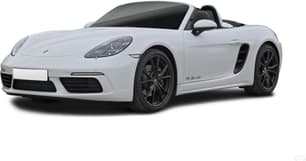
King Theoden may have been talking about the men and women of Rohan in The Lord of the Rings, but he could have just as easily been talking about the team behind the Porsche 718 Boxster.
It’s been nearly 30 years (yes, that long) since the Boxster joined the Porsche line-up as the more affordable sports car alternative to the 911, but now it’s facing a dramatic change that will make it a very different beast.
Porsche has committed to an electric future for the 718 but before it does so, there was one more petrol-powered version to create, this one, the 718 Spyder RS. It stands to be the final 718 to have an internal combustion engine, but could also be the best.
The 718 Spyder RS is the Boxster version of the previously released Cayman-based GT4 RS. So it takes every element of the sports car and turns it up to 11. This is faster, more powerful, lighter and more dynamic than the Boxster has ever been.
The F-Pace has been gifted new styling, new engines and more practicality making it an even better SUV than it already was. You could seriously pick any of the grades and be happy with your purchase. Then there’s the question of the engine…
Jaguar says there’s a few more years left in the combustion engine yet, but we know exactly how many years – four, because the company has gone on the record announcing it will go fully electric by 2025. The question for you is – how will you ring out the end of an era – with a four-cylinder petrol, a six-cylinder turbo diesel, an inline turbo six petrol or a cracking V8?
The sweetspot in the range is the R-Dynamic SE 400, with just enough luxury and more than enough grunt.
If this is to be the end of the 718 as we know it, then it is an end to be remembered. Porsche has produced something special in the Spyder RS, a sports car that can compete with the 911 on any stretch of road - which is something so few cars can claim. The focus on performance has driven the entire concept of the car, but all the elements work in harmony, with form and function coming together.
The very first F-Pace arrived in Australia in 2016 and even after all these years and the arrival of more rivals I still think it’s the most beautiful SUV in its class. The new one seems to look a lot like the old one, but the styling updates have kept it cool.
If you want to see instantly how the design of the F-Pace has evolved from the original to the new one, be sure to watch my video above.
Short story is, this new F-Pace has been given a pretty major styling overhaul inside and out.
Gone is the old F-Pace’s plastic beak. That sounds weird but the previous F-Pace’s bonnet stopped short of the grille and a nose cone had been fitted to cover the rest of the distance. Now the new bonnet meets a larger, wider grille and its flow from the windscreen down isn’t disturbed by a large join line.
Also more pleasing to the eyes is the badge on the grille. The snarling jaguar head is now larger and no longer mounted on a terrible looking large plastic plate. The plate was for the adaptive cruise control radar sensor, but by making the Jaguar badge bigger, the plate was able to be house in the badge itself.
The headlights are slimmer, and the tail-lights have a new design which looks futuristic, but I miss the styling of the previous ones and the way they dipped into the tailgate.
Inside, the cabin has been made over with a giant landscape screen, new chunky climate control dials, a new steering wheel and the rotary shifter has been replaced by a regular upright one which is still small and compact, with cricket ball stitching. Again, take a look at the video I’ve made to see the transformation for yourself.
While all F-Paces have a similar look, the SVR is the high-performance member of the family and stands out with its giant 22-inch wheels, a tough body kit, quad tailpipes, a fixed SVR rear wing, and bonnet and fender vents.
For this update the SVR has been given a new front bumper and larger cooling vents flanking the grille. But it’s more than just tough looks, the aerodynamics have been revised to decrease lift by 35 per cent, too.
What hasn’t changed are the dimensions. The F-Pace is a mid-sized SUV measuring 4747mm end to end, standing 1664mm tall and with the mirrors out is 2175mm wide. That’s not huge, but make sure it’ll fit in your garage.
As the pinnacle of not only the current 718 range, but potentially the entire combustion engine era of the Boxster, Porsche has pulled out all the stops for the Spyder RS.
This includes major changes to the design, but none are purely for aesthetic reasons and instead are driven by the search for performance; and the fact they make the 718 look tougher, meaner and more purposeful than ever before is just a bonus.
It’s a comprehensive redesign that starts at the bumper with a new front lip spoiler to enhance downforce. Then there’s a pair of NACA ducts on the lightweight bonnet to improve brake cooling without compromising aerodynamic drag. The lightweight front fenders include wheel arch vents to stop any potential for front-end lift at high speeds.
And the fenders aren’t the only component that’s gone on a diet, there’s a lighter exhaust, lighter wheels, lighter bonnet, lighter roof, lighter door panels and even lighter carpets on the inside. All up, the Spyder RS tips the scales at 1400kg, which is 40kg lighter than a standard 718 Boxster.
If it’s still not light enough, you can opt for the optional 'Weissach Package' (which was fitted to our test car), which brings even lighter 20-inch forged magnesium wheels and carbon-fibre reinforced plastic for a range of parts including the front luggage compartment, rollover bars and ducktail spoiler on the Gurney flap – plus some cosmetic enhancements.
And we still haven’t even touched on the biggest design change yet - the rear half of the car. Starting with the roof, which Porsche actually calls a ‘sunshield’ and ‘weather guard’ because it’s a stripped down version of what the brand usually uses, to save weight and let the glorious engine noise into the cabin uninterrupted.
But it’s also necessary because the entire rear engine cover has been redesigned to accommodate the larger engine that Porsche has installed in the Spyder RS, a 4.0-litre six-cylinder instead of the usual turbocharged four-cylinder ‘boxer’ engines.
While the Spyder RS looks great with the roof/sunshield on or off, frankly the removal process is much too complicated and requires repeated viewings of a YouTube tutorial to still get it wrong.
While owners will (likely) eventually get the hang of it, it will always be a clunky and awkward process and that’s just the price of being so focused on performance, which you can accept or not.
Inside that ethos of performance over practicality continues, with sports seats, an Alcantara-wrapped steering wheel and even the previously mentioned lightweight carpet floor mats.
It’s a purposeful, rather than luxurious, cabin, but that perfectly suits the nature of the Spyder RS. Our test drive included several long stretches behind the wheel and at no stage did it feel uncomfortable or impractical, despite its stripped-down design.
The F-Pace was always practical with a big 509-litre boot and great rear leg and head room for even me at 191cm tall, but the cabin re-design has added better storage and usability.
The door pockets are larger, there’s a covered area under the floating centre console and in a victory for common sense and practicality the window switches have been relocated from the window sills to the armrests.
This is along with a deep centre console storage area, and two cupholders in the front and another two in the rear fold-down armrest.
Parents will be happy to know that all F-Paces come with directional air vents in the second row as well. And there are ISOFIX outboard child-seat anchors and three top-tether restraints, too.
One area where the 718 range is starting to show its age quite dramatically is the in-car technology. While Porsche’s native system is relatively user-friendly, the lack of wireless Apple CarPlay or Android Auto in any capacity is deeply out-dated; and was frustrating for this Android using reviewer.
Given the age of the current 718 platform, and the impending arrival of the new model, it’s understandable that the multimedia system didn’t get an overhaul, but for a $350K car it does feel a bit behind the times.
In practical terms the Spyder RS is a bit of a struggle if you plan to go away with it. We managed to get a small suitcase and backpack in the under bonnet storage, but that was at capacity. While the addition of the larger engine removes any meaningful rear storage space.
There’s a Jaguar F-Pace for every budget as long as your budget is somewhere in between $80K and $150K. That’s quite a large range in price.
Now, I’m about to take you through the grade names and I need to warn you that it’s going to be messy and confusing a little bit like white water rafting, but not as wet. Life jacket on?
There are four grades: the S, SE, HSE and top-of-the-range SVR.
They all come standard with the R-Dynamic pack.
There are four engines: the P250, D300, P400 and P550. I’ll explain what this means in the engine section down below, but all you need to know is 'D' stands for diesel and 'P' for petrol and the higher the number the more grunt it has.
The S grade only comes with the P250. The SE comes with a choice of P250, D300 or P400. The HSE only comes with the P400 and the SVR has exclusive rights to the P550.
Following all this? Great.
So, the entry grade is officially called the R-Dynamic S P250 and it lists for $76,244 (all prices listed are MSRP - before on-road costs). Above this is the R-Dynamic SE P250 and it lists for $80,854, then there’s the R-Dynamic SE D300 for $96,194 and the R-Dynamic SE P400 for $98,654.
Almost there, you’re doing super.
The R-Dynamic HSE P400 lists for $110,404 and at the top is King F-Pace – the SVR with the P550 listing for $142,294.
There you are, wasn’t so bad was it?
Coming standard from the base grade up is the new 11.4-inch touchscreen, sat nav, Apple CarPlay and Android Auto, there’s keyless entry, push-button start, dual-zone climate, power adjustable front seats, leather upholstery, LED headlights and tail-lights, and an auto tailgate.
The entry-level S and the SE above it come with a six-speaker stereo, but as you step into the HSE and SVR more standard features appear such as a 13-speaker Meridian sound system, plus heated and ventilated front seats. A fully digital instrument cluster is standard on all grades apart from the entry S.
The options list is extensive and includes a head-up display ($1960), wireless charging ($455), and an Activity Key ($403) which looks like an iWatch that locks and unlocks the F-Pace.
Paint prices? Narvik Black and Fuji White are standard at no extra cost for the S, SE and HSE. The SVR has its own standard palette and includes Santorini Black, Yulonhg White, Firenze Red, Bluefire Blue and Hakuba Silver. If you don’t have the SVR but want these colours it’ll be $1890, thank you.
The bad news is, the Spyder RS costs just over $200,000 more than the entry-level 718 Boxster, which is not a small sum of money. The good news is, for that $200K, Porsche has overhauled the 718 from nose-to-tail and enhanced it in nearly every aspect.
There’s a raft of mechanical changes that we’ll get to later on, to help justify the $334,200, plus on-road costs, asking price, but from a specification perspective there are some notable inclusions.
For starters it comes with the 'Porsche Communication Management' (PCM) multimedia system, which includes in-built navigation and Bluetooth connectivity, as well as a 110-watt sound system.
But Australian delivered cars get an even higher level of standard equipment than other countries, with LED headlights including 'Porsche Dynamic Light System' (PDLS), cruise control, digital radio, rear 'ParkAssist' with reversing camera, 'Light Design Package', tyre fit set and windscreen with grey top tint, plus a no-cost optional Bose Surround Sound System all included.
It may be $200K more than 718 but compared to a 911, it actually makes a pretty compelling value argument. A 911 Cabriolet Carrera S starts at $342,700 (plus on-road costs), making that Spyder RS $8500 cheaper and a genuine alternative to its ‘big brother’.
Then, when you compare it against similar mid-engine European sports cars, such as the Maserati MC20 (from $510,000) or McLaren Artura (from $477,310) the Porsche looks like a bargain; relatively speaking, of course.
Jaguar’s engine names sound like forms you have to fill in when you apply for a home loan.
The P250 is a 2.0-litre four-cylinder turbo petrol engine making 184kW and 365Nm; the D300 is a 3.0-litre six-cylinder turbo diesel producing 221kW and 650Nm; while the P400 is a 3.0-litre six-cylinder turbo petrol with outputs of 294kW and 550Nm.
The P550 is a supercharged 5.0-litre V8 producing a colossal 405kW and 700Nm.
The SE grade gives you the choice of the P250, D300 and P400, while the S only comes with the P250 and the SVR of course is powered only by the P550.
The D300 and D400 are new engines, both are straight sixes and replace the V6 engines in the old F-Pace. Superb engines, they are also found in the Defender and Range Rover.
Jaguar calls the D300 and P400 mild hybrids, but don’t be misled by the terminology. These engines are not hybrids in the sense that an electric motor is working to drive the wheels along with a combustion engine. Instead, a mild hybrid uses a 48-volt electrical system to help take the load off the engine by helping it start and running the electronics such as climate control. And yes, it does help save fuel, but not stacks.
There’s plenty of grunt from all these engines no matter which you choose, they all have eight-speed automatics and all-wheel drive.
You are also very likely looking at the last combustion engines to go into an F-Pace. See Jaguar has announced that it will only sell electric vehicles beyond 2025.
Four years and that’s it. Choose wisely.
The key stat for the engine is the cylinder count. Gone are the four cylinders and instead it’s a return to Porsche’s iconic flat-six.
Specifically, the same 4.0-litre six that Porsche uses in its 911 GT3, which is a lot of engine to squeeze into the middle of this lightened sports convertible.
In order to keep the 718 in its place (beneath the 911), Porsche has slightly detuned the engine, so it makes 368kW/450Nm (compared to 375kW/460Nm in the 911 GT3), but the German brand has never worried about a kilowatt contest and instead prefers to focus on driveability and the other elements that make a drive great.
To that end the combination of air-intakes next to the headrests and the lightweight stainless steel exhaust (which gets titanium tips on the Weissach Package) helps the Spyder RS sound like a Carrera Cup racing car when you really wind it up to its 9000rpm redline.
Not that the performance isn’t spectacular, though, with Porsche claiming it takes the Spyder RS just 3.4 seconds to run 0-100km/h, only 10.9 seconds to get from 0-200km/h and will hit a top speed of 308km/h.
The engine is paired to a seven-speed dual-clutch auto transmission (or PDK in Porsche-speak) that the company claims has “short-ratios”, but with peak power not hitting until 8400rpm and peak torque from 6750rpm, you don’t have to rush the ratio changes.
It doesn’t make sense that Jaguar has announced that it will be going all electric by 2025 yet doesn’t offer a plug-in hybrid in its Australian line-up, especially when there is one available overseas.
Jaguar says it doesn’t make sense either, but by that they mean business sense, in bringing one to Australia.
So, for fuel economy I’m marking the F-Pace down. Yes, the D300 and P400 use clever mild-hybrid tech, but it doesn’t go far enough to reducing fuel use.
So the fuel consumptions, then. The official fuel consumption for the petrol P250 is 7.8L/100km, the diesel D300 will use 7.0L/100km, the P400 is stated to sip 8.7L/100km and the P550 V8 petrol will drink 11.7L/100km. Those figures are "combined cycle" numbers, after a combination of open and urban driving.
Porsche says the 4.0-litre engine in the Spyder RS uses 13.0L/100km, which is a big number for what is a relatively small car. But that engine is highly-tuned and built for performance not efficiency, so it’s something owners will need to accept.
Our test drive included some long highway stretches, as well as some spirited driving and urban commuting, so a good mix across all conditions, and we saw consistent returns around the 15-16L/100km range.
It has a 64-litre tank, which means a theoretical driving range of around 490km, assuming you can hit the official claim.
My two test cars at the Australian launch of the new F-Pace were the R-Dynamic SE P400 and the R-Dynamic S P250. Both were fitted with the road noise cancellation system which comes with the optional $1560 Meridian stereo and reduces the level of road noise coming into the cabin.
Which would I rather? Look, I’d be fibbing if I didn’t say the SE P400 with its smooth inline six that has seemingly endless shove, but it’s $20K more than the S P250 and neither engine is low on grunt and both handle and ride almost identically.
That ride has been improved in this new F-Pace with the rear suspension being retuned so that it’s not so firm.
Steering is still on the sharp side, but body control feels better and more composed in this updated F-Pace.
On the twisty and quick country roads I tested the S P250 and SE 400, both performed superbly, with responsive engines, great handling, and serene cabins (thanks to the help of the noise cancelling tech).
The second part of the test was driving both in city traffic for the best part of an hour each which isn’t pleasant in any car. The now wider F-Pace seats were comfortable and supportive, however, the transmission seamlessly swapped gears and even rolling on 22-inch wheels in the SE and 20-inch alloys in the S the ride was excellent.
I’m only giving it a nine out of 10 because perfection is hard for any car to achieve, but the 718 Spyder RS goes as close as any car I’ve driven. This is a masterpiece of modern sports car design, pushing the 718 closer to the 911 than ever before, which is something Porsche has clearly tried to avoid so as to not tarnish the image of its flagship.
But with the 911’s 4.0-litre flat-six in the middle of the 718, plus its more compact dimensions, the lightweight nature of the Spyder RS and the raft of chassis and handling enhancements, this really does leave you questioning ‘do I really need a 911?’
The steering is fantastically direct, the chassis responds to every input with precision and feedback and the braking is strong and consistent. Which helps because that engine is so good it launches you with ferocity and a glorious noise (as good as anything on the market today) whenever you squeeze down on the accelerator.
The highest praise I can give the Spyder RS is not that it was a dream to drive on winding, challenging roads, but that it was just as enjoyable on a trip to the shops or cruising down the freeway. Any drive in this car is a genuine pleasure.
The F-Pace scored the maximum five-star ANCAP rating when it was tested in 2017. Coming standard is advanced safety tech such as forward auto emergency braking (AEB), blind-spot assist, lane keeping assistance and rear cross-traffic alert.
This tech is great, but in the five years since the F-Pace first arrived safety equipment has moved on even further. So, while the AEB can detect pedestrians, it’s not designed to work for cyclists, there’s no reverse AEB, nor evasive manoeuvre systems, nor a centre airbag. All are items which weren’t common in 2017 but are now on most 2021 five-star rated cars.
This is another area where the 718 is showing its vintage, with very little in the way of active safety features. There’s the required stability control, as well as airbags for driver and passenger, plus the previously mentioned reversing camera. But that’s it, there’s no autonomous emergency braking, no lane-keeping assist or even adaptive cruise control.
While that may sound shocking to some, there’s never a moment where you feel unsafe in the 718. It feels incredibly stable and responsive on the road, as the onus falls back upon the driver to pay attention and make smart choices.
There’s no ANCAP rating for the 718, or any Porsche, so it is a question of putting your faith into Porsche’s in-house safety measures.
At the launch of the new F-Pace Jaguar announced that all of its vehicles would be covered by a five-year unlimited/kilometre warranty, a step up from the three-year coverage it used to offer.
Service intervals? What are they? The F-Pace will tell you when it needs maintenance. But you should sign up for a five-year service plan which costs $1950 for the P250 engine, $2650 for the D300, $2250 for the P400 and $3750 for the P550.
It’s difficult to give the Spyder RS a clear score here because Porsche is cagey on the details. The public dealer websites indicate annual oil maintenance is required, with additional servicing every two years or 15,000km.
How much that will cost is unclear, as despite the rest of the 718 range having publicly available prices, there were no such details for the Spyder RS (or even its Cayman sibling, the GT4 RS).
For reference, the 'standard' 718 requires oil maintenance ($895) for the first annual service and an inspection ($1500) the year after. Those costs continue to alternate annually out to eight years/120,000km.