What's the difference?
Jaguar has announced that by 2025 it will only make and sell electric vehicles. That’s less than four years away and means the F-Pace you’re thinking about buying could be the last Jaguar with an actual engine that you ever own. Heck, it could be the last car with an engine you ever own.
Let’s help you pick the right one then, because Jaguar’s just called last drinks.
This is a review with a difference. For three days, I had a Lexus RX450h and thought it was pretty terrible to drive. Every time I turned the steering wheel, the tyres would squeal as though they weren't inflated with air but instead with tiny, fluffy kittens.
I was bitterly disappointed. How could a car get out the door of the Lexus engineering division with such an aversion to corners. I mean, I know it's not meant to be a corner-carving monster, but normal cornering should have been okay.
After those three days, I'd had enough. The low tyre pressure warning light came on and the penny dropped. I hadn't even thought to check the pressures. They were very, very low. Like only at two-thirds of recommended. So after visiting three separate establishments to find a working pump, I had a whole different car.
The F-Pace has been gifted new styling, new engines and more practicality making it an even better SUV than it already was. You could seriously pick any of the grades and be happy with your purchase. Then there’s the question of the engine…
Jaguar says there’s a few more years left in the combustion engine yet, but we know exactly how many years – four, because the company has gone on the record announcing it will go fully electric by 2025. The question for you is – how will you ring out the end of an era – with a four-cylinder petrol, a six-cylinder turbo diesel, an inline turbo six petrol or a cracking V8?
The sweetspot in the range is the R-Dynamic SE 400, with just enough luxury and more than enough grunt.
The RX is a little frustrating - it's going after Mercedes and BMW and Audi in a hotly-contested space and falls over in a couple of key areas. The media/sat nav system is hopelessly outdated and the drivetrain fails to deliver a significant performance or fuel benefit (although, given its 2.2 tonnes, perhaps it delivers a miracle).
It does come with a rock-solid, scandal-free reputation, a reputation for spectacular customer service, it has a lovely cabin and it's certainly an individual looker. For plenty of people, that's quite enough.
The very first F-Pace arrived in Australia in 2016 and even after all these years and the arrival of more rivals I still think it’s the most beautiful SUV in its class. The new one seems to look a lot like the old one, but the styling updates have kept it cool.
If you want to see instantly how the design of the F-Pace has evolved from the original to the new one, be sure to watch my video above.
Short story is, this new F-Pace has been given a pretty major styling overhaul inside and out.
Gone is the old F-Pace’s plastic beak. That sounds weird but the previous F-Pace’s bonnet stopped short of the grille and a nose cone had been fitted to cover the rest of the distance. Now the new bonnet meets a larger, wider grille and its flow from the windscreen down isn’t disturbed by a large join line.
Also more pleasing to the eyes is the badge on the grille. The snarling jaguar head is now larger and no longer mounted on a terrible looking large plastic plate. The plate was for the adaptive cruise control radar sensor, but by making the Jaguar badge bigger, the plate was able to be house in the badge itself.
The headlights are slimmer, and the tail-lights have a new design which looks futuristic, but I miss the styling of the previous ones and the way they dipped into the tailgate.
Inside, the cabin has been made over with a giant landscape screen, new chunky climate control dials, a new steering wheel and the rotary shifter has been replaced by a regular upright one which is still small and compact, with cricket ball stitching. Again, take a look at the video I’ve made to see the transformation for yourself.
While all F-Paces have a similar look, the SVR is the high-performance member of the family and stands out with its giant 22-inch wheels, a tough body kit, quad tailpipes, a fixed SVR rear wing, and bonnet and fender vents.
For this update the SVR has been given a new front bumper and larger cooling vents flanking the grille. But it’s more than just tough looks, the aerodynamics have been revised to decrease lift by 35 per cent, too.
What hasn’t changed are the dimensions. The F-Pace is a mid-sized SUV measuring 4747mm end to end, standing 1664mm tall and with the mirrors out is 2175mm wide. That’s not huge, but make sure it’ll fit in your garage.
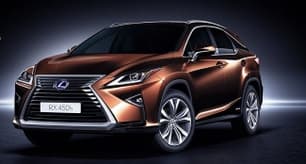
There's a lot of RX and there's a lot going on in that creased, folded and teased sheetmetal. It's a unique design, with a huge 'spindle grille', big lights and the fast glass both front and rear.
It positively screeches Lexus DNA and was a polarising force on our driveway for the week. Most weren't sure, but knew for certain it was a Lexus.
Aggressively flared wheelarches like this aren't common on SUVs (although the squared-off ones are). It's right up on stilts, but the 20s you find it rolling on help to reduce its visual bulk.
That wacky rear quarter glass reminds me of the BMW i3's but it's a Lexus SUV signature. It's quite striking. Do I like it? Not really, but that's completely subjective. You can tell, though, it's built tight as a drum.
Inside is a bit calmer, beautifully laid-out and built to last. The materials are almost all top notch, with lovely switchgear and the real leather is really nice.
There is absolutely nothing avant-garde in there (apart from maybe the pinstripe effect on the centre console), it's all terribly comfortable and easy on the eye. But not exciting, though not all Lexuses are.
This particular car is very US-centric and, if I may, a particularly sunny and humid part, so it can't be too wacky.
The F-Pace was always practical with a big 509-litre boot and great rear leg and head room for even me at 191cm tall, but the cabin re-design has added better storage and usability.
The door pockets are larger, there’s a covered area under the floating centre console and in a victory for common sense and practicality the window switches have been relocated from the window sills to the armrests.
This is along with a deep centre console storage area, and two cupholders in the front and another two in the rear fold-down armrest.
Parents will be happy to know that all F-Paces come with directional air vents in the second row as well. And there are ISOFIX outboard child-seat anchors and three top-tether restraints, too.
There is plenty of room inside this big unit, which is very welcome. Front seat passengers have lots of storage, such as a deep central bin under the armrest, dual cupholders and big door pockets with bottle holders.
Step into the rear and there is a ton of leg and headroom although the transmission tunnel intrudes slightly for the middle passenger. Chuck them out, drop the armrest and you have two more cupholders and each door has pockets and bottle holders.
The boot is pretty big considering the angle of the rear glass. You start with 453 litres (but an expanse of flat floor), which rises to 924 litres with the split-fold seats down. That seems conservative given just how much space you appear to have.
There’s a Jaguar F-Pace for every budget as long as your budget is somewhere in between $80K and $150K. That’s quite a large range in price.
Now, I’m about to take you through the grade names and I need to warn you that it’s going to be messy and confusing a little bit like white water rafting, but not as wet. Life jacket on?
There are four grades: the S, SE, HSE and top-of-the-range SVR.
They all come standard with the R-Dynamic pack.
There are four engines: the P250, D300, P400 and P550. I’ll explain what this means in the engine section down below, but all you need to know is 'D' stands for diesel and 'P' for petrol and the higher the number the more grunt it has.
The S grade only comes with the P250. The SE comes with a choice of P250, D300 or P400. The HSE only comes with the P400 and the SVR has exclusive rights to the P550.
Following all this? Great.
So, the entry grade is officially called the R-Dynamic S P250 and it lists for $76,244 (all prices listed are MSRP - before on-road costs). Above this is the R-Dynamic SE P250 and it lists for $80,854, then there’s the R-Dynamic SE D300 for $96,194 and the R-Dynamic SE P400 for $98,654.
Almost there, you’re doing super.
The R-Dynamic HSE P400 lists for $110,404 and at the top is King F-Pace – the SVR with the P550 listing for $142,294.
There you are, wasn’t so bad was it?
Coming standard from the base grade up is the new 11.4-inch touchscreen, sat nav, Apple CarPlay and Android Auto, there’s keyless entry, push-button start, dual-zone climate, power adjustable front seats, leather upholstery, LED headlights and tail-lights, and an auto tailgate.
The entry-level S and the SE above it come with a six-speaker stereo, but as you step into the HSE and SVR more standard features appear such as a 13-speaker Meridian sound system, plus heated and ventilated front seats. A fully digital instrument cluster is standard on all grades apart from the entry S.
The options list is extensive and includes a head-up display ($1960), wireless charging ($455), and an Activity Key ($403) which looks like an iWatch that locks and unlocks the F-Pace.
Paint prices? Narvik Black and Fuji White are standard at no extra cost for the S, SE and HSE. The SVR has its own standard palette and includes Santorini Black, Yulonhg White, Firenze Red, Bluefire Blue and Hakuba Silver. If you don’t have the SVR but want these colours it’ll be $1890, thank you.
The RX450h F Sport lightens your bank account of $102,460 before on-road costs, the only hybrid SUV within cooee of this price.
That nets you 20-inch alloys, a 15-speaker stereo, dual-zone climate control, heated and cooled electric front seats, reversing camera, that ever rare CD player, keyless entry and start, a solid safety package, reversing sensors, active cruise control, sat nav, a massive sunroof, auto LED headlights, head-up display, partial leather interior, power tailgate, auto wipers and a space-saver spare.
The Lexus media system is run from the gigantic dash-mounted screen that is shamed only by those massive Tesla units.
Sadly, the joystick-style control remains as does the very confusing software system that is less than delightful to use. It's such a shame that a tech-laden machine is let down by the world's most baffling entertainment system.
Once you get it working and understand it, it's okay, I guess, but several years into this job I still can't easily fathom how it works. And that naff analogue clock...
F Sport cars also pick up adaptive suspension and a several driving modes to liven things up.
Jaguar’s engine names sound like forms you have to fill in when you apply for a home loan.
The P250 is a 2.0-litre four-cylinder turbo petrol engine making 184kW and 365Nm; the D300 is a 3.0-litre six-cylinder turbo diesel producing 221kW and 650Nm; while the P400 is a 3.0-litre six-cylinder turbo petrol with outputs of 294kW and 550Nm.
The P550 is a supercharged 5.0-litre V8 producing a colossal 405kW and 700Nm.
The SE grade gives you the choice of the P250, D300 and P400, while the S only comes with the P250 and the SVR of course is powered only by the P550.
The D300 and D400 are new engines, both are straight sixes and replace the V6 engines in the old F-Pace. Superb engines, they are also found in the Defender and Range Rover.
Jaguar calls the D300 and P400 mild hybrids, but don’t be misled by the terminology. These engines are not hybrids in the sense that an electric motor is working to drive the wheels along with a combustion engine. Instead, a mild hybrid uses a 48-volt electrical system to help take the load off the engine by helping it start and running the electronics such as climate control. And yes, it does help save fuel, but not stacks.
There’s plenty of grunt from all these engines no matter which you choose, they all have eight-speed automatics and all-wheel drive.
You are also very likely looking at the last combustion engines to go into an F-Pace. See Jaguar has announced that it will only sell electric vehicles beyond 2025.
Four years and that’s it. Choose wisely.
You can choose three different powertrains in the RX - a 3.5-litre V6, a 2.0-litre turbo four-cylinder, or this one, the 3.5-litre V6 with hybrid.
As a series hybrid it can run for short distances on electric only before firing up the V6 to supply charging and motivation.
The 3.5 produces 193kW/335Nm along with the electric motor. That torque figure seems low and it probably is, but that's a function of the weird way of measuring torque from a hybrid unit. The combined power figure, however, is 230kW.
The hybrid system is hooked up to Lexus' CVT auto and sends power to all four wheels. Lexus says the 450h will complete the sprint from 0-100km/h in 7.7 seconds, which isn't bad for a 2210kg SUV.
It doesn’t make sense that Jaguar has announced that it will be going all electric by 2025 yet doesn’t offer a plug-in hybrid in its Australian line-up, especially when there is one available overseas.
Jaguar says it doesn’t make sense either, but by that they mean business sense, in bringing one to Australia.
So, for fuel economy I’m marking the F-Pace down. Yes, the D300 and P400 use clever mild-hybrid tech, but it doesn’t go far enough to reducing fuel use.
So the fuel consumptions, then. The official fuel consumption for the petrol P250 is 7.8L/100km, the diesel D300 will use 7.0L/100km, the P400 is stated to sip 8.7L/100km and the P550 V8 petrol will drink 11.7L/100km. Those figures are "combined cycle" numbers, after a combination of open and urban driving.
The official combined cycle figure is listed as 5.7L/100km. And, uh, yeah, we didn't get that. I did manage 8.9L/100km over the week, which included a long motorway run from Sydney up to the Blue Mountains (a roughly 160km round trip).
My two test cars at the Australian launch of the new F-Pace were the R-Dynamic SE P400 and the R-Dynamic S P250. Both were fitted with the road noise cancellation system which comes with the optional $1560 Meridian stereo and reduces the level of road noise coming into the cabin.
Which would I rather? Look, I’d be fibbing if I didn’t say the SE P400 with its smooth inline six that has seemingly endless shove, but it’s $20K more than the S P250 and neither engine is low on grunt and both handle and ride almost identically.
That ride has been improved in this new F-Pace with the rear suspension being retuned so that it’s not so firm.
Steering is still on the sharp side, but body control feels better and more composed in this updated F-Pace.
On the twisty and quick country roads I tested the S P250 and SE 400, both performed superbly, with responsive engines, great handling, and serene cabins (thanks to the help of the noise cancelling tech).
The second part of the test was driving both in city traffic for the best part of an hour each which isn’t pleasant in any car. The now wider F-Pace seats were comfortable and supportive, however, the transmission seamlessly swapped gears and even rolling on 22-inch wheels in the SE and 20-inch alloys in the S the ride was excellent.
Right. So this is a salutary lesson about tyre pressures. The first few days the tyres were only pumped up to 200kpa (29psi). That's an easy 100kpa (14psi) short of the required 300 (43psi).
Every time I, or my wife, went around a corner, the big Dunlop Sport Maxx SPs would squeal and squirm and it was most unsatisfactory.
So check your tyres, because the extra 100kpa makes all the difference. Also, the number of service stations it took to find a working pump was unacceptable. Pull your socks up, Sydney.
Anyway.
Correct tyre pressures enacted, the big Lexus turned into a comfortable, competent cruiser. Its motorway performance is super-impressive, purring along the M4 and it's ridiculously poor surface like it was born to it. Which it sort of was.
The hybrid drivetrain allied to the CVT is mostly whisper quiet. It's not the most responsive combination, the initial step-off of the electric motor's torque soon giving way to the rubber band effect of the transmission.
It doesn't feel as swift as the claimed 7.7 seconds and it would be nice if the drive select dial made a genuine difference to the throttle and transmission's response.
In the city, it's a proper wafter, moving about the broken down city streets of Sydney without fuss and a plush ride that's a bit of a surprise given the huge wheels and substantial weight of RX.
It's all very easy and pleasant but the wild looks do not match the experience. Which is not a criticism, just an observation.
The F-Pace scored the maximum five-star ANCAP rating when it was tested in 2017. Coming standard is advanced safety tech such as forward auto emergency braking (AEB), blind-spot assist, lane keeping assistance and rear cross-traffic alert.
This tech is great, but in the five years since the F-Pace first arrived safety equipment has moved on even further. So, while the AEB can detect pedestrians, it’s not designed to work for cyclists, there’s no reverse AEB, nor evasive manoeuvre systems, nor a centre airbag. All are items which weren’t common in 2017 but are now on most 2021 five-star rated cars.
The RX ships with eight airbags (including knee airbags for both front seats), ABS, stability and traction controls, blind spot sensor, reversing camera, forward collision warning, forward AEB and reverse cross traffic alert.
There are three top tether restraints and two ISOFIX points.
The RX scored a maximum five ANCAP stars in January 2016.
At the launch of the new F-Pace Jaguar announced that all of its vehicles would be covered by a five-year unlimited/kilometre warranty, a step up from the three-year coverage it used to offer.
Service intervals? What are they? The F-Pace will tell you when it needs maintenance. But you should sign up for a five-year service plan which costs $1950 for the P250 engine, $2650 for the D300, $2250 for the P400 and $3750 for the P550.
Lexus offers a fence-sitting four year/100,000km warranty with roadside assist thrown into the bargain for the same period.
Service intervals arrive at 12 month/15,000km and there is, sadly, no capped-price servicing.
Lexus will, however, promise you a car for the day or come and get your car from you and drop it back when the service is done. And it will be washed and vacuumed. The website makes a big deal about that.