What's the difference?
The dual-cab ute market and light truck market are potentially two very different landscapes.
While the dual-cab continues to storm the sales charts in Australia, there’s also a growing awareness among hardcore users of these vehicles, that a light truck might often be a better solution.
Better payloads and higher Gross Combination Mass ratings in an age of increasing legal and insurance concerns over overloaded vehicles, were once the light truck’s strong suit. But these days, vehicles like the full-sized US-made pick-ups and even the muscled-up Ford Ranger Super Duty have bridged or even exceeded that gap.
At which point, the light-truck’s benefits become the ease with which it can take on heavier jobs and the sheer size of the cargo and cabin area, not to mention those truck-specific qualities born of generations of refining a concept.
In Australia, it’s Isuzu that absolutely brains the opposition in sales terms. And part of the reason for that has been a realisation that not all would-be buyers want the hassle of the traditional truck-buying process of purchasing a bare chassis and then equipping it so suit their needs.
Which is where Isuzu’s RTW (ready To Work) concept comes in. You simply choose the truck you want, choose a tray, van or service body and then let Isuzu deal with it and phone you when it’s ready to collect.
It's so simple, it’s a wonder not everybody is doing it.
The other news is that Isuzu has finally updated its popular N Series fleet after about 16 years. A new cabin, extensive chassis changes, uprated engines, and all-new transmission, improved suspension and a new focus on safety are all headlines. But 16 years is a long time between drinks, so do the improvements make enough of a difference to keep the concept relevant in a changing market?
Some people just want to save money.
They might know they could spend a little extra to get a brand that has a different reputation, or something that has been reviewed more favourably. Just think about the last time you thought about going to a restaurant for the first time - did you check its reviews? See what people thought? Roll the dice and head there anyway?
That’s the sort of equation you might be considering if you’re thinking about a Great Wall Steed. There are better utes from bigger brands that are available, but none come as cheap as this one if you just want something brand new and with lots of features.
The question is - should you consider it? Should you roll the dice? We’ll have to leave that call to you.
A truck like the NPR (or any other truck, really) is never going to replace a dual-cab ute in terms of its duality. While the latter can tend to weekday chores and be quickly reconfigured for weekend fun, the light truck has no such facility. Nope, it’s a workhorse. Period.
You need a fair bit of real estate just to park the Isuzu overnight and it certainly won’t fit in the typical supermarket car space. It’s hardly sporty to drive, either, although the latest upgrades have made it more user friendly in a total sense and safer than ever before.
But what it does do that a dual-cab ute can’t often do, is tackle bigger, heavier jobs with a fair bit of bandwidth still up its sleeve. And if the nine-to-five side of things is where you need to be, then a vehicle like this has to be worth a look. And if you consistently find that you’re sailing close to the wind in terms of exceeding a ute’s legal payload, towing capacity or GCM, then the extra bigness of a light truck could make a huge difference.
That’s especially so given the price tag. Okay, you’re not buying a lot of high tech for your money, but you are getting some seriously stout engineering and an expectation that you won’t be working the thing to death anytime soon.
Note: CarsGuide attended this event as a guest of the manufacturer, with meals provided.
If you simply want a new ute at a low price, the Great Wall Steed could offer a bit of appeal - it’s not terrible, but it’s also far from great…
My advice would be to see what sort of second-hand HiLux or Triton you could get for similar money.
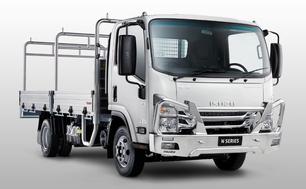
It can’t be easy to make a light truck look fashionable, but Isuzu has done a reasonable job of making the thing look, at least, current. The lighting has all been changed to LEDs now, and the bold, angular face the truck presents looks pretty modern.
But new tech has also forced some design changes. The bull-bar that is part of the Tradepack deal, for instance, has been redesigned with changes to the main hoop. That’s all to accommodate the radar units inside each headlight that inform the front cross-traffic warning system of anything in the way.
Also notable is the attention to detail of the optional (rather than the alloy tray seen here) Australian-made service body. With a choice of internal layouts, the flip-up sides reveal a proper workshop on wheels when configured that way.
It’s also nice to see that all the clips and catches on the drop-side tray can be easily replaced if damaged.
The Great Wall’s exterior styling is reasonably contemporary, even if the proportions are somewhat ungainly. Consider this - the Steed is one of the longest, lowest utes out there.
The dimensions are 5345mm long on a huge 3200mm wheelbase, with a width of 1800mm and a height of 1760mm. There’s just 171mm of ground clearance for this one, which is the 4x2 model.
The wheelbase looks enormous, and the back doors are quite small considering the length of the vehicle (plus the door handles are huge!). The B-pillars are set back further than they should be, and that makes it hard to get into and out of the second row seats.
The interior design is pretty smart, though — compared with some of the other older utes out there, the Steed has reasonable ergonomics and the controls and materials are of a passable quality, too.
But our car - which had just a couple of thousand kilometres on the clock - had a missing piece of exterior trim, along with a few loose bits and pieces inside. The quality is better than the first-gen Great Wall utes, but we hope the next-generation global ute from the brand will be better again. It’ll need to be.
The new cabin Isuzu has brewed up certainly brings the truck into the present, but it’s still very much a light truck in some respects. As in, it’s still a pretty good climb inside, although there are steps and handles to make that easier. The steering column still gets in the way as you swing your left leg inside, though.
The plastic surfaces would still make a car interior designer cringe, and the floor is vinyl and the seats cloth. But the three-abreast seating arrangement makes sense and, should you choose the dual-cab N Series option, there’s actually seven seats in all.
Cabin storage has obviously been a priority for Isuzu, and there are three large, netted overhead bins above the top of the windscreen, as well as bins and buckets across the width of the lower dashboard. Interestingly, each door has just a single, slim pocket and no bottle storage.
The centre console addresses that somewhat with a pair of cup-holders and a pen slot, while there’s also a large bin behind the seat on the bulkhead. There’s also an interior light that wouldn’t look out of place in an industrial kitchen.
The dashboard is home to a pair of USB charge-ports in the centre and the truck stuff continues with a wand for the exhaust brake and a knob near the steering column for a fast-idle setting. It’s also nice to see that even though Isuzu has adopted keyless entry and start for the N Series, the starter button resembles a conventional key and is located right where it should be in the side of the steering column.
What’s missing? Mainly a vanity mirror on either side of the cabin and a physical volume knob for the stereo. Oh, and paddle shifters would be nice too, especially when towing.
Externally, the Tradepack option gets you an aluminium drop-side tray, sturdy ladder racks, a tow bar, bull bar, toolboxes fitted below the tray between the axles and even a wash station for after-work clean ups.
The tray is fitted in Australia (many of the Ready to Work body options are also made here) and the load floor is a vast expanse of alloy with the ability to cope with small, heavy objects thanks to its high-impact materials. But the usual drop-side tray caveats apply including a high loading height, rattling from the sides and the legal requirement to lash everything down before hitting the road.
Meantime, part of the overall appeal of the Isuzu line-up is that there are something like 40 different permutations of cabin width, wheelbase, GVM, overall length and driveline.
But here’s perhaps the N Series’ greatest trick when it comes to being practical: While it’s easy to dismiss the vehicle for being too big and unwieldy, many operators would possibly find that the extra payload and real estate in the cargo area means that they might not need to tow a trailer every time they venture on to a job site. At which point, the dual-cab ute with a tandem trailer starts to look less convenient, especially if there’s any reversing or squeezing on to a tight site involved.
Oh, and if tight spaces really are an issue, the N Series’ sub-10m turning circle makes a typical dual-cab’s 12.5 metre turning circle look ridiculously ungainly. And that’s before we get to that trailer.
Typically for a vehicle like this, a full-sized spare tyre is included.
As mentioned above, the interior of the Steed is acceptable for a budget ute, but that’s as faint praise as saying “you look fine” to the reflection of yourself in the mirror after a big night out.
The cabin has a few elements to it that are decent - the dashboard design is decent, and the controls are pretty logically placed. If you’re stepping up from a first-gen Great Wall ute, you’ll be blown away.
Things like the big media screen and leather-lined steering wheel, as well as electric front seat adjustment and leather seat trim that feels more like cowhide than repurposed garbage bags this time around will all count toward some positive first impressions.
That said, the screen is one of the most confusing ones I’ve encountered - you have to pair your phone by hitting the icon that looks like a PC tower linked to a phone. Why? Also, the load times on the screen are terrible, and when you put it in reverse the screen simply goes black. There is no reversing camera as standard, which is poor form. You can option it if you want, likewise the sat nav is optional - and it looks a lot like a UBD or Melways. Plus the volume levelling is very inconsistent.
As mentioned above the ingress and egress for rear seat occupants is poor - anyone who has feet bigger than a size six will struggle to get in and out without getting tangled. Once you’re back there, the knee room is tight, but head room is fine.
There is reasonable storage throughout - there are cup holders between the front seats, door pockets with bottle holders and a few loose item cubbies up front, too. In the rear there are map pockets but no other storage options unless you fold the rear seat backrest down.
Like the rest of the N Series line-up, the NPR Tradepack model we’ve chosen to review here is available in a range of cabin widths and wheelbases and even a choice of Gross Vehicle Mass. But first, let’s break down the badge. In Isuzu-speak, N stands for the smallest family in the light-truck line-up. As such, it can be driven on a normal car license in Australia.
The P stands for the GVM, in this case that license-friendly 4.5 tonnes, although you can opt for the higher, 6.5-tonne GVM at which point an endorsed license is required.
And, finally, R is Isuzu’s in-house code for a truck that is two-wheel-drive and uses conventional steel-spring suspension rather than air suspension.
Isuzu says the Tradepack option with its large tray and fittings is a very popular one, so that’s what we’ve concentrated on here. That pack equates to all the drop-side tray, racks and fittings, so it’s a comprehensive add-on. Of course, you can take your NPR as a bare cab-chassis, too, and save by swapping over the tray and fittings from your old truck.
Beyond the nuts and bolts stuff, the NPR includes LED lights all-round, heated and powered exterior mirrors (and they’re huge), keyless entry and start, cruise control, steering-wheel mounted controls, climate-control air-con, a suspension driver’s seat and a tilt and reach adjustable steering column. There’s also a 10.1 inch multimedia screen in the centre of the dashboard, digital radio, sat-nav and wired Apple CarPlay and Android Auto connectivity.
The features that tell you this is still a truck and not a passenger car include the steel wheels, cloth seat trim and vinyl flooring.
As it sits, the NPR Tradepack costs $86,014 on the road, but that’s an all-up figure, and not one where you then have to arrange your own accessories and bits and pieces. It’s also within a few hundred dollars of the Ford Ranger Super Duty Super Cab which, perhaps not so coincidentally, has an identical GVM of 4000kg, GCM of 8000kg and slightly more towing capacity of 4500kg versus the NPR dual-clutch’s 4000kg.
The Great Wall’s biggest redeeming feature is its price and specs.
You can get a base model single-cab-chassis version for less than twenty grand drive-away. This model is the 4x2 dual cab, which has a list price of $24,990 plus on-road costs, but it’s almost always on special at $22,990 driveaway. Need a 4x4? Pay an extra two grand and you’ll get it.
The Steed offers an extensive standard features list, including auto headlights, auto wipers, LED daytime running lights, front and rear fog lights, 16-inch alloy wheels, cruise control, single-zone climate control, heated front seats, leather trim, a leather-lined steering wheel, a six-speaker stereo system with USB and Bluetooth connectivity and the aforementioned optional camera and GPS navigation. You get carpet on the floors rather than vinyl, too.
The exterior is packed with features tradies will love - there’s a big step bumper to allow easy access to the tray, which has a tub liner as standard as well as a sports bar. Accessing the cabin will be easy for shorties as there are side steps fitted as standard.
Believe it or not there’s actually a family connection between the 3.0-litre turbo diesel in the Isuzu NRL and the Isuzu D-Max dual-cab and MU-X SUV.
While the displacement of the D-Max remains, the unit in the light truck has been retuned to liberate more torque at lower engine speeds. In this case, that’s 129kW at 2860rpm and 430Nm of torque anywhere between 1450rpm and 2860rpm. That gives the engine great flexibility, but the transmission also plays a part.
That’s either a six-speed manual or a nine-speed dual-clutch unit. The latter has either manual or fully automatic shift modes, and it’s worth is backed up by the potential for lower fuel consumption thanks to the inherent efficiency in such a transmission as well as the three extra ratios.
Designed and made in-house at Isuzu, the brand says it’s confident the wet-clutch unit doesn’t carry the potential flaws of some other dual-clutch units we could name. That said, Isuzu has downgraded the towing capacity from 4.5 to four tonnes if the nine-speed is fitted.
And just like any good truck, there’s the provision for a power-take-off on the side of each transmission option, as well as an exhaust brake to help the mechanical brakes when fully laden.
Unlike many light trucks before it, the Isuzu doesn’t get stuck with a rigid front axle. Instead, you get a proper independent set-up with coil springs, while the rear end remains a live axle with leaf springs in the interests of carting lots of heavy stuff.
Great Wall uses a 2.0-litre turbo-diesel four-cylinder with 110kW of power (at 4000rpm) and 310Nm of torque (from 1800-2800rpm), which is only available with a six-speed manual transmission. There is no automatic transmission available. But you can get a petrol engine if you prefer, which is becoming rarer in the ute segment.
The payload capacity for the Great Wall Steed 4x2 is decent for a dual cab pickup at 1022kg, and it has a gross vehicle mass of 2820kg. The Steed has the standard 750kg un-braked towing capacity, but a meagre 2000kg braked towing rating.
This is a cursed subject in the truck segment, because there’s just no standard pattern of usage, nor a typical loading scenario. Some trucks will spend their whole lives heavily loaded going from red light to red light, others will be less burdened and driven between regional towns.
But what we can tell you is that unladen and driven sensibly, this truck should be able to return fuel consumption figures in the low teens per 100km. Throw the full payload and a trailer on the back and head for hilly country and you could easily double that and then some.
As such, the range from the 100-litre fuel tank is going to vary enormously, but should be somewhere between 500 and 800km.
The other thing to bear in mind is that the upgrade to this model has brought the Isuzus in line with Euro 6 emissions or their Japanese equivalent. So they now need AdBLue and there’s a 14-litre tank for that.
The Great Wall has a claimed fuel use of 9.0 litres per 100 kilometres in the spec we tested, and across our testing regimen - which included on-road driving laden and empty for a few hundred kilometres, it managed 11.1L/100km. Okay, but not great.
The fuel tank capacity of the Great Wall is 58 litres, which is small for the class, and there’s no long range fuel tank option.
Actually climbing aboard the Isuzu is job one, and you’ll need the handles and step to do it safely. Then again, it’s probably no more testing than getting into a really low sports car in a degree of difficulty sense.
With that accomplished, you’re met with two things; the view out and the very un-car-like driving position. The first is fantastic for forward vision. And it’s not just the height advantage over other traffic. The cab-over-engine layout also means you’re almost at the very front of the truck, meaning you can see a lot more of what’s directly in front of you, even if it’s almost under your nose. Jumping back into a dual-cab ute for comparison emphasises the point enormously.
The driving position, meanwhile, might take more getting used to. The steering wheel is almost flat and you tend to sit pretty upright. Long-distance drivers will tell you this is actually great for long stints at the helm, and it honestly feels pretty natural after just a few minutes. But the steering column placement means there’s no chance of left-foot braking which some drivers (this one included) prefer.
Once you’re rolling, the dual-clutch transmission starts to feel pretty handy with short, sharp upshifts and a calibration that sees it keen to downshift on deceleration to help balance the vehicle, take the stress off the brakes and ensure that the engine is in its power band for when you next throttle on.
Speaking of which, the engine is not exactly overpowering, but it does produce the meat of its muscle in the right places, helped no end by having nine ratios to play with. And here’s an interesting point: The way the engine is installed in the NPR – and despite the fact that you’re sitting pretty much right on top of it – there’s less noise and vibration from the 3.0-litre than in an Isuzu D-Max ute. Obviously, low vibrations and less noise are factors in staving off driver fatigue, and clearly Isuzu knows how to achieve this.
Ride quality will vary hugely depending on what’s on board. We tried the NPR with a full load of gear on the tray, taking it almost to its payload limit. At that point, the ride was actually quite compliant, and the only odd sensation is that of having your backside right over the front axle.
The other mantra held dear by fleet managers is that the best way to reduce breakdowns is to take the driver out of the equation as much as possible. That explains the dual-clutch transmission, for one, but it also perhaps explains why the NPR is set up to be actually very easy and simple to drive. It’s definitely scarier to look at than to pilot. And that turning circle is something else!
A lot of utes these days are aiming to be dual purpose vehicles, with passenger-amenable ride, handling, steering and powertrain combinations that mean you can use them for work and play.
The Great Wall? Well, it’s more work-oriented. That’s a nice way of saying you won’t want to subject your family to this truck, but your workmates? Too bad for them.
The ride is harsh without weight in the back, bucking over bumpy sections of road and jolting after a sharp edge.
The steering is light but requires a lot of turns lock to lock, and the turning circle is large. You need to keep that in mind when you’re parking, plus the vision from the driver’s seat isn’t as good as it could be.
The engine enjoys using every gear but first, but the manual shift action isn’t enjoyable and the torque on offer doesn’t come on smoothly.
I will say this - with 750 kilograms in the back, the rear suspension didn’t sag very much at all. The Steed offers a big payload, and the chassis can cope with it.
What can’t cope with the weight is the engine - we had 750kg in the tray and four adults on board, and it was worse than sluggish. I struggled to get it moving from a standstill, revving harder than I usually would in a diesel-engined ute. There’s a lot of lag to contend with, and the engine simply doesn’t like low-speed moves at all.
But at higher speed it got into a groove, and the ride was actually really well sorted with mass over the rear axle. Plus the fact it has four-wheel disc brakes - unlike many of its newer, more high-tech rivals - means the braking performance was pretty promising, too.
You can absolutely thank OH&S legislation for the huge leaps in active and passive safety that vehicles like the Isuzu have made in recent years.
Although this class of vehicle is not required to be crash tested (and, therefore, there’s no safety star rating available) even a scant knowledge of physics suggests that sitting the passengers up high in a vehicle with a strong chassis is a very good start when it comes to crash safety.
Passive safety is also helped by an airbag for both driver and the two front-seat passengers in the case of the three-seat variant we’ve looked at here. But only the outboard passengers get a three-point seat-belt, and the centre position gets a simple lap-belt.
There are also side intrusion bars in the doors as per passenger-car best practice and the overhead storage space features a safety net. There are no side-curtain airbags, but again, that high seating position makes the N Series inherently safer for passengers in a typical side impact.
But it gets better with a long list of driver aids, most of them straight out of the current passenger-car playbook. Running changes to the vehicle over the years have seen the addition of autonomous emergency braking (AEB), anti-skid brakes, stability control, a driver attention monitor, a distance warning system for vehicles in front, brake-force distribution and lane departure warning.
New safety tech this time around includes front cross-traffic alert and braking, mis-acceleration (pedal-error) mitigation, traffic and speed-sign recognition, a distance warning system that also advises of the speed of the car in front and improvements to the rear camera system.
And yet, there’s probably more work to be done here. We’d like to see a standard 360-degree camera and tyre pressure monitoring as well. These are both available at extra cost right now, but really should be standard on a vehicle like this. Rear cross-traffic alert is also missing, but that’s more about standardising the sensors and their calibration on a huge range of rear-body designs, apparently.
There’s also an apparent tech gap to be bridged, too, and right now only the dual-clutch-equipped version gets the speed limiter and adaptive cruise control, while the conventional manual does not.
Isuzu is also making a big noise about the new electronic park brake which can be used in an emergency to bring the vehicle to a complete, controlled stop if necessary.
There isn’t a lot of happy reading here.
The Great Wall Steed scored an abysmal two-star ANCAP crash test safety score when it was tested in 2016, though under the disclaimer that score applies to ‘4x2 petrol dual cab variants only’. That’s nasty, especially considering it has dual front, front side and curtain airbags as standard in dual cab form.
There is tyre pressure monitoring and rear parking sensors as standard, but a camera isn’t fitted as standard. There is no auto emergency braking (AEB) or any other advanced safety tech, either.
But it has ABS anti-lock brakes, electronic brake distribution, stability control, hill descent control and hill hold control. There are three-point seatbelt for all seating positions, and if you dare, there are dual ISOFIX child seat anchor points and three top tether points in both models.
Despite the hard life many trucks are destined to live, Isuzu offers a standard six-year/250,000km warranty on the cabin and chassis of this model. The rear RTW body (whatever form that takes) is covered for three years. There’s also a three-year warranty on genuine accessories provided they were installed by a certified fitter.
Service intervals are every 25,000km, 12 months or 5000 hours of operation, whichever comes first. There’s also six years of roadside assistance thrown in.
Isuzu offers a range of service agreements ranging from the basic package right up to a plan that covers everything including wiper blade replacement.
There are currently 84 Isuzu dealers or authorised service outlets around the country, including some pretty far flung spots, so service and parts should be less of a problem than for some other brands.
Mechanically, Isuzu has worked to reduce servicing times, including the use of sealed-for-life wheel bearings.
Great Wall introduced a five-year/150,000km warranty in April this year, which is good for a challenger brand but doesn't push the boundaries for the ute segment. There is three years of roadside assist cover as well.
There is no capped price servicing plan, but the Steed requires maintenance every 12 months or 15,000km (following an initial six-month checkup).
Concerned about problems, issues, faults, common complaints, transmission or engine reliability? Check out our Great Wall problems page.