What's the difference?
The world of upper large luxury SUVs, like Infiniti’s latest-generation QX80, occupies that rarefied air, way up high in the car market, that I’ll never breathe – and that’s okay with me.
You see, as much as I admire these plush vehicles, even if I did have the cash and the inclination to buy one, I’d be so worried about incidental damage to the exterior (shopping trolleys or other drivers’ touch-parking) or children-induced damage to the interior (car sickness, spilled food or drink, blood from sibling punch-ups in the second row) that I’d never be able to fully relax while driving the thing. (Newsflash: I’ve heard from Infiniti that the QX80’s upholstery has a soil-resistant coating.)
These pricey wagons certainly do have their fans though and now, with extensive exterior changes and some interior ones, does the QX80, based on the Y62 Nissan Patrol, actually offer anything to set it apart from other large premium SUVs? Read on.
This is a BIG moment for the Lexus RX in Australia. And I'm not just referring to the spindle grille that adorns the front-end of this all-new model (though it too is almost commercially massive).
I'm talking more about the vehicle itself, and its importance to the Lexus brand here. The RX is one of Lexus' best sellers in Australia, and so this new one – which welcomes a new platform, new powertrain options and an all-new F Sport Performance trim level – is a big deal.
So, does it live up to the hype (and to its German competition)? Join me as we figure all that out ahead of the RX's debut here in early 2023.
The petrol-only QX80, really a Y62 Patrol with shedloads of bling, is a curious beast; a big, bold status-boosting premium SUV, which is much better suited to the US and Middle East markets than ours. However, it has a real premium feel, is very smooth to drive and the exterior and interior changes have improved what has so far been a divisive model for a brand with a small but growing fanbase here. Infiniti sold 83 of the previous QX80 in 2017 and is hoping to move 100 of these new ones in 2018; they have their work cut out for them, but if brand confidence is worth a few sales, who knows, they might even top the ton.
The RX is a big SUV that doesn't always look, or drive, like one, and – in 500h guise especially – can put a smile on a driver's face, too.
Gone are the cabin quirks and the polarising design elements (well, mostly...), and in their place you'll find a solid, premium-feeling family offering without much in the way of drawbacks.
Note: CarsGuide attended this event as a guest of the manufacturer, with travel, accommodation and meals provided.
The bulk of the facelifted QX80’s design changes have been to the exterior and include, most noticeably, new LED headlights with a redesigned, sleeker but more aggressive front end than its predecessor’s softer, more rounded curves.
The new QX80’s bonnet is 20mm higher than before and has been extended 90mm; the side steps have been stretched 20mm wider, and the power tailgate has been re-designed to include sharper, thinner, rear LED taillights and the bumper is visually wider.
The whole body has a higher visual centre of gravity, with this latest raft of design shifts giving the SUV a taller, broader, wider and more angular overall appearance.
The interior includes a bigger, chunkier redesigned centre and rear console and those aforementioned premium touches, such as leather-wrapped heated steering wheel, updated upholstery-stitching, semi-aniline quilted leather patterning on door panels and seats, as well as its stainless-steel sill plates, all add to the premium feel.
The QX80 looks better than it did but, as the previous one was pretty hard on the eyes, the 2018 version may still polarise opinion.
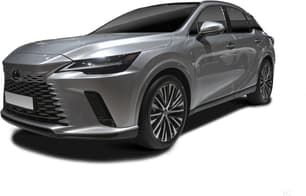
Honestly, the Lexus RX looks far more powerful, and cohesive, in the metal than it does in some photos, and in the right colour (we're fond on the deep black or the copper-rose hues), it looks downright fetching.
That Predator-shaped front-end is massive, but the way the Spindle grille kind of bleeds in the body work at the nose of the vehicle is a neat trick, and the whole design ethos gives the RX a sportier, more modern, and more intimidating, energy from almost every angle.
Perhaps the most clever element though is the wave-like design piece that links the rear window with the boot, somehow managing to shrink almost-five-metre SUV (visually, at least), and leaving the RX looking more sporty than hulking.
The door handles are cool, too. They’re fixed, and you just touch them to open the door, with a similar system used once inside to get out again.
Inside, Lexus has gone for a clean, modern-feeling space, and, thankfully, there isn't a Remote Touch trackpad in sight. Instead, you can choose between two screen sizes – 9.8- or 14.0-inch – which kind of dominate the dash, while the air-con controls are digital and interactive, too.
It must be said, though, some interior treatments feel far more special than others, and while Lexus in Australia isn't spilling on specifics for our market just yet, the top-spec models will almost certainly feel more plush than the cheaper ones.
The QX80 is a big unit – 5340mm long (with a 3075mm wheelbase), 2265mm wide and 1945mm high – and, when you’re seated inside it, it feels like Infiniti designers and engineers must have worked hard to maximise the space afforded them for driver and passengers without seeming to have sacrificed any style or comfort.
And that big open space inside the cabin is easy to get comfortable in. There are soft-touch surfaces everywhere – door panels, arm rests, centre-console edging – and the seats are unsurprisingly soft and supportive but tend towards slippery when there are quick changes in speed or direction, or when tackling steep downhills off-road. (It was fun to watch front-seat passengers slip-slide around inside during the 4WD loop)
If you’re up-front you’re well catered for; big glovebox; overhead sunglasses storage; the centre console now has a roomy smartphone storage area; the twin cupholders have been upsized to cop two 1.3-litre cups with handles (up from one 1.3-litre cup and a 950ml container); the USB port has been moved to the other side of the centre console so it’s easier to get to; the storage area under the front passenger arm-rest is now a 5.4-litre compartment, able to hold up to three upright 1.0-litre bottles or tablet devices.
There are nine cupholders and two bottle-holders in total in the QX80.
There’s a sunroof if you get the urge for natural light from above.
Second-row passengers now get 8.0-inch entertainment screens (up from 7.0-inch) and two additional USB ports.
The tip-up second row seats are easy enough to operate and the third row is power 60/40 split-fold-to-flat and reclining.
The QX80 is available with both seven- and eight-seat configurations, with the back seat in a two- or three-seat formation.
There is a 12V outlet in the cargo area.
The entire RX range now rides on Lexus' GA-K platform, which is lighter (-40kg), more rigid, and offers a lower centre of gravity (-15mm) than the model it replaces.
The RX is wider (+25mm to 1920mm), lower (-10mm to 1695mm), but no longer (still 4890mm) than the outgoing model. But Lexus has lengthened the wheelbase (+60mm to 2850mm) to earn some extra backseat space for rear riders.
And it must be said, there is lots of room for backseat riders. Sitting behind my own 175cm driving position I had more than enough knee room, and enough head room, and a general feeling of airy spaciousness.
Elsewhere you get the usual practicality perks, with two cupholders up front, two more in the pull-down seat divider that splits the rear seat, and there are two ISOFIX attachment points in the back seat, too.
Charging is handled by a four USB ports, and depending on the trim/spec balance Lexus in Australia shoots for, you should at least find vents with temp controls for backseat riders, too.
Lexus is yet to confirm the luggage space specs for the new RX, but given it’s only being offered with five seats, and that there’s been no change to the vehicle’s length, you can expect a fair bit of room for bags in its auto-opening boot.
Pricing has not changed: there is one model and it still costs $110,900 before on-roads and that price does not include paint other than the standard Black Obsidian; metallic paint is $1500 extra. Changes over and above the previous model’s standard features list include 22-inch 18-spoke forged alloy wheels (up from 20-inch), Infiniti’s InTouch 8.0-inch colour touchscreen (up from 7.0-inch), new Espresso Burl coloured trim, new chrome finishes all-round, updated upholstery-stitching everywhere, quilted leather patterning on seats, new headlights, LED foglights and more. There is no Apple CarPlay or Android Auto.
This is an arbitrary seven out of 10, here. Because we don't yet know how many trim levels the new RX will launch in, how much each will cost, or what you'll get for your investment.
What we do know is that the RX will launch with three powertrain options: an all-new turbocharged hybrid, a second, more conventional hybrid, and a turbo-petrol engine. There’s a plug-in hybrid version available overseas, but we ain’t getting it. Or at least, not yet.
In terms of specific trims and equipment levels, you’ll need to wait until closer to the RX’s launch in early 2023 for the full skinny. But you can expect a choice between a 9.8-inch or 14.0-inch central touchscreen with wireless Apple CarPlay and Android Auto, an eLatch door system with fixed handles that unlatch at the push of button inside and out, as well as more high-tech safety kit (thanks to Lexus Safety System 3.0) than you can shake a radar at.
The previous generation’s 5.6-litre V8 petrol engine (298kW@5800rpm and 560Nm@4000rpm) remains, as does the seven-speed automatic transmission with adaptive shift control. It also has Infiniti’s all-mode 4WD system, which offers Auto, 4WD High and 4WD Low settings and it has terrain appropriate modes (sand, snow, rocks) able to be dialled in.
Let’s start with what we’re not getting at launch. Internationally, there's a new plug-in hybrid variant that pairs a 227kW hybrid system with a 18.1kWh lithium-ion battery for an EV driving range of more than 65kms, but fight though Lexus in Australia did, it couldn't secure the model for our market at launch. It wants it though, and badly. So watch this space.
Instead we get three options, including the RX 350h, which pairs a 2.5-litre petrol engine with Lexus' existing hybrid system to produce a total 180kW and 316Nm. It's paired with a constantly variable transmission and will be offered in two- or all-wheel drive.
There’s also a turbocharged 2.4-litre petrol engine on offer in the RX 350, good for 205kW and 430Nm, and paired with an eight speed automatic and AWD.
But the powertrain I really, really like lives in the RX 500h F Performance, and pairs a 2.4-litre turbocharged petrol engine with an electric motor up front, and a second at the rear axle, for a total of 273kW and 551Nm.
The all-new hybrid system has been designed with turbocharged engines in mind, and features a single electric motor at the front, and a bigger rear motor, with the latter able to provide real driving power to the rear tyres - and contribute to a sprint to 100km/h of just 5.9secs.
Lexus calls it an 'eAxle' motor, and it can deliver some 76kW to the rear tyres. It pairs with a 'DIRECT4' all-wheel drive system which the brand says improves "handling, controllability, and feel."
Fitting, then, that it features on the RX 500h F Performance, which also introduces a new go-fast tier for the Lexus brand (though one you can expect to see more frequently in the near future), and which sits between the existing F Sport and the top-tier, full-fat F models.
The brand says things like bigger brakes, performance components and the highest power outputs will be reserved for the F Performance models. And so it is with the RX 500h F Performance, which welcomes six-piston front brakes, adaptive variable suspension, dynamic rear steering and 21-inch wheels.
The QX80 is claimed to use 14.8L/100km. We reckon that fuel-consumption figure is very optimistic and if QX80 owners are partial to towing boats – as Infiniti reckons they are – or if they tackle some 4WDing, then that figure is going to climb much higher quite swiftly.
Let’s start with the pure-petrol RX 350, which will sip a claimed 8.8 litres per hundred kilometres on the combined cycle, and will demand premium petrol. The RX 350h is more fuel efficient, demanding 6.4 to 6.7 litres per hundred kilometres on the combined cycle.
But the most impressive is the RX 500h, which Lexus says will need 8.2 to 8.5 litres per hundred kilometres — making it more efficient than the petrol-powered RX 350, despite producing an extra 68 kilowatts of power and 121 newton metres of torque.
In the world of luxury SUVs big is king and this thing is definitely on the chunky side of big, but it doesn’t often feel too cumbersome for its own good, or too bulky to steer in and out of Melbourne’s bustling morning traffic with precision.
During this event, we did a fair chunk of driving – highway, country roads, gravel roads and a decent bit of 4WDing – and, surprise, surprise, it did pretty well, especially when things of this ilk usually exhibit the ride and handling of an old poorly-sprung couch on wheels.
It did, however, feel top-heavy at times and revealed substantial body-roll when pushed around corners at speed or even during some sections of slow, bouncy off-roading, so I’d be reluctant to experience what it would be like without hydraulic body motion control. However, we were willing to forgive it any rocking-and-rolling when that healthy V8 growl kicked in as we gave it the boot.
The 22-inch tyre-and-wheel combination is not the way I’d go if I was going to use the QX80 for any off-road forays but, having said that, we did fine on them, at road tyre pressures, over a decent off-road loop.
It has 246mm of ground clearance and 24.2 (approach), 24.5 (departure) and 23.6 (ramp-over) angles.
The QX80 has coil springs all-round and it was only ever caught out when it thumped through a couple of surprise potholes along a dirt road.
This Infiniti model has a claimed tare mass of 2783kg, but you wouldn’t have known it was that many kegs because it powered up steep and slippery bush tracks, through deep muddy ruts, over greasy rocks and through a few knee-deep mud holes with ease. It was as easy as pulling up, switching your terrain modes and dialling in your setting: 4WD High, 4WD Low or Auto. It has a locking rear diff and very capable hill descent control, which we tested on a few rather steep sections of track.
It’s nice to see vehicle manufacturers unafraid to put their off-roaders, even their pricey luxury ones, through a decent off-road loop at launch because it shows they have confidence in its capabilities.
The QX80 has a maximum braked towing capacity is 3500kg and 750kg (unbraked).
Right, let’s cut to the chase here. I like the way the all-new RX family drives, pretty much across the board. If that’s all the information you want or need, feel free to check out here and move on to the next sub-heading.
Still here? Ok, then let’s go a little deeper.
None of the powertrains on offer feel under-powered in the RX range, which is a good start, but they all do their jobs a little differently.
The RX 350 is probably the most familiar, with a traditional automatic and that well-known petrol-powered punch. It’s not the most powerful engine on offer here, but it’s more than enough to get the RX up and moving — but, for mine, it can feel a little thrashy (or like it’s straining a little too hard), when you really start to push it, but such is the price you pay for a four-cylinder engine pushing a large SUV.
Next up is the RX 350h, which Lexus reckons will be the best-selling model in Australia. Lexus and Toyota have been doing hybrid powertrains for some time now, and the system fitted to the new RX is predictably solid-feeling, though it too has its drawbacks – namely that the constantly variable transmission can drone on and on under constant acceleration, and even the commendably insulated cabin can’t block it out completely.
So if this is a Goldilocks’ scenario, then the just right has to be the RX 500h, which blends its powerful powertrain with a traditional-feeling automatic to deliver plenty of performance and a tight, engaging drive experience that makes it feel as though the big SUV is somehow shrinking around you from behind the wheel, courtesy of the best performance kit (brakes, adaptive suspension, etc).
But to be honest, no matter the RX, the thing that really stands out here is its on-road dynamics. The car doesn’t really wobble about, there’s not much in the way of body roll, and it feels tight and confidence inspiring, no matter the model - but especially the rear-wheel-steering equipped 500h.
The RX also does a commendable job of locking the outside world outside of the cabin. Where you want it to be a calm and sedate family hauler, it can be that. But it can also put a smile on your face on the right road, too.
And that, I think, is something to be celebrated. And also not something we’ve come to associate with Lexus over the years. But that’s now beginning to change. Long live F Sport Performance, then.
The QX80 does not have an ANCAP safety rating. Safety tech as standard includes blind spot warning, intelligent parking system, forward emergency braking, lane departure prevention (incorporating lane departure warning), distance control assist and predictive forward collision warning, Infiniti/Patrol intelligent rear view mirror (which can display video from a camera mounted in the upper rear windshield) and more. It has two ISOFIX points in the second-row seats.
The Lexus RX welcomes the brand's Lexus Safety System 3.0 setup, which means more high-tech kit than you can shake a radar at.
What appears where on the Australian lineup remains to be seen, but internationally the RX will offer things like Advanced Park, remote parking from your smart phone, Safe Exit Assist that will actually prevent you opening the doors should the cameras detect pedestrians or cyclists, and Pre-Crash Safety, which scans intersections for bikes, people or cars, and activate alarms and the brakes should it sense a collision.
That, and things like Front Cross-Traffic Alert, active cruise, Lane Departure Warning and Lane Tracing Assist, road-sign recognition and Lane Change Assist, should see Lexus shooting for a five-star ANCAP safety rating.
It has a four year /100,00km warranty. Service intervals are scheduled at 12 months/10,000km. The total cost for three years is $1346.11 (GST included).
The Lexus family is covered by a five-year, unlimited-kilometre warranty, which is about bang-on in the premium-vehicle space.
While servicing details are yet to be confirmed, the previous RX required a trip to the service centre every 12 months or 15,000kms, and it will fall under the brand’s capped-price servicing program, and the Lexus Encore program, which offers all sorts of perks to owners.