What's the difference?
The current generation iLoad was launched in 2008. With only minor upgrades during its first decade on sale, it was recently given its first facelift with a new grille design plus new comfort and convenience features.
These updates don't change the fact that the iLoad is now stretching beyond the usual 10-year generational lifespan for LCV models, yet it continues to generate strong sales in a softening market.
It currently commands more than 23 per cent of the mid-size (2.5 to 3.5 tonne) commercial van segment, topped only by Toyota's dominant HiAce with a 33 per cent market share. The closest competitor behind the iLoad is Ford's Transit Custom with only 11 per cent.
We recently spent a week with the iLoad, to find out why this venerable Korean workhorse maintains its popularity in a mid-size van market packed with hungry competitors.
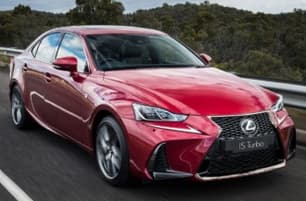
Peter Anderson road tests and reviews the new Lexus IS200t F Sport with specs, fuel consumption and verdict.
Long ago, the Lexus IS overtook the LS as the most recognisable Lexus on the road. With strong, angular styling, sharp pricing and spec against the Germans, and a 2.0-litre straight six engine, it seems like Lexus sold a million of them and only one of them has broken down irretrievably and is now being used to prop up the Harbour Bridge, such was its solid build quality.
Hell, Lexus was even able to hide for a while that it was a rebadged Japanese Toyota Altezza, partly because Toyota didn't do funky rear-wheel drive sedans outside of Japan. The IS took the brand into many more homes than the ES or GS could ever hope to because it looked like it was a Lexus.
We're now three generations and one facelift into the IS and the big selling IS250 is no more, replaced some time ago by a 2.0-litre turbo four and renamed IS200t. You can now get an F Sport version, too, just like you can buy an Audi with S Line or a BMW with M Sport.
That turbo engine hopefully addresses one of the problems with the entry-level IS sedan - it was always a little on the slow side...
The iLoad remains one of the most competent all-rounders in the business. This highlights the excellence of its original design, as it hasn't changed much since it launched here more than a decade ago.
However, it's starting to show its age a bit, particularly in terms of safety compared to HiAce and Transit Custom rivals which have aggressively raised the mid-size van benchmark to a five-star standard that rivals most sedans and SUVs.
We hope Hyundai will soon do the same with the iLoad, because apart from increasingly outdated safety it's pretty hard to fault. We're sure its army of loyal customers would agree.
The Lexus range comes with a four year/100,000km warranty with roadside assist for the duration. Servicing is every 15,000km or twelve months, whichever comes first.
Sadly, there's no fixed or capped-price servicing regime, not even a pre-pay option like the stingy Germans. Lexus will only commit to indicative pricing, although the first service at 15,000km is priced keenly - it's free.
When you buy a Lexus, they don't like to let go of you. My father-in-law's original IS 200 is still fetched by the dealership - should he so desire - for its annual service. If he chooses to darken the dealership door himself, he'll drive out in a loan car. Nobody has ever stalked him at the dealership demanding he consider a new one.
The IS200t seems the pick of the IS bunch, despite pricing on par with a couple of the IS350s. It's a worthy alternative to the usual suspects, with its own look, feel and approach to luxury motoring. In fact, it's far more a luxury car than sports sedan, but manages to do both well. In the end, a BMW will edge it for handling and overall chassis grace, the Merc has that badge and the Audi is all-wheel drive and bang-up-to-date.
But none of them can touch the Lexus for after-sales service nor are any of them quite as well put together as the Japanese-built IS. It may not be as fast or as fun, but it's very, very good.
The iLoad is 5150mm long, 1920mm wide and 1935mm high with a 3200mm wheelbase. That height means it can access underground and multi-storey carparks, in which it's also easy to manoeuvre with a relatively compact 11.22-metre turning circle.
No doubt a big factor in the rear-wheel drive iLoad's enduring appeal is its simplicity and ruggedness, combining MacPherson strut front suspension with rack and pinion steering, leaf-spring live rear axle and four-wheel disc brakes. A sliding door on each side of the cargo hold come standard. The large tailgate window, equipped with a wiper/washer and demister, provides the rear-view mirror with a relatively clear picture of what's behind even with the cargo barrier and clear plastic covering on it.
The cabin environment is bright and airy with a tasteful mix of light and dark grey surfaces. The light grey cloth seats with their colourful striped inserts look sharp but we reckon they would also show some grime pretty quickly in a working role.
Our only criticisms are that, like the new HiAce, there's no fold-down inboard armrest for the driver. We don't know why Australia's top two mid-size vans do not have this simple feature, because it's standard issue in numerous rivals and creates a more relaxed driving position.
Our other gripe is the centre passenger seat, which shares the outer passenger's base cushion but has a separate backrest which can be rotated forward through 90 degrees to reveal a handy storage tray and dual drink holder on the back of it.
However, passenger comfort and safety are compromised as the seat is too narrow for an adult, the backrest has no head restraint, there's very limited leg room and only a lap seat-belt. And to make matters worse, the belt's buckle digs firmly into your right butt cheek when it's clicked in. This ‘seat' should be for emergency use only and, if you must, only for short distances.
The current IS is by far the most distinctive of the three generations. With a couple of exceptions, it is a terrific looking car. It looks long and low slung, like the best sporting sedans, with an almost Maserati-like approach to its proportions. The loud and proud Lexus spindle grille - the object of such derision when it first arrived - looks utterly fantastic and draws attention away from the odd, squished headlights.
it is one of most comfortable cars you can buy, for both front and (short) rear seat passengers.
Inside is less impressive, with a weird stacked dash and integrated screen. The materials are top notch, however and while the designers have tried to do something interesting with the dash design, there are better ideas out there they might want to consider next time around.
The iLoad's 2062kg kerb weight and 3160kg GVM results in a genuine one tonne-plus payload rating of 1098kg and up to 125kg of that can be carried on roof racks. It's also rated to tow up to 1500kg of braked trailer and with a GCM rating of 4660kg (or how much you can legally carry and tow at the same time), that means you can do it at maximum GVM.
In other words, it can legally carry more than a tonne while towing 1.5 tonnes. Those numbers make the iLoad a very practical and versatile workhorse, well suited to a variety of trades and other working roles beyond the usual delivery chores.
The cargo hold, with its 2375mm length, 1620mm width and 1340mm height, offers a total load volume exceeding 4.4 cubic metres and is accessed through sliding doors on each side or via the single-lift tailgate. The load floor with its protective vinyl mat has a total of 10 load anchorage points.
There's no full-length roof lining like the new HiAce but the cargo hold walls and doors are lined to hip height and there's one internal light at the rear. The load floor length and 1272mm between the rear wheel housings means the iLoad can theoretically take two 1165mm-square Aussie pallets (without the cargo barrier installed).
However, loading these could be an issue if fitted with the single-lift tailgate, as it blocks forklift access when opened. And the 870mm side door opening (even less with the cargo barrier fitted) is not wide enough to allow a pallet to pass through it, so do your homework on the iLoad's suitability for your loading requirements.
The cabin has storage bins and bottle holders in each door, plus a shallow tray in the centre dash-pad, two different-sized gloveboxes, a cubby near the gearshift for small items like chewy etc and a pop-out dual cup/bottle holder in the centre console. The centre seat backrest also folds forward to reveal a large open storage tray and two small bottle/cup holders.
The IS's cabin is probably the weakest point of the car, with limited storage for your bits and bobs. Front and rear seat passengers do get cupholders for a total of four, but the rear doors don't have bottle holders, limiting you to the two upfront.
On hot days like Sydney's 2017 summer, those cooled seats are heaven-sent.
The centre console bin is small and is the only place for your phone apart from the cupholders, which isn't an ideal spot, let's face it. The boot is a German-matching 480 litres and you can split fold the seats for more room.
Having said that, it is one of most comfortable cars you can buy, for both front and (short) rear seat passengers. The front seats are especially good and on hot days like Sydney's 2017 summer, those cooled seats are heaven-sent.
Our iLoad test vehicle, with single-lift tailgate, 2.5 litre turbo-diesel engine and optional five-speed automatic transmission has a list price of $41,790, which compares favourably with Toyota HiAce ($44,140) and Ford Transit Custom ($43,790) equivalents.
The recent upgrades brought not only the new grille design but also automatic dusk-sensing headlights, tilt-and-reach adjustable steering wheel and a new design instrument cluster with trip computer. There's also an updated infotainment system (first featured in Kona) featuring a 7.0-inch touchscreen and multiple connectivity including Bluetooth, Apple CarPlay and Android Auto.
Other useful features are a rear-view camera (tailgate models only), power windows with one-touch auto down, height adjustable driver's seat and cruise control (auto variants only). The iLoad rolls on 16-inch steel wheels with 215/70R16C tyres and a full-size spare.
It's also available with a six-speed manual transmission, plus there's a choice of three-seat single cab or six-seat crew cab. Both cabin variants offer a choice of single-lift tailgate or forklift-friendly twin barn-doors with 180-degree opening, plus there's numerous genuine accessories available including the steel-mesh cargo barrier fitted to our test vehicle.
The IS range kicks off with the 200t Luxury at $59,340, closely followed by the hybrid 300h, the V6-powered 350 ($65,390) and then the $73,540 200t F Sport. Pricing then heads up into the mid-$80,000s for the IS350 Sports Luxury.
The 200t F Sport's almost $74,000 price tag fetches you a car with 18-inch alloys, dual-zone climate control, reversing camera, front and rear parking sensors, a hefty safety package, electronic dampers, auto LED headlights, auto wipers, electric heated and cooled front seats, digital instruments, sat nav, keyless entry and start, leather (some real, some not) interior, variable ratio steering rack and power everything.
The 10-speaker stereo is Mark Levinson branded and is controlled by Lexus' own connectivity and sat nav suite. The sound is fantastic, the control system less so. Commands come from a few shortcut buttons (good) and weird mouse-type arrangement on the centre console that is largely infuriating. The less said about the on-screen graphics, the better - they're low-res and on occasions, amateurish. You can connect via USB or Bluetooth but the app integration is limited. You also get an at-first unfathomable DAB+ radio.
Once on boost, the engine is smooth with a lovely flat torque curve.
Options are limited to $1500 for premium paint, which makes up eight out of ten colours.
Out of interest, $74,000 gets you a reasonably well equipped BMW 330i M Sport or Luxury Line and a few hundred dollars more will get you into a hybrid 330e M Sport. Audi will cheerfully sell you a loaded-up A4 quattro 2.0 TFSI and Mercedes might be tempted to sell you a C350e. Infiniti will probably throw themselves at you with a V6 twin-turbo Q50 Red Sport rocketship, or at the very least a V6 Hybrid Premium.
The iLoad's 2.5 litre four-cylinder DOHC 16-valve turbo-diesel is a refined and proven performer with Euro 5-emissions compliance (so no AdBlue needed), common rail direct injection (CRDi) and variable vane turbocharging with impressive flexibility. It produces a class competitive 125kW at 3600rpm and peak torque of 441Nm between 2000-2250rpm, but there's ample throttle response and pulling power on tap either side of those figures.
The five-speed torque converter automatic is an equally robust and proven transmission, although most rivals have updated to closer ratio six-speed units. Even so, the iLoad delivers crisp and smooth shifts in auto mode, with the option of sequential manual shifting if required. The transmission's gearing and 2.92:1 final drive ratio provide a good compromise between stop-start city delivery work and economical highway driving.
The 200t denotes a 2.0-litre turbocharged four-cylinder under that long bonnet, delivering 180kW and 350Nm to the rear wheels via an eight-speed automatic transmission. This translates to seven seconds dead to 100km/h for the 1680kg sedan, which isn't hanging around.
Hyundai's official combined figure of 8.8L/100km seemed realistic at the beginning of our road test which included a variety of roads and payloads, from near empty to three-quarters of a tonne. So we were impressed to see near-identical numbers after crunching trip meter and fuel bowser readings. Needless to say, that's great economy for a one-tonne van and no doubt another reason for its enduring popularity. Based on our figures, you could expect a realistic driving range of around 870km from its 75-litre tank.
Try as we might - and we did - we couldn't get at all close to the claimed combined fuel figure of 7.5L/100km. We didn't even hit the standard plus 30%, but we did get 12.2L/100km. That's a fairly solid miss.
The iLoad has big grab handles on the windscreen pillars to assist entry and once aboard it's not hard for drivers of most shapes and sizes to find a comfortable position, thanks to the height-adjustable seat, height-and-reach adjustable steering wheel and decent-sized left footrest.
The instrumentation is easy to read and dashboard controls are clearly marked and intuitive to use. There's a clear eye-line to the left door mirror but given that there's no blind-spot monitoring, this mirror would benefit from the addition of at least a dedicated wide-angle lens.
In city and suburban driving the iLoad is surprisingly quiet for a van without a sealed bulkhead between cabin and cargo hold. However, tyre roar emanating from the rear wheel housings does become quite intrusive at highway speeds, particularly on coarse bitumen surfaces.
The over-driven fifth gear ensures the engine isn't working hard though, with only 1800rpm at 100km/h and 2200rpm at 110km/h, which contributes to good fuel economy on long hauls. The cruise control also works well and is a big improvement on the last iLoad we tested in 2017.
The 2.5 litre turbo-diesel and five-speed auto are well-honed for this working role. They provide ample performance in city and suburban driving, even though the gaps between five gears are more noticeable now given the increasing use of six gears in rival automatic vans.
After having the good fortune to step out of the IS350 and into the 200t, it was immediately apparent that the 200 is the better car. For a start, it feels so much more nimble. Sure, it doesn't have the seamless urge of that silky V6, but the 2.0 turbo does a fine impression of a bigger engine. Once on boost, the engine is smooth with a lovely flat torque curve. If you're off boost, though, you're in a bit of trouble - the eight-speed is reluctant to downshift and needed prodding from the steering wheel mounted paddles on occasion.
As with just about every Lexus, the ride is impeccable and refinement virtually unmatched in the class.
From a driving point of view, the fundamentals are better - less weight over the front wheels meaning the steering feels better, it turns in better and it moves more fluidly, which is impressive because the 350 isn't a slouch. Even the dashboard is better. The 350 has a traditional two clock arrangement where the 200t has a single dial in the middle that is digitally remastered. Press a button and it slides to the side to provide extra info on your choice of the available data. It leaves a fair amount of black space but it's easier to read and doesn't suffer as badly from reflections.
As with just about every Lexus, the ride is impeccable and refinement virtually unmatched in the class. There's something about the way a Lexus knocks the edge of all but the biggest bumps, sails over speed bumps and handles imperfections that is hard to beat and hard to find unless you're spending really big bucks. The adaptive damping never feels like it's doing anything which is exactly the point - even when switching to Sport+, there's an ease to the ride without it feeling loose.
You'll barely know the engine is there, and the way the transmission slurs around the gears means non-stop serenity.
Only a four-star ANCAP rating achieved back in 2011, plus no AEB, blind-spot monitoring, rear cross-traffic alert, lane-keeping assist etc which are the new benchmarks in this category. There's front and side (thorax) airbags for the driver and outer passenger seats, but none for the centre seat with its lousy lap-belt. The iLoad's safety menu is overdue for an upgrade.
Standard safety kit includes eight airbags (including knee bags for front seat occupants), ABS, stability and traction controls, blind spot sensor, lane departure warning, rear cross traffic alert, brake assist and driver attention detection.
The IS scored the maximum available five ANCAP stars when it was re-tested in October 2016.
Five years/160,000km warranty. Scheduled servicing every 12 months/15,000km whichever occurs first. Lifetime Service Plan includes capped-price servicing for first five scheduled services ranging from $356 to $506.
The Lexus range comes with a four year/100,000km warranty with roadside assist for the duration. Servicing is every 15,000km or twelve months, whichever comes first.
Sadly, there's no fixed or capped-price servicing regime, not even a pre-pay option like the stingy Germans. Lexus will only commit to indicative pricing, although the first service at 15,000km is priced keenly - it's free.
When you buy a Lexus, they don't like to let go of you. My father-in-law's original IS 200 is still fetched by the dealership - should he so desire - for its annual service. If he chooses to darken the dealership door himself, he'll drive out in a loan car. Nobody has ever stalked him at the dealership demanding he consider a new one.