What's the difference?
I’m just going to cut to the chase here. This Honda Civic hybrid is a good car. A great one, even.
But for some reason, nobody is really buying it. And it’s not just because it’s not an SUV – it has been outsold in its segment this year by the the BMW 1 Series, the Mercedes A-Class, the MG4 EV, and the VW Golf. Premium and non-premium alike, they’ve all got the little Honda licked.
So, what’s going on? A CarsGuide investigation is required. Stick around and we’ll try to figure this out together.
For a small SUV that technically starts under the $40,000 mark, the 2024 Volkswagen T-Roc has a fair bit going for it.
It’s still in its first generation, but updates have made some parts of the T-Roc feel properly up to speed. And the parts that haven’t? Well, maybe that’s not such a bad thing.
We’re driving the mid-spec Style 110TSI, which sits above the base CityLife, but below the R-Line. Then of course, there’s the wicked R variant.
But is this a Euro that could replace your trusted Japanese small SUV?
Talk about your new-car unsung heroes – I can't believe Honda's not selling more of these. So, if you can get over the price, and you worry it might be too small for you, I encourage you to check the Civic out. The back seat and boot are both bigger than you might expect, and the drive experience leaves most SUVs in the rear view mirror.
So that’s the T-Roc, a bit of Euro style that’s still priced to take the fight to some small SUVs from Japan or Korea.
Is it the cheapest style-forward small SUV you can get? No, but it’s far from the expensive end of things.
Plus, if you can resist ticking some option boxes, it beats some value-focused rivals and looks good doing it.
If the feeling of a sturdy fit-out and a confidence inspiring drive is important to you, I reckon the T-Roc should be an entry on your shopping list.
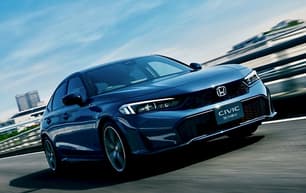
Beauty. Eye. Beholder. All that. But I reckon this Civic looks fantastic. Low-slung and sporty. The perfect antidote to all those bland, beige SUVs currently doing the rounds.
New as part of the most recent refresh is the front-end treatment, a new front bumper, more body-coloured flourishes and new designs for the 18-inch alloys.
I think it looks sleek, premium and purposeful, and not at all boring.
Inside, though, it’s a little less adventurous, though I do adore some of the little design touches, like the perforated metal effect that spans the dash.
The central screen is pretty small by modern standards, and you don't want to push too hard on some of the touch points, like the gloss-black highlights on the doors, which feel flimsy, flexible and pretty cheap.
Now, the screen. Does UX design count in the overall design section? Let's say that it does. I haven’t really experienced less intuitive and user friendly cabin tech lately.
For example, I couldn't figure out (though I must admit I didn't resort to owner's manual) how to get Apple CarPlay to load automatically, if you can.
Instead I had to select my phone, cycle through several screens of approval, and then select my phone again, every single time I got in the car. I had a similar issue using Google maps, which simply wouldn't connect at all for me.
Good tech is easy and intuitive. This wasn't.
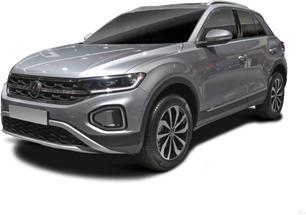
The T-Roc subtly stands out without being garish, avoiding becoming part of the highway or suburban camouflage without relying on extreme design decisions.
For example, the LED daytime running lights that wrap around the shapes below the LED 'I.Q' headlights where vents would otherwise be on the R performance variant are quite cute.
In fact, the whole front end of this small SUV has a friendly look, even if there’s nothing specific that’s particularly exciting about it.
This 'Petroleum Blue Metallic' colour is a $700 option, but anything other than white costs extra.
However, the black roof two-tone look is a standard for the Style, as are the black mirror caps and its 18-inch alloys.
There are roof rails up top, tinted privacy windows for rear passengers and for the rear window and a sloping roofline at the rear that adds a touch of ‘sport’ to the silhouette along with a small spoiler at the top.
The Honda Civic measures 4569mm in length, 1802mm in width and 1415mm in height, and as you've no doubt already noticed, it's not an SUV, rather a liftback-style sedan.
But if you feel like you need an SUV to move a family, I beg to differ. While the middle seat in the second row is too tight for adults (owing largely to the intrusive raised tunnel that runs through the middle of the cabin), the two window seats can absolutely fit adult humans. I'm 175cm, and had absolutely no issue sitting behind my own driving position.
But the biggest surprise is the boot, which opens to reveal a flat and wide storage space that can swallow 409 litres (VDA) of luggage. In real terms, that's more than enough for our pram and the assorted knick-knacks that go with it on a baby day out.
Unfortunately, though, there’s no spare. Instead you’ll find yourself wrestling with a hateful repair kit should you get a puncture, and you don't want to wait for roadside assist.
There's also twin USB ports in the back, as well as air vents, along with twin cupholders in the pulldown divider.
Inside the T-Roc is a bit of an interesting dichotomy.
Some of what’s in here is ‘old-gen’ Volkswagen stuff, but it still holds up today against even some recently introduced models.
The dichotomy is that while it’s very usable and slick, some of its materials and surfaces let it down a touch.
The good points are that the cabin tech is a perfect level of physical and digital. The buttons and controls are easy to use and feel solid and even though the climate controls could be more physical, they’re still good as far as touch panel style controls go.
The older VW gear is arguably better than a lot of what’s found in newer models where some use of touchscreens and haptic panels has drawn negative feedback from customers.
The multimedia software managed via the 8.0-inch touchscreen is more simple and sensible than the new version, plus the Digital Cockpit Pro display for the driver is clear and, importantly, customisable. It’s a similar cockpit system that used to seem quite impressive in high-end Audis.
But what doesn’t feel very high-end is some of the plastic and the decisions around function in the rest of the space.
The leather on the seats is not a cheap option box to tick at $3450, but it feels a little cheap to the touch. It’s a tad hard and even has a bit of a rough look to it.
That option also makes them heated and electrically adjustable, though, which is welcome in winter. Otherwise, cloth seats without the optional leather or heating would be absolutely fine, and that means you get a storage space under them, too.
This central space between the driver and front passenger, too, is a little awkward with the cupholder placement. It’s behind the shifter meaning a tall bottle will be in the way and it’s got slightly odd sizing for bottles or cups with nothing to stop them wobbling.
I am, however, a fan of the angled-away phone slot under the climate controls to minimise phone screen visibility (and distraction) and the traditional shifter itself is welcome.
Look up, and (in our test car) there’s an optional ($2000) panoramic sunroof there. It’s yours if you want it, and it does have an electric blind, but some Japanese and Korean cars at this price point get that as standard.
An average-sized adult will find the second row is spacious enough and relatively comfortable. There’s an armrest, dual-directional vents and two USB-C ports.
Behind that, boot space is generous at 445L with the seats up thanks to an adjustable floor, which is very useful for tall items and even manages to fit a space saver spare tyre under it.
It’s a total of 1290L with the split-fold seats down, too, though they’re not super flat with the adjustable floor down.
Ah, so we may have hit the first Honda hurdle. Ours is the entry-level e:HEV L, and it’s a cool $49,900, drive-away. The top-spec LX is $55,900, on the road.
To put that into perspective, Toyota's two Corolla sedan hybrid grades are about $36K and $39K, drive-away, at the moment. The admittedly non-hybrid Golf starts at $39,990, on the road.
The German premium brands are still more expensive, but I think that might be at least part of the Honda’s problem. It now occupies a space between mainstream and premium, which might also be something of a no-man’s land.
Still, the entry-level L is decently equipped, with 18-inch alloy wheels wrapped in quality Michelin Pilot Sport rubber, all-LED lighting all around and key-less entry.
Inside, there’s synthetic leather and fabric seats, dual-zone climate, a 9.0-inch central touchscreen with Apple CarPlay and Android Auto, but also with Google built-in that provides mapping and updates and a 12-speaker Bose stereo.
Both Civic variants also arrive with a three-year subscription to 'Honda Connect', which gives you remote access to your car to lock or unlock it, pre-heat or cool the cabin, or set a geofence alert if your teenagers are borrowing it, that sort of stuff.
But… there are no full-leather seats, there's no sunroof, no wireless charging and you have to open the boot yourself.
The lack of all that doesn’t feel overly premium.
The specific Style test vehicle being reviewed here is priced at $38,890, before on-road costs. But it's worth noting a new example of the Style will cost you $39,790 at the time of writing, as its price has since ours was 'delivered'.
While the Style features some older VW fitout, it comes with a decent list of features.
A set of 18-inch wheels, self-levelling headlights (with cornering function), some cute LED DRLs plus chrome highlights with black contrast trim are the best way to spot a Style from the outside.
Inside, there’s an 8.0-inch touchscreen for multimedia paired to the driver’s 'Digital Cockpit Pro' display.
The multimedia screen is last-gen VW gear, but that’s not a bad thing.
There’s also dual-zone climate control with an allergen filter, ambient lighting, a six-speaker sound system, wireless phone charger and wireless Android Auto and Apple CarPlay.
There are a few options on our test car that nudge the price up quite quickly, like the metallic paint, leather upholstery, sunroof, plus the keyless entry or ‘Easy open and close package’.
All this brings the total price as-tested to $45,640, before on-roads.
The good news is you don’t need to tick all, or any, of those options for this to still be a compelling option.
The Civic range is an all-hybrid affair, which in this case is what Honda calls its 'two-motor hybrid', which pairs a 2.0-litre petrol engine with two electric motors, one being an electric generator, and the other being the actual propulsion motor which sends power to the wheels. Expect a total 135kW and 315Nm, which is sent to the front wheels via a CVT auto.
The engine in the T-Roc - as with most Volkswagens - does what it says on the tin. Essentially, a 110TSI means there’s 110kW of turbocharged VW happening, in this case a 1.4-litre four-cylinder that also makes 250Nm of torque.
It’s paired to an eight-speed torque converter, which will be music to the ears of those who have been scorned by older VW dual-clutches.
It drives the front wheels only, and there’s no hybridisation or 48-volt system.
Honda says you can expect 4.2L/100km on the combined (urban/extra-urban) cycle, but we found the fuel use was a still impressive 5.5L or so, admittedly mostly in the city.
The 40-litre tank drinks 91 RON 'standard' fuel, meaning its cheapish to fill up, and — using Honda’s numbers at least — should deliver a 950km driving range.
Yesterday, 91 RON was about $1.80 per litre meaning you can theoretically get from Melbourne to Sydney for around $75.
A lack of electrification in a relatively small engine and a traditional drivetrain shouldn't scare you too much, in this case.
Combined cycle fuel consumption is a claimed 6.3L/100km. On test in mostly urban areas or for spirited driving we saw the fuel use rise a little higher than that but not by as much as you might think.
After a mix of primarily urban, some highway and a stint of dynamic test driving, the trip computer admitted to a figure of 8.1L/100km.
First things first – I really, really like the way this Honda drives. There's a finesse, a confidence, in the drive experience that's sometimes missing from the new brands when they first arrive in Australia.
In short, it feels like it was engineered by people who really know what they're doing. That's the easiest way to describe it.
If you're used to driving older-fashioned hybrid systems you might be used to a bit of shuddering harshness when the engine kicks in, but that's simply not the case here.
Instead, the transition is seamless, with the Honda Civic making the choice for you and largely leaving you out of the process entirely.
Where the powertrain does let itself be more known is under heavier acceleration, with engine thrum seriously invading the cabin, without much in the way of flat-footed performance to accompany it.
But the magic of the Civic drive experience is in its balance. It's not a performance car, but there's real driver engagement to be found in the way it rides and handles. Equally, though, it's never uncomfortable, striking the balance between road-holding confidence and comfort really well.
Happy in the city, happy on a twisting road - this is not one of those smaller cars that leaves the drive experience as a secondary factor. It feels like it really has the driver at heart.
The T-Roc is essentially a previous-generation Golf-turned-small SUV in terms of its platform, and that’s a great thing for anyone who likes driving.
The Golf 7.5 was a benchmark for everyday driving as far as hatchbacks are concerned, and even though the current Mk8 might be a bit more up to date, the T-Roc’s use of the platform it rides on is practical and fun.
It’s not as nimble as a Golf, but the T-Roc in front-drive Style guise, with a responsive turbocharged engine and no all-wheel drive system weighing it down, is not only more dynamically capable than most rivals, it’s also easy to access that capability.
The 1.4-litre engine feels well-tuned for its two modes accessible through the shifter - calm but not lazy in ‘Drive’ and eager but not thrashy in ‘Sport’.
It works well with the transmission on the move, picking right gears fairly accurately, though there are paddles behind the wheel for those who prefer to take charge.
The drive modes are also more customisable than just those on the shifter, with 'Individual' selections for steering and drivetrain able to be used rather than the standard 'Eco', 'Normal' or 'Sport' full-system modes.
While the steering wheel itself is a little thick and the feedback, while adequate, isn’t the most telling, it’s accurate and inspires confidence in cornering.
The T-Roc handles turn-in and exits well, even soaking up bumps and not becoming unsettled when braking.
Its safety systems are relatively subtle, and the active cruise control is well sorted, though the automatic braking at car park speeds can be overzealous. Something I’ve experienced in VW Group models several times over the years.
The main culprit for the T-Roc was a shrub beside my driveway that, while not touching the car, would set off the automatic braking system. Still, better than letting the car roll back if there was a proper obstacle or someone who could be hurt in the way.
Aside from that, the Volkswagen T-Roc is fun and easy to drive, and the work that’s gone into that puts its price into perspective a little more.
There are more expensive cars available that are less impressive, some even disappointing.
The big safety news surrounding the Civic is that its eight airbags are joined by 'Honda Sensing', which packages up every safety system you can possibly imagine — forward collision warning, lane keeping, adaptive cruise, AEB – and delivers them as standard across the range.
But the bigger news is that, refreshingly, none of it is overly intrusive. Even the speed limit warning, which – as in most cars – always gets the speed wrong, just flashes gently on the driver display, rather than binging and bonging through the cabin.
The Civic Hybrid scored a full five-star ANCAP safety rating, with the score based on crash testing in Europe through Euro NCAP.
In 2017, ANCAP gave the T-Roc five stars for safety. For most people, that says enough, plus the list of features the SUV comes with is fairly comprehensive even in the Style.
While its rating is getting on in years, the only real downside to the T-Roc’s age when it comes to safety is it only having six airbags - front and side for the front passengers, plus curtain airbags for front and rear passengers.
But the list of tech isn’t lacking, with driver fatigue detection, pedestrian monitoring, parking bay and parallel parking assistance, pedestrian monitoring, side assist, rear cross-traffic alert and lane assist.
The Honda is covered by a five-year/unlimited-kilometre warranty, and servicing is every 12 months or 10,000km.
There is a capped-price servicing program, called 'Low Price Servicing', which means your first five services are $199, but don't cover things like brake pads and tyres.
Volkswagen’s five-year/unlimited kilometre warranty is pretty standard for a premium-leaning brand, with VW also offering roadside assistance for the warranty period.
In terms of servicing, VW offers care plans of three years or five years, covering servicing for $1515 or $2770 respectively. That's an average of $505 or $554 per workshop visit.
Otherwise, servicing costs at 12-month/15,000km intervals can cost from $470 for some to $1104 to the biggest service if you don’t go with the locked-in package.