What's the difference?
Small or compact four-door SUVs have found favour with those who might usually climb into a hatch but, for whatever reasons, are now looking to a vehicle with the ability, actual or otherwise, of being sporty and even a little bit outdoorsy. The reality is most of these vehicles will spend their time on city and suburban streets, which perfectly suits them, and their owners’ lifestyles.
However, some of these diminutive SUVs are better at their intended purpose – and do it with much more style – than others.
How does the base-spec turbocharged Holden Trax, the LS, hold up in a bustling market segment? To find out, read on.
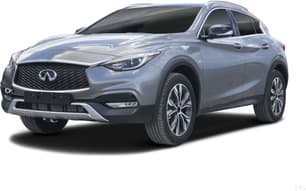
Tim Robson road tests and reviews the 2016 Infiniti QX30 at its Australian launch with specs, fuel consumption and verdict.
There’s no doubt that the compact crossover segment is a vitally important place for any carmaker to be. Nissan’s luxury arm, Infiniti, is no different, and thanks to a decision from its Japanese masters, the diminutive premium brand will go from having no players on the field to having two marquee players in a matter of just a few months.
The architecturally identical front-wheel-drive Q30 launched only a month ago in three variants, and now it’s the turn of the all-wheel-drive QX30 to take to the pitch.
But is there enough of a difference between the two to actually consider them different cars? Is it adding a layer of complexity for the prospective Infiniti customer? As it turns out, the differences run more than skin deep.
The Holden Trax looks nice enough and is pleasant enough to live with day to day. Like many others of its ilk, the Trax may be marketed as an SUV but that catch-call moniker, which has come to be accepted to mean that a vehicle is actually sporty and off-road capable, is misleading.
As an adventure vehicle the Trax falls well short – it needs a diesel engine and much improved capability (AWD) and space – but as a lively daily driver for a young starter, or a one-child family, then it’s perfectly adequate.
If you’ve got your heart set on a Trax and you’re patient, perhaps you’ll wait until 2020 when the next-generation Trax is due here.
Even though it’s almost identical to the Q30, the QX30 manages to feel sufficiently different in suspension tune and cabin ambiance to be considered different.
It’s a disappointing oversight, though, by Infiniti to deny the base GT such basic safety fundamentals as a rear view camera (which Infiniti assures us is being worked on).
It’s a small SUV and it looks sporty and outdoorsy enough in a generic sort of way. A nuggety stance, short-wheelbase and roof rails add to this Trax’s activity-friendly demeanour, without promising too much. Take a look and make up your own mind if it’s your cup of tea; I’m not your life coach so decide for yourself whether it’s cool or plain.
The QX30 is one of the first projects to result from a technology partnership formed between the parent company of Mercedes-Benz and the Nissan-Renault Alliance.
In a sign of how worldly the car industry is becoming, the QX30 is built in Nissan’s Sunderland plant in the UK, using the German Mercedes-Benz A-Class platform and powertrains, all under Sino-French ownership via the Nissan-Renault Alliance.
On the outside, the design that first aired on the Q30 is pretty unique. It’s not a subtle car, with deep crease lines along its sides that, according to Infiniti, is an industry first in terms of manufacturing complexity.
When it comes to differences between the two vehicles, it’s minimal at best. There is a 35mm increase in height (30mm from taller springs and 5mm from roof rails), an extra 10mm in width, and extra trims affixed to the front and rear bumpers. Aside from the all-wheel-drive underpinnings, that is pretty much it for the exterior.
The same black plastic overfenders that are fitted to the Q30 are present on the QX30, with 18-inch rims on both the base model GT and the other variant, the Premium.
The dimensions of the QX30 are also an exact match for those on the Mercedes-Benz GLA, with the long front overhang acting as the main visual connection between the two cars.
Its interior is plain, but practical. The LS has cloth trim and expanses of plastic, which make it a bit ordinary to look at but very easy to live with in the real world because day-to-day life involves liquid spills, crumbs and dirt – lots of dirt.
Storage spaces include a narrow glovebox, narrow plastic door pockets, four cupholders in centre console (no lidded bin here) plus two in the rear centre armrest, and driver and front passenger seat-back pockets.
The rear cargo area is a 356-litre space with the rear seats in use and the cargo cover in place), or a 785-litre space with the 60/40 rear seats folded into the floor. For this to happen, the rear-seat bases flip forward into a vertical position and the seat-backs fold forward to make the ‘new’ flat floor.
The QX30 is obviously very similar to the Q30 in many respects, but the interior is slightly different, with larger, less cosseting seats up front and slightly higher seats in the rear.
The cabin is also lighter in overall appearance, thanks to a paler colour palette.
There are plenty of neat inclusions, including a pair of USB ports, plenty of door storage, a space for six bottles and a sizable glove box.
A pair of cupholders resides up front, along with a pair in the fold-down armrest in the rear.
There is no particularly logical location for the storage of smartphones, though, and the lack of Apple CarPlay or Android Auto is down to Infiniti opting for its own phone connectivity suite.
A decent 430 litres of luggage space behind the rear seats is contrasted by a cramped rear area for all but the smallest of passengers, while sharply shaped rear door apertures making getting in and out a bit of an ask.
There are two ISOFIX baby seat points and a 12-volt socket in the rear, as well.
The Trax is a front-wheel drive small SUV and the LS is the base-spec variant.
Our tester – a MY19 LS with a 1.4-litre turbocharged four-cylinder petrol engine and six-speed automatic transmission – has a listed price of $24,490 drive away. The Trax LS is available with a five-speed manual gearbox, but it’s matched to a 1.8-litre non-turbo petrol four-cylinder engine. The turbocharged LS is the way to go, I reckon.
The LS has a stack of standard features for the price, including Holden’s MyLink multimedia system, with a 7.0-inch colour touchscreen, Apple CarPlay, Android Auto and Bluetooth connectivity, USB port and power socket up front, cruise control, rear-view camera, rear parking sensors, as well as hill-start assist, hill-descent control, and more. No Trax has AEB.
Our test vehicle has 17-inch alloy wheels with a space-saver spare.
It has an Absolute Red paint exterior; prestige paint colours are available – including Mineral Black, Burning Hot and Abalone White – but they cost an extra $550.
The QX30 will be offered in two variants; the base model GT at $48,900 plus on-road costs, while the Premium will cost $56,900.
Both come equipped with the same engine; a 2.0-litre four-cylinder turbocharged petrol engine that’s sourced from Mercedes-Benz and also used on the Q30 and Merc GLA.
Eighteen-inch rims are standard on both cars, while an electronic handbrake, 10-speaker Bose audio, 7.0-inch multimedia screen and a full set of LED lamps all round are fitted across both variants as well.
Unfortunately, the QX30 GT misses out on a reversing camera all together, a fate it shares with the Q30 GT.
Infiniti Cars Australia told us that this was an oversight at the time the cars were being specced for Australia, particularly in light of the other technologies that the car would receive, like automatic emergency braking.
The company says it’s working hard to bring a reversing camera to the GT.
The top-spec Premium gets leather trim, a powered driver’s seat, and additional safety equipment like a 360-degree camera and radar cruise with brake assist.
The only optional extra on each car is metallic paint.
Our test vehicle has the 1.4-litre DOHC 16-valve four-cylinder iTi petrol engine – producing 103kW at 3000rpm and 200Nm at 1850rpm – matched to a six-speed automatic transmission.
The turbo gives the Trax a welcome kick in the automotive pants, making the turbo-equipped variant the pick of the bunch.
Just the one engine is used across both cars; the 155kW/350Nm single-turbo 2.0-litre four-cylinder petrol engine from the Q30 and A-Class.
It’s backed by a seven-speed transmission and wired into an all-wheel-drive system that is biased towards a front-drive configuration.
Sourced from Mercedes-Benz, up to 50 per cent of drive can be sent to the rear wheels, according to Infiniti.
This Trax has a claimed fuel consumption of 6.7L/100km (combined). We clocked up more than 300km of highway and back-roads driving, with a smattering of gravel-road driving thrown in. We recorded 10.7L/100km, which is much thirstier than claimed.
Infiniti claims a combined fuel economy figure of 8.9L/100km for the 1576kg QX30 across both the variants; this is 0.5L thirstier than the Q30 version.
Our brief test yielded a dash figure of 11.2L/100km over 150km.
Driving position is high, steering is quite sharp and handling is tight and controlled, so there’s plenty of welcome driver involvement from the get-go.
The turbocharged engine makes for a lively and responsive drive and, combined well with the six-speed auto, this 1376kg Trax offers up plenty of zip from stop-starts and oodles of oomph for smooth overtaking.
Ride is very firm, bordering on harsh, with rear-seat passengers* especially feeling the lumps and bumps of irregular road surfaces by way of the tight suspension. (*I believe my children.)
Interior space is not an issue though as everyone can manage head and shoulders nicely in the tall cabin. The seats are lacking in full support though, making long trips not such an appealing proposition, and in-cabin noise builds early and becomes quite hard on your ears.
Again, it would be easy to think that the QX30 would feel almost identical to its lower-riding sibling – but that would be incorrect. We criticised the Q30 for being a bit too buttoned down and unresponsive, but the QX30 feels more lively and involving, thanks to its unique spring and damper set-up.
Even though it’s 30mm higher than the Q, the QX doesn’t feel it at all, with a benign, pleasant ride with good body roll control and competent steering.
Our front-seat passenger complained of feeling a little ‘hemmed in’, which is a valid point. The sides of the car are very high, and the roofline is quite low, exacerbated by the steeply raked windscreen.
The 2.0-litre four-potter is smooth and punchy, and the gearbox well suited to it, but it’s lacking in aural character. Luckily the QX30 does a terrific job of suppressing noise before it gets into the cabin, then…
The Trax has a five-star ANCAP rating as a result of testing in August 2013.
The LS has six airbags (including full-length curtain airbags), dusk-sensing headlights, reversing camera, rear-parking sensors, hill-start assist and hill descent control.
The QX30 gets seven airbags, auto emergency braking, forward collision warning and a pop-up bonnet as standard across the line.
The base GT does, however, miss out on a reversing camera.
The Premium model also offers a 360-degree camera, blind spot warning, radar cruise control and brake assist, traffic sign detection, reverse motion detection and lane departure warning.
The Trax has a five-year/unlimited-kilometre warranty and service intervals are recommended at 15,000km/nine months.
The Q30 is offered with a four-year, 100,000km warranty, and servicing is suggested every 12 months or 25,000km.
Infiniti offers a fixed three-year service schedule, with the GT and the Premium both costing an average of $541 over the three services provided.