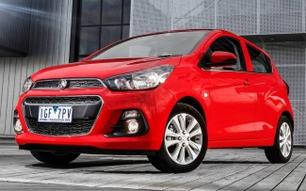
What's the difference?
Andrew Chesterton road tests and reviews the updated Holden Spark LT with specs, fuel consumption and verdict.
The micro-car segment in Australia has driven off a cliff. We are shunning our smallest cars in a way we never have before, and nobody seems to be entirely sure why.
The strength of the second-hand market is one suspected culprit, while another is the tempting price point of vehicles that are one size bigger, with city-car shoppers able to upsize for relative peanuts.
Whatever the reason, the segment is stuck in neutral and halfway along Struggle Street. It needs a spark. And Holden's hoping theirs is just the ticket.
Now you might recognise it as a Barina, but Holden dropped that part of the moniker when this new model launched in March. It is now simply known as the Holden Spark, tested here in top-spec LT guise and wearing a sticker price of $18,990. It sits above only the entry-level, bargain-basement LS ($13,990 manual, $15,690 automatic) in the two-model Spark range.
Designed and built in Korea, the Spark seems to have little to do with our unique marketplace, but Holden promises us this new model couldn't be more dinky-di if it ran on vegemite. Australia had crucial input into its design in Korea, while Holden's Aussie engineers put the new model though its paces on the company's proving ground, tweaking the suspension and steering for Australia's road surfaces.
So the question now is, is the Spark bright enough to lure buyers back to the micro-car segment?
Part of the undeniable charm of Toyota’s 70 Series LandCruisers is the fact they don’t change much, if at all. Sure, the much-loved V8 has been dropped from new 70s in recent years, and it now has LED headlights and a new multimedia system, but otherwise not a lot has been altered. And that’s good.
Because, in a world where everything is so slick, and everyone is so worried about offending someone, the 70 stands out as unapologetically being simply what it is: a boxy truck-like live-axle 4WD.
It's not pretty, it's not comfortable and it offers few, if any, real concessions to occupant safety. But it's very capable off-road and has a ton of potential as a handy touring vehicle.
Toyota has a bad habit of doing the bare minimum with its new-release vehicles, yet the loyalists keep coming back for more and new Toyota fans keep turning up, as well.
It seems this kind of ‘do nothing’ approach works wonders in terms of maintaining the appeal of something like the HiLux or 70 Series line-up.
But does it really? We tested the 2026 Toyota LandCruiser 76 Series in GXL trim to find out.
Read on.
The marvels of local engineering strike again: the Spark LT definitely feels a cut above some of its budget competition from behind the wheel. It is well-equipped, too, and packed with connectivity and technology features. In short, it could be just the spark Australia's city-car segment needs.
It looks like a house brick, it drives like a busted truck, it has less safety gear than a go-kart and fewer standard features than a shopping cart, yet there’s still so much to like about the 2026 Toyota LandCruiser 76 Series.
It’s fun to drive (if you know what to expect), it’s highly functional (for the job-site or camp-site) and one of the best 4WDs straight out of the showroom. And in GXL guise it makes a lot of sense as a work wagon or a touring vehicle.
Sure, Toyota pushes the boundaries of brand loyalty – consistently doing the bare minimum to keep buyers coming back for more – but in the case of the 76, I don’t mind that because this is one of the old-school 4WDs that should always be available.