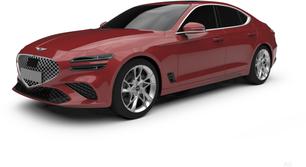
What's the difference?
I’m family testing the updated Genesis G70 this week, which has seen some tweaks to its technology and safety systems.
The G70’s release also sees the line-up trimmed to one highly-specified Sport Luxury grade, available as a four-cylinder Shooting Brake wagon or the V6 sedan on test here.
It competes with other mid-size sedans like the Audi A4, BMW 3 Series and Mercedes-Benz C-Class. So, how does the G70 handle life with a small family of three? Keep reading to find out!
CT, IS, GS, LS, RC, LC. Yes, that list of letters looks like something you’d read when getting your eyes tested at an optometrist, but they are actually all Lexus models.
Ok, you may have known that already, but did you know that those are just their initials? They actually have full names, too; Compact Touring, Intelligent Sport, Grand Sport, Luxury Saloon, Racing Coupe, Luxury Coupe.
And so this review isn’t just on the new-generation ES, but on the Elegant Sedan, which made it to Australia in 2018. And, as if hinting at things to come, it’s available in ES300h petrol-electric hybrid guise only.
This is the seventh-generation of a model that has been part of the Lexus line-up since the very beginning, way back when the luxury arm of Toyota first stepped onto the world stage in 1989.
So, does the ES300h live up to its Elegant Sedan name? Does being hybrid-only in Australia mean it loses its powerful presence? And is there any reason why you’d get one over a Mercedes-Benz E-Class or BMW 5 Series?
So many questions, but after living with the ES300h in top-of-the-range Sports Luxury guise for a week, we now have all the answers.
The updated Genesis G70 3.3T Sport Luxury is beautiful to look at and drive. It features premium features, trims and great power but the cabin is tight on space. Which makes it a little awkward to use, so this will suit a small family best or families where this may not be the primary mover. That said, I love the after-care program and it suited my small family of three, so it gets an 8.0/10 from us.
The ES300h is outstanding in terms of ride comfort, refinement and value. If you’re looking for a true driver’s car then a Lexus RCF is probably a better tree to bark up, but if you’re looking to ferry passengers in a serene, prestigious and fuel-efficient way, then look no further.
The G70 sedan is absolutely gorgeous to look at and the our test vehicle's 'Kawah Blue' paintwork makes the crisp pleating across the body stand out.
The G70 has a muscular stance, much like its BMW rival, but the rear is softer in its shaping.
The front looks sophisticated with the wide-set LED lights and black air-intake vents. The sporty 19-inch alloy wheels and red calipers behind them hint at what the powerful V6 engine can do.
The interior looks high-end with our test vehicle’s white quilted Nappa leather upholstery and a soft-touch black headliner. The dashboard looks solid and robust but the slick looking 10.25-inch touchscreen multimedia system and digital climate control panel elevate the overall design.
The only thing I didn’t like about the design was the ambient lighting. It’s limited to two panels on the roof and is a little distracting when you drive at night. I think if it was scattered more throughout the cabin, it would be less intrusive.
If you think all Lexus models look the same, then pop on over to the Audi, BMW or Benz websites and take a peek at their line-ups. Compared to the ranges from those prestige car makers, Lexus models look wildly different from each other.
Opinions on that ‘Spindle Grille’ are as polarising as views on politics or religion. Personally, I like how upfront and brave the grille design is, but what seems odd to me is that it’s almost as if this was the only place on the exterior where designers were allowed to be a bit adventurous. The rear, while cleanly styled is a bit plain. The bottom just doesn’t match the face.
The ES300h’s roofline in side profile is beautiful as it sweeps almost fastback-style to the boot lid. Again, not the most dramatic styling, but it’s still pleasing in the sense that the design flows well together. The same can be said for the fit and finish – the panel gaps are near-perfect.
This perfection continues into the cabin, where the materials and craftsmanship matches German prestige rivals in places (the door handles, leather and digital instrument cluster, for example), only to be let down in other areas which disclose its budget Toyota family connection (the air vents, steering wheel and display screen).
The ES300h’s interior design isn’t going to set everybody’s world on fire, but there will be those who adore its asymmetrical styling with different textured surfaces that fold, swoop and jut up against each other’s space. Have a look at the images, they’re of the Sports Luxury which sits above the Luxury in the two grade line-up.
The differences visually between the grades is minimal. The Luxury has 17-inch alloys, while the Sport Luxury has 18-inch.
New colours for this generation include Glacial Ecru (the sandy hue of our test car in the images) and Radiata Green. Both grades’ interiors come in a variety of colour schemes, including Black, Chateau, and Topaz. Exclusively for the Sport Luxury cabin is Rich Cream, too. The Sports Luxury steering wheel has wood trim.
One of the more peculiar design elements of the ES300h’s cabin design, and there are a few, are the controls for the drive modes and traction control. They sit like horns on the instrument cluster hood, as though these are things the driver will constantly be reaching for, when in reality most people will never touch the traction control button.
A new-generation car means new foundations, and the ES300h is built on the GA-K platform which underpins the Camry. The platform is part of the latest global architecture which Toyota and Lexus are now using to build its vehicles.
The dimensions of the ES300h, if you’re wondering if it will fit in your garage, are just under 5.0m long, 1.9m wide and 1.4m tall.
The practicality is hurt a little by the space available for passengers. The front row benefits the most when it comes to head- and legroom but if you’re ferrying passengers in the back seat, you’ll have to scoot your seat forward to accommodate them.
Especially if they’re tall because my knees brush the back of the driver’s seat when it’s in my driving position and I’m only 168cm tall!
The individual storage options throughout the car are okay for the class with the front enjoying a small middle console and glove box, two cupholders and two small drink bottle holders in each door.
The rear gets map pockets, two cupholders in a fold down armrest and two very small storage bins in the doors.
The other amenities are great in both rows and a high-level of comfort will be found for adults with the heat and ventilation functions on the front seats and the heat function on the rear outboard seats.
However, the width of the rear seat and the tall transmission tunnel means the middle seat should be strictly reserved for a kid. Think of the G70 as more of a four-seater if you have adults to carry.
The boot has a 330-litre capacity and it’s not too hard to reach to the very back if items roll that way. The back seat has a 60/40 split and there is a temporary spare tyre underneath the floor.
In terms of technology, you get a USB-A and USB-C port up front, as well as, a 12-volt socket and wireless charging pad to choose from. Rear passengers get two USB-C ports and the boot features another 12-volt outlet.
The 10.25-inch multimedia system looks great and is easy to use with a responsive touchscreen. It also has built-in satellite navigation, wired Apple CarPlay and Android Auto and the system now features over-the-air updates and Genesis Connected Services functionality.
The digital climate panel is responsive and very simple to operate, which is handy when on the go. The 12.3-inch digital instrument cluster is semi-customisable and it’s handy that the 8.0-inch coloured head-up display pulls through satellite navigation directions and traffic sign information.
The Lexus ES300h is a five-seater sedan, but it’s really designed to sit two comfortably in the back, given there’s a large driveshaft hump in the floor and that the outboard seats are divided by a fold-down control panel/armrest.
Legroom in the second row is ample. I’m 191cm tall, and I had about 20mm of space between my knees and the seat back when it was in my driving position. Headroom gets tight with that sloping roofline, but there’s just enough space thanks to the low hip point of the rear seats.
Cabin storage is excellent. The fold-down armrest for the rear seats has a storage tray and two cup holders, while the large centre console bin has a lid which can open towards the driver and also to the front passenger (I spent way too long marvelling at how it worked). There are two cup holders up front and decent-sized door pockets, too. Those rear doors open wide for easy exit and entry.
Boot space in the ES300h is 454 litres (VDA), beating the 410-litre cargo capacity of the BMW 530e.
As far as power outlets, you’ll find two USB chargers in the centre console storage bin and a Qi wireless charging pad, which is awkwardly situated making it hard to place larger phones onto it.
The G70 3.3T Sport Luxury sedan on test here is priced at $88,000, before on-road costs, which is $7000 more expensive than the 2.0T Shooting Brake version. That positions it right in the middle of its nearest competitors and you get some fab features included.
The premium items include electric front seats with heat and ventilation functions, heated rear outboard seats, Nappa leather upholstery and other leather trims, a sunroof, a heated leather-wrapped steering wheel and a premium 17-speaker Lexicon by Harman sound system.
The update sees the G70 now have an intelligent speed limit assist feature, the 'Genesis Connected Services' app and over the air updates to its software.
Other standard features include keyless entry, keyless start, remote start from the key fob, a powered tailgate, 19-inch alloy wheels, a temporary spare wheel, dual-zone climate control and extendable sun visors.
Yes, and don’t let anybody tell you any differently. The Luxury lists for $59,888 and the Sports Luxury is $74,888. Both are bargains when you consider the quality and features.
If it was my money, I’d go for the Luxury which is almost indistinguishable visually but doesn’t come with as many tech and convenience features as the Sport Luxury.
Still, the Luxury gets the 12.3-inch screen with sat nav, a 10-speaker Pioneer stereo system with digital radio, a head-up display, dual-zone climate control, wireless charging, 10-way power adjustable front seats, privacy rear windows, a moonroof, proximity key and LED headlights.
The Sports Luxury takes all of that and adds a Mark Levinson 17-speaker sound system, leather seats, heated and ventilated 12-way power adjustable front seats, heated and power reclining rear seats, three-zone climate control, heated steering wheel, power rear sunshade and manual side rear window shades, gesture-open boot and cornering LED headlights.
The Sports Luxury also comes with noise reducing 18-inch wheels – they contain what’s called a Helmholtz resonator which cancels out the drone that can be produced when driving.
Is there anything missing? When I saw the rear fold-down armrest with the control panel I instantly thought the ES300h must have had seat-back screens, but nope. Also, it’s annoying that Lexus still doesn’t have Apple CarPlay and Android Auto as part of its package. This will change we hear, but it has been slow on the uptake.
The Lexus ES300h’s direct rival is the Infiniti Q70 Hybrid GT Premium for $82,900, but it also challenges the likes of Mercedes-Benz E-Class, which starts at $91,900, BMW’s 5 Series, which begins at $92,990, and the Audi A6, which kicks off at $81,900.
Given that the ES300h is hybrid-only, if you’re specifically looking for something with a petrol-electric powertrain, then there’s the BMW 530e or the Mercedes-Benz E350e.
The G70 3.3T Sport Luxury sedan has a 3.3-litre V6 turbo-petrol engine with a maximum power output of 274kW and 510Nm of torque. The G70 sedan is a rear-wheel drive and features an eight-speed auto transmission.
The V6 engine responds eagerly, being able to do a 0-100km/h sprint time in just 4.7-seconds. Suffice it to say it’s fun to drive.
As mentioned at the start of this review, in Australia the Lexus ES is only available with one powertrain variant – a petrol-electric hybrid.
This combines a 2.5-litre four-cylinder petrol engine making 131kW and 221Nm, with an electric motor that has an output of 88kW and 202Nm. The 244.8V nickel-metal hydride battery has been moved from under the boot floor in the previous generation car to under the rear seats, so it no longer eats into the cargo space.
The ES300h isn’t a plug-in hybrid, so battery recharging is done through regenerative braking.
A continuously variable transmission means seamless and smooth low-speed driving using just the motor, but under heavy acceleration the engine activates and you’ll hear that drone associated with CVTs.
The compromise for getting all of the power is that she’s a thirsty gal and the official combined cycle fuel consumption figure is 10.4L/100km and my real-world usage came to 10.6L/100km.
However, that’s after mostly doing open-roading – expect the fuel usage to be higher in an urban setting.
Based on the combined cycle and the 60L fuel tank, expect a driving range of around 577km on average. Which means you’ll be filling up more on a longer journey than more efficient sedans.
This is the point of a hybrid, right? To save fuel? The electric motor can power the car at low speeds around car parks or in bumper-to-bumper traffic, and I found that after 104km of both urban and open road usage my fuel economy in the Sport Luxury was 5.4L/100km.
Lexus’ official combined fuel economy figure for both the Luxury and Sports Luxury is 4.6L/100km.
The G70 sedan is a lovely car to drive with graceful handling and a good well of power to dip into.
That oomph is there when you need it and it’s as easy to drive in the city as it is on the open-road.
The responsive steering makes the G70 sedan feel nimble and well-balanced in turns, even when you accelerate out of a hair-pin corner.
The suspension is on the firm side and that can lead to a few grunts when you hit bigger bumps but the ride is not unpleasant, even for back-seaters.
The cabin is generally quiet but you can get road/wind noise at higher speeds. It’s not enough to intrude on chatting but you don’t forget it’s there, either.
The G70 sedan is easy to park because it has an outstanding 11m turning circle. The 360-degree camera system is clear and the front and rear parking sensors make light work of a tight car park.
Two words: quiet and comfortable. Well that’s three words, but that sums up the ES300h on the road. Yes, rivals may have intelligent adaptive air suspension and leather made from free range cows, and they are supremely tranquil and sumptuous places, but challenging them is this ES300h.
Even with its regular shock absorbers and steel-spring suspension, the ride was outstanding for its comfort and composure on the worst roads Sydney could throw at it over the week we tested the car.
Front and rear seats were supportive and comfortable over long distances, too. From a driver’s perspective the experience was serene – this was an easy and relaxing car to pilot.
I’m not a huge fan of petrol-electric hybrid powertrains, but it suits the seamless personality of the ES perfectly, adding to the smoothness of the ride as it slipped silently through traffic.
Just don’t expect the ES300h to be rewarding from a dynamic driving perspective. The steering was heavy and a little numb, and while the handling was good, I felt disconnected from the road. And whenever I needed to move quickly the combustion engine would splutter to life and the CVT would begin to drone.
The Genesis G70 has a great suite of safety features and it’s almost a case of what doesn’t it have.
But a real highlight is the blind-spot view monitor which pops a video feed of your blind spot onto your instrument cluster. Very handy to have in a city setting!
The G70 has a maximum five-star ANCAP safety rating from testing done in 2018, with the update now featuring 10 airbags, which is fantastic for the class.
Other standard safety features include blind-spot monitoring, blind-spot collision avoidance assist, driver attention warning, forward collision warning, lane keeping aid, lane departure alert, rear cross-traffic alert, rear occupant alert, adaptive cruise control with stop and go function and a tyre pressure monitoring system.
A clear 360-degree camera system as well as front and rear parking sensors also come standard.
The G70 has AEB (operational from 10–180km/h) with pedestrian and cyclist detection.
There are ISOFIX child seat mounts on the rear outboard seats and three top tether anchor points but only two child seats will fit. Front passenger comfort may be compromised for front occupants when a 0-4 rearward facing child seat is installed.
The Lexus ES300h was awarded the maximum five-star ANCAP rating when it was tested in September 2018. Coming standard on both the Luxury and Sports Luxury grades are 10 airbags, AEB with pedestrian detection, lane keeping assistance and adaptive cruise control.
By stepping up to the Sports Luxury you’ll also get adaptive high beams which is fair enough, but you’ll also gain equipment which really should be on the base grade, too, such as blind spot warning and rear cross-traffic alert - which come standard on a Camry SL for half the price.
While there’s absolutely no doubt the ES300h is safe, it lags behind in autonomous technology which is present in cars such as the E-Class.
You’ll find two ISOFIX mounts and three top-tether anchor points across the second row which we used for our four year old and his car seat.
The Genesis after-purchase program is hard to beat and such a treat because you get five years or up to 50,000km complimentary servicing with the G70. How good is that?
The G70 also comes with a five-year/unlimited km warranty and the servicing intervals are every at 12-months or 10,000km, whichever occurs first. The interval could be annoying if you travel a lot but any annoyance will be softened by the fact that the services are free.
The ES300h is covered by Lexus’ four-year/100,000km warranty. Servicing is recommended every 15,000km or 12 months. There is no capped-price servicing scheme.