What's the difference?
Foton Mars.
It’s what the new rival to the GWM Cannon, Isuzu D-Max, Kia Tasman and army of other entry-level mid-sized utes is called in its native China.
And, much like Saturn, that name has a pretty cool ring to it.
But, in Australia, the Mars is launching as the Tunland, a name some might remember from the early 2010s.
Which would be OK if this was, once-again, just another cheap and tired old rehash… when in reality, it is actually just one of those things.
Looking for a value dual-cab ute? Read this before you buy.
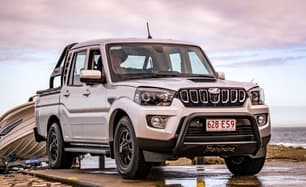
The current generation Mahindra PikUp has been with us since 2007, which is a long time given major players in this market tend to introduce a new generation every decade, or close to it.
However, with Mahindra reportedly developing an all-new ute, based on the underpinnings of its latest Scorpio SUV, the budget-priced PikUp is destined for retirement within a few years.
Better late than never, the latest MY23 version of the S11 dual-cab has for the first time been equipped with an automatic, which is sure to increase buyer appeal in a market in which self-shifting transmissions rule.
We recently revisited this Indian-built dual cab to see how it measures up for tradies in such a competitive market.
Okay, we admit our expectations weren't high.
But in some ways, the 2026 Foton Tunland is so much more than we could have hoped for, with great looks, big space, a well-presented cabin, tight steering and subdued engine noise. In fact, it even shows the established players a thing or two about equipment levels and value for money.
But the ride is too firm, the diesel powertrain needs more muscle and the rattly interior in the V7-C are all areas requiring attention.
Still, this is not a bad effort, and a name change from Tunland to Mars might have better reflected the sheer progress that Foton has made.
Note: CarsGuide attended this event as a guest of the manufacturer, with accommodation and meals provided.
Its sub-$40K pricing undercuts the cheapest Ford Ranger or Toyota HiLux 4x4 equivalents by $10-15K and it’s backed by a decent warranty and 60-strong dealer network (mostly regional). It’s also largely absent from the federal government’s vehicle-recall listings, which suggests solid build quality.
However, it’s also short on safety, has relatively high servicing costs and numerous design quirks. Fact is, such low pricing comes with compromises, so, if you can learn to live with those, this sturdy and willing auto-equipped workhorse could represent good value for those shopping on a budget.
There are two ways of dealing with the elephant in the room here.
Buyers can ignore the problematic ethics of what looks like copying and taking the subsequent controversial front-end styling on face value.
Doing so reveals that the Ford F-150-esque V7 and Ram-like V9 do truly stand out. Beyond just the front-end, both are handsome and well-proportioned. Some may even prefer the Tunland to the originals. There is barely a jarring line to be found.
Good design sells and all this gives the Foton a real leg-up in the market. Plus, with one bold stroke of a pencil, any perceived visual associations with F-150 and Ram is shorthand that the Tunland is much larger than rival mid-sized utes.
This is all strategically brilliant, but is it fair? You decide.
The Foton’s extra size is no illusion. The V7 is 5617mm long (L), 2000mm wide (W), 1910mm high (H) and sits on a 3355mm wheelbase (WB). The V9’s wheel-arch cladding adds 90mm to its girth while the Supreme’s roof rails up height by 45mm.
In comparison, the Ford Ranger XLT’s corresponding L/W/H/WB dimensions are 5370mm/1918mm/1886mm/3270mm, while the regular F-150’s L/W/H/WB are 5884mm/2030mm/1995mm/3694mm respectively.
Crunching these numbers, the Tunland sits nearly midway between Ranger and F-150 in most major dimensions except wheelbase, where it’s about a quarter of the way longer.
This is a similar size strategy employed by the recently released LDV Terron 9 and MG U9 Chinese ute twins.
The extra interior space that endows, along with the clean, uncluttered and largely-intuitive dashboard layout that Foton has created, can only be good news for ute buyers seeking big on a budget. Especially as there’s not much that’s bargain-basement inside the cabin.
The PikUp has a 3040mm wheelbase and 5175mm length, 1820mm width and 1915mm height.
So, compared to a Ford Ranger XL equivalent, it’s 230mm shorter in wheelbase, 195mm shorter overall and 98mm narrower, so it’s relatively compact for a dual cab ute.
Built on a traditional ladder-frame chassis, its twin-wishbone front suspension uses torsion bars instead of the more common coil springs, while under the tail is a leaf-spring live rear axle. Brakes are front discs and rear drums.
With 210mm of ground clearance, its steep 34-degree approach angle is excellent but its 15-degree departure angle is less than half that figure, so it's prone to tail-dragging in the rough stuff.
And its bafflingly large 13.4-metre turning circle (kerb-to-kerb) demands numerous three-point turns.
The interior appears to have a good standard of finish and provides a visually-pleasing mix of black and grey surfaces with satin chrome highlights throughout. Driver controls are easy to see and operate and the front bucket seats are comfortable.
The rear bench seat is quite firm with good lumbar support, but it’s a squeeze for three adults given its relatively narrow width.
Even so, there’s adequate kneeroom and heaps of headroom even for tall adults, which is no doubt appreciated by hat-wearing farmers and tradies.
Large and spacious, one of the other most impressive things about Foton’s new ute is how mature and sophisticated the interior’s very car-like design and layout are.
Yes, it looks like every other Chinese cabin that has come out recently – there is nothing unique to be found here – but it largely works really well. High points include quite accommodating front seats, an excellent driving position, heaps of storage, ample ventilation and, thankfully, physical buttons to access most of the main functions, including basic climate control, multimedia and vehicle settings.
Negative points include the need to prod the screen to get some of those features to actually operate, including the driving modes, and that led to distracted situations. Not good.
And the Mercedes instrumentation design is an outrageous rip-off. We’re talking near-facsimile here.
Plus, every V7-C we drove suffered from persistent squeaks from the door trim and/or rubbers, leading us to conclude that it has to do with this grade’s leaf spring suspension, as opposed to the quieter V9’s coil suspension. And as there was also some shaking of the passenger seat when empty, we suspect there is too much body flexing occurring here. Clearly more work needs to be carried out, especially as Foton says it's already done thousands of kilometres of Australian road tuning over the past year.
Moving to the roomy back seat, the backrest seems to be at an adequate angle, the cushion feels sufficiently padded, and most of the main amenities are present – cupholders, a centre armrest and air vent access.
There's a little bit of storage underneath the back seat, but there's nothing behind the folding backrest other than access to a jack, which is a little bit of a shame given the size of the cabin.
Still, frustrating touchscreen and wobbly noises apart, all in all, it's is a very well made, nicely presented and fairly high-quality effort from the Tunland.
Further back, we’ve crunched even more numbers.
The V7’s tub is 1577mm long, 1650mm wide and 530mm high, with 1240mm between the wheel arches, compared to the Ranger XLT’s 1464mm, 1520mm, 525mm and 1217mm – as well as the F-150’s 2005mm/1656mm/543mm/1285mm – respectively.
While the Tunland subsequently sits nearly midway between medium and full-sized utes generally, its tub’s dimensions are closer to the former. Still, the Foton is still usefully larger for bigger loads, and is also strong for payload (995kg to 1115kg) and GVM (3305kg to 3335kg) ratings, as well as off-road clearances.
Accessories specialists Ironman will supply items like canopies, towbars and bullbar options.
However, do note that the (assisted) tailgate in the V7-C is not lockable at this stage. A fix is coming soon, apparently.
Lastly, only the dual-cab body is likely for the foreseeable future, though other styles including cab-chassis are offered elsewhere.
With its 2115kg kerb weight and 3150kg GVM, the S11 PikUp offers a 1035kg payload rating so it’s a genuine one-tonner.
It’s also rated to tow up to 2500kg of braked trailer but given Mahindra doesn't publish a GCM rating (or how much it can legally carry and tow at the same time) we don’t know if it can retain its maximum payload while towing that weight.
Strangely, the load tub does not have any internal load-anchorage points. The only option for securing ropes or straps are external hooks, which are located along both upper sides of the tub and across the tailgate.
However, these would be ineffective in securing loads that are lower than the tub sides.
Front cabin storage is limited, as there are only narrow bins and no bottle holders in the front doors and you won’t find any cup/bottle holders or storage for small items in the dash, either. However, there is a single glove box and an overhead glasses holder.
The centre console has an open storage tray at the front and single cup and bottle holders in the centre, which are fine for one occupant but not two.
In contrast to the front doors, there are no bins in the base of each rear door, but they do get a large-bottle holder and what looks like a phone holder at mid-height.
There are also pockets on each front seat backrest, but the fold-down centre armrest does not have any cup/bottle holders.
The rear bench seat’s base cushion is fixed, so it can’t swing up and be stored vertically (like many dual cabs) if more internal cargo space is required.
However, it does at least provide some open storage space underneath for soft items like jackets etc.
So, how cheap is the box-fresh and (very) mild-hybrid Tunland range, then? Spanning a $10,000 range and sharing the same 2.0-litre diesel powertrain, the action kicks off from $39,990 (all prices are before on-road costs) for the V7-C 4x2.
Now, the C in V7-C stands for Core, but it’s hardly been stripped-down to one.
Available in 4x2 or 4x4 guise from $42,990 before ORC, the V7-C includes a 14.6-inch touchscreen, wireless Apple CarPlay, a 360-degree camera with transparent-road-down-below views, a dash cam, front/rear parking sensors and a decent stack of advanced driver-assist systems – which will be covered in more detail in the safety section.
Four-wheel drive adds a rear differential lock, 2H/4Auto/4H/4L high-and-low ratio gearing, various off-road driving modes and all-terrain tyres.
Plus, as with all Tunlands, braked towing capacity is 3.5 tonnes, but as the workhorse choice aimed mostly at fleet buyers, only the V7-C’s payload tops one tonne (at up to 1115kg compared to the V9’s 995kg), due to its heavy-duty leaf-spring rear suspension.
Do note, though, that there’s no lockable tailgate for now, or digital radio.
Stepping up to the V9-L (for Luxury) 4x4 from $45,990 switches from a Ford F150-style face to a Ram 1500-esque one, and also gains wheel-arch cladding, side steps, a sports bar, vehicle-to-load power socket, heated and powered front seats, dual-zone climate control, heated/folding mirrors, extra USB ports, extra speakers, a wireless charger and coil-sprung rear suspension instead of the V7-C’s leaf-spring set-up.
Lastly, the flagship V9-S (for Supreme) 4x4 from $49,990 scores a front diff lock, roof rails, panoramic sunroof, vented front seats, heated outboard rear seats, rear privacy glass and more.
The Foton’s value seems rock-solid, with ultra-sharp pricing for a bottom-end ute. Especially for its circa-30 per-cent up-size compared to what is palpably smaller competition.
Bargain-hunting size queens, your ride is ready.
Our S11 PikUp test vehicle is available only with a 2.2-litre four-cylinder turbo-diesel engine and new Aisin-sourced six-speed automatic, for a list price of $38,500, drive-away.
Our example is also equipped with a Mahindra genuine accessory winch-compatible steel bull-bar which adds $3500 (fitted).
The S11 comes standard with 16-inch alloy wheels and 245/75 R16 tyres with a matching spare.
There’s also LED daytime running lights and dusk-sensing halogen headlights with static bending (which automatically illuminates inside kerbs when cornering at night), front fog lights, rain-sensing wipers, side-steps, rear sports bar, load tub-liner, automatic rear diff-lock, reversing camera and more.
There’s fabric-trimmed seating for up to five occupants, with the front bucket seats equipped with unusual but welcome fold-down inboard armrests.
There’s also a USB port, two 12-volt outlets, centre console air-vents for rear passengers and a multimedia system controlled by a 7.0-inch touchscreen with multiple connectivity options, including links for Apple and Android devices.
Mahindra also offers a genuine accessories range, from towbars, nudge bars and bullbars to engine snorkels, wheel options and lots more.
The Tunland’s official combined fuel-consumption average is 8.0 litres per 100km, for a carbon-dioxide emissions rating of 211 grams per kilometre.
Lending a hand here is auto start/stop and battery regenerative energy recovery tech.
So much for the theory. The expected best-selling V7-C 4x4 we drove averaged 10.3L/100km during our drive day. And that's not bad, considering that it had four people and plenty of luggage on board for part of its journey.
Mahindra claims an official combined average of 9.3L/100km. At the conclusion of our 265km test, which was conducted without a load and in mostly city and suburban driving, our ‘real world’ figure based on fuel bowser and trip meter readings came in at 9.4 which is lineball.
So, it should deliver an excellent driving range of around 850km from its 80-litre tank.
Besides the divisive styling, the main difference between the V7 and the V9 is the suspension, and this informs the driving experience somewhat, as both share the same powertrain.
Now, the 2.0-litre four-pot turbo-diesel is exceptionally smooth and well- insulated from inside, while the eight-speed ZF transmission is really slick and responsive.
But this is not a particularly powerful unit. There’s adequate performance, as it does pick up speed fairly quickly, and it does maintain sufficient acceleration for overtaking as long as the stretch of road is long enough, but joining fast traffic or going up hills can be a struggle if you’re in a rush. It's not the worst in class, but not best in class by a long shot.
Probably the biggest surprise, though, is the Tunland’s steering, as it's really well-weighted and progressive, allowing the keen driver to really take advantage of the well-sorted chassis tune’s handling and grip.
Yet the steering is light enough around town, aided by a light driving mode, for easy parking.
The flip side, though, is that the ride can be choppy.
The V7 is the worse of the two, because its leaf sprung rear suspension set-up makes it feel a little bit too firm and bouncy over certain roads, while the V9’s coil-sprung alternative does a noticeably better job of it.
That said, the Tunland is still better than some Chinese utes. But for ride comfort and refinement, the class leaders like Ranger can rest easy.
Finally, the ADAS safety tech has been worked over for Australia, and it's nowhere near as intrusive as it is in a lot of other vehicles. So that's another plus point for the Foton.
That's the on-road driving impressions.
Unsurprisingly, the V7’s ride comfort deteriorated even more off the beaten track, with a jittery patter and some minor body flex causing the door rubbers to squeak. That wasn’t detected in the V9, which clearly handled the rough stuff better.
Overall, though, the Tunland did a good job over a not-too-demanding 4x4 course, aided by decent clearances and the lockable rear (plus V9’s front) differentials, as well as the settled and measured steering.
The fold-down inboard armrest combined with the door’s armrest allows the driver to evenly rest both elbows, which reduces strain on shoulders and arms particularly during long highway hauls.
This set-up could work even better if the wheel had reach adjustment in addition to its adjustable height.
There’s no rake adjustment in the seat’s base cushion, either, but fortunately there’s a big left footrest to help the driver to maintain a comfortable posture.
The driving position is high relative to the bonnet and the tops of the doors, which is ideal for vehicle placement when off-road driving as it provides commanding views over the front and out the sides.
Unladen ride quality is quite firm, as you’d expect of a 4x4 designed to carry one tonne of payload, but is supple enough to provided acceptable comfort.
The steering weight is linear with easy turning effort; handling and braking response is satisfactory and engine and tyre noise are pleasantly low.
Our only major gripe is the huge turning circle, which is nudging that of a full-size American pick-up. The need to often do three-point turns, in situations that you really shouldn’t have to in a vehicle of this size, is annoying (and in some situations embarrassing).
Although its 2.2-litre diesel has modest outputs, it provides decent performance in city and suburban driving with its smooth-shifting auto.
It’s also a low-stressed highway cruiser, requiring less than 2000rpm to maintain 110km/h which is comfortably within its peak torque band.
We didn’t get to do our usual GVM test due to a hiccup with our weight supplies, but we have previously tested a cab-chassis PikUp with just under one tonne of payload (990kg) which it hauled with an all-round competence that belied its relatively small engine output.
Neither ANCAP nor Euro NCAP results are available for the Foton Tunland.
But both the V7 and V9 models tick many, if not all, of the required boxes with Australian-tuned advanced driver assistance systems (ADAS) like autonomous emergency braking (AEB) with pedestrian and cyclist detection, lane departure warning, lane keep assist, lane centring control, traffic sign recognition, blind spot monitoring, door open warning, rear cross-traffic alert, trailer stability assist and adaptive cruise control.
No data is available pertaining to the operating speeds of the AEB systems.
There are also eight airbags fitted, including a front-centre airbag, as well as child seat anchor points for the rear seat, including two ISOFIX-compliant restraints.
ANCAP only awarded it three out of five stars - and that was back in 2012. There are dual front airbags for driver and passenger, electronic stability control and ABS plus a reversing camera and LED daytime running lights.
There are also ISOFIX child seat anchorages and top tethers on the two outer rear seating positions.
Though not quite the 10 years offered by Mitsubishi, Nissan and MG, Foton is swinging big with a seven-year unlimited-kilometre warranty including with roadside assistance and seven years of capped-priced servicing.
Intervals are every 12 months or 15,000km, while you can expect to pay around $650 annually (averaged out over seven years) or nearly $4500 over that period of time.
There are currently 22 dealers around Australia, although that will grow over the next couple of months with independent and broader dealer coverage from the Inchcape group that imports Foton vehicles.
Vehicles are serviced in-house at these dealerships.
Warranty is five years/150,000km. 12 months roadside assist is renewable with each scheduled service at Mahindra dealers.
Service intervals are 12 months/15,000km whichever occurs first.
Capped-price servicing for the first four years or 55,000km totals $2296, or a pricey average of $574 per service.