What's the difference?
Ford's small hatch, the Focus, is criminally under-bought in Australia. The latest model is one of the best hatchbacks on the road and when you chuck in the decent price, impressive equipment and absurdly powerful engine for its size, it's a winner.
But you lot? You don't buy it in nearly the kinds of numbers it deserves. Partly because there isn't a bait-and-upsell boggo model to lure you in, partly because it's got a badge that is not exciting Australians any more and partly because it's not a compact SUV.
Or is(n't) it? Because alongside the ST-Line warm hatch is the identically priced and therefore technically a co-entry level model; the Focus Active. Slightly higher, with plastic cladding, drive modes and a conspicuous L on the transmission shifter, it's a little bit SUV, right?
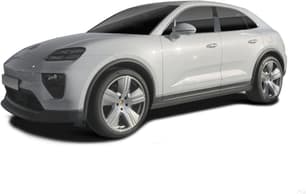
This might be the biggest gamble in Porsche's history. It's the latest version of its best-selling car, the Porsche Macan, only this one has a very big difference.
You see, this time, it’s all-electric. There is not an internal-combustion engine (ICE) in sight. And that makes climbing into an entry-level Macan significantly more expensive than ever before.
So, will this bold shift help or hinder the Macan in Australia? And is this the country’s best all-electric SUV?
There’s only one way find out.
Ten years ago, the idea that the higher-riding version of a hatchback would be a good city car would have been laughable. The Focus Active is pitched as a kind of SUV with its different low-grip driving modes, which you'll never touch if you stick to the city.
The Ford Focus is genuinely a brilliant car, no matter where you take it. The Active takes a terrific chassis, tweaks it for comfort but, ironically, doesn't lose much of the speed.
There is no doubting the substance of the Porsche Macan Electric. Its ride, steering and poise make it a joy to drive on twisting roads, and it ticks the practicality boxes, too.
The only lingering question is whether enough people are ready to make the all-electric switch. Only then will we know if Porsche's Macan gamble has paid off.
Note: CarsGuide attended this event as a guest of the manufacturer, with travel, accommodation and meals provided.
For a fairly conservative hatchback, the Focus came under fire for what some termed its derivative styling. I quite like it, and not just because the styling work was led by an Australian. The front end is very much family Ford, as long as it's the European arm of the family, fitting in with its smaller sibling, the Fiesta. The Active scores the usual black cladding, higher ride height and smaller diameter wheels, in exchange for more compliant, higher-profile tyres. All of that takes nothing away from a design that I think looks pretty good.
The cabin is well put together, with just that oddly angled touchscreen causing me a bit of a twitch. The design is a fairly steady Ford interior with a lot of switchgear shared with the Fiesta, but it's all quite nice. The materials feel mostly pleasant and the hardwearing fabric on the seats feels right for this kind of car.
The Macan Electric looks sharp, all aerodynamic and swept-back like a range-maximising electric SUV should.
There’s functional method behind all this swoopy styling, too. The headlights look as though they’ve been chiselled into the body work, and at the grille, you’ll find active venting to help with cooling when needed.
There is also a sizeable front splitter that looks very much like the Macan is sticking its jaw out. All of which is to assist with aero and range.
It’s also a dual charging port layout with access left and right, though the latter is AC charging only, while the one on the left does both.
Step inside the Macan and you’ll find a familiar and very welcoming space. I especially like the twin-screen set-up that looks great in the way it's kind of embedded into the dash. Each is big, clear and easy to use.
I also really like the control panel that gives you quick-button access to the climate control, and the haptic feedback is next level, with the whole screen clicking in or out whenever you hit a button.
That said, in Turbo-guise you’re dropping almost $200,000, and some of the materials feel too hard and plasticky at that price point.
The Focus is quite roomy compared to other cars in its class. The rear seat has good leg and headroom, with the feeling of space accentuated by large windows. Annoyingly, though, all that work put into making the rear a nice place to be is ruined by a lack of amenities like cupholders, USB ports or an armrest.
Front-seat passengers fare better with two cupholders, a roomy space at the base of the console for a phone and a wireless-charging pad. The front seats are very comfortable, too.
The boot starts at a fairly average 375 litres - clearly sacrificed for rear-seat space - and maxes out at 1320 litres with the seats down. While you have to lift things over the loading lip and down into the boot, it's one of the more sensibly shaped load areas, with straight up and down sides. Ironically, the smaller Puma has a noticeably larger boot.
There is a little open-sesame magic at play with the Macan, and that starts at the frunk, where, if you lovingly caress the bonnet, it will automatically pop open for you, revealing an 84-litre storage space.
Rubbing the charging port will see it slide open, too, but just in case you’re not the kind of person who likes to fondle their car in public, you can use the key.
The Macan’s boot is a little more traditional, opening to reveal 540 litres (but just 480 litres in the 4S or Turbo) of storage with the rear seats in place, with a wide, flat and very useable area for your goodies.
The back seat of the Macan feels spacious enough, without being outstanding. There’s more than enough space for my 175cm frame, with enough knee and head room, but the way the middle console juts out will definitely eat into leg room for any middle-row passenger.
Elsewhere you get air-con controls with vents, along with bottle storage in each of the doors. There is also a pull-down divider that’s home to two extra cupholders.
The Focus Active wears a $30,990 sticker but the several people I know who bought one haven't paid that much, so Ford dealers are obviously keen to do deals. Even at that price, it's got a fair bit of stuff. The Active has 17-inch wheels, a six-speaker stereo, dual-zone climate control, reversing camera, keyless entry and start, front and rear parking sensors, cruise control, auto LED headlights, LED fog lights, sat nav, auto wipers, wireless hotspot, powered and heated folding door mirrors, wireless phone charging, a big safety package and a space-saver spare.
Ford's SYNC3 comes up on the 8.0-inch screen perched on the dashboard, which weirdly feels like it's facing away from you slightly. It has wired Apple CarPlay and Android Auto, sat nav, DAB+ and also looks after various functions in the car.
The panoramic sunroof is a stiff $2000 and includes an annoying perforated cover rather than a solid one.
The Macan arrives with four trim levels, the entry-level Macan, the Macan 4, Macan 4S and then the flagship Macan Turbo. The latter is just a name Porsche now applies to its go-fast models — obviously there isn’t an actual turbo in action.
The new electric range opens with the Macan, which lists at $128,400, before on-road costs. A reminder here that the old entry-level Macan with an ICE powertrain would have set you back less than six figures, so this one represents quite the jump.
Now, it should be pointed out that you can still buy the previous-generation ICE Macan, at least until supply runs dry. The brand isn’t getting any more, but suggests there are enough in the country to satisfy demand until around Q2 next year.
Next is the 4, which is $134,400 and adds a second e-motor. Then comes the 4S, yours for $149,300, before the range tops out with the Turbo, which climbs to $184,400. All prices before on-road costs.
Those are big numbers, but at least Australian-delivered cars are some of the best-specified on the planet.
That starts with the Macan, which gets a 12.6-inch digital instrument cluster, and a second 10.9-inch central touchscreen with Apple CarPlay and Android Auto.
It rides on 20-inch alloys, has synthetic-leather seats that are heated up front and Australian cars get things like the clever 'Porsche Active Suspension Management' (PASM) system as standard.
Next up is the Macan 4, which adds a second electric motor, but otherwise largely mirrors the base car’s spec. Next on the list is the 4S, which rides on a different 20-inch alloy, picks up LED matrix headlights, sports a better Bose stereo, a panoramic roof and four-zone climate control.
Finally, the Turbo is the big dog of the electric Macan range, packing serious power, but also arriving with its own 20-inch alloy wheel design (with 21-inch wheels a no-cost option) — an augmented reality head-up display, and things like the 'Porsche Electric Sport Sound', the 'Sport Chrono Package' and a performance-focused 'Sport+' drive mode.
Ford does an excellent range of small turbo engines. The "normal" Focus range (such as it is, now the wagon has disappeared from the market) comes with a 1.5-litre turbocharged three-cylinder engine. Bucking the SUV-this-size trend (yes, I know it's not really an SUV), this punchy little unit delivers an impressive 134kW and 240Nm. They're both very decent numbers for such a small engine.
The big numbers continue with the transmission boasting eight gears, a number you don't often find in a hatchback. It's a traditional torque-converter auto, too, so those of you who have bad memories of Ford's old PowerShift twin clutches should worry no more.
Power goes to the front wheels only and you'll get from 0 to 100km/h in 8.7 seconds.
The entry-level Macan is equipped with a single rear-mounted electric motor, and it will make a total 250kW (265kW with launch control activated) and 563Nm, which is enough to push the cheapest Macan to 100km/h in 5.7 seconds.
The 4 then adds a second electric motor for AWD, upping the grunt to 285kW (300kW with the launch function) and 650Nm, and drops the sprint to a brisk 5.2 seconds.
The 4S is probably the performance sweet spot, with its dual-motor set-up generating 330kW (380kW in launch) and 820Nm, and a blistering sprint of just 4.1 seconds.
But the Macan Turbo is a true monster. We’re talking 430kW (470kW with launch control), 1130Nm and a sprint to 100km/h that’s as fast as a Carrera Cup race car – just 3.3 seconds.
It’s twin-motor, all-wheel drive and offers the kind of brutal acceleration that gives you a little facelift every time you step on the accelerator.
Ford's official testing for the big window sticker delivered a 6.4L/100km result on the combined cycle. In my time with the Focus, I got 7.2L/100km indicated on the dashboard, which is a pretty solid result given the Focus spent a good deal of the time on suburban or urban roads.
With its 52-litre tank, you'll cover around 800km if you manage the official figure, or just over 700km on my figures.
Every Macan is fitted with a big 100kWh lithium-ion battery, which helps deliver a solid driving range no matter which one you choose.
The entry-level Macan will cover the most distance, at a claimed 654km, while the 4, 4S and Turbo will travel 624km, 619km and 616km, respectively.
The Macan rides on an 800V architecture, and is set up for 270kW DC high-speed charging, which will take 21min to go from 10 to 80 per cent. It will also accept 11kW AC charging, which should take 10 hours to go from empty to full.
Worth noting, though, that most home wall boxes are around 7.0kW, which means a full charge would take more like 13 hours plus.
Despite the very mild off-road pretensions, if it's a comfortable city ride you're after, the Active is the Focus to have. While the ST-Line isn't uncomfortable - not by a long way - the Active's more compliant tyres and higher ride height (30mm at the front and 34mm at the rear) iron out the bigger bumps without sacrificing much of the sportier car's impressive dynamic prowess, even with the low-rolling-resistance tyres.
The cracking 1.5-litre turbo is responsive and well-matched to the eight-speed auto. The big torque number pushes you along the road and makes overtaking much less dramatic than a 1.5-litre three-cylinder has any right to.
Ford's trademark Euro-tuned quick steering is also along for the ride, making darting in and out of gaps a quick roll of the wrist, which has the added benefit of meaning you rarely have to take your hands off the wheel for twirling. That darting is aided and abetted by the engine and gearbox, with the turbo seemingly keeping the boost flowing with little lag. It's almost like they planned it that way.
You have good vision in all directions, which almost renders the fact that the blind-spot monitoring is optional acceptable. Almost. It's very easy to get around in, easy to park and, just as importantly, easy to get in and out of. Compared to, say, a Toyota Corolla, the rear doors are very accommodating.
Porsche seemed at pains to prove that, though the all-electric Macan has lost its ICE heart, it's still worthy of the badge, and still very much a Porsche.
First stop, then, was the Norwell race circuit in Queensland, to put the Macan through its paces with 0-100km/h sprints, drifting (well drift attempts... ) on a watered-down skid pan and finally some high-speed running on the circuit.
And two things immediately became very clear. The first, and most obvious, was that, like the first men on the moon, we were likely among only a handful of people that might ever take their all-electric Porsche mid-size SUV to a race track. And second, this is one seriously sorted electric car.
Happily, for the many (read: every) owners who won't be pulling out of a pit garage at their next local track day, the Macan is actually more enjoyable on the road than it is on the track.
On the latter, there's a freedom to push too hard – what with the lack of trees, guard rails or oncoming traffic – and cracks do appear, mostly from the screaming tyres struggling with the two-tonne-plus weight.
But on public roads, where a thick fog of consequence prevents you pushing too hard, the Macan is a gem.
Porsche tends to have a knack for these things, I know, but the Macan is a seriously smooth and satisfying drive.
The ride is bang-on (comfortable enough on rougher surfaces, firm and grippy enough on twisting roads) and the steering is direct and confidence-inspiring.
Body-roll has been largely banished, too, with the Macan staying flat, stable and satisfying, even on the tighter stuff.
In much the same way the ICE Macan defined what it meant to be a driver's SUV, I think this one does the same in the EV space. And the fact that it does it with five seats and a decent boot is a sizeable bonus.
But there's no denying it lacks in the emotion department. That sense of excitement, the sound track, the hard-to-define fizz – as competent its this, and as weaponised as the EV powertrain is – it does feel a little clinical, like a tool doing its job and doing it well.
One important caveat. We've driven the 4 and Turbo to date. The entry-level Macan and the mid-tier 4S are still incoming. And I suspect I wouldn't be dropping my deposit on the Turbo.
Yes, the power is ridiculous, but I don't reckon you need it. For me, the 4 is more than enough, but I suspect the real performance sweet spot will be with the 4S.
The Active has six airbags, ABS, stability and traction controls, forward AEB (low speed with pedestrian avoidance and highway speeds), forward collision warning, lane-departure warning, speed-sign recognition and active lane-keep assist.
Annoyingly - and I can't for the life of me work out why this is a thing - despite some advanced safety features in the base package, you have to pay $1250 extra for blind-spot monitoring, reverse cross traffic alert and reverse AEB, which are part of the Driver Assistance Pack. No, Ford is not the only company to do this.
The back seat has two ISOFIX points and three top-tether anchors.
The Focus scored five ANCAP stars in August 2019.
The Porsche Macan Electric is yet to be assessed by ANCAP, or by Europe’s NCAP, but it doesn’t appear to be missing any key equipment from its safety list.
That includes curtain airbags that extend all the way to the boot, AEB with pedestrian detection, lane keeping assist, a surround view camera and 'Intersection Assist'.
Ford offers a five-year/unlimited-kilometre warranty and a roadside-assistance package that consists of a membership to your local motoring organisation.
The first five services cost $299 each and also include a free loan car and a 12-month extension to your roadside assist membership for up to seven years.
The Porsche ownership experience is frankly underwhelming by modern standards, with the brand offering just a three-year/unlimited kilometre warranty, plus an eight-year/160,000km battery warranty.
The positive, though, is that servicing should only be required every two years or 30,000km. You also buy a prepaid service plan for three, four or five years, priced at $1495, $2795, $2995.