What's the difference?
Long before Tesla EVs, there were electric golf buggies.
From the first half of last century, they began quietly ferrying birdie and eagle enthusiasts around their favourite courses.
For many, these have been their first (and only) experience of electric vehicles (EVs) at work.
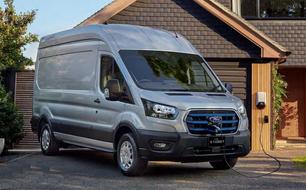
Now, the blue-collared Blue Oval mob has this – the all-new E-Transit Custom.
Designed to take on other electric mid-sized vans such as the LDV eDeliver7, Peugeot E-Expert and the Mercedes-Benz Vito Electric, it is the brand’s second – and more affordable – foray into van electrification.
Does the E-Transit Custom score above par? Let’s dive straight in!
Ford has introduced what is being touted as an adventure-type van to its Transit Custom line-up and it’s called the Trail.
The Trail is based on the long-wheelbase Transit Custom Trend and it’s equipped with a suspension lift, on-demand all-wheel drive, 'Trail' drive mode, LED headlights and daytime running lights, a variant-specific grille, black wheel arch moulding and side strip, yellow exterior decals and 16-inch matt black twin-spoke alloy wheels.
With all that in mind, maybe a van is your next adventure vehicle?
Read on.
Wow. This is state-of-the-art EV van engineering – complete with sporty handling and an excellent ride – yet it maintains all the usual Transit attributes.
The Tesla of electric vans? Maybe.
The only thing remains is pricing and how the E-Transit Custom behaves and drives on Australian roads… and we’ll have the answer to those by the end of this year.
But as it stands, Ford's European mid-sized van is keeping the innovative spirit of the original alive.
Note: CarsGuide attended this event as a guest of the manufacturer, with travel, accommodation and meals provided.
The Ford Transit Custom Trail has plenty of appeal as a work van or a camper fit-out candidate. It’s a well-packaged, comfortable and contemporary van that’s nice to drive and as a bonus, with all-wheel drive it’s given the scope of capability to be able to tackle mild off-roading situations with confidence.
It’s built for work and play and though it’s limited to two-up for travels, the Trail offers so much potential as a camper conversion for adventure seekers its few niggles are easily forgotten when you’re busy making memories.
It may look like the old Transit Custom but the new one has been completely redesigned and rides on an all-new platform.
It’s more aero efficient and the wheelbase has been stretched with the front wheels pulled forward to liberate more leg and foot room.
The roof remains under 2.1-metres high for easier car park clearance, but there’s more space inside due to a lower floor that’s aided by new side steps. This, along with wider side apertures, make for easier loading and unloading.
The E-Transit’s traction battery is integrated into the lower-floor structure, adding significant rigidity as well as a lower centre of gravity, benefitting dynamics and control, as does the switch to an independent rear suspension set-up that conversely improves packaging.
Key cargo-capacity facts are: 3450mm (maximum load length), 6.8 cubic metres (Standard Roof load volume), 9.0 cubic metres (High Roof load volume, up to 1011kg (payload), 3225kg (Gross Vehicle Mass) and 2300kg (maximum braked towing capacity).
More info pertaining to the Australian-market E-Transit Custom will be revealed later in 2024.
It looks like a van but with some striking yet low-key flourishes that all kind of work as a whole. Those include a Trail grille and the matt black alloy wheels. The yellow sticker-pack is a neat touch.
The Trail has more presence than a regular Trend with its 30mm-taller raised suspension and overall adventure-ready look with strong front end and chunky wheel arches.
The striking but low-key theme continues inside with a neatly laid-out yet spartan cabin. The two synthetic leather seats are topped with Trail embossing and lined with yellow stitching.
The cabin is separated from the rear cargo area by a bulkhead, which incorporates a small wired window.
It isn’t just parcels and packages that benefit from all the engineering advances made in the new-gen Transit Custom.
Big doors open to a new, lower and larger cabin. With the front wheels pushed forward, it’s flatter, with more space for three-abreast seating. And, now, the driver enjoys better cross-cabin access right to the opposite door with fewer obstacles.
To aid entry and egress due to its flat base, the E-Transit Custom scores a “squircle” (squarish) steering wheel. It’s one of the few visual distinctions in an otherwise fairly mundane, though well-made, interior. Material quality is of the hardy but pleasant variety.
Our test van was the optional Sport model as-yet not confirmed for the EV (though it’s coming for the diesel), with darker hues, upholstery stripes and a few more luxury features.
Australian-bound E-Transit Customs will be closer to the European Trend spec, which we factored in strongly when assessing the electrified newcomer.
Both grades sampled included Ford’s optional ‘Mobile Office’ that will be made available in Australia. Among other things, it provides a three-position wheel, from the regular position to roughly 45- and 90-degree angles.
The thinking here is for drivers to respectively either rest a laptop or have an in-situ table – complete with a squircle-shaped tray – tilt all the way forward for meal times. A lockout device prevents vehicle operation in anything but the home position.
Handy, though note that two of the three vans we drove with this feature had a rattly wheel in the normal driving position. Ford promises a fix for production is coming.
Other Mobile Office additions include various mounting points for accessories.
The driving position is 4WD-high, with the vast windscreen and very deep side windows providing panoramic views. Because of the rear bulkhead behind the seats, a camera-fied rear-vision mirror, along with the sizeable exterior mirrors, provide sufficient side/rear vision.
The driver’s seat is supportive and comfy if not that shapely, and it seems more fully padded than the flimsy cushions of the (narrower) centre and passenger seats.
The latter both hinge forward to reveal a massive storage cavity (ideal for charging cables) as well as the load-through hatch as per the previous-gen Transit where fitted.
Speaking of storage, Ford’s engineers have repositioned the passenger front airbag from its traditional dashtop home to above the windscreen header, liberating a second glove box fit for housing laptops.
The dashboard’s 13-inch touchscreen is perfectly sized and driver-angled. It uses Ford’s excellent SYNC 4 multimedia system, is powered by a 5G modem for OTA software updates for around 30 modules, and is functional, fast and intuitive. It also comes with Alexa voice commands.
Ample ventilation, big grab handles, massive door pockets for bottles, additional storage areas including behind the configurable digital instrumentation pod, several cupholders, USB-A and -C outlets near shelving areas for minimal cable entanglements, plenty of LED light sources and an armrest/tray, highlight Ford’s many decades of experience building mid-sized vans.
On the launch drive's smooth German roads, wind and road noise intrusion were impressively subdued for a van (especially so given the quiet e-motor operation compared to the clatter of a diesel), though the large frontal area means at speed you won’t mistake this for a luxury EV.
Still, being roomy yet cosy, practical yet thoughtfully presented and solidly built without feeling cheap, the E-Transit Custom's cabin is right on the money – a secure and inviting workhorse first and foremost.
Keep in mind, too, that the cargo area will likely include Ford’s 'Load Area Protection Kit', bringing a moulded load floor liner and protection for the sides and rear doors. Because, this is a workhorse, after all.
It’s a van so there are two distinct sections to the Trail, the cabin and the load space.
Firstly, the cabin. More a work-friendly than family-friendly interior, this Trail is a two-seater with plenty of durable plastic everywhere – ready for work and life – as well as charging (with USB-A and -C ports) and storage (including a van-favourite dash-top slot for logbooks etc, outboard moulded cupholders and a nifty pop-out cupholder), all amenities enough to cope with most daily van-related duties.
The seats are comfortable, supportive and have a fold-down lock-in-place armrest.
Now for the load space. There are no seats back there and as such it has plenty of potential as a work van or touring vehicle.
Access to the rear load space is via a barn door at the back and this Trail has a sliding door on both sides.
The cargo area is substantial – 3002mm long (to the bulkhead; 3450mm long if load-through hatch is used), 1392mm wide (between wheel arches) and 1425mm high (floor to roof). Easily big enough for work equipment or recreational gear. It can cope with four Euro pallets (each measuring 1200mm x 800mm) and it has a listed maximum load volume (with the bulkhead) of 6.8 cubic metres.
Load height through the rear barn doors is 531-585mm, depending on how much weight is already onboard.
The load space has the aforementioned metal bulkhead (with window and load-through hatch), load area protection kit (full height walls and moulded floor), LED lights and eight tie-down loops.
Otherwise, this is a load area ripe for customisation. Maybe a plethora of shelves for a tradie, or some bedding and extra storage for an adventurous person or couple.
So, how much does the V710-series E-Transit Custom cost? Nobody at Ford is saying right now.
However, with the LDV kicking off from under $65,000, the Peugeot from $80K and the Mercedes from about $91K, our money is on cost-of-entry at around $75K when sales commence at the end of this year.
Whichever way it goes, the E-Transit Custom will cost substantially less than the much-larger (V363) E-Transit full-sized van launched here last year at a whopping $104,990, before on-road costs – though that’s since been slashed to $89,990.
Note, too, that we’re only getting the long-wheelbase version, in standard or high-roof specifications for the time being.
Aimed at small to medium-sized businesses, Ford’s Turkish-built EV should be generously-equipped, with adaptive cruise control, a new patented heat pump for significantly reduced battery drain, heated front seats, a reversing camera, a 13-inch touchscreen offering Ford’s excellent 'SYNC 4' multimedia system powered by a 5G modem for OTA software updates, Alexa voice-control assistance and wireless Apple CarPlay/Android Auto.
Plus, the E-Transit Custom has achieved a record-high Euro NCAP rating for a medium-sized van. More details are outlined in the safety section below.
Note, though, there is no spare wheel, just a tyre inflation kit, sadly.
And while you can option up an outlet to power your tools, there is no bi-directional charging, so you cannot power your home in a blackout with this EV.
That said, the E-Transit Custom’s real value is to be found in the imbedded design and engineering features that distinguish this from other electric vans, maintaining a legacy of innovation that started with the original Transit way back in 1965.
The UK’s bestselling vehicle period in 2021 and 2022, the regular Transit Custom is absolutely vital to Ford’s health globally, and it’s not about to drop the ball with the electric version.
Here’s how.
The 2025.75Y Ford Transit Custom Trail has a MSRP of $61,990 (excluding on-road costs).
Standard features onboard include a 13-inch multimedia touchscreen (with wireless Apple CarPlay and Android Auto), a 12-inch digital instrument display and synthetic leather upholstery with Trail logos on the seats.
Other gear includes an eight-way manually adjustable driver’s seat, keyless entry and start, front and rear parking sensors, climate-control air and automatic LED headlights.
It also has all-wheel drive, LED headlights and daytime running lights, a variant-specific grille, black wheel arch moulding and side strip, yellow exterior decals and 16-inch matt black Trail twin-spoke alloy wheels.
The standard no-cost exterior paint is 'Frozen White'. Anything else – 'Agate Black Metallic', 'Grey Matter', 'Magnetic' or 'Moondust Silver' – will cost you $700.
Mated to a large battery pack sharing tech with the Ford F-150 Lightning truck, the E-Transit Custom's single, front-mounted electric motor delivers 160kW of power and 415Nm of torque to the rear wheels via a single-speed auto.
As usual, 'Eco', 'Normal' and 'Sport' modes are included to suit the driver’s mood.
One of the reasons Australia won't bother with the 100kW version is its electronically-limited 117km/h top speed; the 160kW can manage all of 133km/h.
Keeping all that performance in check are a strut/leaf spring arrangement up front and a semi-trailing arm independent rear suspension borrowed from its larger sibling.
Full technical specifications will be revealed closer to the E-Transit Custom’s local launch at the end of this year.
The Ford Transit Custom Trail has a 2.0-litre four-cylinder turbo-diesel engine producing 125kW at 3500rpm and 390Nm at 1750-2500rpm.
The Trail has a clever eight-speed automatic transmission and an on-demand all-wheel drive system.
It all works rather well, but it’s a van afterall and as such it is less dynamic and more dependably driveable than perhaps a cross-shopped SUV wagon. However, as an AWD van the Trail can be trusted to keep its grip on wet bitumen, soggy grass and loosely-gravelled tracks and that’s a strong part of its appeal over a 2WD van.
Ford's official energy consumption figure for the E-Transit Custom is 21.8kWh/100km and the trip computer in our Sport grade test vehicle read 21.6kWh/100km, which is about on the money for this size of van.
With the 64kWh Nickel Cobalt Manganese battery pack that’s 'shrink-wrapped' low down under the load area to help achieve that low floor, the WLTP range figure is 308km for the 160kW (and 337km for the 100kW E-Transit Custom Australia is likely to miss out on).
Ford reckons these numbers are roughly four times the average-daily mileage for van drivers in Europe.
Brake-by-wire regenerative-braking tech allows for one-pedal braking, which in turn helps recharge the battery pack. If you lash out for a big 11kW Wallbox accessory, the standard 11kW AC on-board charge allows a full overnight top-up.
As the E-Transit has a 124kW DC fast-charge capacity, a high-capacity station can replenish the battery from 10-80 per cent full in under 45 minutes.
The Ford Transit Custom Trail has an official combined cycle (urban/extra-urban) fuel consumption figure of 8.5L/100km. On this test I recorded 8.8L/100km.
The Trail has a 70-litre fuel tank so going by my on-test fuel figure you could reasonably expect a driving range of about 795km from a full tank of diesel. However, as with any vehicle, once you’ve loaded the Trail with real-world burdens (e.g kids, dogs, camping gear, etc) you’ll soon see that fuel consumption increase.
For every one of its four generations since 1965, the Transit has set the pace for driveability, as if Ford of Europe was determined to stamp its dynamic authority in the commercial vehicle space.
The original broke the van mould by being far more car-like than any that came before, offering the availability of a powerful engine, responsive steering and safe handling.
That the E-Transit Custom maintains the philosophy is no surprise; that it ended up being so fresh and rewarding to drive – albeit on German roads carefully chosen by Ford – should be a warning for rivals to raise their standards.
Let’s start with the lofty yet cocooning driver environment, which immediately sets you at ease and in the mood. Nothing awkward or uncomfortable to report here.
Shift the natty little column wand into D, and the instant throttle response of a good EV seems slightly too good to be true in what is a boxy workhorse. Acceleration is urgent yet smooth, humming away as the speed builds in a big yet measured way.
That’s all good and well, but given the sheer mass of this mid-sized van, the second big test is how measured and controlled the handling is, especially at speed.
Again, there’s ample feel from the squircle wheel, as the E-Transit tips crisply into corners, glides through fast curves and generally maintains its composure when turning up the pace.
Credit, no doubt, to the new trailing link independent rear suspension system, which must take a lot of the credit in making the Ford van handle so confidently.
It also does a great job absorbing bumps and isolating the occupants from the road surface underneath.
We tried the standard Trend-spec 15-inch wheeled version, as well as the 17-inch Sport version, which does have a slightly firmer edge, but then seems ever keener through corners.
One of the E-Transit Custom’s true achievements is that – with no diesel engine to drown other noises out – the lack of wind, road and tyre noise intrusion is just so relaxing. Its refinement and ability to combat fatigue augers well for EV van drivers of the future.
Again, keep in mind that we’re on slick Euro roads in specially-prepared launch vehicles, equipped with ballast in the back to emulate a load (and hunker down the rear).
Ultimately, the true test will come when behind the wheel of the E-Transit in Australia. But, our first drive revealed what is surely the most modern and enjoyable van we’ve yet to experience: fast, fun, secure and comfortable.
It’s easy to get in and out of the Trail’s driver seat with a wide-opening door and a big step to help you inside.
The seats are comfortable and it’s simple enough to dial-in your driving position via the tilt-and-reach adjustable steering wheel and manually-adjustable seat.
Word of warning: the auto transmission is operated via a stalk mounted on the right-hand side of the steering wheel column, which takes some getting used to.
Once underway, the Trail is punchy enough around town and in the suburbs with its 2.0L 'EcoBlue' turbo-diesel engine offering a more-than-adequate amount of power and torque (125kW and 390Nm) and its clever auto helping out with nifty moves through traffic (for a van, anyway).
Visibility is impressive from the cabin and you’re afforded a convenient vantage point with the Trail standing a bit taller than its regular Transit Custom stablemates as it’s on lifted suspension, but feeling composed on most surfaces.
The Trail has a listed kerb weight of 2046kg and a turning circle of 12.1m, pretty standard for a long wheelbase van, so this is not an insubstantial vehicle and it’s a bit tricky to 'flip a u-ee' if the situation demands it.
It has six drive modes – 'Normal', 'Eco', 'Slippery', 'Tow/Haul', 'Sport', 'Trail' – which each adjust engine torque, throttle response and traction control, among other things, to suit the road surface and conditions.
But we’re all here to see how it goes off-road, aren’t we?
Well, obviously this is no rock-crawling machine and it’s not intended to be. It’s best thought of as having an all-wheel drive system that gives this van mild off-road capabilities, as in it can tackle wet bitumen, soggy grass, lightly corrugated bush tracks and very shallow mud puddles with more confidence than the Transit Custom Trend it's based on.
In a nutshell, the AWD Trail will be able to handle most low-level traction-compromised scenarios. But it does not have enough ground clearance, wheel articulation, grip or underbody protection to tackle any terrain beyond modest off-roading.
Speaking of grip, the Trail as standard rides on Bridgestone Duravis R660 (215/65 R16) rubber, a van/light truck commercial tyre and they are not so well suited to dirt tracks and the like. Grippier all-terrain tyres would help this van perform slightly better off-road than on its showroom rubber.
In its favour, the Trail has a front skid plate and underbody protection in case it cops some knock from the ground during its adventures.
Not in its favour, however, especially as a potential touring vehicle, is the fact it has a space-saver spare wheel and tyre.
If you’re thinking of using your Trail as a tourer, it’s worth knowing payload is listed as 1179kg, maximum braked trailer towing capacity is 2500kg, Gross Vehicle Mass (GVM) is 3225kg and GCM is 5725kg.
Ford Australia has yet to confirm the E-Transit Custom’s final safety spec, but the regular diesel version provides many of the answers.
Euro NCAP has awarded the broader V710 Transit Custom range a maximum five-star 'Platinum' rating. A best-in-class result thanks to a broad array of driver-assist safety.
This includes AEB with passenger and cyclist detection as well as intersection-assist (all operable from 0km/h), lane-keep systems (from 60km/h), blind-spot monitor, rear cross-traffic alert, full stop/go adaptive cruise control and exit-warning alert.
A full suite of airbags is also fitted.
We’ll find out more closer to the E-Transit Custom’s Australian launch.
The Ford Transit Custom was tested as part of ANCAP’s Commercial Van Safety Comparison in 2024 and received a Platinum score “achieving a near-perfect score in safety assessments”, according to ANCAP.
The Trail has all of the Custom’s driver-assist tech and safety features, including six airbags (driver, front passenger, front side curtain and front side seat), as well as AEB, adaptive cruise control (with stop and go), traffic sign recognition and lane centering, blind-spot monitoring and assist, rear cross-traffic alert, forward collision warning, hill launch assist, side wind stabilisation, front and rear parking sensors, a rear view camera (with 180-degree split view) and on-board tyre pressure monitoring.
As with all Fords, a five-year/unlimited-kilometre warranty with (a conditional) seven years of roadside assistance is anticipated. All high-voltage components including the battery are subject to an eight-year/160,000km warranty.
With dramatically fewer moving parts, Ford reckons operating costs can be reduced by up to 40 per cent compared to the diesel-powered Transit Custom equivalent with service intervals likely to match its big EV bro’s at 12 months/30,000km.
The time-saving convenience this brings is one way Ford reckons helps to justify the circa-30 per cent premium the EV commands.
Note, though, that these figures are based on European data and may take in regional EV subsidies and incentives not available in Australia.
Expect capped-price servicing to be another incentive.
All that info and more will drop closer to the EV’s launch closer to the end of this year.
Ford’s five-year/unlimited kilometre warranty applies to the Trail.
Servicing is set down for every 12 months or 30,000km and capped-price servicing is offered. Four scheduled services will set you back $2000 (including a brake fluid change at year three) which isn't over the top for a vehicle of this type.
Ford Australia has about 195 independent Ford dealers in Australia, with many located in metropolitan or suburban areas.