What's the difference?
Picturing yourself driving a Ferrari is always a pleasant way to waste a few 'when I win Lotto' moments of your life.
It’s fair to assume that most people would imagine themselves in a red one, on a sunny, good-hair day with an almost solar-flare smile on their faces.
The more enthusiastic of us might throw in a race track, like Fiorano, the one pictured here, which surrounds the Ferrari factory at Maranello, and perhaps even specify a famously fabulous model - a 458, a 488, or even an F40.
Imagine the kick in the balls, then, of finally getting to pilot one of these cars and discovering that its badge bears the laziest and most childish name of all - Superfast - and that the public roads you’ll be driving along are covered in snow, ice and a desire to kill you. And it’s snowing, so you can’t see.
It’s a relative kick in the groin, obviously, like being told your Lotto win is only $10 million instead of $15m, but it’s fair to say the prospect of driving the most powerful Ferrari road car ever made (they don’t count La Ferrari, apparently, because it’s a special project) with its mental, 588kW (800hp) V12, was more exciting than the reality.
Memorable, though? Oh yes, as you’d hope a car worth $610,000 would be.
There's something about Italy and four-wheeled transport. Even the most functional vehicles developed there somehow morph into high-performance hot rods.
For example, as the SUV phenomenon has swept the world Alfa Romeo, Ferrari, Lamborghini and Maserati have more than matched the German big three and others in elevating the humble family truckster to supercar status.
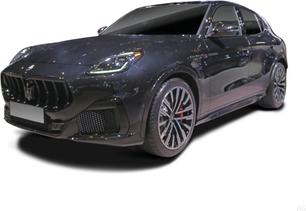
And the Grecale Trofeo is the latest example of Maserati's inability to let an SUV be simply practical. It's a mad twin-turbo V6 all-wheel-drive version of the more typically four-cylinder-powered mid-size SUV.
We spent a week with this ferocious beast to see how much spice it can add to family life.
Clearly, this is not a car for everyone, and you’d have to question whether it’s a car for anyone, really, but people who like spending $610,000 on Ferraris, and waiting in a queue to do so, will be delighted, because it delivers the kind of exclusivity, and bragging rights, that you’d have to hope a car called Superfast would.
Personally, it’s a little too much, a little too over the top and definitely too mad, but if rockets are your thing, you won’t be disappointed.
In its surprisingly crowded premium performance SUV segment, the Maserati Grecale Trofeo offers something different. Next to the X4s, GLCs and Macans of this world, it's quietly confident and charismatic with the performance, practicality and value to back up its distinctive good looks. Despite some gripes around warranty, fuel consumption and ride compliance, it's a compelling alternative to those more predictable choices.
It’s very… big, isn’t it? And it looks even bigger in the flesh with a bonnet you could use to put a roof over your tennis court. In all, the Superfast is 4.6m long, almost 2.0m wide and weighs 1.5 tonnes, so it certainly has presence.
Making something this big look good is a challenge even for those as talented as Ferrari’s design team, but they have nailed it. The front has what appears to be a mouth, poised to swallow lesser cars whole like some whale shark Terminator.
The bonnet appears to be flaring its nostrils, and looks fabulous from the driver’s seat, and the swooping side and taut rear complete things nicely.
Personally, it still just looks too big to be a Ferrari, but then this is not a mid-engined super car, it’s a grand touring rocket ship, and the ultimate expression of unnecessary excess, and it pulls off that aura perfectly.
At close to 4.9m long, a fraction under 2.0m wide and less than 1.7m tall, the Grecale is a 'large' medium SUV with a robust, thick-set look and a low-key design approach relative to its often more overtly muscular competitors.
Signature Maserati elements include a trio of porthole vents in the front fenders, the broad vertically-slatted grille with trident emblem sitting proudly in the centre, and a smaller version of Neptune's weapon of choice adorning the broad C-pillar.
There's also more than a touch of MC20 around the raked headlights (including the DRL signature), a pronounced splitter-style nose piece and broad intakes on either side.
Staggered 21-inch rims fill the arches perfectly, while pronounced side skirts and a gently sloping turret also dial up the sporty look.
The rear is sleek, but again relatively low-key, the major clues to the car's performance potential being the quad exhaust outlets and the carbon nose panel, side skirts and diffuser.
The interior feels sleek and VIP special thanks mainly to the multi-tier dash design, quality of the materials used and multiple screens.
A central 12.3-inch multimedia touchscreen sits above an 8.8-inch 'comfort' screen devoted mostly to heating, ventilation and vehicle settings.
They're tied together in a single, angled panel that looks like an oversized foldable smartphone. Very cool.
The 12.3-inch digital instrument cluster is configurable through multiple custom set-ups and this time around the distinctive dashtop clock is in fact a small screen switchable through classic and contemporary faces.
It can also emit a response signal when it receives a voice command or morph into a G-meter.
From there, the double saddle stitched perforated leather trim, exposed carbon-fibre elements and brushed metal finishes complete a highly polished cabin environment.
Practicality isn’t really your concern when you buy a two-seat mega car like this, so let’s just say it’s about as practical as you would expect it to be. Not very, then.
At close to 4.9m long and nearly 2.0m wide, the Grecale is a big medium five-seater and with a 2.9m wheelbase to play with, interior space and practicality are more than respectable.
There's plenty of space up front and in terms of practicality, decent door bins, two cupholders in the centre console, a lidded oddments tray in front of them (housing USB-C and USB-A sockets), a large lidded box between the seats (which doubles as a centre armrest) with a 12-volt outlet lurking inside as well as a generous glove box.
Sitting behind the driver's seat set for my 183cm position, there's plenty of head, leg and foot room, not to mention a surprising amount of breathing space in general.
Enough width for three adults on short journeys and up to teenage kids will be fine. When it comes to baby capsules or child seats, you'll be good with two but three is a bridge too far.
For storage, there are door bins with room for large bottles, hard-shell maps pockets on the front seatbacks, adjustable ventilation as part of the three-zone climate control system, a fold-down centre armrest including two cupholders and a slot for a phone in between as well as another pair of USB (A and C) sockets.
Boot volume is a healthy 570 litres with all seats up, which is 35L more than the lower GT and Modena grades because rather than a space saver spare, the Trofeo cops a repair/inflator kit. Boo...
It's enough room to fit our three-piece luggage set or the CarsGuide pram with ease, and the 40/20/40 split-folding rear seat liberates even more space.
There are seat release handles in the cargo area as well as multiple tie-down anchor points, a 12V outlet, bag hooks and a two-piece load cover set-up to deter prying eyes.
Is it possible that any car - save one made from gold, dusted with diamonds and stuffed with truffles - would represent good value at a price of $610,000? It seems unlikely, but then people who can spend that much assay value differently, and would probably say that something as profound as the 812 Superfast is worth buying at any price.
Another way to look at it is price-per-litre, which is less than $100,000, considering you do get 6.5 litres of V12 Ferrari donk. Or you could go by kilowatt, which works out at nearly $1000 each for your 588kW.
Other than that you do get a lot of leather, a high-quality interior, superior exterior styling, badge-snob value that’s hard to put a price on and vast swathes of F1-derived technology. And a free car cover.
At $174,900, before on-road costs, the Grecale Trofeo sits in the middle of a pack of performance-focused mid-sized SUVs spanning a roughly $50,000 price band from around $140K to $190K.
Specifically, the Alfa Romeo Stelvio Quadrifoglio ($162,700), BMW X4 M Competition ($185,200), Jaguar F-Pace SVR ($153,570), Mercedes-AMG GLC63 S ($191,800) and Porsche's Macan GTS ($141,700).
That's a quality competitive set and to keep its head above water the Grecale Trofeo comes with a solid standard features list.
Aside from the performance and safety tech we'll cover shortly, highlights include the 21-inch alloy rims, auto LED headlights, 14-way adjustable heated sports front seats (with driver memory function), an electrically-adjustable steering column, alloy door sill finishers, full leather upholstery, 14-speaker Sonus Faber audio (with digital radio), three-zone climate control (with rear touchscreen), a panoramic sunroof and ambient lighting.
Then there are the screens for multimedia (12.8-inch), instrumentation (12.8-inch), ventilation and vehicle settings (8.8-inch) and the multi-mode clock, as well as ambient cabin lighting, adaptive cruise control, a power tailgate (with kick control), Android Auto and Apple CarPlay connectivity plus layers of carbon inside and out. Impressive, even in the 'around $200K' part of the market.
I did want to give the epic, enormous 6.5-litre naturally aspirated V12 engine a perfect 10 here, but when I paused to think about it I had to admit that it is, quite possibly, a little too powerful.
Yes, it is amazing to think Ferrari can build a car that has 588kW (800 horsepower - hence the 812 nomenclature; 800 horses and 12 cylinders) and doesn’t just dig itself a hole in the road as soon as you put your foot down.
And yes, it does provide the kind of performance that makes all other cars seems a bit piss poor and pathetic, even the really good ones.
But honestly, who could ever use it all, or need it all? They might seem like irrelevant questions, I guess, because it’s all about conspicuous over-excess, a car like this, so really the question is, would anyone want to live with 588kW and 718Nm of torque, or is it just too scary in reality?
Well, a little bit, yes, but Ferrari’s engineers have been wise enough not to actually give you all of that power, all the time. Torque is limited in the first three gears, and maximum mental power is actually only available, in theory, at 8500rpm in seventh gear, at which point you’d be approaching its top speed of 340km/h.
The fact that you can rev an engine this big, and this lusciously loud, all the way to 8500rpm is, however, a joy that would never tire.
In more practical terms, you can run 0-100km/h in 2.9 seconds (although cheaper, less crazy cars can do that, too) or 200km/h in 7.9 (which is a tiny bit slower than the far lighter McLaren 720S).
What you can’t do, of course, is achieve any of those numbers on winter tyres, or roads with snow on them.
Lurking under the Grecale Trofeo's bonnet is a 'wet sump' version of the 3.0-litre twin-turbo 'Nettuno' (Neptune) V6 that also found a home between the axles of the Maserati MC20 supercar.
It produces 390kW, which is well in excess of 500hp, and grinds out enough torque (620Nm) to pull a small cottage off its foundations.
It's brimming with performance and efficiency-focused tech. Everything from twin-spark dual-chamber heads and cylinder deactivation to high-pressure direction-injection and variable valve timing.
Drive goes to all four wheels via a ZF-sourced eight-speed auto transmission and an all-wheel-drive system incorporating an electronic self-locking limited slip diff at the rear.
Much as you can’t have a good volcano without some serious lava, you can’t have 800 horsepower without burning a lot of dead dinosaur goo. The Superfast has a claimed fuel-economy figure of 14.9L/100km, but on our drive the screen just said "Ha!" and we burned through a whole tank of fuel in less than 300km.
Theoretical emissions are 340g/km of CO2.
Maserati's official combined cycle fuel economy number for the Grecale Trofeo is 11.2L/100km, emitting 254g/km of CO2 in the process.
We covered urban, B-road and freeway running, not to mention some enthusiastic driving along the way, and recorded an average of 16.9L/100km. Which is thirsty, but not outrageous relative to the competition.
The fuel tank requires 64 litres of 95 RON premium unleaded to fill it which translates to a theoretical range of around 570km, dropping to just 380km using our real-world number.
Even if you're okay with the Trofeo's hefty consumption rate, regular visits to the fuel pump will be kind of a pain.
Insane. It’s a word that people often lift from their lexicon when describing a supercar experience, because clearly, as forms of transport, things like Ferraris and Lamborghinis are not sane options.
But the Superfast really deserves the word, because it feels not only the opposite of sane, but truly bonkers. As if someone built it for a dare, realised it was a bad and possibly dangerous idea, and then put it on sale anyway.
Picture some tiny-handed child with his greasy, post-cheeseburger fingers poised over a big red button on his desk that could wipe out humanity, and that’s basically the situation your right leg finds itself in when driving the Superfast.
There is so much power on tap here - even the limited amount of it that the engineers allow you to access in lower gears - that it truly seems possible you’ll have a Road Runner moment, and simply dig a hole in the ground, if you push the throttle too hard.
Yes, on the one hand, the noises this extreme V12 makes above 5000rpm are memorable and moving, like Satan himself singing Nessun Dorma in a shower of sparks. At one stage we found a long tunnel, perhaps the only dry road within 500km that day, and my colleague forgot all about his licence and let rip.
The numbers on my 'Passenger Screen' spun like poker-machine wheels, then turned red and then implausible. I was shoved back into my seat as if by Thor himself, and I squealed like a small pig, but my co-driver heard nothing over the Monaco tunnel during F1 sound.
Even on dry road, of course, the winter tyres we were forced (by law) to run in the foul snowy conditions could not maintain grip, and we constantly felt the rear skipping sideways. Fortunately we were in Italy, so people simply cheered us on.
The likelihood that you will lose traction in this car is so high that the boffins have included a special feature in its new 'Electronic Power Steering' system called 'Ferrari Power Oversteer'. When you inevitably start going sideways, the steering wheel will apply subtle torque to your hands, 'suggesting' the best way to get the car back in a straight line.
A proud engineer told me that this is basically like having a Ferrari test driver in the car with you, telling you what to do, and that they used their skills to calibrate the system. You can override it, of course, but it sounds scarily like an autonomous-driving precursor to me.
What’s disappointing about this car having EPS at all, rather than a traditional hydraulic system, is that it just doesn’t feel muscular enough for a hairy-handed monster of a car like this.
It is accurate and precise and pointy, of course, and makes driving the Superfast, even in stupidly slippery conditions, almost easy. Almost.
It’s actually surprising how hard you can push a car like this along a windy and wet mountain road without careering off into a muddy field.
More time, and more traction, would have been appreciated, but you can tell it’s the sort of car you’d grow into, and perhaps even feel in control of, after a decade or so together.
So it’s good, yes, and very fast, obviously, but I can’t get past the idea that it’s all a bit unnecessary, and that a 488 GTB is simply, in every single way, a better car.
But as a statement, or a collector’s item, the Ferrari 812 Superfast certainly is one for the history books.
Engage the standard launch control function, step through the blast-off procedure and Maserati says you'll rocket from 0-100km/h in 3.8 seconds, which is supercar fast.
And the way this twin-turbo V6 delivers that kind of performance is impressive; beautifully linear without a hint of lag.
Trundle along at 60km/h, pin the throttle and you'll be in 'lock 'em up and throw away the key' territory in the blink of an eye. This is a full-blown rocket sled.
All 620Nm of peak torque is available from 3000-5500rpm with maximum power (390kW) arriving at 6500rpm. No matter which drive mode you've selected (more on that shortly), thunderous performance is only an extension of your right ankle away.
And the aural accompaniment walks a perfect line between potency and civility, the signature Maserati exhaust growl stepping up a notch in the racier settings but rarely crossing over into bellicose 'boy racer' territory. We have no problem with an occasional pop and bang on the overrun!
At a touch over two tonnes, the Grecale Trofeo is far from a featherweight, but when you're racing up and down the quick-shifting auto transmission's eight ratios, it feels like one.
The elegant alloy, column- (not wheel-) mounted 'manual' shift levers add to the fun and there are five drive modes to play with - 'Comfort', 'GT', 'Sport', 'Corsa' and 'Off-road' - adapting the engine, transmission, steering and suspension.
The track-focused Corsa set-up starts to soften off some of the traction and stability controls, so we didn't go there, but can confirm off-road raises ride height by 30mm (FYI, we didn't head off-road, either).
Suspension is by double wishbones at the front and multi-links at the rear supported by active dampers and air 'springs' all around.
In the softer Comfort setting, ride compliance is on the firm side. Never harsh, but a little more communicative in terms of bumps and thumps than you might expect.
Not for the first time I found the best arrangement was Sport, dialling everything up to racier settings, and the suspension in 'Comfort' which can be achieved with the press of a wheel-mounted button.
The electrically-assisted rack and pinion steering is accurate and quick to respond with excellent road feel thrown in for good measure.
Just beware the flip side of this type of 'quick' steering rack is invariably a large turning circle, and the Grecale Trofeo is no exception.
The staggered 21-inch rims are shod with high-performance Bridgestone Potenza Sport rubber (225/40 fr / 295/35 rr) and the AWD system, complete with rear LSD, help the car feel securely planted and balanced in quick cornering.
Braking is professional grade with big ventilated and cross-drilled rotors front and rear with fixed Brembo calipers at both ends - six piston front and four-piston rear.
Maserati claims the Grecale Trofeo will slow from 100km/h to a standstill in less than 40m, which is not a lot of metres from that speed.
I had one telling 'will I, or won't I?' situation when presented with an amber light and in deciding to give the brakes a workout (there was no one behind me) was rewarded with a secure and insanely rapid stop.
In terms of general observations, the placement of the start button and drive-mode dial on the steering wheel is a nice touch, the front seats are superb in terms of support and comfort, the media interface is quick and easy to use and the only strong hint of Maserati's Stellantis ownership came in the form of familiar 'Jeep-style' audio control rocker switches on the back of the steering wheel.
It might not surprise you to hear that, unlike every other company’s press kits, the Ferrari ones don’t generally include a section on 'safety'. Perhaps because driving something this powerful is inherently unsafe, or possibly because they believe their 'E-Diff 3', 'SCM -E' (magnetorheological suspension control with dual-coil system), 'F1-Traction Control', ESC and so forth will keep you on the road no matter what.
If you do fly off, you’ll have four airbags, and a nose as big as a house forming a crumple zone, to protect you.
No independent ANCAP safety assessment at this stage but the Grecale Trofeo is fitted with active crash-avoidance tech including AEB (with pedestrian recognition) operating from 5.0-258km/h, adaptive cruise control (with stop and go function), 'Active Lane Management' (including lane-keep assist), blind-spot monitoring, rear cross-traffic alert and 'Drowsy Driver Detection'.
There's also a 'Surround View' camera system, 'Traffic Sign Assist' as well as front and rear parking sensors, and 'Rear Cross Path' (incorporating rear AEB).
If a crash is unavoidable, six airbags (dual front, front side and full-length side curtains) are onboard and there are three top tethers across the rear for baby capsules/child restraints, including ISOFIX anchors on the outer positions. There's even an emergency triangle and first-aid kit.
Once you’ve paid the vast cost of entry, it’s nice to know you will get some stuff for free, like your first seven years of servicing, including all parts and labour, carried out by trained Ferrari technicians, who even dress like pit crew. It’s called 'Genuine Maintenance', and is genuinely Kia-challenging in its scope.
The Grecale Trofeo is covered by Maserati's three-year/unlimited km warranty, which is off the market pace, with five years/unlimited km the expected norm. Roadside assistance is included for the duration of the warranty.
Maintenance intervals are 12 months/15,000km, and service over the first three years will set you back $4639, or $1546 per workshop visit. Not cheap, but again, not out of line for a performance model in this part of the market.
Maserati also warrants the body for "perforation by rust corrosion" for four years, extendable up to eight if vehicle maintenance, from an authorised dealer, is up to scratch.