What's the difference?
Hybrid campers tread the line between caravan comfort and camper trailer-manoeuvrability and are touted as somewhat of a new thing; almost an evolution of comfort as more people look for a perfect camping experience.
But camper-trailers like the Cub Longreach LE prove that the concept has been around for decades.
It hasn't always been called the Longreach, but this high-walled, super-sized, off-road camper-trailer was one of the first to offer caravan-like comfort and space in a product that'll go anywhere off-road*. (* In terms of reasonable use and having obviously scrutinised your camper's warranty conditions before setting off to make sure you're covered for that sort of usage.)
The 2019 LE takes the comfort levels even further, so we grabbed one for a night to check it out.
Long before a hash-tag was anything more than a confusing symbol on a typewriter, vanlife was already a thing.
And you can largely thank Volkswagen for that because its Kombi models from the 1950s, '60s and '70s help cement the idea of roaming around the planet in a self-contained car-cum-house as a counter-culture favourite. More than that, the affordable, rugged Kombi made it actually possible.
Back then, there were a couple of paths to tread. You could take a second-hand butcher’s or florist’s Kombi van (windows optional) and trick it out with a bed, a table and whatever gear you needed to survive on the road.
Or, if the cash was around in sufficient quantities, you could buy a Kombi brand-new and have it converted to camper spec. And of all those brand-new conversion options, Volkswagen’s own, in-house conversion supplier, Westfalia was (and is) regarded as the pick of the crop.
So, when VW announces a 21st Century take on the concept of a factory campervan, those who like the idea of a lap of Australia but don’t like caravans or towing, are suddenly all ears.
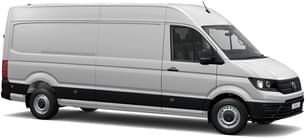
Like most things, the latter-day VW camper has grown a size or two over the last six or seven decades. Which is why the factory Kampervan TD1410 4 Motion (to give it its full name) is based on the long-wheelbase, high-roof version of the Crafter van rather than the original Transporter layout. (There’s still the VW Multivan-based California if the Kampervan is too big.)
But just as commercial vehicles have become bigger and more sophisticated, and glamping has grown out of actual camping, does the modern take on a hippy legend make the grade in 2024? And does the Volkswagen offering retain any of the charm of the original campervan?
Oh, and forget about Westfalia. This conversion is the work of none other than Aussie caravan specialist Jayco.
The deal between Jayco and VW locally, means this variant of the Crafter Kampervan is an Australia-only deal.
This isn’t the camper for everyone – my guess is that plenty of people look at this and find it too sparse, too basic. I kinda get it.
But there are very few campers which offer the same amount of open, internal space, or that are as easy to set up.
That the Longreach, albeit with a few different names, has lasted so long on the Cub Campers' product roster is a testament to its versatility and ability to accommodate a small family on off-road camper trips.
It's arguably one of the forerunners of the hybrid camper scene, and it's now starting to evolve with campers' desires for more comfort.
This is not the vehicle for somebody looking for the odd weekend away. That’s mainly because it will take up a lot of real estate when you’re not using it (it may not even fit in a lot of car-ports or garages) and it’s far from a daily driver for the school run or shopping trips.
If you’re looking for a getaway machine that will also work at home for the other 48 weeks of the year, a conventional caravan and four-wheel-drive is likely to be a better bet, purely because the tow-vehicle can be your day-to-day transport
But if your plans include longer getaways and you have the storage space to keep the Kampervan stashed away safely, it starts to emerge as a functional alternative.
Talk to long-term travellers, and even the best camper trailer needs to be set up each night and folded away next morning, and as for tents, don’t even start us…
But like a full-sized caravan, the VW simply pulls up to where ever it is you want to stay for the night and is ready to feed, entertain and rest its occupants within seconds of stopping.
But unlike a big, heavy caravan, the Volkswagen imposes far fewer driving caveats (including fuel consumption) and is a vastly more enjoyable and simple thing to drive in pretty much any circumstance.
It's not for everybody, but for those whose lifestyle it matches, the VW Kampervan is an alternative to a caravan that deserves short-listing. Let’s face it, 50 million hippies can’t be wrong.
Note: CarsGuide attended this event as a guest of the manufacturer, with accommodation and meals provided.
For a rear-fold camper-trailer, the space inside couldn't be more practical. The long body and high sides mean that when the camper is open and set up, it has a lot more space than most. Behind the bed, for instance, there is enough space for Cub to have fit a small dinette.
The dinette has cushioned benches for two and a swivel table that can also become a counter over the rear floor area.
The camper's length also means that the rear floor area is massive. It is easily big enough to lie a couple of kids on, or if your nest is empty, to set up some camp chairs and a table to enjoy a covered living area.
It is still a rear-fold camper-trailer, though so, despite the fact it has nearly twice the space of other hybrid-style campers, it's very sparsely furnished. There's no internal kitchenette or anything like that.
The Crafter’s phone mirroring system seems to work pretty well, although it’s menu-driven layout can be a bit frustrating (it’s hardly alone there) and Android phones sometimes didn’t want to connect as simply as they should have (potential user-error here, folks).
But the rest of the interior is typically Crafter-smart including lots and lots of cupholders, USB ports and cubby-holes dotted around the front seat area.
Doubtless, a few months on the road will show up design issues according to the individual, but for now, our main comment would be the proximity of the bathroom to the food preparation area (although, to be fair, most owners will cook outside the vehicle).
The mattress is a split queen unit (rather than a single mattress) and it occupies the full width of the rearmost part of the vehicle, so making the bed might be a bit more difficult.
The location and width of the bathroom (although it feels pretty tiny once you’re in there and operates as a wet-room) also means there’s just half the rear view that the vehicle might otherwise have.
The thick pillar between the two rear barn-doors also adds to that blind spot. At least the mirrors are good; nice and wide and very clear.
It’s when the Kampervan is not being used to survey this wide, brown land that its practicality starts to come into question. Unlike a conventional four-wheel drive and caravan rig, the accommodation section of the Crafter can’t simply be unhooked and parked in the driveway.
Which means it’s not really suburb or city-friendly. Underground car-parks will soon detach the air-conditioning unit in a pretty violent way, and the almost-seven-metre length will have you looking for adjacent empty parking spaces (or the car-and-trailer section at Bunnings).
Put simply, this is the touring solution for those who want to tackle the Big Trip in one go, staying on the road for weeks or perhaps even months. Obviously, that’s an observation rather than a criticism, but it remains something to think about.
Cub Campers are famously good to tow, and even the largest of them lives up to the reputation.
As big as it is, the Longreach LE is quite light thanks to the effort Cub puts into engineering. As a result, it's not a strain, even for older dual-cabs like the D22 Navara.
And because it isn't any higher or wider than a modern SUV, there was very little wind-drag or buffeting as we cruised along the highway.
Cub developed the camper's Australian-made and -designed independent, coil-spring suspension and the set-up yields excellent ride in any conditions.
For the LE, Cub has added an extra shock-absorber each side to improve its performance even on the most corrugated roads.
An AL-KO off-road ball hitch is standard but can be upgraded to the Click-Lock version if you'd prefer that or need a more low-profile hitch.
In reverse, the long drawbar makes it an easy camper to manoeuvre around a campsite, plus it has enough size that the tow-vehicle driver never really loses sight of it while positioning it.
You can see the appeal of a high driving position the moment you step into (or climb into, really) the Kampervan. The view out is fabulous and even though the vehicle is just shy of seven metres long, you soon develop a bit of a sixth sense for where the back wheels are, based on what the front wheels have just done.
The glass area is huge with the exception of the view to the rear thanks to that bathroom placement.
The front seats are big and comfy, although the two rear seats are pretty flat and place the occupants quite close together. There’s enough adjustability in the seat and steering column to make anybody feel at home and the exterior mirrors are big and clear.
There’s enough performance, to be sure, but the sheer mass of the Kampervan and the fact that it’s moving a lot of air means you’ll be giving the rather long-travel accelerator a decent workout.
Taking off into traffic is the only time the VW will feel a bit sluggish, but once the engine has a few revs on board it all gets going fairly smartly.
Unlike a lot of modern cars that can feel as though they're travelling a lot slower than they really are, the Kampervan is the opposite. Not that it’s spooky to drive, but there will be times you’ll be in a 100km/h zone, look down and discover you’re doing 90.
In the context of a leisure vehicle, this shouldn’t bother anybody apart from a highway patrol officer down on his or her monthly quota.
The engine is smooth and the transmission is refined and possesses enough smarts to make a better job of shifting itself than the driver ever will.
It’s not exactly silent inside, though, with a smattering of clicks and clatters from some of the less-automotive furniture, but it’s a fair bet even a brand-new house would likewise rattle a bit if you hurled it down a bumpy road at 100km/h.
The biggest source of noise pollution, though, is in the All-Terrain model and consists of a chorus of sucking, sobbing, choking and burping noises from the snorkel which is placed right near the driver’s right ear. Obviously, it’s worse with the window open.
Ride quality is very good. Clearly, having a bit of weight on board doesn’t hurt, but even so, the Kampervan refuses to pitch or wallow despite that ride compliance. In fact, it’s very composed for such a big unit that was originally designed to carry parcels and pallets.