What's the difference?
Cub Campers is Australia’s oldest camper-trailer manufacturer and one of the oldest businesses in the caravan and camping industry, having just celebrated 50 years of operation in 2018.
The company can lay claim to inventing the soft-floor camper trailer, pioneering the rear-fold and championing off-road campers when everyone else was concerned with the on-road market. Amongst all that, though, it was late to the game when it comes to forward-fold campers, not releasing the Frontier until early in 2016, well after the flood of Chinese manufactured versions became immensely popular. So why did Cub wait so long and was it worth it?
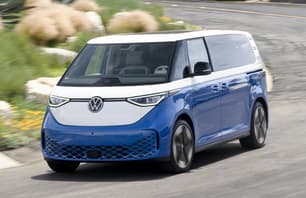
You might call it six degrees of Kombi separation. Somewhere, somehow just about all of us have a VW bus lurking in our family and friends' back story. And this is the latest version of that familiar box on wheels to hit the Aussie market.
It’s the premium, sportier, AWD GTX version of the pure-electric Volkswagen ID.Buzz.
This one-box wonder hits the retro-futurist ball out of the park and we attended its local launch to explore whether what’s under the skin supports the promise of its stunning exterior.
All in all, the Frontier is the best forward-fold camper on the market, although it is also the most expensive. If you were making a buying decision purely based on features, you’d probably look elsewhere, but if you are prepared to pay a little more because this camper-trailer is Australian made, you get a very functional camper that’s easy to set up, reliable, strong and light.
The only way to make this car cooler would be to add a split fold-out windscreen and a tube steel luggage rack on the roof.
It’s fast, super practical, comfortable and guaranteed to put a smile on the face of premium family buyers ready to go for something different. And that smile will extend to just about everyone who lays eyes on it. I love it.
Note: CarsGuide attended this event as a guest of the manufacturer, with travel, accommodation and meals provided.
The real appeal of a forward-fold camper-trailer is the internal configuration. Because the bed folds out over the front of the camper, the trailer body is configured with a wrap-around lounge and dinette area, that also converts into a bed. It brings a certain level of caravan comfort to a camper-trailer-sized package. Cub’s execution is quite good. The lounge is comfortable and the dinette table is highly adjustable up and down or around and around. It converts into a bed more simply than any other on the market I’ve seen.
The downside of the forward-fold concept is the quantity and access of storage. Very little of the internal storage is easy to get to, and in truth there’s very little of it. That’s what happens when you put a couch in a trailer, sorry. There are hatches under the seats, but even they are limited by the slide-out kitchen and battery box across the back, plus, they’re not as easy to get to as a drawer. It’s the same in every manufacturers version, though. However, the Frontier has one unique features that makes it stand out – a series of pigeon holes under the foot of the bed which provide the only easy-to-access internal storage in any forward-fold I’ve come across so far.
The ID.Buzz GTX is offered in shorter wheelbase variants with five- and six-seat configurations for other markets, but here it’s seven seats and long-wheelbase only.
At close to five metres long and just under two metres wide, it’s road-trip ready with heaps of breathing room for all seven occupants.
Placement of the gearshift on the right-hand side of the steering column frees up extra space in the front and there’s heaps of storage including a moveable (and removable) centre console unit between the front seats with pull-out drawers at either end, two trays in each door (the lower one offering room for multiple large bottles), a decent glove box and a fold-out dual cupholder unit.
There’s also an oddments shelf in front of the passenger, a wireless device charging slot in the dash and adjustable fold-down armrests on both sides of the front seats.
Pull the handle on the power-opening sliding side doors and the second row opens up with three seating positions offering hectares of room in all directions.
This row can be moved 200mm longitudinally if a turf war erupts with those in the third row. And storage is great with two pockets and a fold out table on each front seatback as well as huge door bins with waste baskets included. There are also adjustable vents with temperature control in the roof.
There’s enough head and legroom for adults in the third row although the backrest is relatively upright. Even access is straightforward and there are numerous storage trays, cupholders, air vents and storage slots back there.
Power across the cabin runs to two USB-C ports in the dash, another in the front passenger area and four USB-C charging sockets in the rear.
Boot space increases from a handy 306 litres with all seats up to 1340 litres with the 50/50 split-folding third row down, and 2469L with it and the 60/40 split second row lowered. That’s plenty.
And that 1.6-tonne braked trailer towing capacity means a jet ski, even a mid-size camper trailer, is within hauling range.
The power tailgate is welcome and the rear of the boot’s load platform sits above two storage boxes. But you won’t find a spare of any description back there; a repair-inflator kit is your only option. So beware, a flat could really suck the air out of this mobile family room.
The Frontier is quite good under tow. Cub designed and manufactures its own coil-spring independent suspension and has paid quite close attention to the balance and dynamics of the trailer.
As it’s not overly heavy, it’s not a handful, even on the beach, and behind the Mitsubishi Triton I tested it with, it was barely a struggle. On the road, the camper is well behaved, easy to see over and around and because it’s not very long, it’s not very daunting.
Despite the fact that it weighs in at around 2.8 tonnes (2780kg), Volkswagen Australia says this dual-motor ID.Buzz accelerates from 0-100km/h in 6.4 seconds and on to a 160km/h maximum velocity, if you dare.
And there is always some serious oomph lurking under your right foot. Trundle along at 65km/h, pin the accelerator, and in roughly two blinks of an eye you’re doing 95km/h.
Proportionally, this car is like a loaf of bread on wheels - about as high as it is wide. And on the windy launch drive we were buffeted a bit, the car moving sideways slightly when hit with a gust. But overall, it remains stable despite its proportions. That said, some wind noise comes over the bluff nose on the freeway, but never to an alarming degree.
The ID. Buzz rides on VW’s Modular Electric Drive (MEB) platform and there’s been past criticism of the short-wheelbase versions' ride quality, but there are no such issues here.
Suspension is by struts at the front and semi-trailing arms at the rear and this GTX has had a suspension retune with particular attention paid to key components, including the dampers.
On rural roads that have seen better days, dotted with potholes, bumps and thumps, a combination of that suspension retune and the longer wheelbase helped the GTX handle it well.
There are five drive modes with Comfort the default. Eco smooths out acceleration, tapers the climate control and reduces overall power, while Sport dials up the powertrain, suspension and steering. Traction optimises the AWD system for loose or slippery surfaces and Individual allows you to cherry pick various attributes for a custom set-up.
Steering is progressive rate and you can feel it loading up nicely as you head into a corner. Not the last word in terms of road feel, but the car points accurately and turn-in is nice and progressive.
At the same time you’ve got the electric motors constantly shuffling drive between the front and rear axles, helping you out if you decide to explore the car’s sporty nature and have a crack in the corners.
Tyres are Hankook Ventus S1 Evo3 EV specials (235/45 fr - 265/40 rr) and in long, sweeping bends, taken at pretty decent speed, they grip hard. Even on coarse-chip B-road surfaces there’s a bit of rumble but it’s far from a roar.
Braking is by large (358mm) ventilated discs in the front and, believe it or not, drums at the back. A well-designed, modern drum brake can work effectively and the regenerative braking in an EV like this is a big factor in terms of washing off speed.
In terms of lower speed manoeuvres, you’ve got a 360-degree camera view as well as a reversing camera and front and rear parking sensors. If you really need some help, Park Assist Plus will get the job done for you.
In terms of ergonomics, we spent hours behind the wheel and the front seats remained comfortable and supportive in terms of lateral grip.
Speaking of grip, the steering wheel is nice to hold. And the cool little 5.3-inch instrument and car data display is clear as a bell, and the large 12-inch media screen is easy to use and working through the different screens is largely intuitive.