What's the difference?
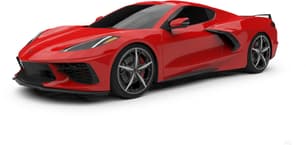
Chevrolet’s Corvette Z06 supercar is an all-American answer to European rivals Lamborghini and Ferrari, but it’s not just this that makes it so appealing.
Spending a week with the most potent Corvette you can get in Australia has left me with a list of notes on this beast I want to hand over to you. Maybe it will help make your mind up about it or change your mind.
What makes the Z06 the flagship of the Australian Corvette range isn’t little luxuries, but seriously upgraded mechanical hardware, much of it track focussed.
Our test car was also fitted with the Z07 Performance package which adds a carbon-fibre aero kit to pin the Corvette down at high speed while also drawing everybody’s attention to it.
Oh, and then there’s the sound of the largest flatplane crank V8 ever to go into a production car… and look out for your ankles - let me explain…
Cast your mind back to 2012, Carly Rae Jepsen’s super-catchy Call Me Maybe single was at the top of the music charts, the first Avengers movie had just hit movie theatres and Toyota’s 86 sports car finally arrived in Australian showrooms after a lengthy teaser campaign.
Fast-forward eight years to 2020, and Carly Rae Jepsen is still releasing bangers, the Avengers have become the zeitgeist of 2010s popular culture and... the Toyota 86 is still available in local showrooms.
Sure, Toyota has tweaked, fiddled and updated the 86 a little since then, but the formula for an affordable, front-engine, rear-wheel-drive coupe is still the same.
But the 86 now competes in a market that has moved ahead in leaps and bounds, and while direct competitors like the Mazda MX-5 are few and far between, it now has to fend off competition from some light-sized warm hatches.
Does the Toyota 86 manage to hold its own in 2020? Or is it better off relegated to the annals of history?
The Chevrolet Corvette Z06 is truly a supercar offering outstanding dynamics for a lot less money being asked by European rivals - just make sure it's not your only car for those times when you're in a hurry.
The Toyota 86 might be a bit of a blast from the past in 2020, especially considering there is a new-generation version just around the corner, but that doesn’t mean it’s a bad car.
In fact, it serves up a fun and visceral driving experience seldom seen in anything other than the most focussed of sports cars, but packaged up with an attainable price.
If you value practicality and straight-line pace, a hot hatch will be the easy choice, but if the driving experience is the most important aspect of a car to you, it’s hard to pass up the Toyota 86.
We’re talking about the closest thing to a real-life Hot Wheels car here. See, while Ferraris look elegant to me like expensive jewellery, Lambourghinis like cheese graters and McLaren’s look like slippery alien spacecraft, the Corvette Z06 looks exactly like an American supercar should - an unapologetic, ludicrous beast. And I love that.
Dialing up the wild is that enormous carbon wing and front splitter with dive planes thanks to the Z07 package. Just a word of warning, though, the front splitter and dive planes stick out not just visually, but in the sense that I walked into them often and my ankles still have the scars.
I can’t recall the last time I drove a car with carbon-fibre wheels either - these are the biggest rims fitted to a Corvette and they’re wrapped in Michelin Pilot Sport Cup 2R ultra performance tyres (275/30ZR20 front and 345/25ZR21 rear) that they look like oil drums on their sides.
The best angle? The rear - straight on. Those headlights.
Wait, no, it’s from above - so you can see the V8 through the glass hatch.
Or it could be front-on looking like a giant shovel..
OK, there are no bad angles..
The Corvette Z06 is long at 4734mm end-to-end, broad at 2024mm wide and its height is a both a sitting-on-the-road-low and numerically pleasing 1234mm.
The plainness of the cabin might be a let down to some people after all the exterior wildness. Ferraris and Lambourghis offer extravagant and exotic interiors, but the Corvette’s innards are almost completely void of flare.
The media screen is small (8.0 inches), switches and controls for windows and air vents are basic, and the huge dividing ‘wall’ between the pilot and passenger might be a bit much for some.
That ‘wall’ is dotted with buttons and while it may look very 'fighter jet cockpit', they’re just climate control switches. Sitting in the passenger seat is a lonely place with no screen visibility nor easy access to controls - I'd actually call this out as a bit of a fail compared to the interiors from Porsche, Audi and Lamborghini with their screen-filled cabins offering co-pilots something to do.
Yes, it feels a bit premium with the Nappa leather and the sports seats, but it could feel more special.
All of this plainness, however, is saved from boredom by the glass window behind the seats allowing you to peer into the engine bay at the V8 like at a reptile enclosure at the zoo.
There’s no denying Toyota’s 86 boasts classic sports car proportions thanks to a long bonnet, short overhangs and a sleek coupe body-style.
Though some things have changed since the model first came to market in 2012, such as revised bumpers and lights, the 86 is just as recognisable today as it was back then.
From the front, the 86 gives off a purposeful and aggressive stance thanks to its angled headlights, gaping intake and bulging arches.
Move to the side and you will see the wheelbase stretches nearly to the edges of the car, while a strong shoulder- and roofline join at the rear haunches to emphasise the 86’s rear-drive character.
The rear end is probable the least favourable angle for the 86, but the wide tail-lights, large diffuser and dual-exhaust outlets add to its sporting character.
Our test car was fitted in the eye-catching Apollo Blue colour, as well as 17-inch wheels, mirror caps and a rear spoiler finished in black.
After eight years on the market, we still think the 86 is one of the better-looking sports cars on the market, largely thanks to its purposeful and no-frills approach to styling.
It’s not quite as over-the-top as something like a Honda Civic Type R, but you still know it means business if it showed up to a track day.
Step inside though, and the cabin has not aged as well as the exterior.
The centre stack houses a 6.1-inch multimedia touchscreen that looks like it was picked out at a Repco sale, while you can practically see the pixels on the digital clock and temperature readout screens.
It’s not all bad though, as the chunky switchgear and large push-button starter add a little character to the interior.
We also like the instrumentation, which puts the tachometer front and centre for the driver while also incorporating a 4.2-inch display to add a bit of modernity.
Supercars don’t tend to be built with practicality as a priority but this two-door, two-seat beastie is spacious enough even for me at 185cm tall with plenty of room in the footwell and loads of elbow-, knee-, and headroom.
Cabin storage is limited to a glove box, door pockets, two cupholders, and a wireless phone charger on the bulkhead behind the seats.
As you can see from the images there’s a boot at the rear which will fit smaller bags and a small boot in the front.
I did the school run in the Corvette a few times (I know, lucky kid) and I can tell you a bass guitar in its case and a school bag, plus my own large handbag make for a cramped cabin. A Kia Carnival the Corvette ain’t, but it’s not trying to be one and compared to its rivals it does well for practicality.
Measuring 4240mm long, 1775mm wide, 1320mm tall and with a 2570mm wheelbase, the 86 coupe is dimensionally smaller in every measure to its Corolla hatchback sibling.
Despite this, Toyota says there is enough seating for four, but the 86 is much closer to a 2+2 than it is to a proper four-seater.
Front occupant space is ample enough, with plenty of adjustable in the seat and steering column for drivers to get into the perfect position.
There’s cupholders in the centre console, storage and the door pockets will even take a water bottle.
Front occupants also have access to a very, very small tray just in front of the shifter, though what it could accommodate is unknown.
We will also mention that when in odd-numbered gears, it can get tricky to use the climate controls, though it wouldn’t be a problem in auto-equipped cars.
Flick the front seats forward, contort yourself into the rear and, well, its more akin to a medieval torture device than passenger-friendly seating.
Headroom is especially limited, though we were surprised with the better-than-expected legroom due to the bucket-shape of the rear seats.
Don’t expect any mod-cons in the rear though, as the only thing to keep yourself entertained back there is the seat belt.
The boot accommodates just 237 litres of volume, which is just about enough to fit a large suitcase, though because of the short space, it will have to go in sideways leaving not a lot of room for much else.
Boot floor is also quite high, meaning tall objects will struggle to fit, but the rear seats can be folded flat to accommodate longer items.
While early versions of the 86 came with a spare wheel, in 2020, all new cars come with a puncture-repair kit.
Almost never does a car with a list price of almost $400K get full marks, but here we are and I’ll tell you why. The Corvette Z06 in its standard form lists for $336,000 and this is outstanding value compared to its supercar rivals such as the Ferrari F8 Tributo for $484,888, or a McLaren 750S for $585,800 or even an entry-grade Lamborghini Huracan, the EVO, for $383,187.
Australia gets the top 3LZ trim, with the local standard features list for the Corvette Z06 including Nappa leather upholstery, GT2 bucket seats, a 12-inch digital instrument display, a 14-speaker Bose sound system, red seat belts, wireless phone charging, carbon-fibre and suede microfibre trimmed steering wheel, a media system with sat-nav plus wireless Apple CarsPlay and Android Auto, power seats, heated steering wheel, dual-zone climate control, heated and ventilated seats and a head-up display.
Our test car was fitted with plenty of options including the Z07 Performance Package that brings carbon-fibre everything. We’re talking the enormous carbon-fibre rear wing and aero kit with side skirts and a front splitter with dive planes –and there are the carbon-fibre wheels (20-inch at the front and 21-inch at the rear).
The Z07 package also brings a more hardcore suspension tune and carbon ceramic brakes for ridiculously good stopping power.
The Z06 has the most powerful V8 engine in the Corvette range, too, and we'll get to that soon.
The Toyota 86 kicks off at $31,440 before on-road costs for the base GT manual, while the GTS version starts at $36,640.
An automatic transmission adds $2300 to the asking price.
Our test car, a top-spec GTS with all the options, rings the till up to $39,590 thanks to the Dynamic Performance Pack and Apollo Blue paint adding $2950.
As standard, the 86 comes with dual exhaust tips and LED headlights with daytime running lamps, while the black spoiler and side mirrors are an option available to the GTS grade.
The 17-inch wheels finished in black are also exclusive to this spec of 86, and the Dynamic Performance Pack adds larger Brembo brakes and Sachs suspension (more on those later).
Inside, the 86 is fitted with a black leather interior, sports seats with Alcantara inserts, Alcantara touches on the dashboard and door trims, rear privacy glass, dual-zone climate control, heated front seats, 4.2-inch multi-function driver display, push-button start, floor mats and three-spoke multifunction steering wheel.
The multimedia system is displayed on a 6.1-inch colour touchscreen, and includes features such as Bluetooth connectivity, USB input and satellite navigation.
No doubt this version of the 86 wears a sizeable pricetag, one that puts it right in contention amongst faster and more practical hot hatches like the Hyundai i30 N, though how much value you put in a coupe body-style and rear-drive dynamics is up to you.
Compared to something like the 2.0-litre MX-5 though, which starts at $43,820, the 86 looks much more attractive, but again, this is not taking into consideration the Mazda’s convertible party piece.
The 5.5-litre naturally aspirated V8 in the Z06 makes 475kW and 595Nm. That’s a lot more power than the Corvette Stingray’s V8, which produces 369kW. The GT3 racecar version of the Z06 uses a derived version of the 5.5-litre V8, and actually it shares 70 per cent of the engineering components.
Revving to a high 8600rpm the Z06’s V8 lets out a high-pitched scream when pushed hard, much like a Ferrari because like many Ferraris the Z06 has a flatplane crank V8 - actually it’s one of the largest flatplane V8s to go into a production car.
Corvettes are now mid-engined cars and the Z06 has an eight-speed dual-clutch transmission that changes gears quicker than I can blink, sending all that mumbo straight to the rear wheels.
Acceleration comes hard, fast and loud with the Z06 able to boot itself from 0-100km/h in 2.9 seconds. That beautifully linear acceleration with no turbos will pull you all the way towards its top speed of 313km/h.
Powering all Toyota 86s is a 2.0-litre four-cylinder Boxer petrol engine, outputting 152kW/212Nm when paired to a the six-speed manual gearbox.
Automatic transmission versions are downgraded to 147kW/205Nm.
Peak power comes in at a heady 7000rpm, while maximum torque is available from 6400-6600rpm for both manual and automatic versions.
Tipping the scales at around 1258kg means the manual 86 can accelerate from zero to 100km/h in 7.6 seconds, while the automatic version is 0.6s slower to the landmark time.
As with practicality, fuel efficiency isn’t the Corvette’s priority and after driving it daily for a week in the suburbs, city and a few dashes out to more open country roads the Z06 was using an average of 23.8L/100km, according to the trip computer.
Luckily the fuel tank is pretty big at 70 litres and with an official combined fuel consumption of just under 16L/100km you have a range of 438km… in theory.
Official fuel-consumption figures for the 86 is 8.4 litres per 100km with the six-speed manual.
However, we managed an 8.3L/100km figure after a week’s worth of driving, which is especially impressive given most of our time was spent in Melbourne’s inner-city.
Of note, the 86 requires 98 RON petrol.
What the Corvette Z06 is like to drive really depends where you drive it. Our suburb has a ridiculous number of speed humps, which are like the Corvette Z06’s Kryptonite thanks to its very limited ground clearance and a carbon front splitter that almost skims the road at the best of times.
This made the Z06 one of the slowest fast cars I’ve ever piloted. My son would beg me to drive him to school in it, but the journey would take twice as long as we slowly eased over each hump while holding our breath. A lift system does raise the front of the vehicle but even then, don't breathe out.
The width and poor visibility made inching down narrow streets of parked cars a stressful exercise, too.
The Corvette Z06 is almost too much of a racecar to live with and then you let it free on an open country road and its purpose is clear - it runs like you wouldn’t believe and screams in delight all the way, while clamping itself to the road with sticky tyres, perfectly set up suspension and proper downforce.
Steering feels mainlined though to your nervous system, the pedals under your feel like your actual feet, and it all feels like a dream until you wake up again when you reach the city limits and round abouts, and traffic and yes, speed humps.
The Corvette Z06 clearly is a car that needs to be joined by other cars in your driveway, ones that don’t even notice speed humps.
Front engine, rear-wheel drive, it’s a tried-and-true formula for an engaging driving experience and the Toyota 86 certainly doesn’t disappoint its spiritual predecessors in this regard.
Sure, the engine is a little underpowered, but the free-revving 2.0-litre will happily be wrung out until the 7600pm cut off.
The slick six-speed shifter is also an absolute joy to move, offering satisfying ‘snicks’ with every gear change, and a positive and natural throw that makes it hard to mis-shift.
Pedal placement, a crucial element in a manual car, is equally excellent, with just the right amount of spacing between the clutch, brake and throttle.
Don’t get us wrong, we aren’t heel-and-toe devotees, but it's nice they are positioned well, and offer the right amount of feedback and engagement.
From the driver’s position, looking out over the long bonnet can be a bit daunting, but with the bulging front wheelarches, you can actually tell exactly where the front wheels are, making apex-clipping a breeze.
The fantastic steering response helps with that too, as does the communicative chassis that conveys exactly what the rear axle is wanting to do.
Balanced, neutral handling is the name of the game here, with MacPherson struts up front and a double wishbone rear.
Our test car was also fitted with the up-rated Brembo brakes and Sachs-branded dampers that are designed to improve stopping power and handling respectively.
However, without driving this car and an 86 without the Dynamic Performance Pack fitted, it’s hard to make comment on how much the handling characteristics have changed.
We can say that the Brembo brakes are excellent at scrubbing speed from the perky Toyota coupe, thanks to larger callipers and rotors.
Along with four airbags, the Corvette Z06 has AEB, forward collision alert, lane-keeping assistance, rear cross-traffic alert, blind-spot monitoring, auto high beam headlights and adaptive cruise control.
An ANCAP safety rating doesn't exist for any member of the Corvette and will likely never due to low volume.
The Toyota 86 carries a maximum five-star ANCAP safety rating and was crash-tested in 2012.
It scored 34.4 points out of a maximum of 37, with excellent 94 and 96 per cent results in the frontal offset and side impact tests respectively.
However, ANCAP standards have since moved on, and mandates the standard inclusion of driving assistance technologies such as autonomous emergency braking (AEB) for a five-star result.
The Toyota 86 is not fitted with AEB as standard, nor is it available as an option, but does come fitted with cruise control, reversing camera, hill-start assist and seven airbags.
GMSV covers the Corvette with a three-year/100,000km warranty which is short by current standards where carmakers typically offer a duration of five years/unlimited kilometres.
One of the appealing sides to the Corvette is that it’s made by a down-to-Earth American car company and a longer warranty offering peace of mind would seem more appropriate.
Service intervals are every 12 months or 12,000km, with capped-price servicing sadly unavailable.
Like all new Toyota vehicles, the 86 comes with a five-year/unlimited kilometre warranty, which is also accompanied by a seven-year anti-corrosion assurance.
The first service is due in the first month of ownership and is free, while scheduled servicing is usually every 15,000km/nine months, which every comes first.
Each of the next four services covering up to 36 months/60,000km is capped at $200 per servicing, while the next service rises to $391, $1860 and $391
Therefore, the first 63 months/105,000km of ownership will set buyers back $3051 in servicing.