What's the difference?
Chevrolet’s Corvette Z06 supercar is an all-American answer to European rivals Lamborghini and Ferrari, but it’s not just this that makes it so appealing.
Spending a week with the most potent Corvette you can get in Australia has left me with a list of notes on this beast I want to hand over to you. Maybe it will help make your mind up about it or change your mind.
What makes the Z06 the flagship of the Australian Corvette range isn’t little luxuries, but seriously upgraded mechanical hardware, much of it track focussed.
Our test car was also fitted with the Z07 Performance package which adds a carbon-fibre aero kit to pin the Corvette down at high speed while also drawing everybody’s attention to it.
Oh, and then there’s the sound of the largest flatplane crank V8 ever to go into a production car… and look out for your ankles - let me explain…
This Jeep isn’t a 4WD, it’s electric, front-wheel drive and built on the same platform as cars from France.
It’s not sounding very ‘Jeep’ so far, but the Avenger isn’t trying to be a traditional Jeep in that sense.
What it is trying to do is draw in a new kind of Jeep owner, and lead the brand into the electric era without being all ‘EV-ish’ - just a car that happens to be electric.
So can Jeep do it? We’re jumping in the light SUV as it hits our shores to find out.
The Chevrolet Corvette Z06 is truly a supercar offering outstanding dynamics for a lot less money being asked by European rivals - just make sure it's not your only car for those times when you're in a hurry.
The Jeep Avenger is a strong move for the brand as a city-focused offering, and particularly as its first EV.
The styling and easy driving experience should be a draw, but its price in an increasingly competitive small SUV (and electric car) market could be a turn-off for some - even if it is only few thousand dollars more expensive than the slightly larger Compass.
Despite a couple of small flaws and a lacklustre safety rating overseas, the Avenger is ultimately one of the best-driving cars the brand has put out in years, and deserves a look if you’re keen on a practical but stylish EV.
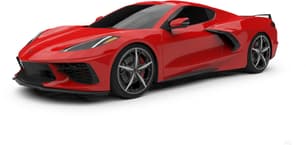
We’re talking about the closest thing to a real-life Hot Wheels car here. See, while Ferraris look elegant to me like expensive jewellery, Lambourghinis like cheese graters and McLaren’s look like slippery alien spacecraft, the Corvette Z06 looks exactly like an American supercar should - an unapologetic, ludicrous beast. And I love that.
Dialing up the wild is that enormous carbon wing and front splitter with dive planes thanks to the Z07 package. Just a word of warning, though, the front splitter and dive planes stick out not just visually, but in the sense that I walked into them often and my ankles still have the scars.
I can’t recall the last time I drove a car with carbon-fibre wheels either - these are the biggest rims fitted to a Corvette and they’re wrapped in Michelin Pilot Sport Cup 2R ultra performance tyres (275/30ZR20 front and 345/25ZR21 rear) that they look like oil drums on their sides.
The best angle? The rear - straight on. Those headlights.
Wait, no, it’s from above - so you can see the V8 through the glass hatch.
Or it could be front-on looking like a giant shovel..
OK, there are no bad angles..
The Corvette Z06 is long at 4734mm end-to-end, broad at 2024mm wide and its height is a both a sitting-on-the-road-low and numerically pleasing 1234mm.
The plainness of the cabin might be a let down to some people after all the exterior wildness. Ferraris and Lambourghis offer extravagant and exotic interiors, but the Corvette’s innards are almost completely void of flare.
The media screen is small (8.0 inches), switches and controls for windows and air vents are basic, and the huge dividing ‘wall’ between the pilot and passenger might be a bit much for some.
That ‘wall’ is dotted with buttons and while it may look very 'fighter jet cockpit', they’re just climate control switches. Sitting in the passenger seat is a lonely place with no screen visibility nor easy access to controls - I'd actually call this out as a bit of a fail compared to the interiors from Porsche, Audi and Lamborghini with their screen-filled cabins offering co-pilots something to do.
Yes, it feels a bit premium with the Nappa leather and the sports seats, but it could feel more special.
All of this plainness, however, is saved from boredom by the glass window behind the seats allowing you to peer into the engine bay at the V8 like at a reptile enclosure at the zoo.
One of the Avenger's biggest draws for me is its style.
Those who like the Jeep brand for its rugged off-road vibes, but don’t actually want or need to go off-road might enjoy that it still looks very Jeep.
We’re told that the decisions made in this car’s design are all for a purpose, and some of them are very clear.
For a start there’s a deliberate plastic barrier wrapped around the full 360 degrees of Avenger to protect the paintwork and body panels in low-speed collisions that can be just as likely off-road as in a carpark.
There’s also the sunken headlights, which sit far enough back that they’re less likely to be damaged in an impact, being one of the most expensive and breakable parts at the front of a car.
But there’s also a series of little hidden ‘easter eggs’ that the Avenger’s head designer Daniele Calonaci left up to us to find for ourselves.
For a start, the tail-lights feature an ‘X’ shape that’s inspired by the jerry cans used to carry spare fuel and liquids in World War 2.
The ‘X’ theme continues in other places on the Avenger, though there are some more cutesy design features like a series of seven-slot grille motifs around the car in places like the wheels, tail-light, and even a small one under the front grille.
There’s a 3D ladybug in the roof rail up top, too. But perhaps the most ‘aww’-inspiring is the silhouette of a child looking through a telescope in the lower passenger side of the windshield, up at some stars in the upper driver’s side. The child? That’s Calonaci’s son.
Supercars don’t tend to be built with practicality as a priority but this two-door, two-seat beastie is spacious enough even for me at 185cm tall with plenty of room in the footwell and loads of elbow-, knee-, and headroom.
Cabin storage is limited to a glove box, door pockets, two cupholders, and a wireless phone charger on the bulkhead behind the seats.
As you can see from the images there’s a boot at the rear which will fit smaller bags and a small boot in the front.
I did the school run in the Corvette a few times (I know, lucky kid) and I can tell you a bass guitar in its case and a school bag, plus my own large handbag make for a cramped cabin. A Kia Carnival the Corvette ain’t, but it’s not trying to be one and compared to its rivals it does well for practicality.
The outside of the Avenger is plenty of fun, but the inside is a fairly sensible place.
That’s not to say it’s boring, but the use of space for a car of this size is impressive, and there are plenty of places to store things.
There’s a well thought out phone charging pad in a relatively deep storage compartment in the centre of the Avenger, as well as the cupholders in front of the centre armrest and another storage bin underneath, plus a ‘shelf’ along the dash.
The amount of storage is impressive given the Avenger’s interior is a nice, tidy design that still manages to incorporate some useful elements some cars forgo - buttons for the climate controls, for example, are something that are increasingly (and frustratingly) rare.
Anyone who has used a Uconnect system in a Jeep or Fiat in the past might like to know that this one (accessible via a 10.25-inch touchscreen) is a step-up from predecessors.
It’s not perfect, some elements of the menu and feature placement seem a little random at first, but it doesn’t lag, is easy to connect to wirelessly, and has a fairly helpful voice control system.
Functionality is most of the way there generally, but a few missing things like dual-zone climate control or electric adjustment for the passenger seat feel like let-downs, plus the heating on the front seats seemed to be quite weak for a long time before eventually warming.
Behind those seats, the second row is lacking just about any amenities besides a USB port, but it’s not too cramped for a light SUV. Adults might find it suitable for relatively short trips, but kids should be fine for a while.
The sunroof (when featured) doesn’t extend very far back, so the second row also feels a little dark.
Behind that, an impressive 355 litres of boot space expands to 1250 litres when the seats are folded down, plus a plastic lining on the boot lip means you don’t scratch the car when loading or unloading.
Almost never does a car with a list price of almost $400K get full marks, but here we are and I’ll tell you why. The Corvette Z06 in its standard form lists for $336,000 and this is outstanding value compared to its supercar rivals such as the Ferrari F8 Tributo for $484,888, or a McLaren 750S for $585,800 or even an entry-grade Lamborghini Huracan, the EVO, for $383,187.
Australia gets the top 3LZ trim, with the local standard features list for the Corvette Z06 including Nappa leather upholstery, GT2 bucket seats, a 12-inch digital instrument display, a 14-speaker Bose sound system, red seat belts, wireless phone charging, carbon-fibre and suede microfibre trimmed steering wheel, a media system with sat-nav plus wireless Apple CarsPlay and Android Auto, power seats, heated steering wheel, dual-zone climate control, heated and ventilated seats and a head-up display.
Our test car was fitted with plenty of options including the Z07 Performance Package that brings carbon-fibre everything. We’re talking the enormous carbon-fibre rear wing and aero kit with side skirts and a front splitter with dive planes –and there are the carbon-fibre wheels (20-inch at the front and 21-inch at the rear).
The Z07 package also brings a more hardcore suspension tune and carbon ceramic brakes for ridiculously good stopping power.
The Z06 has the most powerful V8 engine in the Corvette range, too, and we'll get to that soon.
Before the Avenger had even landed, Jeep announced a $3000 reduction to the original pricing. While it might seem like this move stems from an increasingly competitive small-SUV market, Jeep says production costs dropped after the pricing was initially set, and the decision was made to pass it along to customers.
In any case, the Avenger now starts from $49,990 before on-road costs for the entry-level Longitude, with a mid-spec Limited costing $54,990 and the appropriately named Summit set at $60,990.
This puts the Avenger among the most expensive offerings in the 'Light SUV' category along with the electric Mini Aceman (from $55,990) and hybrid Lexus LBX (from $47,550), but around the same price as the slightly larger Hyundai Kona Electric (from $54,000) and Renault Megane E-Tech (from $54,990).
It also looks like brilliant value compared to the much smaller and lower-ranged Fiat 500e (from $52,500). Style comes at a cost.
For the Avenger, there’s a bunch of kit that’s standard across the range, plus only one cost-option - premium paint at $990.
Each Avenger gets dual 10.25-inch screens inside, one for the driver instrument display and the other a touchscreen for the multimedia controls, centred on the dash so it can be reached by both front occupants.
Satellite navigation, keyless start, adaptive cruise control and Jeep’s Selec-terrain drive mode system are all also standard features.
The Limited adds partial synthetic leather trim to the seats, keyless entry, more safety features like blind-spot assist and parking sensors, plus a height-adjustable boot floor and more powerful AC charger, with an 11kW version replacing the 7kW of the Longitude. The Limited also has optional two-tone roof paint in black for $495.
Climbing to the Summit means you get the two-tone roof as standard, plus LED projector headlights and LED tail-lights, 18-inch alloys, leather accented heated seats with power adjustment and lumbar massage for the driver, plus it also gets a sunroof over the front occupants.
The 5.5-litre naturally aspirated V8 in the Z06 makes 475kW and 595Nm. That’s a lot more power than the Corvette Stingray’s V8, which produces 369kW. The GT3 racecar version of the Z06 uses a derived version of the 5.5-litre V8, and actually it shares 70 per cent of the engineering components.
Revving to a high 8600rpm the Z06’s V8 lets out a high-pitched scream when pushed hard, much like a Ferrari because like many Ferraris the Z06 has a flatplane crank V8 - actually it’s one of the largest flatplane V8s to go into a production car.
Corvettes are now mid-engined cars and the Z06 has an eight-speed dual-clutch transmission that changes gears quicker than I can blink, sending all that mumbo straight to the rear wheels.
Acceleration comes hard, fast and loud with the Z06 able to boot itself from 0-100km/h in 2.9 seconds. That beautifully linear acceleration with no turbos will pull you all the way towards its top speed of 313km/h.
The Avenger has one drivetrain for now, a front-wheel drive electric motor, though it sounds like we shouldn’t rule out the possibility of other petrol hybrid drivetrains in the future.
The EV Avenger we’ve got is built on a 400-volt electric architecture, with a single motor delivering 115kW of power and 260Nm of torque.
It’s got a a mode that increases the regenerative braking, though isn’t quite a one-pedal driving experience.
Jeep says it’ll hit 100km/h in 9.0-seconds, but apparently tops out at 150km/h.
As with practicality, fuel efficiency isn’t the Corvette’s priority and after driving it daily for a week in the suburbs, city and a few dashes out to more open country roads the Z06 was using an average of 23.8L/100km, according to the trip computer.
Luckily the fuel tank is pretty big at 70 litres and with an official combined fuel consumption of just under 16L/100km you have a range of 438km… in theory.
The Avenger has a reasonably sized 54kWh lithium-ion battery for a light SUV, which it says allows for a driving range of up to 396km, or 390km in the top-of-the-range Summit, due to the specification.
Under WLTP testing, Jeep says the Avenger is rated at 15.4kWh/100km (15.8kWh/100km for the Summit) for efficiency, and it comes with a Type 2 CCS combo charging socket for either DC fast charging up to 100kW, or AC charging up to 7kW in base Longitude and 11kW in higher variants.
On DC charging at its max 100kW rate, the Avenger should take about 24 minutes to charge from 20 to 80 per cent, while slower AC charging at 11kW takes five hours and 34 minutes.
On the launch drive route, we were seeing between 14.8 and 16.4kWh/100km on the trip computer, so Jeep’s claims seem accurate.
What the Corvette Z06 is like to drive really depends where you drive it. Our suburb has a ridiculous number of speed humps, which are like the Corvette Z06’s Kryptonite thanks to its very limited ground clearance and a carbon front splitter that almost skims the road at the best of times.
This made the Z06 one of the slowest fast cars I’ve ever piloted. My son would beg me to drive him to school in it, but the journey would take twice as long as we slowly eased over each hump while holding our breath. A lift system does raise the front of the vehicle but even then, don't breathe out.
The width and poor visibility made inching down narrow streets of parked cars a stressful exercise, too.
The Corvette Z06 is almost too much of a racecar to live with and then you let it free on an open country road and its purpose is clear - it runs like you wouldn’t believe and screams in delight all the way, while clamping itself to the road with sticky tyres, perfectly set up suspension and proper downforce.
Steering feels mainlined though to your nervous system, the pedals under your feel like your actual feet, and it all feels like a dream until you wake up again when you reach the city limits and round abouts, and traffic and yes, speed humps.
The Corvette Z06 clearly is a car that needs to be joined by other cars in your driveway, ones that don’t even notice speed humps.
The mix of a fun exterior and practical interior for the Jeep seem to blend into the Avenger’s driving experience. It doesn’t feel too much like an EV, but it is still playful and capable on the road.
Jeep wanted the Avenger to come across like a normal car that just happens to be electric, and the relatively calm take-off (rather than the usual immediate torque push electric cars are capable of) seems to prove that.
Though 115kW doesn’t sound like much on paper, it feels brisk enough for what the little Jeep is built for, and its delivery means even on a wet day like what we copped during the launch drive, wheelspin and torque steer were minimal.
Once up to speed, the Avenger feels pretty light for an EV, and it’s playful enough in corners without feeling like it’s becoming unstuck or hard to handle.
The suspension and steering are clearly aiming for comfortable driving more than sporty performance, and so while both feel well-sorted, neither are particularly communicative. But the steering is accurate and feels nice and light, making the Avenger easy to point into a corner and you can trust it to hold on.
Perhaps the biggest downside is the brake pedal, which is soft and doesn’t grab as quickly or progressively as you’d expect. It takes a few presses to work out how much pressure you need to stop the car.
But a drive mode that adds a bit of regenerative braking helps out there, even if it’s not proper single-pedal driving.
At higher speeds, the Avenger settles well over big bumps and undulations, feels comfy on most surfaces, and despite a bit of road noise and a small rattle in the dash on one of our test cars, it feels pretty easy and confidence-inspiring.
Jeep says the Avenger is built to handle some light off-road driving but I imagine its front-wheel-drive setup would be limiting in some circumstances, especially in the rainy, muddy weather we faced. Despite that, some unsealed mud and gravel driving proved the Avenger capable of gentle inclines at low speeds without risk of sliding.
For reference, ground clearance is 200mm, while the approach and departure angles are 20 and 32 degrees, respectively.
Along with four airbags, the Corvette Z06 has AEB, forward collision alert, lane-keeping assistance, rear cross-traffic alert, blind-spot monitoring, auto high beam headlights and adaptive cruise control.
An ANCAP safety rating doesn't exist for any member of the Corvette and will likely never due to low volume.
The Jeep Avenger hasn’t been tested by ANCAP, but comes with a disappointing three-star score from Euro NCAP.
Jeep Australia says it’s currently working with ANCAP regarding a potential local score, but wouldn’t detail what that could mean. A small SUV’s score dropping below four stars might concern some young family-type buyers, though most of its poor scoring comes in the categories of Vulnerable Road Users (pedestrians and cyclists) and Safety Assist (active tech).
In terms of what the Avenger offers as standard, there’s auto emergency braking (AEB), lane-keep assist, traffic sign recognition, driver monitoring, a reversing camera and six airbags (no front-centre bag, though).
It’s notably missing rear-cross traffic alert, and the base Longitude makes do with regular adaptive cruise control and parking sensors at the rear only, while higher variants get blind-spot assist, surround parking sensors, and intelligent cruise control.
GMSV covers the Corvette with a three-year/100,000km warranty which is short by current standards where carmakers typically offer a duration of five years/unlimited kilometres.
One of the appealing sides to the Corvette is that it’s made by a down-to-Earth American car company and a longer warranty offering peace of mind would seem more appropriate.
Service intervals are every 12 months or 12,000km, with capped-price servicing sadly unavailable.
Jeep offers a five-year/100,000km warranty, which is starting to be overtaken by other brands increasingly offering seven-year/unlimited kilometre warranties or longer.
The high-voltage battery system of the Avenger is, however, covered for eight years or 160,000km, whichever comes first.
Jeep also offers capped-price servicing for the five-year warranty, with scheduled visits costing just $250 and spaced out at 12,500km or 12-month intervals.
There’s also the brand’s lifetime roadside assist, but only when you service your car with Jeep.