A wedge is being driven into Australia’s busy mid-size sedan market. Though the wedge is thin, Kia believes its Camry/Mazda6/Accord Euro rival, the Optima, has the goods. Kia has high hopes this is the car that will bring it elusive cachet. But it isn’t going to happen overnight.
"Optima is not going to be a volume seller - at least not at first," says Kia Australia spokesman Kevin Hepworth.
Value
It arrives in January in only one model, the highly-specified Platinum, with an expected $36,000 price tag. Not until late next year will the Platinum be assisted on the showroom by a smaller engined variant that aims to pick up the budget and fleet end of the business.

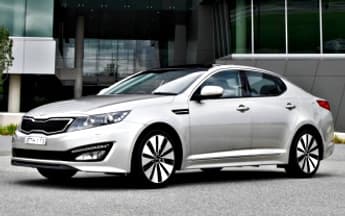

Australia gets the complete list of accessories as standard in the Platinum - save only for sat-nav and that’s probably a temporary situation and remedied by the availability of local software. That means the Optima gets here with two sunroofs, 18-inch alloy wheels, a 530-Watt and eight-speaker Infinity audio, Bluetooth, rear camera and ark sensors, cruise control, dual-zone aircon, leather and vented/heated seats.
Safety
For safety, there’s standard electronic stability control, hill-start assist, ABS on four-wheel ventilated disc brakes, six airbags and the promise of a five-star crash rating from Australia’s ANCAP.
Technology
Australia also betters other markets by getting the best engine. In this case, a 147kW/250Nm 2.4-litre four-cylinder engine with direct-petrol injection. In Kia-speak, it’s called gasoline direct injection and marked by the acronym GDI.
This engine will be mated to a six-speed sequential automatic with standard steering wheel-mounted paddle shifters. Kia says it’s good for a 0-100km/h time of 8.5 seconds. No fuel economy or emission figures are available. Kia says it is now finalising data.
Australia is also the only market to get a retuned suspension. Worked on by former Toyota engineer Graeme Gambold - who also reworked the Sportage for local conditions - the Optima gets new High Performance Dampers (HPDs) made by esteemed European suspension makers ZF Sachs.
The coil springs are also re-rated, the steering system - hydraulic, not the Korean electric system - is new and the brakes are bigger. Part of the change meant 18-inch wheels are standard.
Styling
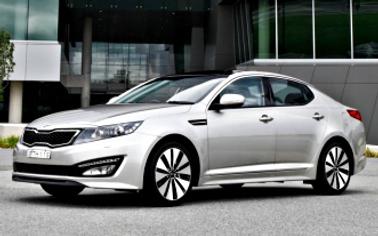
Externally, the Optima is a very attractive sedan. It is unlike any Korean - probably because it was designed by a European, former Audi stylist Peter Schreyer - and that will erase any preconceived ideas by prospective buyers.
Inside it is even better. It is clever in its use of space and will seat five adults in comfort - first because of the excellent rear legroom but also because the central tunnel hump has been reduced to a mere bump on the floor.
The boot is claimed to be the biggest in its class and the Australian-specced split and fold rear seat (most other markets get a fixed seat back) makes a versatile cargo area.
The dashboard is designed with a sports-car theme, with the main instrument and radio area angled to the driver. Initial cars get foot-operated park brake but by the end of 2011, this will be replaced with an electronic park brake that consists merely of a dash button.
Driving
Australia gets the pick of the Optima range but none of that went on show when the car held its international launch this week in Dubai. Basically, what was served up by Kia was the higher-spec body - which we will call Platinum - but without the Aussie-bound tauter suspension, tighter all-hydraulic steering and the 2.4-litre GDI engine. The test cars that we punted through the emir had the 2.4-litre non-GDI engine and standard soft suspension - both not on our shopping list.
But on top-class bitumen ribbons that alternate from rifle-barrel straights through the moonscape dunes to squiggles up and down rocky hills devoid of vegetation, these pre-production cars showed that Kia is onto a good thing. Specifically, the six-speed automatic gearbox works very well with the base engine. t’s smooth and the ratios spread right out so 110km/h comes up at only 2000rpm.
There is beauty in the exterior - and that will win sales - but there’s also a spacious and very friendly interior that has strong overtones of cars including Volkswagen’s Passat - a car Kia puts top of its list as the benchmark for its new Optima. The driving position is more like a sports sedan than a mid-size family car. Adapting to the driver’s seat is made easy by electric adjustment and tilt/telescopic movement for the steering wheel.
Controls are well laid out, the stitched vinyl dashboard pad looks great and the Infinity sound system is a welcome addition to a car that I found both quiet and with a supple ride. However, the final ride comfort rating won’t b known until its January launch in Australia. Seat comfort is very good - despite the small width of the cushions - but the foot-operated park brake is old fashioned in this car, as is the red illumination for the radio and vent controls.
It’s impressive and the downsides of this test (the engine could do with more pep and the steering was vague) will, says Kia, be addressed by the time the car hits our shores.
Related cars for sale on CarsGuide
See more Kia Optimas for sale View cars for saleKia Optima 2011: Platinum
| Engine Type | Inline 4, 2.4L |
|---|---|
| Fuel Type | Unleaded Petrol |
| Fuel Efficiency | 7.9L/100km (combined) |
| Seating | 5 |
| Price From | $7,480 - $10,560 |
| Safety Rating |
|


Pricing Guides
Range and Specs
| Vehicle | Specs | Price* |
|---|---|---|
| Platinum | 2.4L, Unleaded Petrol, 6 SPEED AUTOMATIC | $7,480 - $10,560 |

.jpg)
.jpg)
.jpg)
.jpg)
.jpg)
.png)
.jpg)
.png)
.jpg)
.jpg)

.png)